
Author name: SAI NGO & Business Consultancy

SAI NGO & Business Consultancy offers comprehensive and reliable services across NGO registration, Society and Trust formation, Partnership and Company registration, Trademark and Section 8 Company registration, GST, MSME registration, as well as Website and Logo development. Recognised nationwide, we are proud to be one of India’s most trusted and leading NGO consultancy firms.

How to Register as a Sole Proprietor in India Successfully Complete Guide
Company Registration

7 Easy Steps: How to Register as a Sole Proprietor in India Successfully

If you’ve been wondering how to register as a sole proprietor in India, you’re not alone. Every day, thousands of freelancers, home-based business owners, local traders, and first-time entrepreneurs ask the same question — and struggle to find a clear, jargon-free answer. You have a skill, a service, or a product idea. You want to start small, stay in control, and keep things simple. That’s exactly why sole proprietorship is the most popular business structure in India. But here’s where most people get stuck: What documents do you need? Is there an official certificate? Where do you even begin? If you’ve been Googling for a clear answer and keep running into confusing jargon — this guide is for you. Let’s break it all down, step by step. What Is a Sole Proprietorship, Exactly? A sole proprietorship is the simplest form of business in India. It’s a business owned and run by one individual — you. There’s no co-founder, no board, no separate legal entity. You are the business. This is the most common business structure in India, especially among small traders, shopkeepers, freelancers, and home-based businesses. Think of the neighbourhood kirana store, the independent tutor, or the small digital marketing consultant — chances are, they’re operating as sole proprietors. The key thing to understand is this: a sole proprietorship is not “registered” as a company or LLP is. There is no single government registration that officially creates your sole proprietorship. Instead, it becomes legally recognised through a combination of other registrations — like a GST number, a bank account in your business name, or a shop licence. This can sound confusing at first. But once you understand the system, it’s actually quite flexible. Who Should Choose Sole Proprietorship? Sole proprietorship is ideal for you if: It may not be the best fit if you’re planning to hire large teams, raise venture capital, or run a high-liability business — in which case a private limited company may suit you better. Key Benefits of Registering as a Sole Proprietor in India Here’s why thousands of entrepreneurs every year choose sole proprietorship: How to Register as a Sole Proprietor in India: Step-by-Step Here’s the practical roadmap. You don’t need all of these — but having more registrations gives your business more credibility and legal standing. Step Details Step 1: Choose Your Business Name Pick a name for your business. It can be your own name or a trade name. Make sure it’s not already trademarked. Registering a trademark for your business name later is a good idea for protection. Tip: Your business name on all registrations should be consistent. Even small spelling differences can cause problems later. Step 2: Open a Current Bank Account in Your Business Name This is one of the most important steps. Banks require certain documents to open a current account for a sole proprietorship. These typically include: • Your identity proof (Aadhaar, PAN) • Address proof for your business premises • Two of the following: GST certificate, trade licence, or Udyam registration A separate business bank account keeps your personal and business finances clean — which matters a lot when you’re filing taxes or applying for loans. Step 3: Register for GST (If Applicable) GST registration is one of the primary ways a sole proprietorship gets officially recognised. You must register for GST if: • Your annual turnover exceeds ₹20 lakh (₹10 lakh for special category states) • You sell goods or services across states • You sell on e-commerce platforms like Amazon, Flipkart, or Meesho (mandatory regardless of turnover) Even if your turnover is below the threshold, voluntary GST registration is a smart move — it adds credibility, lets you claim input tax credits, and is often required by corporate clients. You can register for GST online at gst.gov.in — it’s free and takes a few days to process. Step 4: Get Udyam Registration (MSME Registration) Udyam Registration (formerly known as Udyog Aadhaar) is a government registration for Micro, Small, and Medium Enterprises. It’s free, entirely online, and gives your business access to: • Priority lending and bank loans at lower interest rates • Government schemes and subsidies for MSMEs • Protection against delayed payments (under the MSMED Act) • Easier access to tenders and government contracts You can register at udyamregistration.gov.in. It’s one of the easiest and most beneficial registrations you can get. Step 5: Obtain a Shop and Establishment Licence (If Required) If you operate from a physical location — a shop, office, or workshop — most state governments require you to register under the Shops and Commercial Establishments Act. You can check your state portal here: services.india.gov.in This is commonly called a Shop Act Licence or Gumasta Licence (in Maharashtra). The process varies by state, but typically involves: • Business address proof • Owner’s ID and address proof • Passport-size photographs • Business name details Step 6: Get a PAN Card for Your Business As a sole proprietor, you don’t need a separate PAN for your business — your personal PAN card is used for all business transactions and tax filings. Make sure your PAN is linked to your Aadhaar and your bank account. Apply here: incometax.gov.in Step 7: Open a Professional Tax Account (State-Specific) In some states like Maharashtra, Karnataka, and West Bengal, you’re required to register for Professional Tax if you’re earning income from a profession or business. Visit your state commercial tax department or start here: services.india.gov.in Common Mistakes to Avoid Many new sole proprietors make these errors — and they can cost you time, money, and credibility. Common Mistake Details & Guidance 1. Not opening a separate business bank account Mixing personal and business finances creates a headache at tax time and looks unprofessional to clients and vendors. It’s always recommended to open a dedicated current account for better financial management and loan eligibility. 2. Skipping GST registration when it’s mandatory Operating without GST registration when you’re required to have it can lead to penalties and back-taxes. When in
How to Register an NGO in India The Complete Step-by-Step Guide (2026)
NGO Consultancy, NGO Registration

How to Register an NGO in India Successfully (2026): Full Beginner’s Guide

How to register an NGO in India — it’s one of the most searched questions by passionate changemakers ready to turn their vision into a legally recognised organisation. Maybe you want to educate underprivileged children, protect the environment, or empower rural women. The passion is there. The plan is taking shape. But one question stops almost every aspiring founder in their tracks: “How do I actually make this official?” How to register an NGO in India can feel overwhelming at first — the legal jargon, multiple government departments, and different registration types make it confusing. But once you understand the process, it’s very much doable. This complete guide on how to register an NGO in India walks you through every step — clearly, practically, and without confusing legalese. Whether you’re starting from scratch or trying to formalise an existing initiative, this is the only guide you’ll need. What Is an NGO and Why Does NGO Registration in India Matter? A Non-Governmental Organisation (NGO) is a non-profit entity that works for social, cultural, environmental, or humanitarian causes — independent of the government. In India, NGOs play a massive role in filling gaps where the state cannot reach. Before we get into how to register an NGO in India step by step, it helps to understand why NGO registration in India matters so much. Operating as an informal group seriously limits what you can do. Without completing your NGO registration in India, your organisation cannot: In short, NGO registration in India gives your organisation legal standing, financial legitimacy, and public trust — all essential if you’re serious about creating lasting impact. Types of NGO Registration in India NGO Structure Description 1. Trust Registration Governed by the Indian Trusts Act, 1882, a Trust is the simplest way to register an NGO in India. It requires a minimum of two trustees and works well for charitable activities like education and healthcare. If you’re just starting out and want a quick, low-cost NGO registration in India, a Trust is often the first choice. 2. Society Registration Registered under the Societies Registration Act, 1860, a Society requires a minimum of 7 members. This is a popular option to register an NGO in India for cultural, educational, or scientific purposes. Societies are governed by a managing committee and offer slightly more structure than a Trust. 3. Section 8 Company The most structured form of NGO registration in India, a Section 8 Company is registered under the Companies Act, 2013. It offers the highest credibility, is governed by the Ministry of Corporate Affairs (MCA), and is the preferred option for organisations planning large-scale or international operations. If you want to register an NGO in India with maximum legal standing, a Section 8 Company is the way to go. When you decide to register an NGO in India, the first major decision is choosing the right legal structure. India doesn’t have a single NGO Act. Instead, there are three primary ways to register an NGO in India, each with its own advantages. Not sure which structure fits your cause? Your choice depends on the size of your operations, number of founding members, funding sources, and long-term goals. When in doubt, seek expert advice before you register an NGO in India. Key Benefits When You Register an NGO in India Understanding the benefits is just as important as knowing how to register an NGO in India. Once your NGO registration in India is complete, the advantages go far beyond legal compliance: How to Register an NGO in India: Step-by-Step Process Here is a complete, practical roadmap on how to register an NGO in India. While specific steps vary by structure, this process applies broadly across all three registration types: Step Description Step 1: Define Your Mission and Structure Before filling a single form, clarify your NGO’s purpose, planned activities, and the registration type that suits you best. This is the foundation of the entire NGO registration process in India — getting this wrong causes delays down the line. Step 2: Choose a Name Pick a unique, meaningful name for your organisation. For Section 8 Companies, you’ll need MCA name approval. For Trusts and Societies, follow state-level naming guidelines. The name you choose will represent your organisation’s identity throughout the NGO registration in India process and beyond. Step 3: Prepare Your Core Documents To register an NGO in India, you’ll typically need the following documents ready: • Memorandum of Association (MoA) or Trust Deed • Rules and Regulations or Bye-laws of the organisation • Identity and address proof of all founding members or trustees • Registered office address proof Step 4: Draft the Trust Deed or MoA This is the single most important document in the NGO registration process in India. It defines your objectives, governance structure, and operational rules. Errors or vague language here is the leading reason applications get rejected. Always have a legal professional review this before you register an NGO in India. Step 5: Submit to the Relevant Authority Trust: Submit to the Sub-Registrar’s office in your district Society: Submit to the Registrar of Societies in your state Section 8 Company: Submit online via the Ministry of Corporate Affairs (MCA) portal Step 6: Pay the Registration Fee Registration fees to register an NGO in India vary by state and structure — typically ranging from a few hundred to a few thousand rupees. Section 8 Company fees are determined by MCA based on authorised capital. Step 7: Obtain Your NGO Registration Certificate Once approved, you receive your NGO registration certificate in India — the official proof of your organisation’s legal existence. For Section 8 Companies, this comes as a Certificate of Incorporation from the MCA. Step 8: Apply for PAN and Open a Bank Account Use your NGO registration certificate in India to apply for a PAN card under the organisation’s name. Then open a dedicated current account — essential for transparent financial management. Step 9: Apply for 12A and 80G Registrations File applications with the Income

What is a Section 8 Company A Complete Guide for NGOs and Non Profits in India
NGO Consultancy, NGO Registration

What is a Section 8 Company? Complete & Easy Guide for NGOs in India

You have a powerful idea. Maybe you want to support underprivileged children with education. Or build clean water access in rural areas. Or empower women in small towns. You know what you want to do — but when it comes to setting up your organisation legally, you are suddenly stuck. Which structure do you choose? A Trust? A Society? Or a Section 8 Company? If someone has mentioned ‘Section 8 Company’ to you and you are not quite sure what it means — you are in the right place. In this post, we will break it down clearly, simply, and practically, so you can make the right decision for your mission. What is a Section 8 Company? A Section 8 Company is a type of company registered under the Companies Act, 2013 in India. It is formed specifically for promoting charitable objectives — such as education, arts, science, religion, social welfare, environment protection, or any other useful purpose. The name comes from Section 8 of the Companies Act, 2013, which governs this type of entity. Here is the key thing to understand: a Section 8 Company is a non-profit. This means that any income or profit earned by the company must be used only to further its stated objectives. Profits cannot be distributed to its members or directors as dividends or bonuses. Think of it as a company that works like an NGO — but with the legal strength and credibility of a registered company. How is a Section 8 Company Different from a Trust or Society? Many people setting up an NGO in India have to choose between three legal structures: a Trust, a Society, or a Section 8 Company. Each has its own pros and cons, but here is a quick comparison: If you plan to scale your work, apply for government grants, receive CSR funding from corporates, or work with international partners, a Section 8 Company is often the preferred choice. Who Should Register a Section 8 Company? A Section 8 Company is ideal for individuals and groups who: If any of these sound like you, it is worth reading on. Key Benefits of Registering a Section 8 Company Key Benefit Description Higher Credibility & Recognition Section 8 Companies are regulated by the Ministry of Corporate Affairs (MCA) and must file annual returns. This makes them more transparent and trustworthy. Donors, government bodies, and corporate partners prefer working with them over Trusts or Societies. No Minimum Capital Requirement Unlike private limited companies, Section 8 Companies do not require minimum paid-up capital. You can start with available resources. Tax Exemptions & Benefits Section 8 Companies can apply for 12A and 80G registration under the Income Tax Act. 12A: Exemption from income tax on surplus income. 80G: Donors can claim tax deductions, encouraging more donations. CSR Funding Eligibility Under the Companies Act 2013, companies must spend 2% of their profits on CSR activities. Section 8 Companies can receive this funding, opening doors to major grants and support. Perpetual Succession The company continues to exist even if members or directors change. This ensures stability and long-term continuity. Limited Liability Directors and members have limited liability, meaning their personal assets are protected in case of legal issues or company debts. FCRA Registration Eligibility Section 8 Companies can apply for FCRA registration, allowing them to receive foreign donations and work with international organisations. How to Register a Section 8 Company: Step-by-Step Step Process Details 1. Digital Signature Certificate (DSC) All proposed directors must obtain a DSC from a certified authority. This is required for signing and submitting documents online. 2. Director Identification Number (DIN) Each director must apply for a DIN, a unique identification number issued by MCA. 3. Name Reservation (RUN Form) Apply for your company name through the MCA portal. The name must be unique and reflect your charitable purpose. 4. Section 8 License (INC-12) Apply for a license from the Registrar of Companies (RoC). This includes submitting your Memorandum of Association (MoA) and Articles of Association (AoA). 5. Incorporation (SPICe+ Form) File the incorporation form along with all required documents after receiving the license. 6. Certificate of Incorporation Once approved, you receive the Certificate of Incorporation along with a Corporate Identity Number (CIN). Your Section 8 Company becomes legally registered. 7. PAN, TAN & Bank Account Apply for PAN and TAN, and open a bank account for financial transactions. 8. 12A & 80G Registration Apply for tax exemptions under the Income Tax Act to unlock financial benefits and attract donors. Note: The complete process usually takes 3–6 weeks if documents are correct. Even small errors can cause delays or rejection. It is advisable to consult an expert to ensure smooth registration. Common Mistakes People Make When Registering a Section 8 Company Common Mistake Explanation Choosing the Wrong Name Many applicants select names that are too generic, similar to existing entities, or do not reflect a charitable purpose. This often leads to rejection by the RoC and delays in approval. Always conduct proper name research before applying. Weak MoA & AoA Drafting The MoA and AoA are the foundation of your application. A vague or poorly written MoA that does not clearly define objectives or comply with Section 8 requirements is a major reason for rejection. Not Having Enough Directors A minimum of 2 directors (private) or 3 directors (public) is required. Starting the process without a proper board structure can delay or block registration. Ignoring Post-Registration Compliance Many organisations fail to file annual returns, hold board meetings, or maintain proper records. Compliance is mandatory under the Companies Act, and non-compliance can result in penalties. Delaying 12A & 80G Application Delaying these applications leads to missed tax benefits. It is always advisable to apply immediately after registration to maximize financial advantages. Mixing Personal & Company Finances Using personal accounts for company transactions is a serious compliance issue. Always maintain separate bank accounts and proper financial records for transparency. Important: Avoiding these common mistakes can save you time, money, and

Taxation of Trust Without 12A Registration What You Must Know
Trust Registration

Taxation of Trust Without 12A Registration: What You Must Know

Are you running a trust but haven’t registered under 12A yet? Many NGOs and charitable trusts in India start with a genuine purpose—to serve society. But when it comes to taxation, things can quickly become confusing. One of the most common questions we hear is:“What happens if my trust does not have 12A registration? Will I still get tax benefits?” If you’re unsure about this, you’re not alone. Understanding how taxation works without 12A registration is crucial, because a small mistake can lead to heavy tax liabilities. Let’s break this down in a simple and practical way. What is 12A Registration and Why Does It Matter? Topic Details What is 12A Registration? 12A registration (under the Income Tax Act, 1961) allows a trust or NGO to claim tax exemption on its income. Without 12A Registration Tax Treatment Your trust is treated like a normal taxable entity. Tax Benefit You do NOT get income tax exemption. Tax Rate You may have to pay tax at Maximum Marginal Rate (MMR). With 12A Registration Tax Benefit Income applied for charitable purposes becomes tax-free. Donor Benefit Donors may also benefit if 80G registration is obtained. 👉 Key Insight Summary 12A is the foundation of tax savings for NGOs. Taxation of Trust Without 12A Registration Point Explanation If Trust is NOT Registered under 12A 1. Entire Income Becomes Taxable Your trust’s income is treated like any other taxpayer. This includes: • Donations (including voluntary contributions) • Grants • Income from activities • Interest income 2. No Exemption for Charitable Activities Even if you are doing genuine social work, income used for charity is NOT exempt. 👉 Yes, even if you spend everything on social work, it can still be taxable. 3. Tax Rate Applies Income may be taxed at normal slab rates or Maximum Marginal Rate (30%). In many cases, this leads to a higher tax burden. 4. No Benefit of Accumulation Rules Registered trusts can accumulate income under certain conditions. But without 12A: • No such benefit is available • All income is considered taxable Who Needs to Understand This? This is especially important for: 👉 Even small trusts must understand this early to avoid penalties later. Why 12A Registration is Important (Key Benefits) Benefit Why It Matters Why 12A Registration is Essential ✔ Tax Exemption on Income Income used for charitable purposes becomes tax-free. ✔ Better Credibility Registered NGOs gain more trust from donors and institutions. ✔ Eligibility for Grants Many government and CSR grants require 12A registration. ✔ Long-Term Financial Stability You save money that can be used for your mission. ✔ Easier Compliance Clear structure for accounting and reporting. Practical Example 👉 A trust receives ₹10,00,000 in donations 👉 It spends ₹9,00,000 on charitable work Without 12A: Entire ₹10,00,000 can be taxable Even though ₹9,00,000 was spent on charity With 12A: ₹9,00,000 used for charity becomes exempt Only remaining income (if any) is considered 👉 That’s a huge difference in tax liability. Step-by-Step: What You Should Do If You Don’t Have 12A Step Action Plan Roadmap for Unregistered Trust Step 1: Review Your Trust Structure • Check trust deed carefully • Ensure objectives are clearly charitable Step 2: Organize Financial Records • Maintain proper books of accounts • Keep donation records and receipts Step 3: Apply for 12A Registration • File application in Form 10A (online) • Submit required documents Step 4: Prepare for Verification Authorities may review: • Activities • Financials • Objectives Step 5: Stay Compliant • File returns regularly • Follow income application rules 👉 Key Advice: Starting early helps avoid future complications. Common Mistakes NGOs Make Common Mistake Impact / Reality Common Mistakes Trusts Make ❌ Assuming “Charity = No Tax” Many believe that doing social work automatically means tax exemption. 👉 This is not true without 12A registration. ❌ Delaying Registration Waiting too long can lead to: • Higher taxes • Missed benefits • Compliance issues ❌ Poor Documentation Lack of proper records can result in: • Rejection of application • Difficulty during audits ❌ Mixing Personal and Trust Funds This creates serious legal and tax problems. ❌ Ignoring Professional Advice Tax laws for NGOs are technical. Small mistakes can be costly. 👉 Even well-intentioned mistakes can lead to heavy tax liabilities and legal complications. Taking the right steps early can save your trust from future problems. Expert Tips You Should Know Here are some practical insights from experience: 💡 Apply Early Don’t wait until your income increases.Start compliance from day one. 💡 Draft a Strong Trust Deed Clear objectives aligned with charitable purposes improve approval chances. 💡 Maintain Transparency 💡 Plan for 80G Along with 12A This helps attract donors by giving them tax benefits. 💡 Stay Updated with Rules NGO compliance laws change over time. Stay informed. Final Thoughts Running a trust is not just about intention—it’s also about compliance and sustainability. Without 12A registration: On the other hand, proper registration: A Small Note Before You Proceed If you’re unsure where to start, it’s always better to get proper guidance.Many people prefer expert support to avoid delays or rejections. You can also connect with a professional for a quick consultation. 👉 If you need help or want to discuss your case, you can book a quick consultation with us.

MGT 8 Applicability for Private Companies Complete Guide 2026
Company Registration

MGT-8 Applicability for Private Companies: Complete Guide (2026)

Are you confused whether your private company needs MGT-8 certification? Many business owners and NGO founders assume that compliance like MGT-8 is only for large companies or listed entities. But in reality, even private limited companies can fall under its applicability — and missing it can lead to penalties, delays, or compliance issues. If you’re running a private company (including Section 8 companies or NGO-related entities), understanding MGT-8 applicability is not optional — it’s essential. Let’s break it down in a simple and practical way. What is MGT-8? MGT-8 is a compliance certificate issued by a practicing Company Secretary (CS) under the Companies Act, 2013. It certifies that your company has complied with various legal requirements related to: This certificate is attached to the Annual Return (Form MGT-7) filed with the Ministry of Corporate Affairs (MCA). Why is MGT-8 Important? Think of MGT-8 as a legal health check-up of your company. It assures the government that your company is operating transparently and following all necessary compliance rules. Key Importance: For NGOs or Section 8 companies, this becomes even more important because transparency and compliance directly impact funding opportunities. MGT-8 Applicability for Private Companies Now the main question: Does MGT-8 apply to private companies? Yes — but only under specific conditions. A private limited company must obtain MGT-8 certification if: 1. Paid-up Share Capital ≥ ₹10 Crore OR 2. Turnover ≥ ₹50 Crore If your company meets either of the above criteria, MGT-8 becomes mandatory. Simple Rule to Remember: Criteria Applicability Small private company ❌ Not required Paid-up capital ≥ ₹10 Cr ✔ Required Turnover ≥ ₹50 Cr ✔ Required What about Small Private Companies? If your company: 👉 Then MGT-8 is not mandatory. However, compliance should still be maintained properly because MCA scrutiny is increasing year by year. Special Note for NGOs / Section 8 Companies Many NGO founders assume MGT-8 does not apply to them — which is partially incorrect. If your Section 8 company crosses the threshold: 👉 Then MGT-8 becomes applicable just like any other private company. This often happens when NGOs start receiving: So even non-profit entities must stay alert. What Does MGT-8 Cover? Key Areas Covered in MGT-8 Compliance Area Description Statutory Registers Maintenance of all required statutory registers as per Companies Act ROC Filings Timely and accurate filing of forms with Registrar of Companies Board Meetings & AGM Proper conduct and documentation of Board Meetings and Annual General Meetings Legal Compliance Adherence to provisions of the Companies Act Share Transactions Handling of share transfers and allotments Director Compliance Director disclosures, appointments, and related compliance Overall Governance Complete review of company governance and compliance framework Step-by-Step Process to Get MGT-8 Step Process Details Step 1: Prepare Annual Records Ensure all documents are updated including Minutes of meetings, Registers, Financial statements, and ROC filings Step 2: Draft Annual Return (MGT-7) Prepare the company’s annual return carefully with accurate details Step 3: Appoint Company Secretary Hire a qualified practicing Company Secretary to issue MGT-8 Step 4: Compliance Verification CS reviews documents, identifies gaps, and suggests corrections if needed Step 5: Issue of MGT-8 Certificate is issued after successful verification of compliance Step 6: Attach with MGT-7 Submit MGT-8 along with MGT-7 to MCA portal Common Mistakes Companies Make Many private companies unknowingly make errors that can lead to penalties. Avoid these mistakes: These mistakes may seem small but can create serious legal complications. Penalty for Non-Compliance If MGT-8 is applicable and not filed: For NGOs, this can also impact: Expert Tips (From Practical Experience) Tip No. Compliance Tip Why It Matters 1 Don’t wait till the last date Start preparing at least 1–2 months before deadlines to avoid last-minute stress, penalties, and errors. 2 Track your turnover regularly Many companies unknowingly cross ₹50 crore, which triggers additional compliance requirements like MGT-8. 3 Maintain records monthly Keeping documents updated monthly helps avoid year-end confusion and ensures smooth compliance checks. 4 Work with professionals early A Company Secretary can identify issues early and help you stay compliant without last-minute corrections. 5 Treat compliance as an asset Strong compliance improves credibility during funding, partnerships, and business expansion opportunities. Final Thoughts MGT-8 applicability for private companies is often misunderstood — but it plays a crucial role in ensuring your company stays legally strong and future-ready. Whether you are running a growing private limited company or a scaling NGO, staying ahead of compliance is always a smart move. If you’re unsure whether MGT-8 applies to your company, it’s always better to get proper guidance. Many businesses prefer expert support to avoid delays, penalties, or rejections. If you need help or want to discuss your case, you can book a quick consultation with us.

Which Document is Mandatory for DSC Complete Guide for Individuals Organizations
Company Registration, NGO Consultancy

Which Document is Mandatory for DSC? (Complete Guide for Individuals & Organizations)

If you’re applying for a Digital Signature Certificate (DSC) for the first time, one question almost everyone asks is: “Which document is mandatory for DSC?” Some people upload only PAN, others submit Aadhaar, and many applications get rejected simply because the wrong document format or proof is provided. If you want to avoid delays, confusion, and rejection — this guide will make everything clear in simple terms 👇 📌 What is DSC and Why is it Required? A Digital Signature Certificate (DSC) is a secure digital key used to: In India, DSC is legally valid under the IT Act and is mandatory for many government and compliance-related activities. 📄 Which Document is Mandatory for DSC? Let’s answer the main question clearly: 👉 There is no single “one mandatory document” for DSC.👉 But you must submit both Identity Proof and Address Proof. ✔ Minimum Mandatory Requirements: For DSC application, you need: 💡 In most cases, Aadhaar (eKYC) is the easiest and fastest way to complete DSC verification. Mandatory Documents for Individual DSC Category Documents Identity Proof Aadhaar Card (eKYC – preferred) PAN Card Passport Driving Licence Voter ID Address Proof Aadhaar Card Electricity Bill Water Bill Gas Bill Bank Statement (attested) Passport Voter ID 📌 Important: Documents must be clear and valid Name should match across all documents Mandatory Documents for Organization DSC Requirement Details Applicable For Company, NGO / Trust, LLP, Partnership Documents PAN Card of Applicant ID Proof of Authorized Signatory Address Proof Organization Registration Proof Authorization Letter / Board Resolution 💡 For NGOs and Trusts, Trust Deed or Registration Certificate is required. Mandatory Documents for Foreign Applicants Requirement Details Required Documents Attested Passport (mandatory) VISA Copy Resident Permit (if applicable) Government Address Proof Additional Requirement Documents must be Apostilled OR Consularized ⭐ Why Proper Documents for DSC Are So Important? Submitting the correct documents is not just a formality — it directly impacts approval. ✔ Key Importance: 💡 Even a small mismatch (like name spelling) can delay your DSC. Step-by-Step: How to Prepare Documents for DSC 1️⃣ Check Your Identity Proof Use Aadhaar or PAN Ensure details are correct 2️⃣ Verify Address Proof Must be recent (utility bills) Should match your application 3️⃣ Keep Soft Copies Ready Clear scanned copies No blur or cut edges 4️⃣ Match All Details Name Date of Birth Address 5️⃣ Submit Authorization Required for companies / NGOs Common Mistakes People Make ❌ Uploading blurred or cropped documents ❌ Name mismatch between PAN & Aadhaar ❌ Using expired documents ❌ Submitting wrong address proof ❌ Missing authorization letter (for organizations) ❌ Not following attestation rules (foreign applicants) 💡 Important: These mistakes may look small, but they can lead to rejection or re-verification delays. 💡 Expert Tips (From Practical Experience) To make your DSC process smooth, keep these tips in mind: 👉 If you’re unsure where to start, it’s always better to get proper guidance. 🤝 Final Thoughts Getting a DSC is a simple process — but only when your documents are correct and properly submitted. Many applicants face unnecessary delays because they: 👉 That’s why many people prefer expert support to avoid delays or rejections. 📞 Need Help with DSC Documentation? If you’re: You can also connect with a professional for a quick consultation. If you need help or want to discuss your case, you can book a quick consultation with us.

Trust Registration vs Society Registration: Which is Better for Your NGO in India?
Society Registration, Trust Registration

Trust Registration vs Society Registration: Which is Better for Your NGO in India?

When starting a non-governmental organization in India, one of the first and most important decisions is choosing the right legal structure. Many founders struggle to decide between Trust Registration vs Society Registration. Both structures are widely used for NGOs in India and allow organizations to work in areas like education, healthcare, social welfare, environment protection, and rural development. However, the legal framework, management structure, compliance requirements, and registration process differ between the two. Understanding the difference between Trust Registration and Society Registration is essential before starting an NGO because the structure you choose will affect governance, credibility, funding opportunities, and legal compliance. In this detailed guide, we will explain everything you need to know about Trust Registration vs Society Registration in India, including benefits, eligibility, documents, registration process, cost, timeline, and expert tips to help you choose the best option for your NGO. What is Trust Registration in India? A Trust is a legal arrangement where a person (called the Settlor) transfers property or assets to trustees who manage them for the benefit of the public or a specific group. Trusts in India are governed by the Indian Trusts Act, 1882 (for private trusts) and state laws for public charitable trusts. Trusts are commonly formed for: Key Characteristics of a Trust Example Activities of Trust NGOs Trusts are especially common in religious and family-controlled charitable institutions. What is Society Registration in India? A Society is an association of individuals who come together for charitable, literary, scientific, or social purposes. Societies are governed by the Societies Registration Act, 1860. A society must have at least 7 members to register. Common Purposes of Societies Societies are democratic organizations where decisions are taken collectively by the governing body or managing committee. Key Features of Society NGOs Societies are widely used for community-based NGOs and development organizations. Trust Registration vs Society Registration: Key Differences Below is a comparison to help you clearly understand Trust Registration vs Society Registration. Feature Trust Society Governing Law Indian Trust Act / State Trust Acts Societies Registration Act, 1860 Minimum Members 2–3 Trustees Minimum 7 Members Management Trustees Governing Body / Managing Committee Regulation Less regulated More regulated Transparency Moderate High Decision Making Trustees control decisions Democratic voting system Compliance Minimal compliance Annual filings required Why Choosing Between Trust Registration vs Society Registration is Important Choosing between Trust Registration vs Society Registration is a critical decision when starting an NGO in India. The legal structure you select will influence how your organization operates, how decisions are made, and how easily you can receive funding or government support. Selecting the right structure from the beginning helps avoid legal complications and ensures smooth functioning of the organization in the long run. Below are some key reasons why understanding the difference between Trust Registration and Society Registration is important. ✔ Governance Structure Trusts are managed by trustees who make most of the decisions, while societies operate through a democratic system where members or a governing body participate in decision-making. Choosing the right structure determines how your NGO will be governed. ✔ Funding Opportunities Many government schemes, CSR initiatives, and funding agencies prefer working with organizations that have a transparent structure. Societies and Section 8 companies often receive more preference for large-scale funding programs. ✔ Compliance Requirements Trusts generally have fewer compliance requirements, while societies require regular filings, meetings, and documentation. Understanding these obligations helps you choose a structure that suits your management capacity. ✔ Transparency and Credibility Societies are considered more transparent due to regulatory oversight and member participation. This can increase credibility among donors, government authorities, and the public. ✔ Long-Term Growth and Expansion If your NGO plans to expand operations, involve multiple stakeholders, or work at a national level, selecting the appropriate legal structure becomes essential for long-term sustainability. Benefits of Trust Registration ✔ Simple Registration Process Trust registration is generally easier and faster compared to society registration. ✔ Less Compliance Trusts have fewer regulatory requirements and reporting obligations. ✔ Long-Term Stability Trusts can function for many years without frequent regulatory intervention. ✔ Founder Control Trustees typically retain decision-making authority. ✔ Suitable for Religious & Charitable Institutions Many temples, hospitals, and charitable institutions operate as trusts. Benefits of Society Registration ✔ Democratic Governance Societies operate through elected governing bodies. ✔ Higher Transparency Societies require proper documentation and reporting. ✔ Suitable for Community NGOs Societies encourage member participation. ✔ Better Credibility Societies are often trusted more by government agencies and donors. ✔ Preferred for CSR Funding Many CSR programs prefer working with registered societies. Eligibility Criteria for Trust Registration vs Society Registration Before starting an NGO, it is important to understand the eligibility criteria for Trust Registration vs Society Registration in India. Each structure has specific requirements regarding the number of members, objectives, and governance framework. Meeting these eligibility conditions ensures that your NGO registration process is smooth and legally compliant. Eligibility Criteria for Trust Registration ✔ Minimum Number of Trustees A trust generally requires at least 2 to 3 trustees. However, the exact requirement may vary depending on the state laws where the trust is registered. ✔ Settlor (Founder) The person who creates the trust is called the Settlor. The settlor transfers property, funds, or assets to trustees to manage for charitable purposes. ✔ Charitable Objective The trust must be created for a lawful charitable purpose such as education, healthcare, poverty relief, environmental protection, or social welfare. ✔ Trust Deed A properly drafted Trust Deed is required. This legal document outlines the objectives, rules, powers of trustees, and management structure of the trust. ✔ Registered Office Address The trust must have a registered office address along with a No Objection Certificate (NOC) from the property owner if the premises are rented. Eligibility Criteria for Society Registration ✔ Minimum Seven Members At least seven members are required to register a society under the Societies Registration Act, 1860. These members form the governing body of the organization. ✔ Non-Profit Objective The society must be established for non-profit and charitable purposes such

Company Registration in India 2026 – Complete Step by Step Guide 1
Company Registration

Company Registration in India 2026 – Complete Step-by-Step Guide

Starting a business in India begins with one crucial step — company registration. Whether you are launching a startup, consultancy, manufacturing unit, or NGO, registering your business legally creates a strong foundation for growth. This complete guide explains types of company registration, documents required, costs, and the step-by-step registration process in India for 2026. India registered more than 1.6 lakh new companies in FY 2023-24, showing how rapidly entrepreneurship is growing. With programs like Startup India and DPIIT recognition, this is the best time to start your business. Why Company Registration is Important Running an unregistered business can create legal and financial limitations. Registration provides several advantages. Legal Identity A registered company becomes a separate legal entity that can own assets and sign contracts. Limited Liability Structures like Private Limited and LLP protect your personal assets from business debts. Investor Trust Investors and venture capitalists only invest in registered companies, especially Private Limited companies. Tax Benefits Registered businesses can claim GST input credits, business deductions, and startup tax exemptions. Brand Credibility A legally registered company builds trust with customers, banks, and vendors. Types of Company Registration in India India offers several business structures depending on the size and purpose of your business. Sole Proprietorship Owner: 1Liability: UnlimitedBest for: Small shops, freelancersCost: ₹500 – ₹2,000Time: 1–3 days Partnership Firm Members: 2–20Liability: UnlimitedBest for: Family businessesCost: ₹2,000 – ₹5,000Time: 7–14 days Limited Liability Partnership (LLP) Members: Minimum 2Liability: LimitedBest for: Professionals and service firmsCost: ₹5,000 – ₹15,000Time: 15–20 days One Person Company (OPC) Members: 1Liability: LimitedBest for: Solo entrepreneursCost: ₹6,000 – ₹15,000Time: 10–15 days Private Limited Company Members: Minimum 2Liability: LimitedBest for: Startups and growing businessesCost: ₹6,000 – ₹30,000Time: 10–15 days Section 8 Company Members: Minimum 2Liability: LimitedBest for: NGOs and charitable organizationsCost: ₹10,000 – ₹30,000Time: 20–30 days Documents Required for Company Registration Basic Documents PAN card of directors or partnersAadhaar card or passportRecent bank statement or utility billPassport-size photographsRegistered office proof (rent agreement + NOC) Additional Documents for Private Limited Company Digital Signature Certificate (DSC)Director Identification Number (DIN)Memorandum of Association (MoA)Articles of Association (AoA) Additional Documents for LLP LLP AgreementFiLLiP Form filingDSC of partnersDPIN number Important:Address proof documents should be less than two months old. Step-by-Step Company Registration Process in India Step 1 – Obtain Digital Signature Certificate All directors must obtain a DSC from authorized agencies. Step 2 – Apply for Director Identification Number DIN is now included in the SPICe+ form. Step 3 – Reserve Company Name Submit your company name through the MCA portal. Step 4 – Draft MoA and AoA These documents define the objectives and internal rules of the company. Step 5 – File SPICe+ Form Submit all documents online through the MCA21 portal. Step 6 – Pay Government Fees Fees vary depending on share capital and state stamp duty. Step 7 – Receive Certificate of Incorporation After approval, MCA issues the Certificate of Incorporation, CIN, PAN, and TAN. Step 8 – Post-Registration Compliance Open bank accountAppoint auditorIssue share certificatesConduct first board meeting Private Limited Company Registration A Private Limited Company is the most preferred structure for startups. Key Features Minimum 2 directorsMaximum 200 shareholdersSeparate legal entityEligible for startup tax benefitsAllows foreign investmentSuitable for venture capital funding OPC vs Private Limited Company Many entrepreneurs ask which structure is better. OPC Single ownerLower complianceBest for freelancers and consultants Private Limited Multiple shareholders allowedSuitable for raising fundsBest for scalable startups LLP Registration in India LLP combines the flexibility of a partnership with limited liability protection. Advantages No minimum capital requirementLower compliance compared to companiesPartners not personally liableNo audit required below ₹40 lakh turnover LLP is ideal for consultants, CA firms, law firms, and IT service companies. Startup India Benefits After registering your company, you can apply for DPIIT recognition. Benefits 3-year income tax exemptionUp to ₹20 lakh seed fundingSelf-certification under labor laws80% rebate on patent filingAccess to government tenders Frequently Asked Questions Can I register a company myself? Yes, but professional assistance helps avoid rejection and saves time. How much does it cost to register a Private Limited company? Usually between ₹6,000 and ₹30,000 including professional and government fees. Which is better: OPC or Private Limited? OPC is ideal for solo founders, while Private Limited is better for investment-ready startups. Which is better: Private Limited or LLP? Private Limited is suitable for startups. LLP works well for professional firms. Is digital signature mandatory? Yes, DSC is required for all MCA filings. Why Choose Sai NGO & Business Consultancy 1000+ Companies Registered20+ Years Experience4.9 Google RatingOffices in Ranchi, Pune, Patna, and Prayagraj Services include: Private Limited Company RegistrationLLP RegistrationOPC RegistrationSection 8 Company RegistrationGST RegistrationTrademark RegistrationISO CertificationITR FilingStartup India RegistrationAnnual ROC Compliance Conclusion Company registration in India has become faster and easier in 2026. However, choosing the right business structure and completing legal formalities correctly is extremely important. Whether you are starting a startup, consultancy, or NGO, proper registration ensures long-term stability and growth. Sai NGO & Business Consultancy provides complete assistance from registration to compliance. Websitewww.ngotus.in

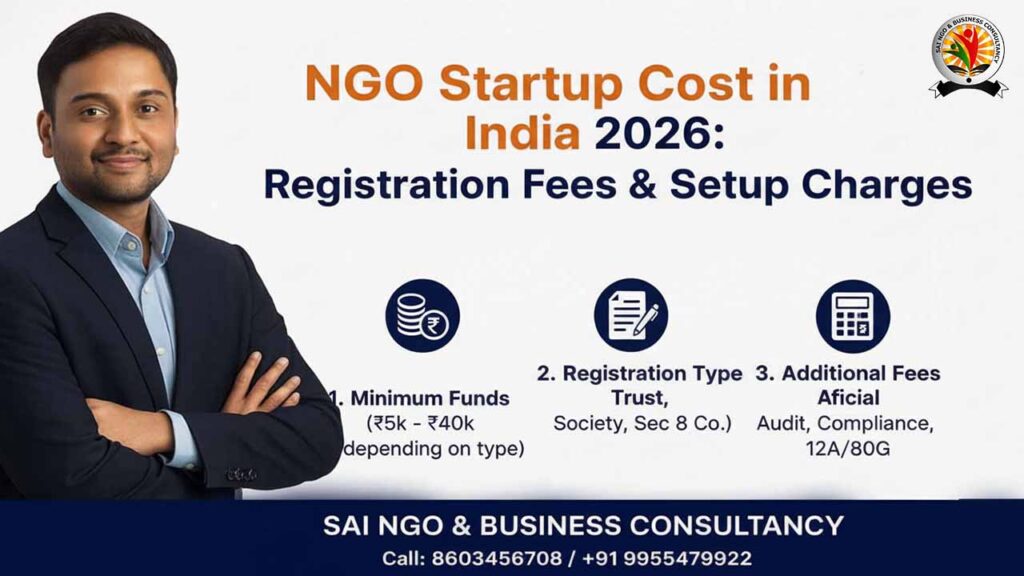
NGO Startup Cost in India 2026
NGO Consultancy, Society Registration, Trust Registration

NGO Startup Cost in India 2026: Registration Fees & Setup Charges

NGO Startup Cost in India 2026: Starting a Non-Governmental Organization (NGO) in India is one of the most fulfilling ways to contribute to society — whether you aim to promote education, environmental protection, or social welfare. However, before you begin, it’s essential to understand how much money is actually required to start an NGO and what expenses you should expect during the registration and setup process. The good news? Establishing an NGO in India is quite affordable if you plan wisely. The cost mainly depends on the legal structure you choose — Trust, Society, or Section 8 Company — along with other factors like document preparation, government fees, and professional assistance. 📑 Table of Contents ▼ Overview: Cost to Start an NGO in India NGOs in India can be registered in three primary legal formats: Each type involves different procedures, costs, and documentation requirements. Here’s a quick overview: NGO Type Approx. Registration Cost Ideal For Processing Time Trust ₹5,000 – ₹15,000 Small / Family-run NGOs 10–15 days Society ₹8,000 – ₹20,000 Community & Membership-based NGOs 30–45 days Section 8 Company ₹20,000 – ₹40,000 Large NGOs / Seeking Corporate Credibility 45–60 days Trust Registration: The Most Affordable Option Forming a Trust is the simplest and least expensive way to start an NGO in India.You’ll need a Trust Deed, two trustees, and a registered address. Estimated Cost Breakdown Advantages Pro Tip Stamp duty charges differ from state to state, so it’s best to check local registration office rates before budgeting. Society Registration: Ideal for Community-Based NGOs A Society works on democratic principles, requiring at least seven founding members. It’s perfect for organizations involving group participation, such as welfare associations, education groups, or women’s empowerment forums. Estimated Cost Breakdown Advantages Pro Tip Documentation costs may include notarization and verification fees, so plan for a small buffer amount. Section 8 Company Registration: For Long-Term Growth & Funding If your NGO aims to build credibility, attract foreign donations, or partner with corporations, registering as a Section 8 Company under the Companies Act, 2013 is the best route. This structure requires at least two directors and two shareholders. Estimated Cost Breakdown Advantages NGO Startup Cost in India 2026: Cost Summary NGO Type Government Fees Legal/Consultant Fees Total Estimate Trust ₹500 – ₹2,000 ₹5,000 – ₹15,000 ₹5,500 – ₹17,000 Society ₹500 – ₹2,000 ₹5,000 – ₹20,000 ₹8,000 – ₹22,000 Section 8 Company ₹5,000 – ₹15,000 ₹10,000 – ₹40,000 ₹20,000 – ₹55,000 Hidden or Additional Costs Besides registration, NGOs must consider these recurring or additional expenses: Can a Single Person Start an NGO in India? No, Indian law requires more than one founding member for NGO registration: These requirements promote transparency, teamwork, and accountability. Registering Your NGO Online in India You can now register your NGO digitally through government-approved portals: Once registered, apply for 12A and 80G certifications to gain tax benefits and attract donors.Registration on NGO Darpan is free, but professional fees for document verification may apply. Steps to Register an NGO in India Updated 2025 A quick guide to complete your NGO registration under Trust, Society, or Section 8 Company structure. Choose the Legal Structure Select the right option — Trust, Society, or Section 8 Company — based on your goals, funding scope, and compliance preference. Gather Members Meet the minimum requirement: 2 trustees for Trust, 7 members for Society, or 2 directors and 2 shareholders for Section 8 Company. Secure Registered Office Address Use your own or rented space. If rented, get a No Objection Certificate (NOC) from the owner with utility bill proof. Prepare Key Documents Draft Trust Deed / MOA / AOA based on your structure and collect valid ID and address proofs for all members. Pay Registration Fees & Stamp Duty Check your state’s applicable stamp duty and registration charges before making the payment. Submit Application Online Submit your documents through MCA for Section 8 or via State Registrar Portals for Trusts and Societies. Obtain PAN, TAN & Open Bank Account Apply for PAN and TAN in your NGO’s name and open a current account for operations. Apply for 12A & 80G Exemptions Apply for 12A and 80G certificates to get tax exemptions and donor benefits for your NGO. 🚀 Go to MCA 📇 NGO Darpan Quick Budgeting Tips for NGO Founders 📞 Need Assistance? We’re Just a Call Away! Talk to our NGO Registration Experts in Pune for instant guidance and support. Call Us: +91 86034 56708 Call Us: +91 99554 79922 How Much Money Is Required to Start an NGO – FAQs Click a question below to expand and read the answers. 1) What’s the minimum money required to start an NGO? Startup Cost 👉 You can start with as low as ₹5,000–₹10,000 if forming a Trust. Costs increase for a Society (₹10,000–₹20,000) or Section 8 Company (₹20,000–₹40,000). 2) Can I register an NGO online for free? 👉 Legal registration isn’t free. However, NGO Darpan registration (for government grants) is completely free of charge. 3) Can one person start an NGO? 👉 No. A minimum of 2 trustees (Trust), 7 members (Society), or 2 directors & 2 shareholders (Section 8 Company) is mandatory. 4) Do I need an office for registration? 👉 Yes, a registered address is required, but it can be your home address if permitted. For rented space, a No Objection Certificate (NOC) from the owner is needed. 5) What are the extra costs after registration? 👉 Annual audits, compliance filings, renewal charges, and tax exemption appl Final Thoughts Starting an NGO in India doesn’t require a massive investment — a small, well-planned budget between ₹5,000 and ₹40,000 is enough to get started.Choose your legal structure carefully, understand the associated costs, and register through official portals to ensure transparency. Once registered, focus on building credibility, applying for tax exemptions, and working towards your social mission. With proper budgeting and clarity, your NGO can grow from a small community effort to a recognized social impact organization Also Read:

Who is Eligible to Open an NGO in India
NGO Consultancy

Who is Eligible to Open an NGO in India in 2026? Eligibility Criteria Explained

Non-Governmental Organizations (NGOs) play a vital role in India’s social, cultural, and developmental growth. They help bridge the gap between government initiatives and community welfare. If you’re passionate about serving society, forming an NGO in 2025 can be your first big step. Let’s understand who is eligible to start an NGO, what documents you need, and how to choose the right type of registration. 📑 Table of Contents ▼ 🧾 Eligibility Criteria to Start an NGO in India To register an NGO legally in India, certain conditions must be fulfilled. The government allows individuals, groups, or organizations to register as a Trust, Society, or Section 8 Company. 👇 Table below explains the requirements: Types of NGO and Their Requirements Type of NGO Minimum Members Required Registration Authority Trust – Registered under the Indian Trusts Act, 1882. Ideal for religious or charitable purposes. At least 2 trustees required. No upper limit on members. Registered with the Sub-Registrar Office of the respective district. Society – Registered under the Societies Registration Act, 1860. Commonly formed for cultural, educational, or public welfare causes. Minimum 7 members from different states required. Registered under the Registrar of Societies at the state level. Section 8 Company – Registered under the Companies Act, 2013. Most transparent and suitable for large NGOs or CSR projects. At least 2 directors and 2 shareholders required. Registered with the Ministry of Corporate Affairs (MCA). 🧍‍♀️ Who Can Start an NGO? Anyone above 18 years of age can start an NGO in India. The following are eligible: Foreign nationals can also form or join an NGO in India, but they must comply with the Foreign Contribution Regulation Act (FCRA) for receiving international funds. 📋 Documents Required for NGO Registration 🧠 Eligibility Summary Table Criteria Requirement Minimum Age 18 years or above Nationality Indian citizen (foreigners allowed with FCRA approval) Members Required Trust – 2 | Society – 7 | Section 8 Company – 2 Purpose Non-profit activities like education, health, women empowerment, or social welfare Frequently Asked Questions (FAQs) – Who is Eligible to Open an NGO in India? (2025 Guide) 1️⃣ Who is eligible to start an NGO in India? Any Indian citizen aged 18 years or above can start an NGO in India. To register a Trust or Section 8 Company, you need at least 2 members, and for a Society, you must have at least 7 members from different states. 2️⃣ Can a single person open an NGO in India? No, a single person cannot register an NGO. The Indian law requires at least 2 members for a Trust or Section 8 Company, and 7 members for a Society registration since NGOs are collective entities. 3️⃣ What is the minimum age to open an NGO in India? The minimum age to form or join an NGO in India is 18 years. Any adult Indian citizen can become a trustee, member, or director in an NGO. 4️⃣ Can foreign nationals or NRIs open NGOs in India? Yes, foreign nationals and NRIs can participate in or establish NGOs in India. However, they must comply with the Foreign Contribution Regulation Act (FCRA) if they wish to receive or manage foreign donations. 5️⃣ Which type of NGO registration is best for funding eligibility? A Section 8 Company is the most preferred form for NGOs seeking CSR and international funding. It offers higher legal credibility, transparency, and better compliance under the Companies Act, 2013. 6️⃣ What documents are required to register an NGO in India? The essential documents include: – PAN Card and Aadhaar of all members – Address proof of the registered office – Trust Deed / Memorandum of Association / Articles of Association – Passport-size photographs – ID proofs of trustees or directors – Rent Agreement or ownership proof of office 7️⃣ What are the costs involved in NGO registration? The registration cost varies based on the type of NGO: – Trust: ₹5,000 – ₹10,000 – Society: ₹8,000 – ₹15,000 – Section 8 Company: ₹15,000 – ₹30,000 (including professional fees) 8️⃣ Can government employees start an NGO? Government employees can be members of an NGO, but they must not hold any executive position or receive financial benefits. Prior permission from their department is usually required. 9️⃣ Can NGOs operate all over India after registration? Yes. Once registered, NGOs can operate anywhere in India, regardless of their registration location. However, certain legal compliances like PAN, TAN, and FCRA (if applicable) must be maintained. 🔟 Which type of NGO registration is easiest to start? Registering a Trust is the easiest and fastest way to start an NGO in India. It requires minimal paperwork, fewer members, and is best suited for small-scale charitable initiatives. Also Read: Conclusion Starting an NGO in India in 2025 is a noble and structured process. Whether you are an individual or a group, you can contribute to society effectively by choosing the right type of registration. Among all types, Section 8 Company offers the highest credibility, transparency, and funding opportunities. With proper documentation and compliance, your NGO can become a trusted name in the service of humanity. Sai NGO & Business Consultancy – India’s Trusted Legal Partner Expert services in NGO Registration, Trust Registration, Society Registration, GST Filing, ITR Filing, Company Registration, and Trademark Services. 📞 Call Now: +91 8603456708 📧 Email: saingoconsultancy@gmail.com ✔ 10+ Years Experience | 5000+ Clients | 700+ Reviews | Govt. Trademark Registered Follow us: Facebook | LinkedIn | Instagram © 2025 Sai NGO & Business Consultancy. All Rights Reserved.

Scroll to Top