Non-Governmental Organizations (NGOs) play a vital role in India’s social, cultural, and developmental growth. They help bridge the gap between government initiatives and community welfare. If you’re passionate about serving society, forming an NGO in 2025 can be your first big step. Let’s understand who is eligible to start an NGO, what documents you need, and how to choose the right type of registration.
To register an NGO legally in India, certain conditions must be fulfilled. The government allows individuals, groups, or organizations to register as a Trust, Society, or Section 8 Company.
👇 Table below explains the requirements:
💬
Join Our WhatsApp Channel
Stay updated with NGO news, government updates, and important announcements directly on WhatsApp.
Types of NGO and Their Requirements
Type of NGO
Minimum Members Required
Registration Authority
Trust – Registered under the Indian Trusts Act, 1882.
Ideal for religious or charitable purposes.
At least 2 trustees required.
No upper limit on members.
Registered with the Sub-Registrar Office of the respective district.
Society – Registered under the Societies Registration Act, 1860.
Commonly formed for cultural, educational, or public welfare causes.
Minimum 7 members from different states required.
Registered under the Registrar of Societies at the state level.
Section 8 Company – Registered under the Companies Act, 2013.
Most transparent and suitable for large NGOs or CSR projects.
At least 2 directors and 2 shareholders required.
Registered with the Ministry of Corporate Affairs (MCA).
🧍♀️ Who Can Start an NGO?
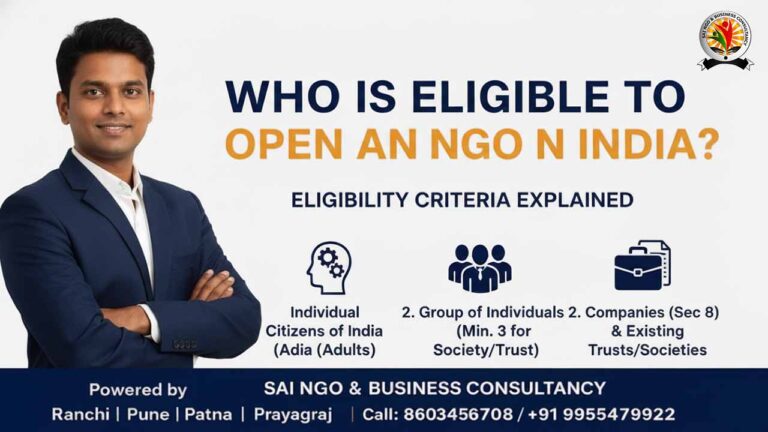
Anyone above 18 years of age can start an NGO in India. The following are eligible:
Indian citizens or NRIs (with valid documents)
Groups of individuals with a social welfare purpose
Companies under CSR initiatives
Educational and charitable institutions
Foreign nationals can also form or join an NGO in India, but they must comply with the Foreign Contribution Regulation Act (FCRA) for receiving international funds.
📋 Documents Required for NGO Registration
Identity proof (Aadhaar, PAN, or Passport) of all members
Address proof of registered office
Memorandum of Association (MOA) and Rules & Regulations
Trust Deed or Articles of Association (for Section 8 Company)
Passport-sized photographs of founders
🧠 Eligibility Summary Table
Criteria
Requirement
Minimum Age
18 years or above
Nationality
Indian citizen (foreigners allowed with FCRA approval)
Members Required
Trust – 2 | Society – 7 | Section 8 Company – 2
Purpose
Non-profit activities like education, health, women empowerment, or social welfare
Frequently Asked Questions (FAQs) – Who is Eligible to Open an NGO in India? (2025 Guide)
1️⃣ Who is eligible to start an NGO in India?
Any Indian citizen aged 18 years or above can start an NGO in India.
To register a Trust or Section 8 Company, you need at least 2 members,
and for a Society, you must have at least 7 members from different states.
2️⃣ Can a single person open an NGO in India?
No, a single person cannot register an NGO.
The Indian law requires at least 2 members for a Trust or Section 8 Company,
and 7 members for a Society registration since NGOs are collective entities.
3️⃣ What is the minimum age to open an NGO in India?
The minimum age to form or join an NGO in India is 18 years.
Any adult Indian citizen can become a trustee, member, or director in an NGO.
4️⃣ Can foreign nationals or NRIs open NGOs in India?
Yes, foreign nationals and NRIs can participate in or establish NGOs in India.
However, they must comply with the Foreign Contribution Regulation Act (FCRA)
if they wish to receive or manage foreign donations.
5️⃣ Which type of NGO registration is best for funding eligibility?
A Section 8 Company is the most preferred form for NGOs seeking
CSR and international funding. It offers higher legal credibility,
transparency, and better compliance under the Companies Act, 2013.
6️⃣ What documents are required to register an NGO in India?
The essential documents include:
– PAN Card and Aadhaar of all members
– Address proof of the registered office
– Trust Deed / Memorandum of Association / Articles of Association
– Passport-size photographs
– ID proofs of trustees or directors
– Rent Agreement or ownership proof of office
7️⃣ What are the costs involved in NGO registration?
The registration cost varies based on the type of NGO:
– Trust: ₹5,000 – ₹10,000
– Society: ₹8,000 – ₹15,000
– Section 8 Company: ₹15,000 – ₹30,000 (including professional fees)
8️⃣ Can government employees start an NGO?
Government employees can be members of an NGO,
but they must not hold any executive position or receive financial benefits.
Prior permission from their department is usually required.
9️⃣ Can NGOs operate all over India after registration?
Yes. Once registered, NGOs can operate anywhere in India,
regardless of their registration location.
However, certain legal compliances like PAN, TAN, and FCRA (if applicable) must be maintained.
🔟 Which type of NGO registration is easiest to start?
Registering a Trust is the easiest and fastest way to start an NGO in India.
It requires minimal paperwork, fewer members, and is best suited for small-scale charitable initiatives.
Starting an NGO in India in 2025 is a noble and structured process. Whether you are an individual or a group, you can contribute to society effectively by choosing the right type of registration. Among all types, Section 8 Company offers the highest credibility, transparency, and funding opportunities. With proper documentation and compliance, your NGO can become a trusted name in the service of humanity.
Sai NGO & Business Consultancy – India’s Trusted Legal Partner
Expert services in NGO Registration, Trust Registration, Society Registration, GST Filing,
ITR Filing, Company Registration, and Trademark Services.
Disclaimer:
The information provided here is for general informational and educational purposes only and does not constitute legal advice or solicitation. Advocate P.R. Pandey offers free legal consultation based on individual case requirements. Outcomes, timelines, and approvals may vary depending on applicable laws, facts, and authorities. Visitors should seek independent legal advice for specific matters.
Advocate P.R. Pandey
Founder & CEO, Sai NGO & Business Consultancy
With over 15+ years of dedicated advocacy experience, he has facilitated
registration for 5000+ NGOs across India and earned 900+ Google reviews
with a stellar 4.9-star rating.