
SAI NGO & BUSINESS CONSULTANCY
Expert services for NGO, Trust, Society Registration & Compliance across India.
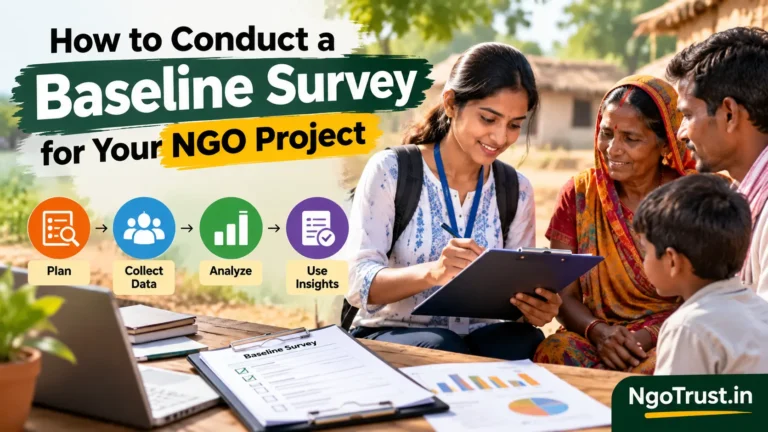
Quick definition: A baseline survey is a structured study done before an NGO project begins. It records the starting condition of your target group, such as income, health, school attendance or access to services, so you can later prove what your project actually changed.
Most NGOs are good at doing the work. Where many struggle is showing the results.
A donor asks, “How many families are better off because of your programme?” Without a starting point, you can only guess. A baseline survey gives you that starting point, and it makes every report, proposal and impact story that follows more credible.
This guide explains how to conduct a baseline survey for your NGO project in plain steps, with the mistakes to avoid along the way.
What Is a Baseline Survey in an NGO Project?
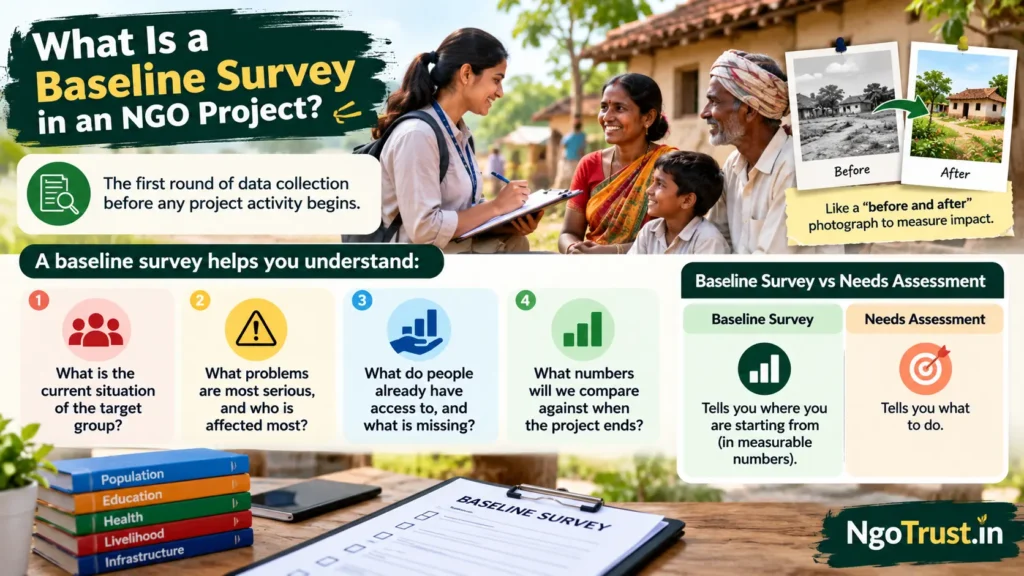
A baseline survey is the first round of data collection in a project. You gather facts about the people, village or institution you plan to work with before any activity begins.
Think of it as a “before” photograph. Months later, you take an “after” photograph and compare the two. The difference between them is your evidence of impact.
A baseline survey usually answers questions like these:
- What is the current situation of the target group?
- What problems are most serious, and who is affected most?
- What do people already have access to, and what is missing?
- What numbers will we compare against when the project ends?
It is different from a needs assessment. A needs assessment tells you what to do. A baseline survey tells you where you are starting from, in numbers you can measure again later.
Why Does Your NGO Need a Baseline Survey?
Short answer: because without it, you cannot prove change. Funders, CSR teams and government bodies increasingly ask for measurable results, and many require baseline data in the proposal or within the first few months of the project.
Here is what a good baseline survey does for you:
- Sets realistic targets. If 70% of girls in your area already attend school, a target of “increase enrolment to 75%” makes more sense than “increase to 100%”.
- Shapes your activities. Data often shows that the real problem is different from the assumed one.
- Builds donor trust. Clear numbers show that your NGO is organised and accountable.
- Makes impact reporting easy. Your midline and endline surveys have something solid to compare with.
If you are also working on your NGO’s legal and compliance base, our team at NGO Trust regularly sees how strong data and clean paperwork together improve funding chances.
How Do You Conduct a Baseline Survey? (Step by Step)
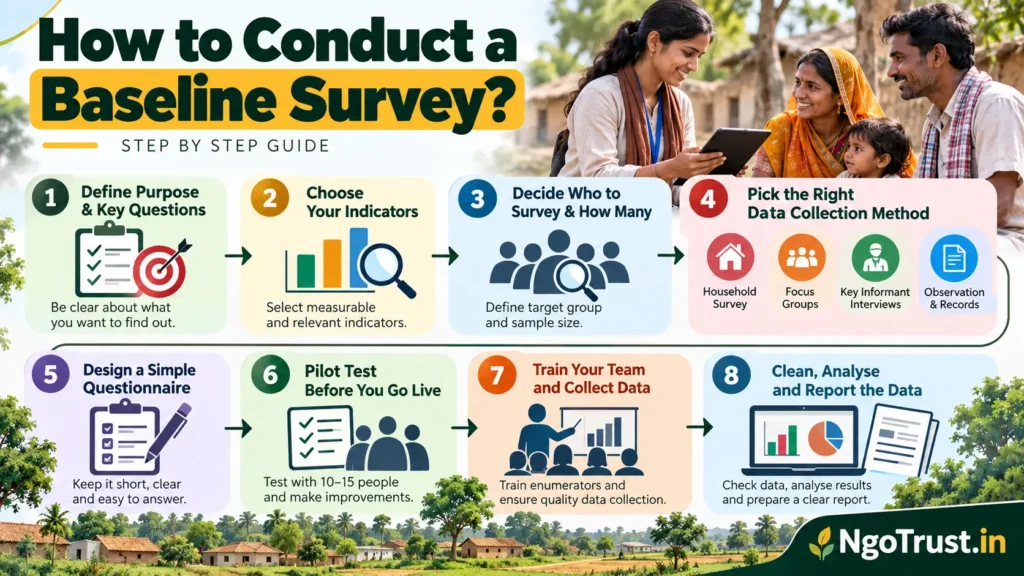
Here is the process most NGOs follow, from planning to the final report.
Step 1: Define the Purpose and Key Questions
Start by writing down why you are doing the survey and what you want to find out. Keep it to three to five questions.
For example, an NGO running a nutrition programme for children under five might ask: What is the current rate of malnutrition? How many mothers know about balanced feeding? How far is the nearest health centre?
Vague questions lead to vague data. If a question cannot be answered with a number or a clear fact, rewrite it.
Step 2: Choose Your Indicators
Indicators are the specific things you will measure. They turn a big goal into something countable.
If your goal is “improve women’s livelihoods”, your indicators could be:
- Average monthly household income
- Number of women with their own bank account
- Number of women who have taken a skill training
Pick indicators that match your project’s logframe or theory of change. Fewer, well-chosen indicators beat a long list that nobody can track. The BetterEvaluation website has helpful guidance on selecting indicators and methods.
Step 3: Decide Who to Survey and How Many
You rarely need to survey everyone. A well-chosen sample can represent the whole group.
First, define your target population clearly. Is it all households in five villages, or only households with children under five?
Then decide your sample size. As a rough guide, for a large population, around 300 to 400 households gives a 95% confidence level with a 5% margin of error. For small populations, you need a smaller number. A free tool such as the SurveyMonkey sample size calculator can help you check.
Use random selection where you can. If you only speak to people who are easy to reach, your results will lean towards the more visible, often better-off families.
Step 4: Pick the Right Data Collection Method
The method depends on what you are measuring and on your budget.
- Household surveys with a structured questionnaire work best for numbers like income, education and health.
- Focus group discussions help you understand attitudes, habits and reasons behind the numbers.
- Key informant interviews with teachers, health workers or panchayat members add local context.
- Observation and records from schools, clinics or government offices can fill gaps.
Most strong baseline studies mix quantitative (numbers) and qualitative (stories and opinions) methods. Numbers show what is happening. Conversations explain why.
Step 5: Design a Simple Questionnaire
A good questionnaire is short, neutral and easy to answer. Aim for 20 to 40 minutes at most per household.
A few practical rules:
- Use local language and everyday words.
- Ask one thing per question. “Do you have a toilet and clean water?” is really two questions.
- Avoid leading questions such as “Don’t you agree that the school is poor?”
- Keep sensitive questions, like income or health, for the middle or end, after trust is built.
Tools like KoboToolbox and Open Data Kit are free and let your team collect data on a phone, even without internet, then upload it later. This saves time on data entry and cuts down errors.
Step 6: Pilot Test Before You Go Live
Try your questionnaire on 10 to 15 people from a similar area. You will quickly see which questions confuse people, which take too long and which answers do not make sense.
Fix these problems before the main survey starts. A pilot that takes two days can save you weeks of poor-quality data.
Step 7: Train Your Team and Collect Data
Your enumerators, the people who ask the questions, shape the quality of your data. Give them a short training so that everyone asks each question in the same way.
Cover these points:
- The purpose of the survey and how to explain it to respondents
- How to take consent, and why people can refuse or stop at any time
- How to keep answers confidential
- How to use the mobile app or paper form correctly
Have a supervisor check a few completed forms every day. Catching mistakes on day one is far easier than fixing them after 500 forms are done.
Step 8: Clean, Analyse and Report the Data
Once collection ends, check the data for missing values, duplicates and impossible entries, such as a household with an income of zero and ten earning members.
Then calculate your indicators. Simple averages, percentages and comparison tables are enough for most NGO projects. You do not need complicated statistics.
Your baseline report should be short and clear. Include:
- The purpose and methods used
- Sample size and how it was chosen
- Results for each indicator
- Key findings and what they mean for the project
- Limitations, such as areas you could not reach
Save the raw data and the questionnaire safely. You will need the exact same tools for your midline and endline surveys.
How Much Time and Money Does a Baseline Survey Need?
It depends on the size of your project. A small, single-village survey may take three to four weeks from planning to report. A multi-district study can take two to three months.
Cost mainly depends on sample size, travel, the number of enumerators and whether you hire an outside expert. Many NGOs include a baseline survey budget line, often a small share of the total project budget, when they apply for funding. It is much easier to plan this in the proposal than to find money later.
What Is the Difference Between Baseline, Midline and Endline Surveys?
These are three points in the same measurement journey.
- Baseline: done before the project starts, to record the starting point.
- Midline: done halfway through, to check progress and correct course.
- Endline: done at the end, to measure total change against the baseline.
For the comparison to be fair, all three should use the same indicators, the same questions and a similar sample. Organisations that evaluate impact in a rigorous way, such as 3ie, stress this consistency again and again.
What Common Mistakes Should You Avoid?
Most baseline surveys go wrong in the same few ways:
- Starting too late. A baseline done after activities begin is no longer a true baseline.
- Collecting too much data. Every extra question adds cost and fatigue. Ask only what you will use.
- Ignoring a comparison group. If you want to prove your project caused a change, a similar group that does not receive the project helps a lot.
- Skipping consent and privacy. Always explain the purpose and protect personal details.
- Not planning for follow-up. If you cannot repeat the survey later, the baseline loses its value.
When Should You Take Professional Help?
You can run a basic baseline survey with your own team, especially for a small project. But some situations call for expert support:
- Your funder requires an independent or third-party baseline
- The project covers many districts or a large sample
- You need help with design, sampling or data analysis
- Your team is stretched thin with field work
It also helps to have your NGO’s registration, FCRA status and compliance records in order before you approach larger donors. You can verify and update your organisation’s profile on the government’s NGO Darpan portal, which many funders check.
If you are unsure where to begin, a short conversation with an experienced consultant can save months of trial and error. For background data on your project area, official sources like the Census of India and the Ministry of Statistics and Programme Implementation are good places to start.
Frequently Asked Questions
What is a baseline survey in simple words?
A baseline survey is a study done before a project starts to record the current situation of the people you plan to help. Its results become the starting point against which you measure progress and impact.
When should an NGO conduct a baseline survey?
Conduct it after you finalise your project design but before any activity begins. If activities have already started, collect baseline data as early as possible and note this limitation in your report.
How long does a baseline survey take?
A small survey typically takes three to four weeks, including planning, field work and reporting. Larger studies covering several districts can take two to three months.
How many people should be surveyed in a baseline study?
It depends on the size of your target population. For a large population, about 300 to 400 respondents give reliable results at a 95% confidence level. For small groups, a smaller sample or a full count may be enough.
What is the difference between a baseline survey and a needs assessment?
A needs assessment identifies problems and decides what the project should do. A baseline survey measures the starting values of your chosen indicators so you can track change over time.
Can a small NGO do a baseline survey without an outside expert?
Yes. With a clear questionnaire, a pilot test, trained volunteers and a free tool like KoboToolbox, a small NGO can complete a solid baseline survey on its own. Expert help is useful for large or donor-mandated studies.
Is a baseline survey mandatory for CSR or foreign-funded projects?
It is not a legal requirement in every case, but many CSR partners and international donors ask for baseline data as part of their project terms. Check your funding agreement or proposal guidelines.
What tools can be used for baseline data collection?
Popular free options include KoboToolbox and Open Data Kit for mobile data collection, and Google Sheets or Excel for cleaning and basic analysis.
A Simple Way to Move Forward
A baseline survey does not have to be complicated. Start with clear questions, choose a few strong indicators, test your tools and keep your process honest. The effort you put in now will make every report, donor meeting and renewal conversation easier.
If you would like a second pair of eyes on your project plan, survey design or NGO documentation, you are welcome to reach out to the team at NGO Trust. We are happy to talk through your situation and suggest a practical next step, with no pressure.
Useful Links
- BetterEvaluation: https://www.betterevaluation.org
- SurveyMonkey Sample Size Calculator: https://www.surveymonkey.com/mp/sample-size-calculator/
- KoboToolbox: https://www.kobotoolbox.org
- Open Data Kit: https://getodk.org
- 3ie (International Initiative for Impact Evaluation): https://www.3ieimpact.org
- NGO Darpan: https://ngodarpan.gov.in
- Census of India: https://censusindia.gov.in
- Ministry of Statistics and Programme Implementation: https://www.mospi.gov.in