
SAI NGO & BUSINESS CONSULTANCY
Expert services for NGO, Trust, Society Registration & Compliance across India.
Starting a Non-Governmental Organization (NGO) is one of the most effective ways to create a positive impact in society. Whether your goal is to support education, healthcare, environmental protection, women empowerment, child welfare, rural development, or other charitable causes, choosing the right legal structure and understanding the registration process is essential for long-term success.
In India, NGOs can be registered as a Trust, Society, or Section 8 Company, each with its own legal requirements, governance framework, and compliance obligations.
Many founders also have questions about the minimum number of members required, registration costs, documentation, tax exemptions under 12A and 80G, eligibility for CSR funding, and the process for receiving foreign donations through FCRA Registration.
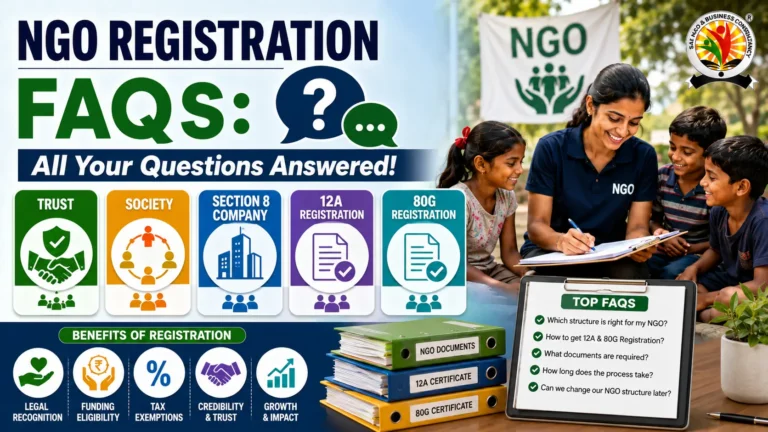
To help you navigate these requirements, we have created this comprehensive NGO Registration FAQ guide. This resource answers the most commonly asked questions about NGO registration, post-registration compliance, tax benefits, fundraising, governance, and legal obligations.
What You’ll Learn in This Guide
- Types of NGO Registration in India
- Trust Registration Requirements
- Society Registration Requirements
- Section 8 Company Registration Process
- Documents Required for NGO Registration
- 12A & 80G Registration Benefits
- FCRA Registration & Foreign Funding Rules
- NGO Compliance Requirements
- CSR-1 & NGO DARPAN Registration
- Common Questions About NGO Management and Funding
Whether you’re planning to start a new NGO or looking to understand the legal and compliance requirements for an existing organization, this FAQ guide will provide clear, practical, and up-to-date answers to help you make informed decisions.
Let’s get started.
General NGO Registration FAQs
1. What is an NGO?
A Non-Governmental Organization (NGO) is a non-profit entity established to work for charitable, educational, social, environmental, religious, cultural, healthcare, or public welfare purposes. Unlike businesses, NGOs are created to serve society rather than generate profits for owners or shareholders.
NGOs in India are commonly registered as Trusts, Societies, or Section 8 Companies. Each structure has its own legal framework, compliance requirements, and governance model.
2. What are the different types of NGO registrations in India?
In India, NGOs can be registered under three primary legal structures: Trust, Society, and Section 8 Company. The choice depends on the organization’s objectives, management style, funding requirements, and long-term vision.
| NGO Type | Governing Law | Minimum Members |
|---|---|---|
| Trust | Indian Trusts Act / State Trust Act | 2–3 Trustees |
| Society | Societies Registration Act, 1860 | 7 Members |
| Section 8 Company | Companies Act, 2013 | 2 Directors & 2 Shareholders |
Key Takeaway: Trusts are easier to manage, Societies are suitable for member-driven organizations, and Section 8 Companies offer the highest credibility.
3. Which NGO structure is best for me?
The ideal NGO structure depends on your goals and operational requirements. Trusts are often preferred for charitable and religious activities, Societies work well for educational and cultural organizations, and Section 8 Companies are suitable for large-scale NGOs seeking CSR funding and institutional partnerships.
| Purpose | Recommended Structure |
|---|---|
| Religious Activities | Trust |
| Educational Institutions | Trust / Society |
| Community Welfare Programs | Society |
| CSR Funding Focus | Section 8 Company |
| National-Level NGO | Section 8 Company |
4. How many members are required to register an NGO?
The minimum member requirement varies according to the type of NGO being registered.
| NGO Type | Minimum Requirement |
|---|---|
| Trust | 1 Settlor + 2–3 Trustees |
| Society | 7 Members |
| Section 8 Company | 2 Directors + 2 Shareholders |
The same person can often act as both a shareholder and director in a Section 8 Company, subject to legal requirements.
5. What documents are required for NGO registration?
The exact documentation requirements depend on the registration type, but the following documents are generally required:
- PAN Card
- Aadhaar Card
- Passport-size Photographs
- Address Proof
- Office Address Proof
- Rent Agreement (if applicable)
- NOC from Property Owner
- Trust Deed, MOA, or AOA
Proper documentation helps ensure a smooth registration process and reduces the chances of delays.
6. How long does NGO registration take?
The registration timeline depends on the legal structure, state regulations, and completeness of documentation.
| Registration Type | Typical Time |
|---|---|
| Trust Registration | 7–15 Days |
| Society Registration | 15–30 Days |
| Section 8 Company Registration | 15–30 Days |
Timelines may vary depending on government processing and document verification.
7. What is the cost of NGO registration?
The cost of NGO registration varies depending on the type of organization, state-specific fees, stamp duty, documentation requirements, and professional assistance charges.
Factors affecting cost include:
- Registration Type
- Government Fees
- Stamp Duty
- Professional Service Charges
- Compliance Requirements
For an accurate estimate, it is advisable to consult a professional registration expert.
Trust Registration FAQs
1. What is a Trust?
A Trust is a legal entity created for charitable, religious, educational, medical, social welfare, or public benefit purposes. It is formed when a person known as the Settlor transfers assets or property to Trustees, who manage them according to the objectives stated in the Trust Deed.
Trusts are among the most commonly used NGO structures in India due to their simple governance framework and relatively low compliance requirements. They are often established to run schools, hospitals, orphanages, religious institutions, scholarship programs, and community development projects.
| Particulars | Details |
|---|---|
| Type of Organization | Non-Profit Organization |
| Main Purpose | Charitable & Public Welfare Activities |
| Governing Document | Trust Deed |
| Managed By | Trustees |
| Founder | Settlor |
2. How many members are required for Trust Registration?
The minimum number of persons required for Trust Registration varies depending on state regulations. In most states, a charitable trust requires one Settlor and at least two or three Trustees.
While only the minimum number is required for registration, many organizations appoint additional trustees to improve governance, accountability, and transparency. A larger trustee board can also strengthen the organization’s credibility when applying for grants or CSR funding.
| Requirement | Typical Minimum |
|---|---|
| Settlor | 1 |
| Trustees | 2–3 |
| Total Persons | 3–4 |
3. Who can become a Trustee?
Any competent adult individual can generally become a Trustee. Trustees are responsible for managing the trust’s affairs, safeguarding its assets, ensuring compliance, and carrying out its charitable objectives.
Trustees should be trustworthy individuals who are willing to act in the best interests of the organization. Depending on the Trust Deed, trustees may have powers relating to financial management, appointment of officers, project approvals, and organizational governance.
| Eligibility Criteria | Requirement |
|---|---|
| Minimum Age | 18 Years |
| Mental Capacity | Must be Competent |
| Identity Proof | Required |
| Address Proof | Required |
4. Who is a Settlor in a Trust?
A Settlor is the person who creates the Trust and initiates the registration process. The Settlor signs the Trust Deed and contributes the initial trust property, assets, or settlement amount required to establish the Trust.
After the Trust is formed, day-to-day management is generally handled by the Trustees. In some cases, the Settlor may also serve as a Trustee if permitted by the Trust Deed.
5. What is a Trust Deed?
A Trust Deed is the primary legal document of a Trust. It defines the organization’s objectives, governance structure, trustee powers, management rules, registered office details, and procedures for utilizing trust assets and funds.
The Trust Deed serves as the foundation of the organization and is required for registration, opening bank accounts, applying for tax exemptions, and obtaining various government approvals.
Key Components of a Trust Deed
| Component | Purpose |
|---|---|
| Trust Name | Official identity of the Trust |
| Objectives | Defines charitable activities |
| Settlor Details | Founder information |
| Trustee Details | Management information |
| Registered Office | Official address |
| Trustee Powers | Governance authority |
| Dissolution Clause | Closure procedure |
6. What documents are required for Trust Registration?
The registration authority typically requires identity proof, address proof, and office-related documents along with the Trust Deed.
Documents Required
| Document | Required |
|---|---|
| PAN Card of Settlor & Trustees | Yes |
| Aadhaar Card | Yes |
| Passport-size Photographs | Yes |
| Address Proof | Yes |
| Trust Deed | Yes |
| Electricity Bill | Yes |
| Rent Agreement (if applicable) | Yes |
| NOC from Property Owner | Yes |
7. Can family members become Trustees in the same Trust?
Yes. Family members can serve as trustees in the same charitable trust. Many family-run charitable organizations operate successfully with family members managing trust activities.
However, including independent trustees can improve transparency, strengthen governance, and enhance donor confidence. Some funding agencies and CSR partners may also prefer organizations with diverse trustee representation.
8. Can a Trust receive donations?
Yes. A registered charitable Trust can receive donations from individuals, businesses, institutions, foundations, and philanthropists. Donations can be accepted through bank transfers, UPI, payment gateways, cheques, and other lawful channels.
Trusts that obtain 12A and 80G registrations often attract more donors because they can offer tax-related benefits and demonstrate stronger regulatory compliance.
| Donation Source | Allowed |
|---|---|
| Individual Donations | ✓ |
| Corporate Donations | ✓ |
| CSR Contributions | ✓ |
| Grants | ✓ |
| Foreign Donations | FCRA Compliance Required |
9. What are the benefits of Trust Registration?
Trust Registration provides legal recognition, credibility, and a structured framework for managing charitable activities. It helps organizations access funding opportunities, establish partnerships, and build trust among donors and beneficiaries.
Key benefits include legal status, eligibility for tax exemptions, improved fundraising opportunities, and long-term organizational continuity.
| Benefit | Description |
|---|---|
| Legal Recognition | Official NGO status |
| Tax Benefits | Eligible for 12A & 80G |
| Donor Confidence | Increased credibility |
| Funding Access | Grants & CSR Opportunities |
| Organizational Stability | Long-term continuity |
10. Is Trust Registration valid across India?
Yes. A registered Trust can generally conduct charitable activities throughout India. However, depending on the nature of activities, additional registrations, local permissions, or compliance requirements may apply in specific states or sectors.
Organizations planning nationwide operations should also ensure compliance with income tax regulations, labor laws, fundraising requirements, and FCRA provisions where applicable.
11. What is the difference between a Private Trust and a Public Charitable Trust?
A Trust can generally be categorized as either a Private Trust or a Public Charitable Trust based on who benefits from its activities. Understanding this distinction is important before registering a Trust because it affects eligibility for tax exemptions, fundraising opportunities, and legal compliance requirements.
A Private Trust is established for the benefit of specific individuals, families, or a defined group of beneficiaries. The beneficiaries are identified or can be identified, and the Trust’s assets are used primarily for their benefit. Private Trusts are commonly used for estate planning, wealth management, and family asset protection.
A Public Charitable Trust, on the other hand, is created for the benefit of the general public or a large section of society. Its objectives typically include education, healthcare, poverty relief, women empowerment, child welfare, environmental protection, rural development, and other charitable activities. Most NGOs in India are registered as Public Charitable Trusts.
Difference Between Private Trust and Public Charitable Trust
| Particulars | Private Trust | Public Charitable Trust |
|---|---|---|
| Beneficiaries | Specific Individuals or Family Members | General Public |
| Main Purpose | Personal or Family Benefit | Charitable Activities |
| Donations from Public | Generally Limited | Allowed |
| Eligibility for 12A & 80G | Usually Not Available | Available |
| CSR Funding Eligibility | Generally Not Eligible | Eligible (Subject to Conditions) |
| NGO Registration Purpose | No | Yes |
Which Trust is Suitable for NGO Activities?
If your objective is to run an NGO, receive donations, apply for grants, obtain 12A and 80G Registration, or undertake social welfare activities, a Public Charitable Trust is generally the preferred option.
Key Takeaway: NGOs should typically register as Public Charitable Trusts because they are designed to serve public welfare and are eligible for various funding and tax exemption benefits.
12. What should be included in a Trust Deed?
A Trust Deed is the most important legal document of a Trust. It serves as the foundation of the organization and defines how the Trust will be governed, managed, and operated. A well-drafted Trust Deed helps prevent future disputes and provides clarity regarding the rights and responsibilities of trustees.
The Trust Deed is submitted during registration and is often reviewed when applying for bank accounts, PAN, 12A Registration, 80G Registration, CSR funding, and other approvals.
Essential Clauses in a Trust Deed
| Clause | Purpose |
|---|---|
| Name Clause | Specifies the official name of the Trust |
| Registered Office Clause | Provides the official address |
| Objects Clause | Defines the charitable objectives |
| Settlor Clause | Details of the founder |
| Trustee Clause | Information about trustees |
| Powers of Trustees | Authority and responsibilities |
| Meeting Clause | Procedures for meetings |
| Bank Account Clause | Rules for financial transactions |
| Amendment Clause | Process for modifying the Trust Deed |
| Dissolution Clause | Procedure for winding up the Trust |
Information Usually Included
- Name of the Trust
- Registered office address
- Details of the Settlor
- Details of Trustees
- Charitable objectives
- Trustee powers and duties
- Procedures for appointment and removal of trustees
- Banking and financial management provisions
- Audit and accounting provisions
- Dissolution and asset transfer provisions
A properly drafted Trust Deed not only facilitates registration but also enhances the credibility and governance of the organization.
Key Takeaway: The Trust Deed acts as the constitution of the Trust and should clearly define its objectives, governance structure, and operational procedures.
13. Does a Trust need renewal after registration?
In most cases, Trust Registration itself does not require periodic renewal. Once a Trust is legally registered, the registration generally remains valid unless the Trust is dissolved or its registration is cancelled by a competent authority under applicable laws.
However, while the Trust Registration may remain valid, the organization must continue to comply with various legal and regulatory requirements. Certain registrations, approvals, and certifications associated with the Trust may require periodic review, renewal, revalidation, or ongoing compliance.
Compliance Requirements After Trust Registration
| Compliance Area | Requirement |
|---|---|
| Books of Accounts | Must Be Maintained |
| Income Tax Return Filing | Required |
| Audit (Where Applicable) | Required |
| 12A Compliance | Required |
| 80G Compliance | Required |
| FCRA Compliance | Required (If Applicable) |
| Trustee Records | Should Be Updated |
Trusts should also ensure that changes in trustees, office address, objectives, or governing provisions are properly documented and updated wherever required.
Common Misconception
Many founders assume that because Trust Registration is permanent, no further compliance is necessary. In reality, ongoing compliance is essential to maintain credibility, tax benefits, funding eligibility, and legal standing.
Key Takeaway: Trust Registration itself is generally permanent, but regular compliance and maintenance of statutory records remain essential.
14. Can a Trust own property in its name?
Yes. A registered Public Charitable Trust can own movable and immovable property in its own name, subject to applicable laws and the provisions of the Trust Deed.
The property held by the Trust is considered Trust property and must be used solely for achieving the organization’s charitable objectives. Trustees act as custodians of the property and are responsible for managing it in the best interests of the Trust.
Types of Property a Trust Can Own
| Property Type | Examples |
|---|---|
| Immovable Property | Land, Buildings, Offices |
| Movable Property | Furniture, Equipment, Vehicles |
| Financial Assets | Bank Deposits, Investments |
| Intellectual Property | Trademarks, Copyrights |
Trust property cannot generally be used for the personal benefit of trustees or related parties unless specifically permitted by law and the Trust Deed.
Benefits of Holding Property in the Trust’s Name
- Greater organizational stability
- Enhanced donor confidence
- Long-term asset protection
- Better eligibility for grants and funding
- Improved transparency
Key Takeaway: A registered Trust can legally acquire, own, manage, and utilize property for charitable purposes.
15. Can a Trust receive donations from across India?
Yes. A registered Public Charitable Trust can receive donations from individuals, businesses, institutions, philanthropists, and organizations located anywhere in India.
Donations may be received through various lawful channels such as bank transfers, UPI, payment gateways, cheques, demand drafts, and fundraising campaigns.
Types of Donations a Trust Can Receive
| Donation Type | Permitted |
|---|---|
| Individual Donations | ✓ |
| Corporate Donations | ✓ |
| Institutional Donations | ✓ |
| CSR Contributions | ✓ (Subject to Eligibility) |
| Foreign Donations | FCRA Required |
Trusts that obtain 80G Registration often find it easier to attract donors because contributors may be eligible for tax benefits on their donations.
To maintain transparency, all donations should be properly recorded and accounted for in the organization’s financial records.
Key Takeaway: A Trust can accept donations from across India, provided it follows applicable legal and financial regulations.
16. Can a Trust be dissolved or closed?
Yes. A Trust may be dissolved or wound up under specific circumstances, subject to the provisions contained in the Trust Deed and applicable laws.
The procedure for dissolution typically depends on the clauses included in the Trust Deed. If the Trust is dissolved, its remaining assets generally cannot be distributed among trustees or founders. Instead, they are usually transferred to another charitable organization with similar objectives.
Common Reasons for Dissolution
- Completion of Objectives
- Lack of Funds
- Inactive Operations
- Merger with Another NGO
- Legal or Administrative Reasons
What Happens to Trust Assets?
| Asset Type | Usual Treatment |
|---|---|
| Cash Balances | Transferred to Another Charitable Entity |
| Land & Buildings | Transferred as per Legal Requirements |
| Equipment & Assets | Donated or Transferred |
| Investments | Utilized According to Dissolution Provisions |
Before initiating dissolution, organizations should consult legal professionals to ensure compliance with all applicable laws and regulations.
Key Takeaway: A Trust can be dissolved, but its charitable assets must generally continue to be used for charitable purposes rather than personal benefit.
17. What are the powers and responsibilities of Trustees?
Trustees are responsible for managing the affairs of the Trust and ensuring that its activities are carried out in accordance with the Trust Deed and applicable laws.
Key Responsibilities of Trustees
- Implementing Trust objectives
- Managing Trust assets
- Maintaining financial records
- Approving budgets and expenditures
- Ensuring legal compliance
- Protecting donor interests
- Monitoring charitable activities
Common Powers of Trustees
| Power | Purpose |
|---|---|
| Open Bank Accounts | Financial Management |
| Acquire Property | Asset Management |
| Appoint Staff | Operational Management |
| Accept Donations | Fundraising |
| Approve Projects | Program Implementation |
| Enter Agreements | Organizational Operations |
Trustees have a fiduciary duty to act honestly, transparently, and in the best interests of the Trust.
Key Takeaway: Trustees play a critical role in governance, compliance, and the overall success of the organization.
18. Can a Trustee be removed from a Trust?
Yes. A Trustee may be removed under certain circumstances, subject to the provisions of the Trust Deed and applicable laws.
The removal process should be conducted fairly, transparently, and in accordance with the procedures specified in the governing documents.
Common Reasons for Removal
- Misconduct
- Breach of Trust
- Financial Irregularities
- Conflict of Interest
- Inability to Perform Duties
- Violation of Trust Deed Provisions
Typical Removal Process
| Step | Action |
|---|---|
| Notice | Inform the Trustee |
| Meeting | Discuss the Issue |
| Resolution | Trustee Removal Decision |
| Documentation | Record the Decision |
| Update Records | Reflect Changes Officially |
Many Trust Deeds also include provisions for appointing replacement trustees to ensure continuity in governance.
Key Takeaway: Trustees can be removed when necessary, provided the process follows the Trust Deed and applicable legal requirements.
Society Registration FAQs
1. What is a Society?
A Society is a non-profit organization registered under the Societies Registration Act, 1860. It is commonly formed by a group of individuals who come together to promote charitable, educational, literary, scientific, cultural, environmental, religious, or social welfare objectives.
Unlike a Trust, which is generally managed by trustees, a Society operates through a democratic structure where members participate in decision-making. This makes Society Registration a popular choice for educational institutions, cultural associations, welfare organizations, and community development groups.
| Particulars | Details |
|---|---|
| Governing Law | Societies Registration Act, 1860 |
| Purpose | Charitable, Educational, Social Welfare Activities |
| Management | Governing Body / Managing Committee |
| Registration Type | Membership-Based Organization |
| Main Documents | MOA & Rules and Regulations |
2. How many members are required for Society Registration?
A minimum of seven members is required to register a Society in India. These members act as the founding members of the organization and sign the registration documents.
For societies intending to operate on a national level, members from multiple states may be required depending on the applicable regulations. Having a diverse group of members can also improve governance and representation within the organization.
| Requirement | Minimum Number |
|---|---|
| Founding Members | 7 |
| Governing Body Members | As per Society Rules |
| Maximum Limit | No Fixed Limit |
3. Who can become a member of a Society?
Any competent individual who is at least 18 years old can become a member of a Society. Members are responsible for supporting the objectives of the organization and participating in its governance activities.
Members may hold positions such as President, Vice President, Secretary, Treasurer, or Executive Committee Member depending on the Society’s Rules and Regulations.
| Eligibility Criteria | Requirement |
|---|---|
| Minimum Age | 18 Years |
| Identity Proof | Required |
| Address Proof | Required |
| Legal Capacity | Must be Competent |
4. What is the Memorandum of Association (MOA)?
The Memorandum of Association (MOA) is one of the most important documents required for Society Registration. It defines the Society’s identity, objectives, registered office address, and details of the founding members.
The MOA serves as the constitutional document of the Society and provides legal clarity regarding its purpose and scope of activities.
Information Included in the MOA
| Component | Purpose |
|---|---|
| Society Name | Legal Identity |
| Registered Office | Official Address |
| Objectives | Purpose of Formation |
| Founder Details | Member Information |
| Governing Body Details | Management Structure |
5. What are the Rules and Regulations of a Society?
The Rules and Regulations document outlines how the Society will be managed and operated. It includes provisions related to membership, elections, meetings, powers of office bearers, financial management, and dispute resolution.
This document acts as the internal governance framework of the Society and helps ensure transparency and accountability.
Common Clauses Included
- Membership Admission and Removal
- Election Procedures
- Meeting Rules
- Powers of Office Bearers
- Financial Management
- Audit Requirements
- Dissolution Procedures
6. What positions are typically found in a Society?
Most societies are managed by a Governing Body or Executive Committee consisting of elected office bearers.
| Position | Primary Responsibility |
|---|---|
| President | Overall Leadership |
| Vice President | Assists President |
| Secretary | Administration & Compliance |
| Joint Secretary | Supports Secretary |
| Treasurer | Financial Management |
| Executive Members | Governance & Decision-Making |
The exact structure may vary depending on the Society’s Rules and Regulations.
7. What documents are required for Society Registration?
The registration authority generally requires identity proofs of members, address proof of the registered office, and organizational documents such as the MOA and Rules & Regulations.
Member Documents
- PAN Card
- Aadhaar Card
- Passport-size Photographs
- Address Proof
Office Documents
- Electricity Bill or Utility Bill
- Rent Agreement (if applicable)
- Property Ownership Proof
- NOC from Property Owner
Society Documents
- Memorandum of Association (MOA)
- Rules & Regulations
- Member List
| Document | Required |
|---|---|
| MOA | ✓ |
| Rules & Regulations | ✓ |
| Member ID Proofs | ✓ |
| Office Address Proof | ✓ |
| NOC (if applicable) | ✓ |
8. Can a Society receive donations and grants?
Yes. A registered Society can receive donations from individuals, corporations, foundations, and institutions. It may also be eligible for government grants, CSR funding, and philanthropic support depending on its activities and compliance status.
Obtaining registrations such as 12A and 80G can further enhance fundraising opportunities and donor confidence.
| Funding Source | Eligibility |
|---|---|
| Public Donations | ✓ |
| Corporate Donations | ✓ |
| CSR Funding | ✓ |
| Government Grants | ✓ |
| Foreign Donations | FCRA Required |
9. What are the benefits of Society Registration?
Society Registration provides legal recognition and establishes a transparent, democratic governance structure. It allows multiple individuals to work together toward a common charitable objective while ensuring proper management and accountability.
Some key benefits include:
- Legal Recognition
- Democratic Decision-Making
- Access to Grants and Donations
- Eligibility for 12A & 80G
- Enhanced Credibility
- Better Governance Structure
- Long-Term Organizational Continuity
| Benefit | Description |
|---|---|
| Legal Status | Recognized Entity |
| Governance | Democratic Structure |
| Fundraising | Donations & Grants |
| Tax Benefits | 12A & 80G Eligibility |
| Credibility | Improved Public Trust |
10. Can a Society operate across India?
Yes. A registered Society can conduct activities throughout India, subject to compliance with applicable laws and regulations. Many societies work across multiple states through educational programs, social welfare initiatives, healthcare projects, and community development activities.
Organizations operating nationally should ensure proper compliance with tax laws, labor regulations, fundraising requirements, and FCRA provisions where applicable. Registration itself provides a strong legal foundation for expanding charitable activities across the country.
11. What is the difference between a Society and a Trust?
Both Societies and Trusts are popular legal structures for NGOs in India, but they differ in terms of management, governance, membership requirements, and operational flexibility.
A Trust is generally managed by a Board of Trustees and is suitable for organizations focused on charitable, religious, or philanthropic activities. A Society, on the other hand, is a membership-based organization governed by a Managing Committee or Governing Body and is often preferred for educational, cultural, scientific, and community development activities.
Society vs Trust Comparison
| Particulars | Society | Trust |
|---|---|---|
| Governing Law | Societies Registration Act, 1860 | Trust Act / State Trust Act |
| Minimum Members | 7 | 2–3 Trustees |
| Management | Governing Body | Board of Trustees |
| Decision Making | Democratic | Trustee-Based |
| Flexibility | High | Moderate |
| Suitable For | Membership Organizations | Charitable Activities |
Many NGOs choose a Society when multiple stakeholders need to participate in decision-making.
Key Takeaway: A Society offers a more democratic structure, while a Trust provides simpler governance and management.
12. Can a Society registered in one state operate across India?
Yes. A Society registered in one state can generally conduct activities throughout India, provided it complies with applicable laws and regulations in the states where it operates.
Many NGOs registered as Societies successfully implement projects across multiple states, including educational programs, healthcare initiatives, environmental campaigns, and community development activities.
However, depending on the nature of activities, additional registrations, permissions, or local compliances may be required.
Activities a Society Can Conduct Across India
- Educational Programs
- Healthcare Projects
- Women Empowerment Initiatives
- Rural Development Activities
- Environmental Campaigns
- Skill Development Programs
| Area | Allowed |
|---|---|
| Multi-State Operations | ✓ |
| Fundraising Across India | ✓ |
| Branch Offices | ✓ |
| CSR Projects | ✓ |
Key Takeaway: Registration in one state does not restrict a Society from carrying out charitable activities in other parts of India.
13. Is Society Registration done online or offline?
The registration process depends on the state where the Society is being registered. Some states provide online filing facilities, while others still require physical submission of documents.
In many cases, the registration process involves preparing and submitting the Memorandum of Association (MOA), Rules & Regulations, member documents, and office address proof to the Registrar of Societies.
Registration Modes
| Mode | Availability |
|---|---|
| Online Registration | Available in Some States |
| Offline Registration | Available in Most States |
| Hybrid Process | Common in Several States |
Common Registration Steps
- Choose a Society Name
- Prepare MOA
- Draft Rules & Regulations
- Collect Member Documents
- Submit Application
- Verification by Registrar
- Issue of Registration Certificate
Key Takeaway: Society Registration may be completed online, offline, or through a combination of both methods depending on the state.
14. Can a Society own property?
Yes. A registered Society can own, acquire, lease, manage, and utilize movable and immovable property for its charitable or organizational purposes.
Property owned by the Society belongs to the organization itself and not to individual members. Such property should be used to further the objectives stated in the Society’s Memorandum of Association.
Types of Property a Society Can Own
| Property Type | Examples |
|---|---|
| Land | School Land, Community Centers |
| Buildings | Offices, Training Centers |
| Vehicles | Ambulances, Service Vehicles |
| Equipment | Computers, Machinery |
| Intellectual Property | Trademarks, Copyrights |
Proper records should be maintained for all assets owned by the Society.
Key Takeaway: A Society can legally own and manage assets necessary for achieving its objectives.
15. How are office bearers elected in a Society?
Office bearers are generally elected according to the Rules and Regulations of the Society. The election process is designed to ensure transparency and democratic governance.
Common office bearers include the President, Vice President, Secretary, Treasurer, and Executive Committee Members.
Typical Election Process
- Notice of Election
- Nomination of Candidates
- Voting by Members
- Declaration of Results
- Recording in Meeting Minutes
Common Office Bearers
| Position | Responsibility |
|---|---|
| President | Overall Leadership |
| Vice President | Supports President |
| Secretary | Administration |
| Treasurer | Financial Management |
| Executive Members | Support governance, decision-making, and implementation of organizational activities |
Key Takeaway: Elections help ensure accountability and allow members to participate in the management of the Society.
16. How often should Society meetings be conducted?
The frequency of meetings depends on the Society’s Rules and Regulations. Regular meetings are important for reviewing activities, approving budgets, discussing projects, and making important decisions.
Most societies conduct Executive Committee meetings periodically and hold Annual General Meetings (AGMs) to review organizational performance and compliance matters.
Common Meeting Types
| Meeting Type | Purpose |
|---|---|
| Executive Committee Meeting | Operational Decisions |
| General Body Meeting | Member Participation |
| Annual General Meeting (AGM) | Annual Review |
| Special Meeting | Urgent Matters |
Maintaining proper meeting minutes is considered a good governance practice.
Key Takeaway: Regular meetings improve transparency, accountability, and organizational effectiveness.
17. Can a Society be dissolved?
Yes. A Society may be dissolved in accordance with the provisions of the Societies Registration Act and the Society’s Rules and Regulations.
The decision to dissolve generally requires approval from members and proper documentation. Any remaining assets are usually transferred to another organization with similar charitable objectives rather than being distributed among members.
Common Reasons for Dissolution
- Completion of Objectives
- Inactive Operations
- Financial Difficulties
- Merger with Another NGO
- Administrative Decisions
Asset Distribution After Dissolution
| Asset | Typical Treatment |
|---|---|
| Cash Funds | Transfer to Similar NGO |
| Property | Transfer According to Law |
| Equipment | Donation or Transfer |
| Investments | Utilized as Permitted |
Key Takeaway: A Society can be dissolved, but its charitable assets should generally continue to serve public welfare purposes.
18. Can family members be members of the same Society?
Yes. Family members can legally become members of the same Society unless restricted by the organization’s Rules and Regulations.
Many family-led NGOs begin with relatives serving as founding members. However, including members from different professional and social backgrounds can improve governance, transparency, and public credibility.
Advantages of Diverse Membership
- Better Decision Making
- Improved Transparency
- Stronger Governance
- Enhanced Donor Confidence
- Broader Community Representation
| Membership Type | Allowed |
|---|---|
| Family Members | ✓ |
| Friends & Associates | ✓ |
| Professionals | ✓ |
| Community Representatives | ✓ |
Key Takeaway: Family members may be members of the same Society, but a diverse membership structure often strengthens the organization.
Section 8 Company Registration FAQs
1. What is a Section 8 Company?
A Section 8 Company is a non-profit organization registered under the Companies Act, 2013 for promoting charitable, educational, social welfare, environmental, scientific, cultural, sports, healthcare, or other public benefit objectives. Unlike regular companies, a Section 8 Company cannot distribute profits to its members. Any surplus income must be used solely for achieving the organization’s objectives.
Section 8 Companies are widely preferred by NGOs seeking professional governance, corporate credibility, CSR funding, and large-scale institutional support.
| Particulars | Details |
|---|---|
| Governing Law | Companies Act, 2013 |
| Purpose | Non-Profit Activities |
| Profit Distribution | Not Allowed |
| Regulating Authority | Ministry of Corporate Affairs (MCA) |
| Legal Status | Separate Legal Entity |
2. How many directors and shareholders are required to register a Section 8 Company?
A Section 8 Company requires a minimum of two directors and two shareholders for registration. In many cases, the same individuals can act as both directors and shareholders.
For larger organizations, additional directors and members can be appointed to strengthen governance and management.
| Requirement | Private Section 8 Company |
|---|---|
| Minimum Directors | 2 |
| Minimum Shareholders | 2 |
| Maximum Directors | 15 (without special approval) |
| Resident Director | At least 1 Indian Resident Director |
3. Who can become a director of a Section 8 Company?
Any individual who is at least 18 years old, legally competent, and possesses the required identification documents can become a director of a Section 8 Company.
Directors are responsible for overseeing the organization’s operations, ensuring legal compliance, managing finances, and fulfilling fiduciary duties under the Companies Act.
Director Eligibility
| Criteria | Requirement |
|---|---|
| Minimum Age | 18 Years |
| PAN Card | Required |
| Address Proof | Required |
| Director Identification Number (DIN) | Required |
| Digital Signature Certificate (DSC) | Required |
4. What documents are required for Section 8 Company Registration?
The registration process requires documents relating to directors, shareholders, and the registered office address.
Director Documents
- PAN Card
- Aadhaar Card
- Passport-size Photograph
- Email Address
- Mobile Number
Registered Office Documents
- Electricity Bill or Utility Bill
- Rent Agreement (if applicable)
- NOC from Property Owner
Organizational Documents
- Memorandum of Association (MOA)
- Articles of Association (AOA)
- Declaration and Consent Forms
| Document | Required |
|---|---|
| PAN Card | ✓ |
| Aadhaar Card | ✓ |
| DSC | ✓ |
| DIN | ✓ |
| MOA | ✓ |
| AOA | ✓ |
| Office Address Proof | ✓ |
5. What is the difference between a Section 8 Company and a Trust or Society?
While all three structures are used for non-profit activities, a Section 8 Company offers stronger governance, greater transparency, and higher credibility among donors, corporations, and government agencies.
| Particulars | Trust | Society | Section 8 Company |
|---|---|---|---|
| Governing Law | Trust Act | Societies Registration Act | Companies Act, 2013 |
| Minimum Members | 2–3 Trustees | 7 Members | 2 Directors & Shareholders |
| Compliance | Low | Medium | High |
| Credibility | Good | Good | Excellent |
| CSR Funding Preference | Moderate | Good | High |
| Governance Structure | Simple | Democratic | Corporate |
Section 8 Companies are often preferred by organizations planning large-scale operations and seeking institutional funding.
6. Can a Section 8 Company earn profits?
Yes. A Section 8 Company can generate revenue through donations, grants, membership fees, training programs, consultancy services, publications, and other lawful activities related to its objectives.
However, unlike a for-profit company, profits cannot be distributed to directors or members. Any surplus income must be reinvested in the organization’s activities and used to further its charitable objectives.
| Activity | Permitted |
|---|---|
| Donations | ✓ |
| Grants | ✓ |
| Membership Fees | ✓ |
| Training Programs | ✓ |
| Dividend Distribution | ✗ |
7. Can a Section 8 Company receive CSR funding?
Yes. Section 8 Companies are among the most preferred NGO structures for receiving Corporate Social Responsibility (CSR) funding due to their transparent governance framework and compliance standards.
Many corporations prefer partnering with Section 8 Companies because they are regulated under the Companies Act and maintain structured reporting and accountability systems.
Common Funding Sources
| Funding Source | Eligibility |
|---|---|
| Public Donations | ✓ |
| CSR Funding | ✓ |
| Government Grants | ✓ |
| Foundation Grants | ✓ |
| Foreign Donations | FCRA Required |
8. What are the compliance requirements for a Section 8 Company?
A Section 8 Company must comply with various requirements under the Companies Act, including maintaining statutory records, conducting board meetings, filing annual returns, and preparing financial statements.
Although compliance requirements are higher than those for Trusts and Societies, they contribute to greater transparency and credibility.
Common Compliance Requirements
| Compliance | Required |
|---|---|
| Books of Accounts | ✓ |
| Board Meetings | ✓ |
| Financial Statements | ✓ |
| Annual Return Filing | ✓ |
| Income Tax Return | ✓ |
| Audit (where applicable) | ✓ |
9. What are the benefits of Section 8 Company Registration?
Section 8 Company Registration offers numerous advantages, particularly for organizations aiming for long-term growth and professional management.
Key benefits include:
- High credibility among donors and institutions
- Strong governance framework
- Eligibility for CSR funding
- Separate legal identity
- Perpetual succession
- Enhanced transparency and accountability
- Easier access to grants and partnerships
| Benefit | Description |
|---|---|
| Legal Entity | Separate Legal Identity |
| Credibility | Excellent Reputation |
| Funding Access | CSR & Institutional Grants |
| Governance | Structured Management |
| Continuity | Perpetual Succession |
10. Can a Section 8 Company operate throughout India?
Yes. A Section 8 Company registered under the Companies Act can operate across India. It can establish branches, conduct charitable projects, partner with organizations, and implement programs in multiple states.
Organizations working nationally should ensure compliance with applicable tax laws, labor regulations, sector-specific permissions, and FCRA requirements if foreign contributions are involved. Its nationwide recognition and professional structure make it an ideal choice for NGOs with ambitious growth plans.
11. How should I choose a name for a Section 8 Company?
Choosing the right name is one of the first and most important steps in Section 8 Company Registration. The name should reflect the organization’s charitable objectives and comply with the naming guidelines prescribed by the Ministry of Corporate Affairs (MCA).
A good name helps establish credibility, improve public recognition, and communicate the organization’s mission effectively. The proposed name should be unique and should not be identical or similar to an existing company, LLP, trademark, or registered organization.
Common Naming Guidelines
| Requirement | Description |
|---|---|
| Unique Name | Must not match existing entities |
| Meaningful Name | Should reflect NGO objectives |
| No Misleading Words | Should not create confusion |
| MCA Approval | Subject to MCA verification |
| Trademark Check | Recommended before application |
Examples of Suitable Names
- Education Development Foundation
- Rural Welfare Foundation
- Green Earth Foundation
- Social Impact Foundation
- Healthcare Development Foundation
Key Takeaway: A unique and objective-based name increases the likelihood of MCA approval and strengthens your organization’s identity.
12. Can directors receive a salary in a Section 8 Company?
Yes. Directors of a Section 8 Company may receive reasonable remuneration or salary for services actually rendered to the organization, subject to applicable laws and governance requirements.
Unlike regular companies, a Section 8 Company cannot distribute profits to its members. However, compensation for genuine professional services, management responsibilities, or employment roles may be permissible.
Examples of Permitted Payments
| Payment Type | Allowed |
|---|---|
| Salary for Services | ✓ |
| Professional Fees | ✓ |
| Reimbursement of Expenses | ✓ |
| Dividend Distribution | ✗ |
| Profit Sharing | ✗ |
The remuneration should be reasonable, properly documented, and approved according to governance procedures.
Key Takeaway: Directors may be compensated for legitimate work, but profits cannot be distributed among members.
13. Can profits be distributed among members?
No. One of the fundamental principles of a Section 8 Company is that its profits or income cannot be distributed among its members, directors, or shareholders.
Any surplus generated by the organization must be reinvested and utilized exclusively for promoting its charitable objectives.
Use of Surplus Funds
| Permitted Use | Allowed |
|---|---|
| Charitable Activities | ✓ |
| Educational Programs | ✓ |
| Healthcare Projects | ✓ |
| Infrastructure Development | ✓ |
| Dividend Distribution | ✗ |
| Personal Benefit | ✗ |
This restriction helps ensure that the organization remains focused on public welfare rather than private gain.
Key Takeaway: All income and surplus funds must be used to further the charitable objectives of the organization.
14. Can a Section 8 Company own property?
Yes. A Section 8 Company is a separate legal entity and can own, acquire, lease, sell, and manage property in its own name.
The organization may own assets necessary for carrying out its charitable activities, including land, buildings, offices, equipment, vehicles, and intellectual property.
Types of Assets a Section 8 Company Can Own
| Asset Type | Examples |
|---|---|
| Land | Schools, Hospitals, Training Centers |
| Buildings | Offices, Community Centers |
| Vehicles | Ambulances, Service Vehicles |
| Equipment | Computers, Medical Equipment |
| Intellectual Property | Trademarks, Copyrights |
Since the company has a separate legal identity, the assets belong to the organization and not to its members or directors.
Key Takeaway: A Section 8 Company can legally own and manage assets needed for its operations and charitable projects.
15. How can a Section 8 Company be closed?
A Section 8 Company can be closed or wound up in accordance with the Companies Act, 2013 and applicable regulatory procedures.
Closure may occur voluntarily when the organization’s objectives have been fulfilled or when it becomes impractical to continue operations. The winding-up process typically involves settling liabilities, preparing final accounts, obtaining necessary approvals, and distributing remaining assets according to legal requirements.
Common Reasons for Closure
- Completion of Objectives
- Financial Constraints
- Inactive Operations
- Organizational Restructuring
- Merger with Another Entity
What Happens to Remaining Assets?
| Asset Type | Treatment |
|---|---|
| Cash Balances | Transferred as Permitted by Law |
| Property | Transferred to Similar Charitable Entity |
| Equipment | Donated or Transferred |
| Investments | Utilized According to Legal Requirements |
Members cannot divide the assets among themselves after closure.
Key Takeaway: A Section 8 Company can be closed through a legal winding-up process, but its charitable assets must continue to serve charitable purposes.
16. What is the role of Directors in a Section 8 Company?
Directors are responsible for managing the affairs of the company and ensuring that it operates in accordance with its objectives, governing documents, and legal obligations.
They are responsible for strategic planning, financial oversight, compliance management, project approvals, and overall governance.
Key Responsibilities of Directors
- Policy Making
- Financial Supervision
- Regulatory Compliance
- Project Monitoring
- Fund Utilization Oversight
- Risk Management
Powers of Directors
| Power | Purpose |
|---|---|
| Approve Budgets | Financial Management |
| Open Bank Accounts | Operational Control |
| Hire Employees | Organizational Development |
| Approve Projects | Program Execution |
| Enter Contracts | Legal Operations |
Directors have fiduciary responsibilities and must act in the best interests of the organization.
Key Takeaway: Directors play a central role in ensuring transparency, accountability, and organizational growth.
17. Is annual ROC filing mandatory for a Section 8 Company?
Yes. A Section 8 Company must comply with annual filing requirements prescribed by the Ministry of Corporate Affairs (MCA).
These filings help maintain transparency and ensure that the company remains compliant with the Companies Act.
Common Annual Compliance Requirements
| Compliance | Mandatory |
|---|---|
| Financial Statements | ✓ |
| Annual Return | ✓ |
| Board Meetings | ✓ |
| Books of Accounts | ✓ |
| Income Tax Return | ✓ |
| Audit (Where Applicable) | ✓ |
Failure to file annual returns may result in penalties and compliance issues.
Key Takeaway: Annual ROC compliance is mandatory and should be completed within the prescribed timelines.
18. Can a Trust or Society be converted into a Section 8 Company?
In certain situations, organizations may choose to transition from a Trust or Society structure to a Section 8 Company to improve governance, credibility, and access to institutional funding.
The process is not an automatic conversion and generally involves establishing a new Section 8 Company and complying with applicable legal and regulatory requirements.
Common Reasons for Transition
- Better Governance Structure
- Increased Donor Confidence
- Access to CSR Funding
- Professional Management
- National-Level Operations
Comparison
| Feature | Trust/Society | Section 8 Company |
|---|---|---|
| Compliance | Lower | Higher |
| Governance | Basic | Structured |
| Credibility | Good | Excellent |
| CSR Preference | Moderate | High |
Key Takeaway: Many growing NGOs eventually prefer the Section 8 Company structure due to its professional governance framework and stronger credibility among donors and funding agencies.
12A & 80G Registration FAQs
1. What is 12A Registration?
12A Registration is a tax exemption registration granted to eligible NGOs by the Income Tax Department. It allows the income of a Trust, Society, or Section 8 Company to be exempt from income tax, provided the organization uses its income for charitable purposes and complies with applicable regulations.
Without 12A Registration, an NGO’s income may be taxable like that of any other entity. Therefore, obtaining 12A Registration is one of the most important steps after NGO registration.
| Particulars | Details |
|---|---|
| Governing Law | Income Tax Act, 1961 |
| Purpose | Income Tax Exemption for NGOs |
| Applicable To | Trusts, Societies & Section 8 Companies |
| Issuing Authority | Income Tax Department |
| Benefit | Tax Exemption on Eligible Income |
2. What is 80G Registration?
80G Registration is a certification granted by the Income Tax Department that allows donors to claim tax deductions on eligible donations made to an NGO.
This registration helps NGOs attract more donations because contributors can reduce their taxable income by claiming deductions under the Income Tax Act.
| Particulars | Details |
|---|---|
| Purpose | Tax Benefit for Donors |
| Applicable To | Registered NGOs |
| Issuing Authority | Income Tax Department |
| Benefit | Encourages Donations |
Benefits of 80G Registration
- Increased donor confidence
- Better fundraising opportunities
- Tax benefits for contributors
- Enhanced credibility
3. What is the difference between 12A and 80G Registration?
Although both registrations are issued under the Income Tax Act, they serve different purposes.
| Particulars | 12A Registration | 80G Registration |
|---|---|---|
| Benefit To | NGO | Donor |
| Purpose | Income Tax Exemption | Tax Deduction on Donations |
| Mandatory for NGO Growth | Highly Recommended | Highly Recommended |
| Issuing Authority | Income Tax Department | Income Tax Department |
Key Difference: 12A helps the NGO save taxes, while 80G helps donors save taxes.
4. Can an NGO apply for 12A and 80G together?
Yes. NGOs can generally apply for both registrations simultaneously after obtaining their NGO registration.
Applying for both registrations together is often recommended because it enables the organization to enjoy tax exemptions while also offering tax benefits to donors. This combination significantly improves fundraising potential and organizational credibility.
| Registration | Benefit |
|---|---|
| 12A | NGO Tax Exemption |
| 80G | Donor Tax Benefits |
| Both Together | Stronger Fundraising Capability |
5. Which NGOs are eligible for 12A and 80G Registration?
Trusts, Societies, and Section 8 Companies engaged in genuine charitable activities may apply for 12A and 80G Registration.
The organization’s objectives should be charitable in nature, and its governing documents should clearly reflect those objectives.
Eligible NGO Structures
| NGO Type | Eligible |
|---|---|
| Trust | ✓ |
| Society | ✓ |
| Section 8 Company | ✓ |
Common Charitable Activities
- Education
- Healthcare
- Poverty Relief
- Women Empowerment
- Child Welfare
- Environmental Protection
- Rural Development
- Skill Development
6. What documents are required for 12A and 80G Registration?
The Income Tax Department generally requires organizational and financial documents to verify the NGO’s activities and objectives.
Common Documents Required
| Document | Required |
|---|---|
| NGO Registration Certificate | ✓ |
| PAN Card of NGO | ✓ |
| Trust Deed / MOA / AOA | ✓ |
| Activity Report | ✓ |
| Financial Statements | ✓ |
| Bank Account Details | ✓ |
| Trustee/Director Details | ✓ |
The exact documentation requirements may vary depending on the organization’s circumstances.
7. What are the benefits of obtaining 12A Registration?
12A Registration provides significant financial advantages to NGOs by exempting eligible income from taxation. This allows organizations to allocate more resources toward charitable activities rather than tax liabilities.
Key Benefits
| Benefit | Description |
|---|---|
| Income Tax Exemption | Reduces Tax Burden |
| Improved Credibility | Builds Trust Among Donors |
| Better Financial Planning | More Funds for Projects |
| Grant Eligibility | Useful for Funding Applications |
Organizations with 12A Registration often find it easier to attract institutional funding and partnerships.
8. What are the benefits of obtaining 80G Registration?
80G Registration makes an NGO more attractive to donors because contributions may qualify for tax deductions.
Many individuals and businesses prefer donating to organizations that hold 80G Registration because it provides a financial incentive while supporting charitable causes.
Major Benefits
| Benefit | Description |
|---|---|
| Donor Tax Savings | Encourages Contributions |
| Enhanced Credibility | Increases Public Trust |
| Better Fundraising | Attracts More Donors |
| Corporate Appeal | Useful for CSR Donations |
9. How long does it take to obtain 12A and 80G Registration?
The processing time depends on the completeness of the application, supporting documentation, and verification procedures conducted by the Income Tax Department.
Organizations should ensure that all documents are accurate and up to date before submitting their applications to avoid unnecessary delays.
| Process | Typical Timeline* |
|---|---|
| Application Preparation | Few Days |
| Department Review | Varies |
| Approval Timeline | Subject to Government Processing |
*Actual timelines may vary depending on departmental workload and verification requirements.
10. Why are 12A and 80G important for NGO growth?
12A and 80G Registrations are often considered essential for the long-term growth and sustainability of an NGO. Together, they improve financial efficiency, strengthen credibility, and make fundraising significantly easier.
Many grant-making organizations, corporate CSR departments, and institutional donors prefer supporting NGOs that possess these registrations because they demonstrate legal compliance and financial transparency.
Impact on NGO Growth
| Area | Benefit |
|---|---|
| Tax Savings | 12A Registration |
| Fundraising | 80G Registration |
| Donor Trust | Both Registrations |
| Grant Opportunities | Both Registrations |
| Organizational Credibility | Both Registrations |
For most NGOs, obtaining 12A and 80G Registration soon after registration is a strategic step toward building a sustainable and well-funded organization.
11. When should a newly registered NGO apply for 12A Registration?
A newly registered NGO should consider applying for 12A Registration as early as possible after completing its registration process. Obtaining 12A Registration allows eligible NGOs to claim income tax exemption on income used for charitable purposes and helps establish credibility with donors, grant-making organizations, and government agencies.
Many NGOs wait until they begin receiving donations or generating income, but early registration can help avoid future tax complications and improve funding opportunities.
Benefits of Applying Early
| Benefit | Description |
|---|---|
| Tax Exemption | Reduces tax liability |
| Better Credibility | Builds donor confidence |
| Funding Opportunities | Supports grant applications |
| Financial Planning | Better resource utilization |
Recommended Sequence
- NGO Registration
- PAN Application
- Bank Account Opening
- 12A Registration
- 80G Registration
- CSR-1 (If Applicable)
- FCRA (When Eligible)
Key Takeaway: Early 12A Registration helps NGOs establish a strong legal and financial foundation.
12. Can 12A Registration be cancelled?
Yes. The Income Tax Department may cancel 12A Registration if it finds that the NGO is not operating in accordance with its charitable objectives or is violating applicable laws.
Cancellation generally occurs when serious compliance issues, misuse of funds, or non-charitable activities are identified during review or assessment proceedings.
Common Reasons for Cancellation
| Reason | Risk Level |
|---|---|
| Misuse of Funds | High |
| Non-Charitable Activities | High |
| False Information | High |
| Violation of Tax Laws | High |
| Improper Financial Records | Moderate |
How NGOs Can Avoid Cancellation
- Maintain proper books of accounts
- Use funds only for approved objectives
- File required returns on time
- Maintain transparency
- Follow all applicable regulations
Key Takeaway: Proper governance and compliance are essential for maintaining 12A Registration.
13. What is the difference between 12A and 12AA?
12A and 12AA are both related to tax exemptions for charitable organizations under the Income Tax Act. Historically, Section 12AA governed the procedure for granting registration to charitable organizations, while Section 12A established the eligibility framework.
Over time, the registration framework has evolved, and references to 12AA are often seen in older documents, articles, and registrations.
Comparison
| Particulars | 12A | 12AA |
|---|---|---|
| Purpose | Tax Exemption Framework | Registration Procedure |
| Relevance Today | Applicable | Historical Reference |
| Governing Authority | Income Tax Department | Income Tax Department |
| Objective | NGO Tax Benefits | Registration Approval Process |
Why People Still Ask About 12AA
Many NGOs continue to encounter references to 12AA in older registration certificates, legal documents, and online resources, which creates confusion.
Key Takeaway: 12A provides tax exemption benefits, while 12AA was historically associated with the registration process for obtaining those benefits.
14. Can an NGO with multiple charitable activities get 12A Registration?
Yes. NGOs engaged in multiple charitable activities may be eligible for 12A Registration, provided their objectives are charitable in nature and comply with applicable laws.
Many successful NGOs work simultaneously in areas such as education, healthcare, women empowerment, skill development, environmental protection, child welfare, and rural development.
Common Eligible Activities
| Activity | Eligible |
|---|---|
| Education | ✓ |
| Healthcare | ✓ |
| Child Welfare | ✓ |
| Women Empowerment | ✓ |
| Environmental Protection | ✓ |
| Rural Development | ✓ |
| Skill Development | ✓ |
The key requirement is that the activities should genuinely serve charitable purposes.
Key Takeaway: An NGO can pursue multiple charitable objectives and still qualify for 12A Registration.
15. Is 12A Registration mandatory for NGOs?
No. An NGO can legally exist and operate without 12A Registration. However, many organizations choose to obtain it because of the significant tax benefits and funding advantages it provides.
Without 12A Registration, an NGO may have difficulty maximizing its financial resources and may face limitations when applying for grants and funding opportunities.
Comparison
| Particulars | With 12A | Without 12A |
|---|---|---|
| Tax Exemption | ✓ | ✗ |
| Donor Confidence | Higher | Lower |
| Grant Eligibility | Better | Limited |
| Financial Efficiency | Higher | Lower |
Why Most NGOs Apply for 12A
- Income tax exemption
- Better fundraising opportunities
- Improved credibility
- Easier grant applications
- Stronger financial sustainability
Key Takeaway: While not mandatory, 12A Registration is highly beneficial for most NGOs.
16. Does 12A Registration help in getting grants and donations?
Yes. Although 12A Registration does not guarantee funding, it significantly improves an NGO’s credibility and financial standing.
Many donors, foundations, CSR departments, and grant-making organizations prefer supporting NGOs that have obtained 12A Registration because it demonstrates legal compliance and responsible financial management.
How 12A Helps Fundraising
| Funding Source | Positive Impact |
|---|---|
| Individual Donors | ✓ |
| Corporate Donors | ✓ |
| CSR Funding | ✓ |
| Foundations | ✓ |
| Grant Agencies | ✓ |
Advantages for Donors and Funders
- Greater confidence in compliance
- Better financial transparency
- Enhanced organizational credibility
- Improved governance perception
Key Takeaway: 12A Registration strengthens an NGO’s reputation and can improve its ability to attract grants, donations, and long-term funding support.
17. How do donors claim tax benefits under 80G?
One of the primary benefits of donating to an NGO with 80G Registration is that eligible donors may claim tax deductions under the Income Tax Act. This benefit encourages charitable giving and helps NGOs attract more donations from individuals and organizations.
To claim the deduction, donors must maintain proper records of their contributions and include the relevant information while filing their Income Tax Return (ITR).
Documents Required by Donors
| Document | Purpose |
|---|---|
| Donation Receipt | Proof of Donation |
| NGO PAN | Verification |
| 80G Certificate Details | Tax Benefit Eligibility |
| Form 10BE | Deduction Claim Support |
Steps to Claim 80G Benefits
- Make a donation to an eligible NGO.
- Obtain an official donation receipt.
- Collect Form 10BE from the NGO.
- Mention the donation details while filing the ITR.
- Retain supporting documents for future verification.
Key Takeaway: Donors can claim tax benefits only when donations are made to NGOs holding valid 80G Registration and proper documentation is maintained.
18. What is Form 10BE?
Form 10BE is a certificate issued by eligible NGOs to donors for claiming deductions under Section 80G of the Income Tax Act.
This form contains important details regarding the donation, including the amount donated, donor information, and registration details of the NGO. It serves as evidence that the donation qualifies for tax benefits.
Information Included in Form 10BE
| Information | Purpose |
|---|---|
| Donor Details | Identification |
| Donation Amount | Tax Deduction Calculation |
| NGO Registration Details | Verification |
| Donation Reference Number | Record Keeping |
Why Form 10BE is Important
- Supports tax deduction claims
- Improves transparency
- Reduces disputes during tax assessment
- Helps maintain donor confidence
Key Takeaway: Form 10BE plays an important role in enabling donors to claim tax deductions on eligible donations.
19. Can an NGO have 12A Registration but not 80G Registration?
Yes. An NGO may obtain 12A Registration without obtaining 80G Registration. Both registrations serve different purposes and are granted separately.
12A Registration provides tax exemption benefits to the NGO itself, while 80G Registration provides tax deduction benefits to donors.
Comparison
| Particulars | 12A | 80G |
|---|---|---|
| Benefit To | NGO | Donor |
| Tax Exemption | ✓ | ✗ |
| Donor Tax Benefit | ✗ | ✓ |
| Separate Application Required | ✓ | ✓ |
Many NGOs apply for both registrations together because they complement each other.
Practical Impact
| Situation | Result |
|---|---|
| NGO has 12A only | NGO gets tax exemption |
| NGO has 80G only | Donors get tax benefits |
| NGO has both | Benefits for NGO and Donors |
Key Takeaway: While an NGO can have only 12A Registration, obtaining both 12A and 80G generally provides greater advantages.
20. Is 80G Registration mandatory for CSR funding?
No. 80G Registration is not always a mandatory requirement for receiving CSR funding. However, many companies prefer supporting NGOs that possess strong compliance credentials, including 12A and 80G Registration.
CSR funding eligibility is influenced by various factors such as NGO credibility, legal structure, CSR-1 Registration, governance standards, project quality, and organizational track record.
Factors Considered by CSR Donors
| Factor | Importance |
|---|---|
| CSR-1 Registration | Very High |
| 12A Registration | High |
| 80G Registration | High |
| Financial Transparency | High |
| Project Impact | Very High |
| Compliance Record | High |
Why NGOs Still Obtain 80G
- Improves credibility
- Strengthens donor confidence
- Supports fundraising
- Demonstrates compliance
Key Takeaway: Although not always mandatory, 80G Registration can significantly enhance an NGO’s attractiveness to CSR partners and donors.
21. Can 80G Registration be rejected?
Yes. The Income Tax Department may reject an 80G application if the NGO fails to meet eligibility requirements or submits incomplete or inaccurate information.
Organizations should carefully review their documents and ensure compliance before applying.
Common Reasons for Rejection
| Reason | Risk Level |
|---|---|
| Incomplete Documentation | High |
| Non-Charitable Objectives | High |
| Inaccurate Information | High |
| Poor Financial Records | Moderate |
| Compliance Deficiencies | Moderate |
| Governance Issues | Moderate |
How to Improve Approval Chances
- Maintain proper documentation
- Keep accurate financial records
- Clearly define charitable objectives
- Ensure legal compliance
- Submit complete applications
Key Takeaway: Careful preparation and compliance can significantly improve the likelihood of obtaining 80G Registration.
22. What are the common reasons for 80G Registration rejection?
Most rejections occur because the NGO is unable to demonstrate genuine charitable activities or fails to satisfy documentation and compliance requirements.
The Income Tax Department may review organizational objectives, governance practices, financial records, and operational activities before making a decision.
Common Issues
| Issue | Potential Impact |
|---|---|
| Incomplete Application | Rejection |
| Missing Documents | Rejection |
| Lack of Charitable Activities | Rejection |
| Poor Record Keeping | Delay or Rejection |
| Non-Compliance with Tax Laws | Rejection |
Best Practices
- Maintain transparent records
- Keep updated activity reports
- Ensure consistency between objectives and activities
- Submit accurate information
Key Takeaway: Most 80G rejections can be avoided through proper documentation and compliance management.
23. Is 80G applicable to donations only or grants as well?
80G Registration is primarily designed to provide tax benefits to eligible donors making qualifying donations to approved NGOs.
While grants and institutional funding may support NGO activities, the availability of tax deductions depends on the nature of the contribution and applicable tax provisions.
Common Funding Sources
| Funding Source | 80G Relevance |
|---|---|
| Individual Donations | High |
| Corporate Donations | High |
| Philanthropic Contributions | High |
| Foundation Grants | Depends on Structure |
| Government Grants | Generally Different Rules Apply |
NGOs should maintain proper records for all sources of funding regardless of their tax treatment.
Benefits of Maintaining 80G Registration
- Encourages public donations
- Improves fundraising capacity
- Enhances credibility
- Supports long-term sustainability
Key Takeaway: 80G Registration is most commonly associated with donations and can play a significant role in strengthening an NGO’s fundraising efforts.
FCRA Registration FAQs
1. What is FCRA Registration?
FCRA (Foreign Contribution Regulation Act) Registration is a legal authorization that allows eligible NGOs in India to receive donations, grants, and contributions from foreign sources. The Act is administered by the Ministry of Home Affairs (MHA), Government of India.
Any NGO intending to accept foreign contributions from individuals, organizations, foundations, or institutions located outside India must comply with FCRA regulations. Receiving foreign funds without the required approval can result in penalties and legal consequences.
| Particulars | Details |
|---|---|
| Full Form | Foreign Contribution Regulation Act |
| Governing Authority | Ministry of Home Affairs (MHA) |
| Purpose | Receive Foreign Donations |
| Applicable To | Trusts, Societies & Section 8 Companies |
| Mandatory for Foreign Funding | Yes |
2. What is considered a foreign contribution under FCRA?
Foreign contribution includes donations, grants, gifts, securities, articles, or financial assistance received from foreign sources.
Foreign sources may include:
- Foreign citizens
- Foreign companies
- International NGOs
- Foreign foundations
- Overseas charitable organizations
- Foreign governments and agencies
Even if the contribution is intended for charitable purposes, it may still fall under FCRA regulations.
| Type of Contribution | Covered Under FCRA |
|---|---|
| Monetary Donations | ✓ |
| Foreign Grants | ✓ |
| Gifts & Articles | ✓ |
| Foreign Securities | ✓ |
3. Which NGOs are eligible for FCRA Registration?
Only legally registered NGOs can apply for FCRA Registration. Generally, organizations should have a proven track record of genuine charitable activities and meet the eligibility criteria prescribed by the Ministry of Home Affairs.
Eligible organizations include:
| NGO Structure | Eligible |
|---|---|
| Trust | ✓ |
| Society | ✓ |
| Section 8 Company | ✓ |
Organizations should ensure proper governance, documentation, and compliance before applying.
4. What is the difference between FCRA Registration and FCRA Prior Permission?
NGOs can receive foreign contributions through either FCRA Registration or FCRA Prior Permission, depending on their circumstances.
| Particulars | FCRA Registration | Prior Permission |
|---|---|---|
| Purpose | Ongoing Foreign Funding | Specific Foreign Donation |
| Donor Requirement | Not Restricted to One Donor | Specific Donor Required |
| Funding Purpose | Multiple Approved Activities | Specific Project |
| Long-Term Solution | Yes | No |
Prior Permission is often used when an NGO wants to receive a specific foreign contribution from a particular donor for a defined project.
5. Is a dedicated FCRA bank account required?
Yes. NGOs receiving foreign contributions must maintain a designated FCRA bank account as required by law.
Foreign contributions are generally required to be received through the prescribed FCRA bank account. Separate accounting records must also be maintained for foreign funds to ensure transparency and compliance.
| Requirement | Mandatory |
|---|---|
| Designated FCRA Bank Account | ✓ |
| Separate Accounting Records | ✓ |
| Reporting of Foreign Funds | ✓ |
6. What documents are required for FCRA Registration?
The exact documentation requirements may vary, but NGOs are generally required to submit organizational, financial, and governance-related documents.
Common Documents Required
| Document | Required |
|---|---|
| NGO Registration Certificate | ✓ |
| PAN Card of NGO | ✓ |
| Trust Deed / MOA / AOA | ✓ |
| Activity Reports | ✓ |
| Financial Statements | ✓ |
| Bank Account Details | ✓ |
| Trustee/Director Information | ✓ |
Accurate documentation improves the chances of a smooth application process.
7. How can foreign contributions be used?
Foreign contributions must be used strictly for the objectives and activities for which they were received. NGOs should maintain proper records and ensure that funds are utilized in accordance with applicable laws.
Common Uses of Foreign Contributions
- Educational Programs
- Healthcare Projects
- Child Welfare Initiatives
- Women Empowerment Programs
- Rural Development Projects
- Environmental Activities
- Disaster Relief Efforts
| Use of Funds | Permitted |
|---|---|
| Charitable Activities | ✓ |
| Welfare Projects | ✓ |
| Educational Programs | ✓ |
| Personal Use | ✗ |
8. What are the compliance requirements under FCRA?
NGOs receiving foreign contributions must comply with various reporting and record-keeping requirements. Proper financial management and transparency are essential for maintaining compliance.
Common Compliance Requirements
| Compliance Requirement | Applicable |
|---|---|
| Maintain Books of Accounts | ✓ |
| Record Foreign Contributions | ✓ |
| Annual Reporting | ✓ |
| Bank Account Compliance | ✓ |
| Activity Reporting | ✓ |
Failure to comply may lead to penalties, suspension, or cancellation of registration.
9. What are the benefits of FCRA Registration?
FCRA Registration enables NGOs to access international funding opportunities and collaborate with global donors, foundations, and development organizations.
Key Benefits
| Benefit | Description |
|---|---|
| Access to Foreign Funding | International Donations & Grants |
| Larger Funding Opportunities | Global Support |
| International Partnerships | Collaboration with Foreign Organizations |
| Project Expansion | Increased Financial Resources |
Many NGOs rely on foreign contributions to support large-scale social, educational, healthcare, and environmental initiatives.
10. Why is FCRA Registration important for NGOs?
For NGOs seeking international support, FCRA Registration is often an essential requirement. It provides a legal framework for receiving foreign contributions and helps ensure transparency in the use of international funds.
Organizations with FCRA compliance are generally better positioned to access global grants, build international partnerships, and expand their impact through sustainable funding sources.
FCRA at a Glance
| Area | Benefit |
|---|---|
| Foreign Donations | Legally Permitted |
| International Grants | Accessible |
| Global Partnerships | Easier to Establish |
| Organizational Growth | Enhanced Funding Opportunities |
| Regulatory Compliance | Improved Transparency |
For NGOs planning to work on a larger scale or collaborate with international donors, understanding and complying with FCRA requirements is a critical step toward long-term sustainability and growth.
11. How old should an NGO be before applying for FCRA Registration?
Under the Foreign Contribution Regulation Act (FCRA), NGOs generally need to demonstrate a track record of genuine charitable activities before becoming eligible for regular FCRA Registration.
Organizations seeking regular FCRA Registration are typically expected to have been actively engaged in charitable work and maintain proper financial and activity records. NGOs that do not yet meet the eligibility requirements may explore the option of obtaining FCRA Prior Permission for a specific foreign donor and project.
Typical Requirements for Regular FCRA Registration
| Requirement | Importance |
|---|---|
| Registered NGO | Mandatory |
| Genuine Charitable Activities | Essential |
| Financial Records | Essential |
| Activity Reports | Essential |
| Compliance History | Important |
Alternatives for New NGOs
| Option | Suitable For |
|---|---|
| FCRA Registration | Established NGOs |
| FCRA Prior Permission | Specific Foreign Grant |
Key Takeaway: NGOs should establish a strong operational and compliance record before applying for regular FCRA Registration.
12. What is FCRA Prior Permission?
FCRA Prior Permission is a mechanism that allows eligible NGOs to receive a specific foreign contribution from a specific foreign donor for a specific project, even if they do not have regular FCRA Registration.
This option is commonly used by newly established organizations that wish to receive foreign funding for a defined charitable activity.
FCRA Registration vs Prior Permission
| Particulars | FCRA Registration | Prior Permission |
|---|---|---|
| Funding Source | Multiple Donors | Specific Donor |
| Purpose | Ongoing Funding | Specific Project |
| Long-Term Solution | Yes | No |
| Suitable For | Established NGOs | New NGOs |
When Prior Permission is Useful
- Project-based foreign funding
- New NGOs
- First-time foreign donors
- Limited-duration projects
Key Takeaway: Prior Permission allows NGOs to legally receive a specific foreign contribution without holding full FCRA Registration.
13. Is an SBI New Delhi FCRA Account mandatory?
Yes. NGOs receiving foreign contributions under FCRA are generally required to receive such funds through the designated FCRA account as prescribed under applicable regulations.
The designated account serves as the primary channel for receiving foreign contributions and helps improve transparency and regulatory oversight.
Purpose of the Designated FCRA Account
| Function | Benefit |
|---|---|
| Foreign Fund Receipt | Regulatory Compliance |
| Transaction Monitoring | Transparency |
| Fund Tracking | Better Accountability |
| Reporting | Easier Compliance |
Additional Accounts
Organizations may be permitted to transfer funds from the designated account to other utilization accounts in accordance with applicable regulations.
Key Takeaway: NGOs should ensure compliance with current FCRA banking requirements before accepting foreign contributions.
14. What are the annual compliance requirements under FCRA?
NGOs receiving foreign contributions must comply with various reporting, accounting, and record-keeping obligations under FCRA.
Maintaining transparency in the receipt and utilization of foreign funds is a critical requirement.
Common FCRA Compliance Requirements
| Compliance Requirement | Required |
|---|---|
| Books of Accounts | ✓ |
| Foreign Contribution Records | ✓ |
| Bank Statements | ✓ |
| Activity Reports | ✓ |
| Annual Reporting | ✓ |
| Fund Utilization Records | ✓ |
Best Practices
- Maintain separate accounting records
- Document all foreign contributions
- Track project-wise expenditure
- Retain supporting documents
- Ensure timely reporting
Benefits of Strong Compliance
- Improved credibility
- Reduced regulatory risk
- Better donor confidence
- Easier future funding opportunities
Key Takeaway: Proper record-keeping and timely compliance are essential for maintaining FCRA approval.
15. What happens if FCRA Registration is cancelled?
FCRA Registration may be cancelled by the competent authority if serious violations of FCRA provisions are identified.
Cancellation can significantly affect an NGO’s ability to receive foreign contributions and may impact ongoing projects that depend on international funding.
Common Reasons for Cancellation
| Reason | Risk Level |
|---|---|
| Misuse of Foreign Funds | High |
| Non-Compliance | High |
| False Information | High |
| Improper Record Keeping | Moderate |
| Violation of FCRA Conditions | High |
Possible Consequences
- Loss of foreign funding eligibility
- Increased regulatory scrutiny
- Operational disruptions
- Reputational impact
How NGOs Can Reduce Risk
- Maintain proper records
- Use funds only for approved purposes
- Follow all reporting requirements
- Conduct periodic compliance reviews
Key Takeaway: Strong governance and compliance practices are essential for protecting FCRA approval.
16. Can an NGO legally receive foreign donations without FCRA?
Generally, NGOs intending to receive foreign contributions must comply with FCRA requirements. Receiving foreign contributions without the necessary approval may lead to legal and regulatory consequences.
Before accepting any foreign contribution, organizations should carefully verify whether the contribution falls under FCRA regulations and ensure that all legal requirements have been fulfilled.
Common Sources of Foreign Contributions
| Source | May Fall Under FCRA |
|---|---|
| Foreign Citizens | ✓ |
| Foreign Foundations | ✓ |
| International NGOs | ✓ |
| Foreign Companies | ✓ |
| Overseas Institutions | ✓ |
Risks of Non-Compliance
- Regulatory action
- Penalties
- Funding restrictions
- Reputational damage
Key Takeaway: NGOs should verify FCRA requirements before accepting any foreign contribution.
17. Can an NGO receive donations from NRIs without FCRA?
The treatment of contributions from Non-Resident Indians (NRIs) depends on various factors, including the source of funds and the applicable FCRA provisions.
Because foreign contribution regulations can be complex and fact-specific, NGOs should carefully review the nature of the contribution and seek professional guidance where necessary.
Factors Considered
| Factor | Importance |
|---|---|
| Citizenship Status | Important |
| Source of Funds | Important |
| Donor Location | Important |
| Nature of Contribution | Important |
Why Proper Verification Matters
- Compliance Protection
- Reduced Legal Risk
- Accurate Reporting
- Better Governance
Key Takeaway: NGOs should carefully assess NRI contributions to determine whether FCRA compliance requirements apply.
18. What is the difference between FCRA Registration and FCRA Prior Permission?
Both mechanisms allow NGOs to receive foreign contributions, but they serve different purposes and are intended for different situations.
Detailed Comparison
| Particulars | FCRA Registration | FCRA Prior Permission |
|---|---|---|
| Funding Source | Multiple Donors | Specific Donor |
| Funding Purpose | General Activities | Specific Project |
| Duration | Ongoing | Project-Based |
| NGO Profile | Established NGOs | New NGOs |
| Flexibility | High | Limited |
Which Option is Better?
| Situation | Recommended Option |
|---|---|
| Long-Term Foreign Funding | FCRA Registration |
| Single Foreign Grant | Prior Permission |
| Multiple International Donors | FCRA Registration |
| New NGO with One Project | Prior Permission |
Key Takeaway: FCRA Registration is generally suitable for NGOs seeking ongoing foreign funding, while Prior Permission is designed for specific projects funded by a specific foreign donor.
NGO Compliance & Post-Registration FAQs
1. What should be done after NGO Registration?
Registering a Trust, Society, or Section 8 Company is only the first step in establishing an NGO. After registration, organizations must complete several important tasks to ensure legal compliance and smooth operations.
These include obtaining a PAN, opening a bank account, maintaining financial records, applying for tax exemptions, and complying with annual filing requirements. Completing these steps early helps build credibility with donors, government agencies, and funding organizations.
Post-Registration Checklist
| Requirement | Trust | Society | Section 8 Company |
|---|---|---|---|
| PAN Application | ✓ | ✓ | ✓ |
| Bank Account Opening | ✓ | ✓ | ✓ |
| 12A Registration | Recommended | Recommended | Recommended |
| 80G Registration | Recommended | Recommended | Recommended |
| Accounting Records | ✓ | ✓ | ✓ |
| Annual Compliance | ✓ | ✓ | ✓ |
2. Is a PAN card mandatory for an NGO?
Yes. Every registered NGO should obtain a Permanent Account Number (PAN) from the Income Tax Department. PAN is essential for opening bank accounts, filing income tax returns, receiving grants, and applying for tax exemption registrations such as 12A and 80G.
Most government authorities, banks, and funding organizations require the NGO’s PAN for verification and compliance purposes.
| Purpose | PAN Required |
|---|---|
| Bank Account Opening | ✓ |
| Income Tax Filing | ✓ |
| 12A Registration | ✓ |
| 80G Registration | ✓ |
| Grant Applications | ✓ |
3. Can an NGO open a bank account after registration?
Yes. Once registration is completed, the NGO can open a bank account in its official name. Most banks require registration documents, PAN, address proof, and a resolution authorizing account operation.
Having a dedicated organizational bank account is important because it ensures transparency and separates NGO finances from personal accounts.
Common Documents Required
- Registration Certificate
- PAN Card
- Trust Deed / MOA / AOA
- Address Proof
- Trustee/Director Resolution
- Identity Proof of Authorized Signatories
4. Does an NGO need to maintain books of accounts?
Yes. Proper financial record-keeping is essential for every NGO, regardless of its size or legal structure. Accurate accounting helps demonstrate transparency, supports compliance requirements, and builds trust among donors and funding agencies.
Common Financial Records
| Record Type | Purpose |
|---|---|
| Cash Book | Records Cash Transactions |
| Bank Book | Tracks Bank Transactions |
| Receipt Register | Donation Records |
| Payment Register | Expense Records |
| Asset Register | Fixed Asset Tracking |
| Donation Register | Donor Management |
Maintaining organized financial records can simplify audits, grant applications, and annual compliance activities.
5. Is annual audit mandatory for NGOs?
Audit requirements depend on the NGO’s legal structure, annual income, funding sources, and applicable regulations. Many NGOs are required to have their accounts audited by a qualified Chartered Accountant, particularly when they receive substantial donations or claim tax exemptions.
An audit enhances financial transparency and helps identify accounting or compliance issues before they become significant problems.
| Compliance Area | Requirement Status |
|---|---|
| Audit May Be Required | ✓ |
| Income Tax Compliance | ✓ |
| 12A Registered NGOs | Often Required |
| 80G Registered NGOs | Often Required |
| FCRA Registered NGOs | Generally Required |
6. What annual compliances must NGOs follow?
NGOs are required to comply with various reporting and filing obligations depending on their structure and registrations.
Common Annual Compliances
| Compliance | Trust | Society | Section 8 Company |
|---|---|---|---|
| Books of Accounts | ✓ | ✓ | ✓ |
| Income Tax Return | ✓ | ✓ | ✓ |
| Audit (if applicable) | ✓ | ✓ | ✓ |
| Annual Meeting Requirements | Limited | ✓ | ✓ |
| MCA Filings | ✗ | ✗ | ✓ |
| FCRA Reporting | If Applicable | If Applicable | If Applicable |
Timely compliance helps avoid penalties and protects the NGO’s legal status.
7. What is CSR-1 Registration?
CSR-1 Registration is a requirement for NGOs that wish to receive Corporate Social Responsibility (CSR) funding from companies obligated to undertake CSR activities under the Companies Act.
Organizations seeking corporate partnerships should consider obtaining CSR-1 Registration if eligible.
| Particulars | Details |
|---|---|
| Purpose | Receive CSR Funding |
| Applicable To | Eligible NGOs |
| Filing Authority | Ministry of Corporate Affairs |
| Benefit | Access to Corporate Funding |
8. What is NGO DARPAN Registration?
NGO DARPAN is an online platform developed to create a database of voluntary organizations and NGOs operating in India. Registration can help NGOs improve visibility and may be useful when applying for certain government grants and schemes.
Benefits of NGO DARPAN
- Government Recognition
- Improved Credibility
- Easier Grant Applications
- Better Transparency
| Particulars | Details |
|---|---|
| Platform | NGO DARPAN |
| Managed By | Government Portal |
| Purpose | NGO Identification & Verification |
9. What happens if an NGO fails to comply with legal requirements?
Failure to comply with applicable laws can result in penalties, loss of tax benefits, funding difficulties, reputational damage, and regulatory action.
Common consequences include:
| Non-Compliance Issue | Possible Consequence |
|---|---|
| Failure to File Returns | Penalties |
| Poor Record Keeping | Audit Issues |
| Tax Non-Compliance | Loss of Benefits |
| FCRA Violations | Suspension or Cancellation |
| MCA Filing Defaults | Additional Fees & Penalties |
Maintaining proper compliance is essential for long-term sustainability and donor confidence.
10. Why is ongoing compliance important for NGOs?
Compliance is not merely a legal obligation; it is a key factor in building trust with donors, beneficiaries, government agencies, and funding organizations. NGOs that maintain proper records, submit timely filings, and operate transparently are generally better positioned to secure grants, attract donations, and expand their impact.
Benefits of Strong Compliance
| Benefit | Impact |
|---|---|
| Donor Confidence | Increased Donations |
| Tax Benefits | Continued Eligibility |
| Grant Opportunities | Improved Funding Access |
| Legal Protection | Reduced Risk |
| Organizational Growth | Sustainable Operations |
A well-managed compliance system helps ensure that an NGO can focus on its mission while meeting all regulatory requirements and maintaining public trust.
NGO Registration Services FAQs
1. Why should I hire a professional for NGO registration?
NGO registration involves selecting the right legal structure, preparing legal documents, meeting regulatory requirements, and ensuring compliance with applicable laws. Professional assistance can help avoid documentation errors, delays, and compliance issues that may arise during the registration process.
Experts can also advise on whether a Trust, Society, or Section 8 Company is the most suitable structure based on your objectives and future funding plans.
2. Which NGO registration structure should I choose?
The right structure depends on your organization’s goals, governance preferences, and funding requirements.
| Requirement | Recommended Structure |
|---|---|
| Religious & Charitable Activities | Trust |
| Membership-Based Organization | Society |
| CSR Funding & Professional Governance | Section 8 Company |
| Small Local NGO | Trust |
A professional consultation can help determine the best option for your specific needs.
3. Do you provide NGO registration services across India?
Yes, we assist clients with NGO registration and compliance services across India. Whether you are looking to register a Trust, Society, or Section 8 Company, our team can guide you through the documentation, application, and compliance process.
4. Do you assist with 12A and 80G Registration?
Yes. We help eligible NGOs obtain 12A and 80G registrations to maximize tax benefits and improve fundraising opportunities.
Benefits of Our Assistance
- Documentation Support
- Application Filing
- Compliance Review
- Registration Guidance
- Follow-Up Support
5. Do you help with FCRA Registration and Compliance?
Yes. We provide guidance on FCRA Registration, Prior Permission applications, compliance requirements, documentation, and reporting obligations related to foreign contributions.
6. Can you help with CSR-1 and NGO DARPAN Registration?
Yes. We assist NGOs with:
- CSR-1 Registration
- NGO DARPAN Registration
- Government Grant Readiness
- Compliance Documentation
- Organizational Setup
These registrations can improve credibility and expand funding opportunities.
7. What support do you provide after NGO registration?
Our services extend beyond registration and include:
| Service | Available |
|---|---|
| NGO Registration | ✓ |
| 12A Registration | ✓ |
| 80G Registration | ✓ |
| CSR-1 Registration | ✓ |
| NGO DARPAN Registration | ✓ |
| FCRA Consultation | ✓ |
| Annual Compliance | ✓ |
| Accounting Support | ✓ |
8. How do I get started?
Getting started is simple. Share your objectives, preferred NGO structure, and basic details with our team. We will review your requirements, recommend the most suitable registration option, and guide you through the complete process from documentation to registration and compliance.
11. What is an NGO Annual Report?
An NGO Annual Report is a comprehensive document that summarizes the organization’s activities, achievements, financial performance, and impact during a financial year. It serves as an important communication tool for donors, beneficiaries, government agencies, CSR partners, and other stakeholders.
A well-prepared annual report demonstrates transparency, accountability, and effective utilization of resources. Many funding agencies and CSR departments review annual reports before approving grants or partnerships.
Information Commonly Included in an Annual Report
| Section | Details |
|---|---|
| Chairman’s Message | Leadership Overview |
| Organizational Profile | NGO Introduction |
| Major Activities | Projects & Programs |
| Beneficiary Impact | Outcomes Achieved |
| Financial Summary | Income & Expenditure |
| Donor Acknowledgement | Funding Support |
| Future Plans | Upcoming Initiatives |
Benefits of an Annual Report
- Improves transparency
- Enhances donor confidence
- Supports fundraising
- Demonstrates organizational impact
- Strengthens credibility
Key Takeaway: An annual report helps showcase the NGO’s work, financial transparency, and social impact.
12. What is the difference between an Annual Report and an Annual Return?
Many NGO founders confuse Annual Reports with Annual Returns, but they serve different purposes.
An Annual Report is a narrative and financial summary prepared for stakeholders, while an Annual Return is a statutory filing submitted to the relevant government authority to fulfill compliance requirements.
Comparison
| Particulars | Annual Report | Annual Return |
|---|---|---|
| Purpose | Inform Stakeholders | Regulatory Compliance |
| Audience | Donors, Public, Partners | Government Authorities |
| Content | Activities & Impact | Legal Information |
| Mandatory Filing | Not Always | Often Mandatory |
| Financial Details | Included | Included as Required |
Why Both Are Important
- Annual Reports build trust.
- Annual Returns ensure legal compliance.
- Together they improve transparency and accountability.
Key Takeaway: Annual Reports communicate impact, while Annual Returns fulfill statutory obligations.
13. What happens if an NGO fails to file annual returns?
Failure to file required annual returns can result in penalties, compliance issues, loss of credibility, and difficulties in obtaining grants or tax benefits.
The consequences depend on the NGO structure and the type of registration involved. Repeated non-compliance may lead to regulatory action and additional scrutiny.
Possible Consequences
| Issue | Possible Impact |
|---|---|
| Late Filing | Penalties |
| Non-Filing | Legal Action |
| Compliance Defaults | Reduced Credibility |
| Tax Issues | Additional Scrutiny |
| Funding Challenges | Donor Concerns |
How to Avoid Problems
- Maintain a compliance calendar
- Keep financial records updated
- Conduct periodic reviews
- Seek professional guidance when required
Key Takeaway: Timely filing of annual returns helps maintain legal compliance and organizational credibility.
14. Should NGOs publish their annual reports publicly?
While not always legally mandatory, publishing annual reports is considered a best practice in the nonprofit sector.
Publicly available reports improve transparency and allow donors, beneficiaries, CSR partners, and funding agencies to understand how the organization utilizes its resources.
Advantages of Public Disclosure
| Benefit | Description |
|---|---|
| Transparency | Builds Trust |
| Accountability | Demonstrates Responsibility |
| Fundraising | Encourages Donations |
| Credibility | Improves Reputation |
| Stakeholder Engagement | Better Communication |
Common Publication Methods
- NGO Website
- Annual Meetings
- Donor Reports
- Social Media Channels
- Funding Proposals
Key Takeaway: Publicly sharing annual reports can significantly improve stakeholder confidence and organizational credibility.
15. Does a newly registered NGO need to prepare an annual report?
Yes. Even newly registered NGOs should maintain records of their activities and prepare annual reports, regardless of their size or funding level.
Preparing annual reports from the beginning helps establish a culture of transparency and creates valuable documentation for future grant applications and compliance requirements.
Information New NGOs Can Include
| Section | Examples |
|---|---|
| Registration Details | Organizational Information |
| Activities Conducted | Awareness Programs |
| Beneficiaries Reached | Community Impact |
| Financial Summary | Donations & Expenses |
| Future Plans | Upcoming Projects |
Long-Term Benefits
- Better record keeping
- Easier funding applications
- Improved governance
- Enhanced accountability
Key Takeaway: Annual reporting should begin from the first year of operation.
16. What is the difference between an Audit Report and an Annual Report?
An Audit Report and an Annual Report serve different purposes, although both contribute to transparency and accountability.
An Audit Report is prepared by a qualified auditor after examining the NGO’s financial records. An Annual Report provides a broader overview of organizational activities, achievements, and finances.
Comparison
| Particulars | Audit Report | Annual Report |
|---|---|---|
| Prepared By | Auditor | NGO Management |
| Focus | Financial Verification | Activities & Impact |
| Objective | Financial Accuracy | Stakeholder Communication |
| Includes Financial Statements | ✓ | Usually |
| Includes Project Details | Limited | Extensive |
Why NGOs Need Both
- Audit Reports strengthen financial credibility.
- Annual Reports demonstrate organizational impact.
- Together they improve transparency and donor confidence.
Key Takeaway: Audit Reports verify finances, while Annual Reports showcase achievements and overall performance.
17. What records should an NGO maintain for compliance purposes?
Maintaining proper records is one of the most important responsibilities of an NGO. Accurate documentation supports compliance, audits, grant applications, and organizational transparency.
Essential Records
| Record Type | Purpose |
|---|---|
| Registration Documents | Legal Identity |
| Trust Deed / MOA / AOA | Governance |
| PAN & Tax Records | Tax Compliance |
| Books of Accounts | Financial Tracking |
| Bank Statements | Transaction Verification |
| Donation Records | Donor Management |
| Asset Register | Property & Equipment Tracking |
| Meeting Minutes | Governance Documentation |
| Employee Records | HR Compliance |
| Project Reports | Activity Documentation |
Benefits of Proper Record Keeping
- Easier audits
- Better compliance
- Improved donor confidence
- Faster grant applications
- Stronger governance
Key Takeaway: Well-maintained records help NGOs operate efficiently and remain compliant with legal and regulatory requirements.
18. Why is compliance important for the long-term success of an NGO?
Compliance is more than a legal obligation—it is the foundation of sustainable NGO growth. Organizations that maintain proper records, meet filing deadlines, and follow applicable laws are more likely to attract donors, CSR partners, grant-making agencies, and government support.
Strong compliance practices also reduce legal risks and improve public trust.
Impact of Good Compliance
| Area | Benefit |
|---|---|
| Donor Trust | Increased Funding |
| Government Relations | Better Opportunities |
| CSR Partnerships | Improved Eligibility |
| Financial Transparency | Enhanced Credibility |
| Organizational Stability | Long-Term Growth |
Benefits of a Strong Compliance Culture
- Reduced legal risk
- Better funding opportunities
- Increased public confidence
- Improved operational efficiency
- Sustainable organizational growth
Key Takeaway: NGOs that prioritize compliance are generally better positioned to achieve long-term impact, attract funding, and build a strong reputation.
Need Help Registering Your NGO?
Whether you want to start a Trust, Society, or Section 8 Company, our experts can help you navigate the registration process and ensure full compliance with applicable regulations.
Our NGO Services
- Trust Registration
- Society Registration
- Section 8 Company Registration
- 12A Registration
- 80G Registration
- CSR-1 Registration
- NGO DARPAN Registration
- FCRA Consultation
- Annual Compliance Support
Contact us today for a free consultation and take the first step toward building a legally compliant and impactful NGO.