
SAI NGO & BUSINESS CONSULTANCY
Expert services for NGO, Trust, Society Registration & Compliance across India.
What are fundraising ideas that don’t require government grants? They are ways for an NGO to raise money from individuals, businesses, communities, and its own activities instead of waiting for public funding. Common examples include crowdfunding, monthly giving, CSR partnerships, community events, and small social enterprises.
Most small NGOs know the frustration. You write a proposal, wait months, and hear nothing. Meanwhile, the work on the ground cannot pause.
The good news is that government grants are only one door. Plenty of NGOs in India run steady, well-funded programmes using other routes. This guide covers ten of them, plus the basic setup you need so donors and companies can trust you.
Why Should an NGO Look Beyond Government Grants?
Government grants are slow, competitive, and often tied to strict conditions. A change in policy or budget can end a grant overnight. Relying on one source is risky for any organisation.
A mix of funding sources gives you stability. If one stream slows down, the others keep your work going. It also gives you more freedom to run programmes the way your community actually needs them.
What Are the Best Fundraising Ideas for NGOs Without Government Grants?
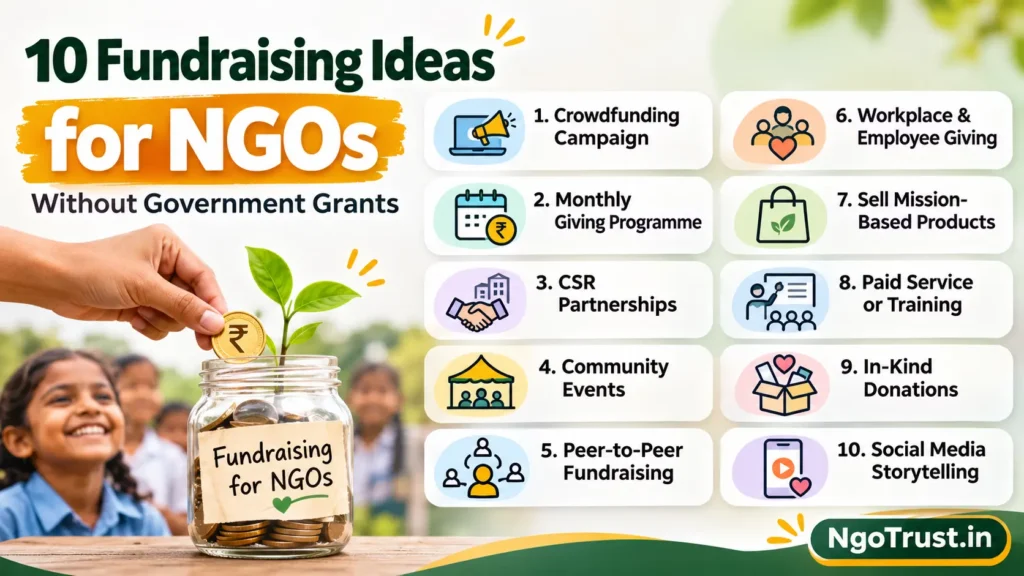
The best ideas are the ones that match your cause, your team size, and your supporters. Here are ten that work well for NGOs in India.
1. Run a Crowdfunding Campaign
Crowdfunding is the fastest way to reach many small donors at once. Platforms like Ketto and Milaap let you create a campaign page, share it online, and collect donations by UPI, card, or net banking.
A campaign works best when it has one clear goal, such as “Fund 50 school kits for girls in Gaya.” Add photos, a short video, and regular updates. People give when they can see exactly where their money goes.
2. Build a Monthly Giving Programme
A hundred people giving Rs 300 a month is more reliable than one big donation that never repeats. Monthly giving gives you predictable income, which makes planning much easier.
Offer a simple name for the programme, like “Friends of [Your NGO],” and tell members what their monthly amount achieves. Send a short update every month. Donors who feel informed rarely cancel.
3. Partner With Companies Through CSR
Under the Companies Act, 2013, eligible companies must spend a share of their profits on social causes. That money needs partners on the ground, and NGOs are the natural choice.
Start by approaching mid-size local companies, not only big names. Share a one-page project note with a clear budget and expected results. Keep in mind that your NGO needs a CSR-1 registration with the Ministry of Corporate Affairs before it can receive CSR funds.
4. Organise Community Events
A small event can raise both money and awareness. Think of a charity cricket match, a cultural evening, a book fair, or a food stall at a local mela.
Keep costs low. The goal is to raise more than you spend. Local shops often sponsor events in return for a banner or a mention, which covers your expenses before a single ticket is sold.
5. Launch Peer-to-Peer Fundraising
In this model, your supporters raise money from their own friends and family. A college student might run a birthday fundraiser. A runner might collect pledges for a marathon.
Give supporters a simple toolkit: a campaign link, a short story about your work, and a few sample messages. Their personal network trusts them far more than it trusts an unknown organisation.
6. Start Workplace and Employee Giving
Many companies are happy to let employees donate small amounts from their salary or run a giving drive during festivals. You do not need a huge corporate budget for this.
Reach out to the HR or admin team of a local firm. Offer a short presentation, a volunteering day, or an impact report. Employees who volunteer with you often become long-term donors.
7. Sell Products That Carry Your Mission
Merchandise can bring in steady funds while spreading your message. Handmade items made by the people you support work especially well, such as jute bags, candles, or embroidered goods.
This also creates livelihood for your beneficiaries, which strengthens your story. Be clear with buyers about how much of the sale supports your programmes.
8. Offer a Paid Service or Training
If your team has skills, turn them into a small income stream. An NGO working in education can run paid workshops. One focused on health can offer training to corporate staff.
The income goes back into your mission. Before you start, check with a professional on how such income is treated under your registration, so you stay compliant.
9. Collect In-Kind Donations
Not every donation needs to be money. Books, clothes, food grains, laptops, or free venue space all reduce your costs and free up cash for other needs.
Publish a simple wish list on your website and social media. Specific requests, like “20 used laptops for our computer class,” get a better response than a general appeal.
10. Use Social Media to Tell Real Stories
A good story can raise more than a polished brochure. Share short posts about one person, one family, or one small win. Keep the language plain and the photos honest (and always take consent).
Add a clear donation link to every post. Platforms like Instagram and WhatsApp work well in India because supporters can share your story in seconds.
What Should You Set Up Before You Start Fundraising?
Donors and companies will ask for proof that you are a legitimate organisation. Having your paperwork ready makes every idea above easier to execute.
Here are the basics:
- Legal registration: a trust, society, or Section 8 company
- 12A registration: exempts your income from tax
- 80G registration: lets donors claim a tax deduction on their gifts, which is a strong reason for people to give
- CSR-1 registration: required to receive CSR funds from companies
- FCRA registration: needed only if you plan to accept foreign donations
- NGO Darpan listing: a unique ID that adds credibility
- Clean accounts: audited statements and a dedicated bank account
Rules and procedures change from time to time, so check the latest requirements on the official portals before you apply.
How Do You Choose the Right Fundraising Idea?
Do not try all ten at once. Pick two or three that fit your team.
- If you have a small team, start with crowdfunding and monthly giving.
- If you have strong local connections, try events and CSR outreach.
- If you have skilled staff or beneficiaries, try products or paid training.
Track what works for three months, then drop what does not and put more effort into what does.
Frequently Asked Questions
Can an NGO survive without government grants?
Yes. Many NGOs run on individual donations, CSR funds, crowdfunding, events, and earned income. The safest approach is to use several sources together so that no single one controls your budget.
What is the easiest way for a small NGO to raise funds?
Crowdfunding and monthly giving are usually the easiest starting points. They need little investment, and you can launch them with a simple page and a clear story.
Do I need 80G registration to raise funds?
No, it is not legally required to collect donations. But 80G lets donors claim a tax deduction, so it makes people far more willing to give, especially businesses and higher-income individuals.
Can NGOs receive CSR funds from companies?
Yes, provided the NGO is registered and holds a valid CSR-1 registration. Companies usually also check your 12A and 80G status, your past work, and your financial records.
Can an NGO accept donations from other countries?
Only with FCRA registration. Without it, accepting foreign contributions can lead to serious penalties, so apply before you start any international fundraising.
How long does it take to build a steady donor base?
Expect three to twelve months of consistent effort. Regular updates, honest reporting, and quick thank-you messages are what turn first-time donors into long-term supporters.
Start Small, Stay Consistent
You do not need a large grant to do meaningful work. You need a clear cause, a few reliable funding streams, and records that show donors you can be trusted.
Pick one idea from this list and try it this month. Small steps add up faster than most people expect.
If the registrations or compliance side feels confusing, a short conversation with someone who handles NGO paperwork every day can save you months of trial and error. The team at ngotrust.in helps with NGO registration, 12A and 80G, CSR-1, and FCRA, and you are welcome to get in touch whenever you are ready.
Useful Links
- Ketto: https://www.ketto.org
- Milaap: https://milaap.org
- Ministry of Corporate Affairs (CSR information): https://www.mca.gov.in
- Income Tax Department of India (12A and 80G): https://www.incometax.gov.in
- FCRA online portal: https://fcraindia.nic.in
- NGO Darpan (NITI Aayog): https://ngodarpan.gov.in