
SAI NGO & BUSINESS CONSULTANCY
Expert services for NGO, Trust, Society Registration & Compliance across India.
Trademark registration is the process of legally recording your brand name, logo, tagline or other identifier with the government, so that only you can use it for your goods or services. In India, you file Form TM-A with the Trade Marks Registry, and a registered mark stays valid for 10 years and can be renewed again and again.
That one paragraph is the whole idea. The rest of this guide walks you through how it works, what it costs and where beginners usually slip up.
What Is a Trademark, Exactly?
A trademark is anything that tells customers who is behind a product or service. It can be:
- A brand name (like “Amul” or “Tata”)
- A logo or symbol
- A tagline or slogan
- A unique color combination, sound or packaging shape
Think of it as your brand’s identity card. When someone sees your name on a shop sign or a website, they should know it is really you and not a copycat.
In India, trademarks are governed by the Trade Marks Act, 1999 and the Trade Marks Rules, 2017. The Trade Marks Registry, which works under IP India, handles all applications.
Why Does Trademark Registration Matter for a New Business?
Many first-time founders believe that registering a company or buying a domain name already protects their brand. It does not. A company name only stops another company from registering the exact same name with the Registrar. It does not stop someone from using a similar name in the market.
Here is what trademark registration gives you:
- Exclusive rights. You can stop others from using an identical or confusingly similar mark for the same kind of business.
- Legal action. You can file an infringement suit. Without registration, you can only bring a weaker “passing off” claim, where you must prove your reputation first.
- The ® symbol. Once registered, you can legally use it next to your brand.
- A business asset. A registered trademark can be sold, licensed or franchised.
- Trust. Banks, investors and customers take a registered brand more seriously.
The best time to register a trademark is before you spend money on signboards, packaging and ads. Changing a brand name later costs far more than filing early.
Can Anyone Apply for Trademark Registration?
Yes. An individual, a proprietorship, a partnership firm, an LLP, a company, a trust or an NGO can all apply. Even if your business is not yet formally registered, you can file as an individual and mention that the mark is “proposed to be used.”
Foreign applicants can also file in India, but they must go through an Indian trademark agent or attorney who provides an address for service.
How to Register a Trademark in India: Step by Step
The trademark application process looks long on paper, but each step is simple once you know the order.
Step 1: Run a Trademark Search
Before you file anything, check whether someone already owns a similar mark. The Registry offers a free public search tool where you can look up words, logos and classes.
Search for more than your exact spelling. Try phonetic versions, spelling changes and translations. “Kwik Mart” and “Quick Mart” may look different, but the Registry can treat them as the same.
This single step prevents most rejections.
Step 2: Choose the Right Class
Trademarks are filed under 45 classes based on the Nice Classification. Classes 1 to 34 cover goods, and classes 35 to 45 cover services.
For example, a bakery would typically file under Class 30 (bakery products), while a software consultancy would look at Class 42. If your business covers more than one area, you may need more than one class.
Picking the wrong class is one of the most common beginner mistakes. Your protection only extends to the class you choose.
Step 3: Prepare Your Documents
The documents are light. You usually need:
- Applicant’s name, address and ID proof
- A clear image of the logo (if filing a logo mark)
- A description of the goods or services
- Date of first use, if the brand is already in the market
- Power of attorney, if an agent files on your behalf
- Startup or MSME certificate, if you want the reduced fee
Step 4: File Form TM-A
You file the application online through the IP India e-filing portal using Form TM-A. Once it is submitted, you get an application number right away. From that day, you can use the ™ symbol next to your brand.
Note that ™ is not the same as ®. The ™ symbol only says you claim the mark. The ® symbol is allowed only after the mark is actually registered. Using ® before registration is not permitted.
Step 5: Examination by the Registry
An examiner reviews your application and checks whether your mark is too similar to an existing one, too generic or descriptive, or otherwise against the law.
If there is an objection, you will receive an examination report. You get a chance to reply, usually within a month, and you may also be called for a hearing. Many applications get an objection at this stage, so do not panic if you receive one. A well-written reply often clears it.
Step 6: Publication in the Trade Marks Journal
Once the examiner is satisfied, your mark is published in the Trade Marks Journal. This is a public notice that says, “This brand is about to be registered. Does anyone object?”
Step 7: The Opposition Window
For four months after publication, any person can file an opposition against your mark. If nobody does, you move ahead. If someone does, both sides submit their evidence, and a hearing decides the outcome.
Step 8: Registration Certificate
If there is no opposition, or if you win it, the Registry issues your trademark registration certificate. Your mark is protected from the date you filed, for 10 years.
How Much Does Trademark Registration Cost in India?
The government fee for online trademark registration is ₹4,500 per class for individuals, startups and small enterprises, and ₹9,000 per class for all other applicants such as companies and LLPs.
Here is the simple breakdown for e-filing:
| Applicant type | Fee per class (online) | Fee per class (physical) |
| Individual, startup or small enterprise | ₹4,500 | ₹5,000 |
| Company, LLP and others | ₹9,000 | ₹10,000 |
A few things to keep in mind:
- The fee is charged per class and per mark. A name and a logo in two classes means four fees.
- Online filing is cheaper than paper filing.
- Renewal, due every 10 years, costs ₹9,000 per class when filed online.
- Professional charges are separate and vary from one service provider to another.
Fees can change, so confirm the current amount on the IP India portal before you pay.
How Long Does Trademark Registration Take?
If there are no objections and no opposition, the whole process usually takes around 6 to 12 months. If the Registry raises an objection or someone files an opposition, it can stretch to 18 months or more.
There is also an expedited route for applicants in a hurry, but it carries a much higher government fee, so most small businesses do not need it.
The good news is that you do not have to wait for registration to start using your brand. Use ™ from the filing date and keep building your business.
What Are the Most Common Trademark Registration Mistakes?
After seeing many applications, the same problems keep showing up:
- Skipping the search. People file first and discover a conflict months later.
- Choosing a descriptive name. A name like “Best Tasty Sweets” only describes the product. The Registry usually rejects such names because every sweet shop should be free to use those words.
- Wrong class selection. It leaves your actual business unprotected.
- Filing in the wrong name. If the owner of the brand and the applicant are different people, ownership issues can follow.
- Ignoring the examination report. Missing the reply deadline can lead to the application being treated as abandoned.
- Forgetting renewal. A registration lasts 10 years, then it has to be renewed. A late renewal costs more, and a missed one can remove your mark from the register.
Word Mark or Logo: Which Should You Register First?
A word mark protects the name itself, in any font or style. A logo mark protects only that particular design.
If your budget is tight, start with the word mark, because the name is what people search for and remember. Add the logo later when it is final. If you register the logo alone and then change the design, you may need to apply again.
Do You Need a Lawyer or Consultant for Trademark Registration?
The law does not require one. Many people file on their own, especially for simple, unique names.
Help becomes useful when:
- Your brand name is close to existing marks
- You are unsure about classes
- You received an examination report or an opposition notice
- You plan to build a larger brand, franchise or export business
A professional can read the Registry’s objections, draft replies and watch the application until the end. That saves time, and more importantly it saves you from a rejection that could have been avoided.
Trademark Registration FAQs
What is trademark registration?
Trademark registration is the legal process of recording your brand name, logo or slogan with the government so that you get exclusive rights to use it for specific goods or services.
How much does it cost to register a trademark in India?
The government fee is ₹4,500 per class for individuals, startups and small enterprises when filing online. For companies, LLPs and other applicants, it is ₹9,000 per class.
How long does trademark registration take in India?
It usually takes 6 to 12 months if there is no objection or opposition. Objections and oppositions can add several more months.
How long is a trademark valid?
A registered trademark is valid for 10 years from the date of application. You can renew it for further 10-year periods.
Can I use my brand name while the application is pending?
Yes. You can use the ™ symbol after filing. You can use ® only after the mark is registered.
Is company registration the same as trademark registration?
No. Company registration creates a legal entity. Trademark registration protects your brand name and logo in the market. You usually need both.
Can I register a trademark without a business?
Yes. You can file as an individual and apply on a “proposed to be used” basis.
What can be registered as a trademark?
Names, logos, slogans, letters, numerals, packaging shapes, color combinations and sounds can be registered if they are distinctive and not misleading.
What happens if someone opposes my trademark?
Both parties file their arguments and evidence, and the Registry holds a hearing. If you win, your mark proceeds to registration. If you lose, it is refused.
A Simple Way to Get Started
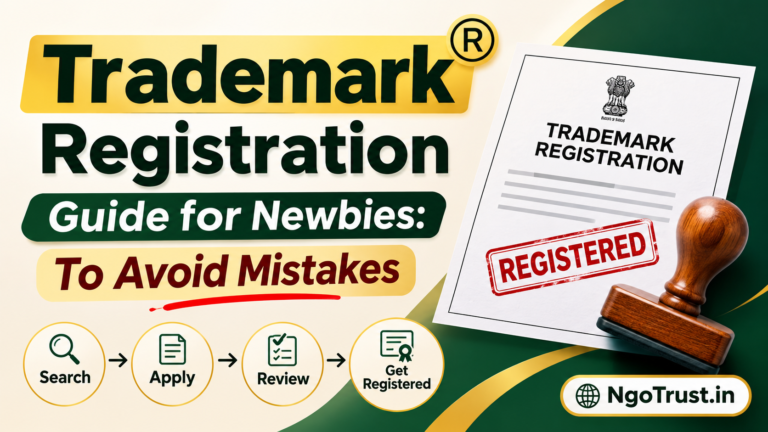
Trademark registration feels heavy only until you see the order of things: search, pick your class, file TM-A, answer any objection, wait out the opposition window, and collect your certificate. Do the search properly, choose your classes with care, and your chances improve a lot.
If you are still unsure about a name, a class or a reply to an examination report, a short chat with a professional can save months of back and forth. At ngotrust.in, we help founders, NGOs and small businesses with brand protection and registrations. If you would like a second pair of eyes on your trademark plan, you are welcome to reach out for a consultation whenever it suits you. No pressure, just clear answers.
Note: This guide is for general information and is not legal advice. Fees and procedures can change, so please check the official IP India website before filing.
Useful Links
- IP India (Trade Marks Registry): https://ipindia.gov.in
- Trademark Public Search: https://tmrsearch.ipindia.gov.in/tmrpublicsearch/
- Trademark E-Filing Portal: https://ipindiaonline.gov.in/trademarkefiling/
- Nice Classification (WIPO): https://www.wipo.int/classifications/nice/en/
- India Code (Trade Marks Act, 1999): https://www.indiacode.nic.in
- Startup India (DPIIT recognition): https://www.startupindia.gov.in
- NGO Trust: https://ngotrust.in