

SAI NGO & BUSINESS CONSULTANCY
Expert services for NGO, Trust, Society Registration & Compliance across India.
A public limited company (PLC) is a type of company that can offer its shares to the general public and is listed (or eligible to be listed) on a stock exchange. Unlike a private limited company, it must have at least 7 shareholders, a minimum paid-up capital, and is subject to stricter regulatory requirements under the Companies Act, 2013.
If you are running a private limited company and thinking about what comes next for your business growth, converting it into a public limited company may be the right move. This guide walks you through everything you need to know: what the conversion actually means, why businesses choose it, how it is done, and the mistakes that trip most people up.
What Does Converting from Private Limited to Public Limited Company Mean?
When you convert a private limited company to a public limited company, you are essentially changing the legal structure of your business under the Companies Act, 2013. This process is governed by Section 14 of the Companies Act, which deals with alteration of the Memorandum of Association (MOA) and Articles of Association (AOA).
A private limited company, by definition, restricts the right to transfer shares, limits the number of shareholders to 200, and cannot invite the public to subscribe to its shares. A public limited company removes all of these restrictions. The result: your business can raise capital from the public, attract institutional investors, and work toward a potential listing on stock exchanges like the BSE or NSE.
This is not just a paperwork change. It is a strategic business decision with real legal, financial, and operational consequences.
Who Should Consider This Conversion?
Not every private limited company needs to convert. But if any of the following describe your situation, it is worth taking seriously:
- Companies planning an IPO: If you are thinking about going public and listing your shares on a stock exchange, you must first be registered as a public limited company.
- Businesses needing large-scale capital: Startups and mid-size businesses that have outgrown angel and venture funding and want to raise money from the public market benefit greatly from this structure.
- Companies with more than 200 shareholders: Once a private limited company exceeds 200 members, it is legally required to convert to public limited status.
- Firms seeking better credibility: A public limited company often commands more trust from suppliers, banks, and enterprise clients than its private counterpart.
- Organizations planning ESOPs at scale: Offering stock options to a large number of employees becomes far easier under the public company framework.
Key Benefits of Converting a Private Limited Company to a Public Limited Company
Here is why thousands of growing businesses have made this transition:
- Access to Public Capital: The single biggest reason. A public limited company can raise funds by issuing shares to the general public through an IPO or Follow-on Public Offer (FPO). This dramatically increases your fundraising capacity.
- Higher Business Credibility: Public companies are subject to more transparency and regulatory oversight. Ironically, this can actually build more trust with partners, vendors, and customers.
- No Cap on Number of Members: Unlike a private limited company (capped at 200 members), a public limited company can have an unlimited number of shareholders.
- Easier Share Transfers: Shares of a public limited company are freely transferable. This makes it easier to bring in investors, reward employees, and facilitate exits.
- Stock Exchange Listing Eligibility: Only public limited companies can apply for listing on SEBI-regulated stock exchanges. This opens a world of liquidity and valuation opportunities.
- Institutional Investment Opportunities: Pension funds, insurance companies, and mutual funds often prefer or are required to invest only in listed public companies.
- Better Loan Terms: Public companies often receive better terms from banks and financial institutions because of their higher disclosure norms and perceived credibility.
Step-by-Step Process to Convert a Private Limited Company to a Public Limited Company
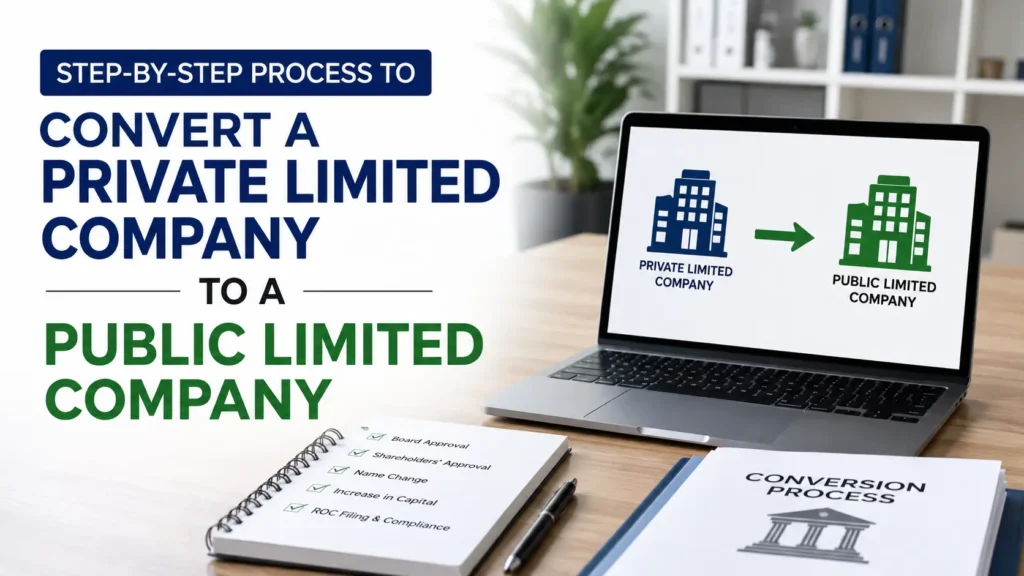
The conversion process involves several legal and procedural steps. Here is a clear breakdown:
| Step | Process | Details |
|---|---|---|
| Step 1 | Hold a Board Meeting | Pass a Board Resolution approving the conversion from private limited to public limited company. This resolution also authorizes alteration of the MOA and AOA. |
| Step 2 | Pass a Special Resolution at an EGM | Call an Extraordinary General Meeting (EGM). A special resolution (requiring at least 75% approval of shareholders) must be passed to alter the MOA and AOA. This removes the restrictive clauses that make the company ‘private.’ |
| Step 3 | File with the Registrar of Companies (ROC) |
Within 30 days of passing the special resolution, file the following with the Ministry of Corporate Affairs (MCA) portal:
|
| Step 4 | Obtain a Fresh Certificate of Incorporation | Once the ROC verifies and approves all filings, a fresh Certificate of Incorporation is issued. This new certificate reflects the company’s changed status from private to public limited. |
| Step 5 | Update All Legal Documents and Registers | Update the company name on letterheads, contracts, bank accounts, PAN, and all other legal records to include ‘Limited’ instead of ‘Private Limited.’ |
| Step 6 | Ensure Compliance with Public Company Requirements | After conversion, you must comply with additional requirements including minimum 7 shareholders, minimum 3 directors on the board, appointment of a company secretary if applicable, and enhanced financial disclosures. |
Important Note: The entire conversion process typically takes 4 to 8 weeks, depending on how quickly the ROC processes the filings. Timelines can vary based on your state and the current workload at the MCA.
Minimum Requirements After Converting to Public Limited
- Minimum shareholders: 7 (as opposed to 2 for a private limited company)
- Minimum directors: 3 (as opposed to 2 for a private limited company)
- Minimum paid-up capital: Rs. 5 lakh (note: for listing, SEBI has additional requirements)
- Company name: Must end with ‘Limited’ instead of ‘Private Limited’
- Annual compliance: Higher number of filings and disclosures required under the Companies Act, 2013
Common Mistakes to Avoid During the Conversion Process
Many companies run into avoidable problems. Here are the most common ones:
Not Updating the AOA Properly
The Articles of Association of a private limited company contain specific restrictive clauses. Many companies fail to remove all of them during the conversion, which can cause compliance issues later. Every single private-specific clause must be deleted or amended.
Missing the 30-Day Filing Deadline
Form MGT-14 must be filed within 30 days of the special resolution. Missing this deadline results in late fees and additional ROC scrutiny. Set a calendar reminder the day the EGM is held.
Not Meeting the Minimum Shareholder Requirement Before Filing
A public limited company must have at least 7 shareholders at the time of conversion. If your current shareholder count is below this, you must induct new members before initiating the process.
Forgetting to Update Contracts and Bank Accounts
Once you receive the new Certificate of Incorporation, your company’s legal name has changed. Failing to update this across all contracts, bank mandates, and government registrations can create legal complications.
Skipping Professional Legal Review
The altered MOA and AOA carry significant legal weight. Getting these documents drafted or reviewed by a qualified company secretary or corporate lawyer is not optional; it is necessary.
Expert Tips for a Smooth Private to Public Limited Conversion
- Start early with shareholder alignment: Make sure all existing shareholders understand and agree with the conversion. Disputes at the EGM stage can derail or delay the entire process.
- Run a pre-conversion compliance audit: Before initiating the conversion, check that all existing ROC filings (annual returns, financial statements) are up to date. Outstanding defaults can cause processing delays.
- Prepare your compliance calendar: Public limited companies have more ongoing compliance obligations. Start building your compliance calendar before the conversion is complete.
- Consult SEBI guidelines early if an IPO is your goal: If the reason you are converting is to eventually go public on a stock exchange, consult SEBI’s Issue of Capital and Disclosure Requirements (ICDR) Regulations early. The requirements go well beyond just the Companies Act, 2013.
- Use the MCA21 portal for all filings: All ROC filings for conversion must be done through the Ministry of Corporate Affairs’ MCA21 portal. Make sure your Digital Signature Certificate (DSC) is active and your Director Identification Numbers (DINs) are valid.
How Long Does the Conversion Take and What Does It Cost?
The typical timeline is 4 to 8 weeks from the board meeting to receiving the new Certificate of Incorporation. Costs include:
- Professional fees for a company secretary or legal advisor (varies widely based on firm)
- ROC filing fees (based on authorized capital of the company)
- Stamp duty on the altered MOA and AOA (varies by state)
- Miscellaneous administrative costs for updating records
For most small to mid-size companies, the total professional and filing costs typically fall between Rs. 15,000 and Rs. 50,000, though this can go higher for large companies with complex share structures.
Thinking about converting your private limited company to public limited? This is a process where getting the details right matters. A qualified company secretary or corporate law firm can save you weeks of delays and thousands in late fees. If you would like to understand whether conversion is the right move for your business, consider booking a free initial consultation with a compliance expert before taking the first step.
Frequently Asked Questions (FAQ)
What is the difference between a private limited and a public limited company?
A private limited company restricts share transfers, caps shareholders at 200, and cannot offer shares to the public. A public limited company has no such restrictions, can raise money from the public, and is eligible for stock exchange listing. The conversion from private limited to public limited company removes these restrictions and adds greater regulatory requirements.
Is it mandatory to list on a stock exchange after converting to a public limited company?
No. Converting to a public limited company does not mean your shares will automatically be listed on a stock exchange. Listing is a separate process governed by SEBI. Many public limited companies in India are unlisted. However, listing becomes possible only after you have completed the conversion.
How many members are required to convert a private limited company to a public limited company?
A minimum of 7 shareholders (members) is required for a public limited company. If your private limited company has fewer than 7 shareholders at the time of conversion, you will need to induct additional members before filing.
What documents are needed for conversion?
The key documents include: the altered Memorandum of Association (MOA), the altered Articles of Association (AOA), a copy of the special resolution passed at the EGM, the notice and minutes of the EGM, and the Board Resolution. These are filed via Form MGT-14 on the MCA21 portal.
Can a company with pending ROC filings apply for conversion?
Technically you can file for conversion even with pending defaults, but the ROC may delay processing or raise objections. It is strongly advisable to clear all outstanding annual return and financial statement filings before initiating the conversion process.
What happens to the existing contracts and agreements after conversion?
Existing contracts remain legally valid after conversion since the company’s legal identity (CIN) does not change. However, the company’s name changes from ‘XYZ Private Limited’ to ‘XYZ Limited,’ so all contracts, letterheads, bank accounts, and registrations should be updated to reflect the new name
Does the company need a minimum paid-up capital for conversion?
Under the Companies Act, 2013 as amended, the minimum paid-up capital requirement of Rs. 5 lakh for public limited companies was removed as a statutory requirement. However, if you plan to list on a stock exchange, SEBI’s ICDR Regulations impose separate minimum net worth and capital requirements.
Useful Links
The following resources were referenced in this post and may be helpful if you are starting the conversion process:
- Ministry of Corporate Affairs (MCA21 Portal): https://www.mca.gov.in
- Companies Act, 2013 (Full Text): https://www.mca.gov.in/content/mca/global/en/acts-rules/ebooks/acts.html
- SEBI ICDR Regulations: https://www.sebi.gov.in/legal/regulations/oct-2018/sebi-issue-of-capital-and-disclosure-requirements-regulations-2018_40328.html
- BSE (Bombay Stock Exchange) Listing Requirements: https://www.bseindia.com
- NSE (National Stock Exchange) Listing Requirements: https://www.nseindia.com
- Institute of Company Secretaries of India (ICSI): https://www.icsi.edu