
SAI NGO & BUSINESS CONSULTANCY
Expert services for NGO, Trust, Society Registration & Compliance across India.
FCRA registration refers to the process by which a nonprofit organisation in India obtains a certificate under the Foreign Contribution (Regulation) Act, 2010, from the Ministry of Home Affairs. This certificate legally permits NGOs, trusts, and societies to receive donations, grants, and contributions from foreign sources.
If your nonprofit works in education, health, environment, or social welfare, there will come a moment when a foreign donor, international foundation, or overseas grant programme expresses interest in supporting your work. That is a big opportunity. But without FCRA registration, you legally cannot accept that money.
This guide covers everything a nonprofit needs to understand about FCRA registration, its real-world benefits, and why getting registered sooner rather than later is a smart move for any serious NGO in India.
What Is FCRA Registration and Who Needs It?
FCRA stands for Foreign Contribution (Regulation) Act. The Foreign Contribution (Regulation) Act, 2010 is a central legislation administered by the Ministry of Home Affairs (MHA). It regulates how organisations in India receive and use foreign contributions.
Any organisation that wants to accept foreign funding must first apply for and receive FCRA registration. This applies to:
- Registered societies under the Societies Registration Act
- Trusts under various state trust acts
- Section 8 Companies under the Companies Act, 2013
- Religious and cultural organisations receiving international donations
- Educational institutions or research bodies with foreign collaborators
Without this registration, receiving even a single foreign donation is a punishable offence under Indian law.
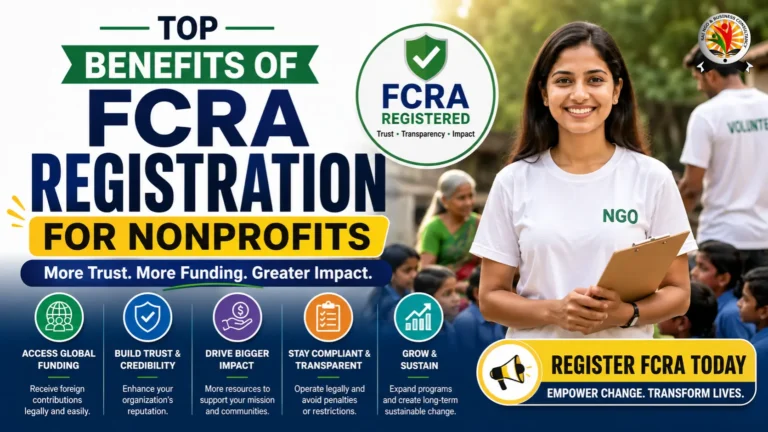
Key Benefits of FCRA Registration for Nonprofits
1. Legal Permission to Receive Foreign Donations
The most direct and important benefit of FCRA registration is that it gives your organisation the legal right to accept contributions from foreign individuals, organisations, governments, and foundations.
Without this certificate, even well-intentioned donations from an overseas Indian or a foreign charity trust can land your organisation in serious legal trouble. FCRA registration removes that risk entirely and puts your NGO on the right side of the law.
2. Access to International Grants and Funding
Many reputed international grant-making bodies, including the Bill & Melinda Gates Foundation, USAID, and several European aid agencies, require their Indian partners to hold a valid FCRA registration before disbursing funds.
With FCRA registration, your nonprofit becomes eligible to apply for:
- International foundation grants
- Foreign government aid programmes
- CSR funds from multinational companies routed through foreign entities
- Diaspora fundraising from Indians living abroad
This dramatically expands your funding options beyond domestic donors and government schemes.
3. Builds Credibility and Trust with Donors
FCRA registration signals to both Indian and international donors that your organisation has passed a thorough vetting process by the Government of India. It tells the world that your NGO is not only legitimate but also compliant, transparent, and trustworthy.
For international donors especially, FCRA registration is often a non-negotiable prerequisite. Many foreign donors will not even begin a conversation with an NGO that does not hold this certificate.
4. Transparent Financial Management
One underrated benefit of FCRA registration is that it encourages, and in fact mandates, strong financial practices. Registered organisations must:
- Maintain a separate FCRA-designated bank account (currently only with State Bank of India, New Delhi Main Branch, as per current MHA rules)
- File annual returns (FC-4 form) with the Ministry of Home Affairs
- Clearly separate foreign funds from domestic funds in their accounts
- Submit audited financial statements
These requirements push nonprofits to build better accounting systems, which strengthens the organisation overall and makes it more accountable to its donors and beneficiaries.
5. Boosts Organisational Reputation
Being listed in the MHA FCRA database is a mark of distinction. Potential partner organisations, government bodies, and academic institutions often search this database before entering into formal partnerships with NGOs.
An FCRA-registered nonprofit stands apart from thousands of unregistered organisations. It sends a clear signal: this organisation is serious, accountable, and committed to operating within the law.
6. Programme Expansion and Scale
Foreign funding often comes in significantly larger amounts than domestic small-donor contributions. FCRA registration enables nonprofits to take on larger, multi-year projects that require consistent and substantial funding.
This creates a pathway for organisations to move from small community-level interventions to programmes with regional or national impact, something that is nearly impossible to achieve on domestic donations alone.
7. Strengthens Long-Term Sustainability
Nonprofits that depend on a single funding source are always vulnerable. FCRA registration allows organisations to diversify their funding base by adding foreign donations to the mix.
This diversification protects your nonprofit from the risk of a funding gap if one domestic source dries up. A mix of local and international funding is one of the healthiest financial positions an NGO can be in.
Who Is Eligible to Apply for FCRA Registration?
To apply for FCRA registration, a nonprofit must:
- Be registered for at least three years (for regular registration; prior permission is available for newer organisations)
- Have spent at least Rs. 15 lakhs on its core objectives in the last three years (for regular registration)
- Have a genuine charitable, religious, educational, economic, or cultural purpose
- Not be on any government watch or blacklist
- Have a clean track record with no known violations of Indian law
Newer organisations that do not yet meet the three-year requirement can apply for Prior Permission under FCRA, which allows them to receive foreign contributions for a specific project from a specific foreign donor.
How to Apply for FCRA Registration: A Simple Overview
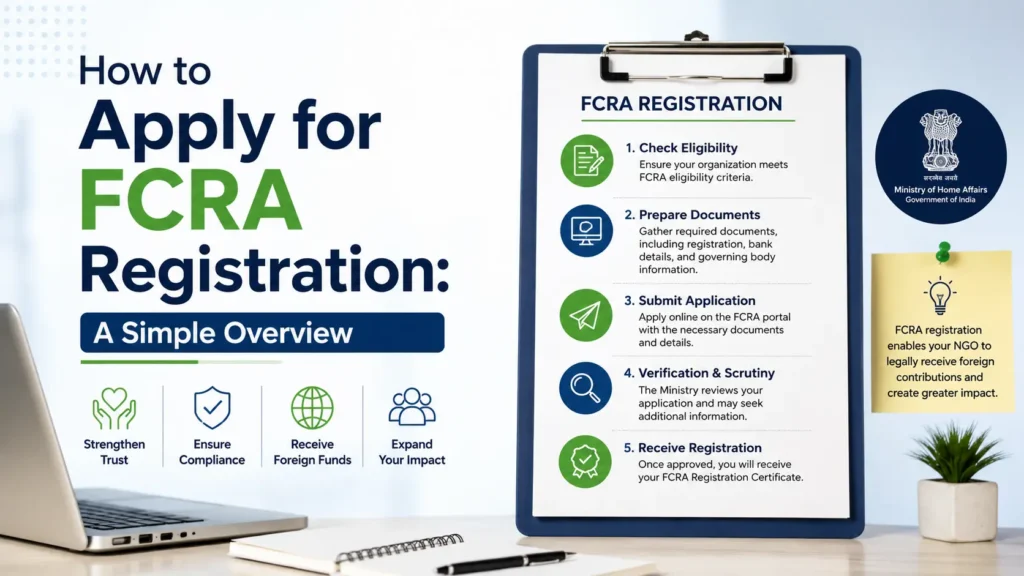
The application process is fully online through the FCRA Online Portal. Here is a simplified view of the steps involved:
- Register your organisation on the FCRA portal
- Fill Form FC-3A (for regular registration) or FC-3B (for prior permission)
- Upload required documents: registration certificate, PAN card, audited accounts, activity reports, etc.
- Pay the applicable government fee online
- Open a designated FCRA bank account with SBI New Delhi Main Branch
- Submit and await MHA review (usually takes 90 days or more)
While the process is online, the documentation and compliance requirements can be complex. Many nonprofits find it helpful to work with a legal or compliance consultant who specialises in NGO law to avoid delays or rejections.
FCRA Registration Renewal: What Nonprofits Should Know
FCRA registration is not a one-time process. Registered organisations must apply for renewal every five years using Form FC-3C, at least six months before the expiry date.
Failure to renew on time means your registration lapses, and your organisation loses the ability to receive foreign contributions until renewal is granted. Timely renewal, along with consistent annual return filings, is essential to maintaining uninterrupted FCRA compliance.
Common Mistakes Nonprofits Make With FCRA Compliance
Even well-meaning organisations sometimes fall into compliance traps. The most frequent mistakes include:
- Missing the annual FC-4 return deadline (31st December each year)
- Using FCRA funds for purposes not covered under the stated objectives
- Not maintaining a separate designated bank account for foreign contributions
- Failing to report changes in key functionaries, address, or bank details to MHA
- Accepting foreign funds in a non-FCRA account, which is a direct violation
These mistakes can result in suspension or cancellation of FCRA registration, which can severely damage an organisation’s reputation and ability to function.
Frequently Asked Questions (FAQs) About FCRA Registration
What is the main benefit of FCRA registration for NGOs?
The primary benefit of FCRA registration is that it legally allows NGOs and nonprofits to receive donations and grants from foreign sources, including individuals, foundations, and foreign governments. Without it, accepting any foreign contribution is a criminal offence under Indian law.
Is FCRA registration mandatory for all nonprofits?
No, FCRA registration is mandatory only for nonprofits that wish to receive foreign contributions. If your organisation only accepts domestic donations, FCRA registration is not required. However, if any portion of your funding comes from a foreign source, registration is compulsory.
How long does it take to get FCRA registration approved?
The Ministry of Home Affairs typically takes around 90 days to process applications, though timelines can vary. Incomplete applications or missing documents can cause significant delays. Some organisations report waiting six months or more for approval.
What happens if an NGO accepts foreign donations without FCRA registration?
Accepting foreign contributions without FCRA registration is a punishable offence under the Foreign Contribution (Regulation) Act, 2010. Penalties can include cancellation of the organisation’s registration, forfeiture of the contribution received, and in serious cases, criminal prosecution.
Can a new NGO apply for FCRA registration?
A newly registered NGO (less than three years old) cannot apply for regular FCRA registration. However, it can apply for Prior Permission under FCRA, which allows it to receive foreign funding from a specific donor for a specific project. Once the organisation completes three years and meets the financial threshold, it can apply for full registration.
Where can I check if an NGO has FCRA registration?
You can verify any organisation’s FCRA registration status on the official FCRA Online Portal maintained by the Ministry of Home Affairs. The database is publicly searchable.
What is the difference between FCRA registration and FCRA prior permission?
FCRA registration is a general, ongoing approval that allows an organisation to receive foreign contributions from any approved foreign source. Prior permission, on the other hand, is granted for a specific foreign donor and a specific project, and is typically available to newer organisations that do not yet qualify for full registration.
Thinking About FCRA Registration? A Quick Word Before You Start
FCRA registration is one of those things where getting it right the first time matters a lot. A rejected application can delay your funding plans by months. Incomplete or incorrect filings can lead to compliance issues down the line.
If you are working through the process for the first time, or if your organisation’s registration is due for renewal, speaking with a qualified NGO compliance professional can save you a significant amount of time, stress, and potential legal risk.
Most organisations find that a single consultation helps them understand exactly where they stand, what documents they need, and what to expect from the process. It is often the most practical first step.
Useful Links
The following official and authoritative resources were referenced in this article:
- FCRA Online Portal (Ministry of Home Affairs): https://fcraonline.nic.in/
- MHA FCRA NGO Database (Verify Registration): https://fcraonline.nic.in/fc_report.aspx
- Ministry of Home Affairs, India: https://mha.gov.in/
- Bill & Melinda Gates Foundation (example of international funder): https://www.gatesfoundation.org/