
SAI NGO & BUSINESS CONSULTANCY
Expert services for NGO, Trust, Society Registration & Compliance across India.
Quick definition: NGO skills are the practical abilities that people working in a non-governmental organisation need to run programmes, manage funds, follow the law, and earn the trust of communities, donors, and regulators.
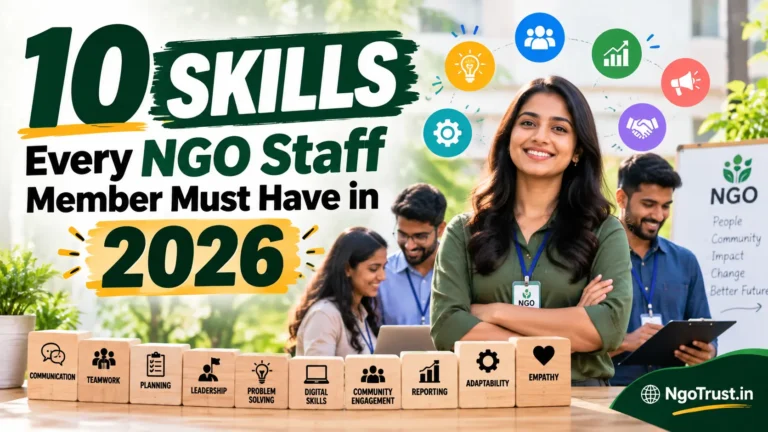
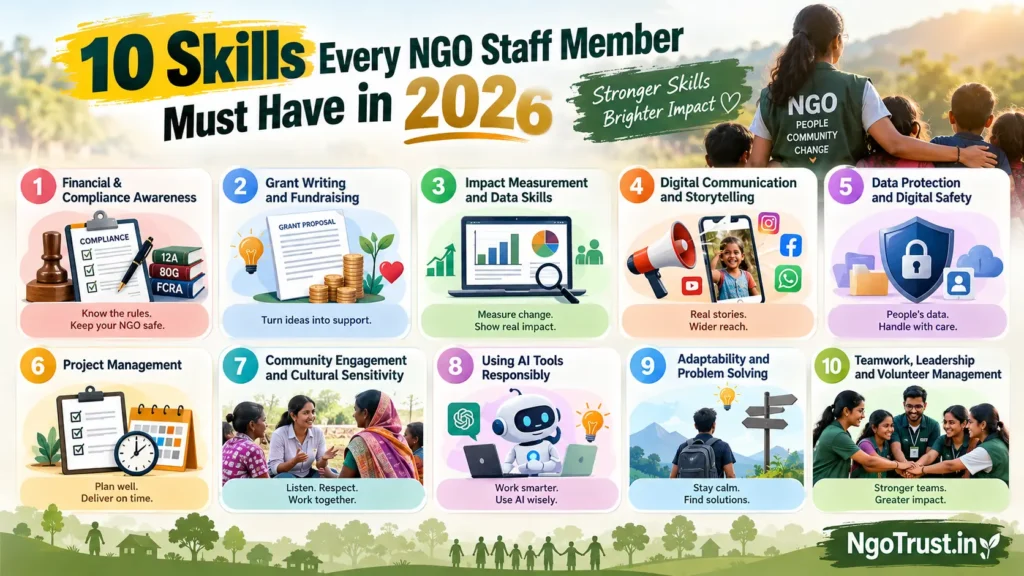
The most important skills for NGO staff in 2026 are financial and legal compliance awareness, grant writing, impact measurement, digital communication, data protection, project management, community engagement, responsible use of AI tools, adaptability, and strong teamwork. Together, these skills help an NGO win funding, stay compliant, and deliver real change.
A few years ago, a passion for social work was often enough to get started in the sector. That is no longer the case. Donors ask for data. Regulators ask for paperwork. Communities ask for results they can see.
If you work in an NGO, or plan to, the skills below will decide how far you can take your work in 2026 and beyond. Some are technical. Some are about people. All of them can be learned.
Why Do NGO Staff Need New Skills in 2026?
NGOs now work in a more demanding environment than ever before. Funders want clear proof of impact. The government expects timely filings and clean records. Supporters expect updates on social media, not just an annual report.
At the same time, tools are changing fast. Spreadsheets have given way to dashboards. Donor outreach happens on WhatsApp and email. Even a small trust in a small town may now be asked to explain how it stores beneficiary data.
Staff who can handle this mix of heart and skill become the people an organisation cannot do without.
1. Financial and Compliance Awareness
Do NGO staff need to understand compliance? Yes. Even if you are not the accountant, you should know the basics of the rules your organisation lives under.
In India, that usually means understanding:
- Registration as a trust, society, or Section 8 company
- Tax exemption under Section 12A and donor tax benefits under Section 80G
- FCRA rules, if your NGO receives foreign contributions
- Annual filings and audit requirements
A missed deadline or a wrongly filed return can put your registration at risk. Staff who spot problems early save the organisation from stress later. You can check an organisation’s listing status on the government’s NGO Darpan portal, and foreign contribution rules are published on the FCRA online portal.
2. Grant Writing and Fundraising
Money keeps programmes running, and someone has to ask for it well.
Good grant writing is not about fancy words. It is about showing a clear problem, a realistic plan, a fair budget, and a way to measure results. Funders read hundreds of proposals. The ones that stand out are simple and honest.
Fundraising also goes beyond grants now. Many NGOs raise money through individual donors, crowdfunding, and CSR partnerships. If your organisation wants to work with companies, it helps to understand how the government’s CSR portal works, and that NGOs must register with the Ministry of Corporate Affairs through Form CSR-1 before they can receive CSR funds.
3. Impact Measurement and Data Skills
What is impact measurement in an NGO? It is the process of tracking whether your work is actually changing lives, using clear indicators instead of guesses.
Saying “we trained 500 women” is an output. Saying “310 of them started earning within six months” is an outcome. Funders care far more about the second.
Staff do not need to be data scientists. But they should be comfortable with:
- Setting simple, measurable goals at the start of a project
- Collecting data in a clean, consistent way
- Reading basic charts and spreadsheets
- Reporting numbers honestly, including the ones that did not go well
This skill, often called monitoring and evaluation (M&E), is now one of the most in-demand abilities in the sector.
4. Digital Communication and Storytelling
People give to people, not to reports. A strong story about one child, one farmer, or one village can do more than ten pages of statistics.
In 2026, every NGO staff member should be able to explain their work in plain language, whether on a website, an Instagram post, a newsletter, or a WhatsApp update. Short videos and clear photos help, but only when you have the consent of the people shown.
A good rule is to write as if you are telling the story to a friend who knows nothing about your work. If they understand it and care, you are on the right track.
5. Data Protection and Digital Safety
NGOs collect sensitive information: names, phone numbers, addresses, health details, and sometimes children’s records. Losing or misusing this data can hurt people and damage trust overnight.
India’s Digital Personal Data Protection Act, 2023 sets rules for how personal data should be handled. Staff should know the basics:
- Collect only the data you truly need
- Get clear consent before using someone’s information or photo
- Store files securely and use strong passwords
- Never share beneficiary details on open WhatsApp groups
These habits are simple, and they protect both the community and the organisation.
6. Project Management
What does project management mean for NGO staff? It means planning a programme from start to finish, so that time, money, and people are used well and nothing important is missed.
Many NGO projects slip because nobody tracked the timeline, or because the budget ran out before the final month. Staff who can build a basic workplan, assign tasks, and review progress every week are valuable at any level.
Tools like Trello, Asana, or even a well-kept spreadsheet are enough. The skill is in the habit, not the software.
7. Community Engagement and Cultural Sensitivity
No programme succeeds if the community does not trust it. This is the oldest skill in the sector and still the most important.
Good community engagement means listening first. It means asking people what they need instead of assuming. It means respecting local customs, languages, and decision makers, and being patient when change takes time.
Staff who build real relationships on the ground often catch problems long before a report would. They also bring back the ideas that make a programme better.
8. Using AI Tools Responsibly
AI tools can now draft emails, summarise reports, clean up data, and translate content in minutes. For small NGO teams with limited time, that is a real help.
But there are limits. AI can make up facts, and it should never be given private beneficiary data. Every piece of AI-written content needs a human check before it goes out under your organisation’s name.
The skill to build here is judgement. Know what to hand to a tool, what to review closely, and what to keep human.
9. Adaptability and Problem Solving
Funding gets delayed. A policy changes. A monsoon floods the project site. Plans change, and staff need to change with them.
Adaptable people stay calm, look at the options, and make a decision instead of waiting for instructions. They also learn from what went wrong and share it with the team, so the same mistake does not repeat.
This is hard to teach in a classroom, but it grows with practice. Taking on small problems and solving them is the best training.
10. Teamwork, Leadership, and Volunteer Management
Most NGOs run on small teams and many volunteers. Getting people to work well together is a skill on its own.
This includes giving clear instructions, saying thank you, handling disagreements fairly, and helping volunteers feel that their time matters. You do not need a senior title to show leadership. Anyone who takes responsibility, supports others, and keeps the mission in focus is leading.
Strong teams also keep their people longer, which saves the time and cost of hiring again and again.
How Can You Build These NGO Skills Step by Step?
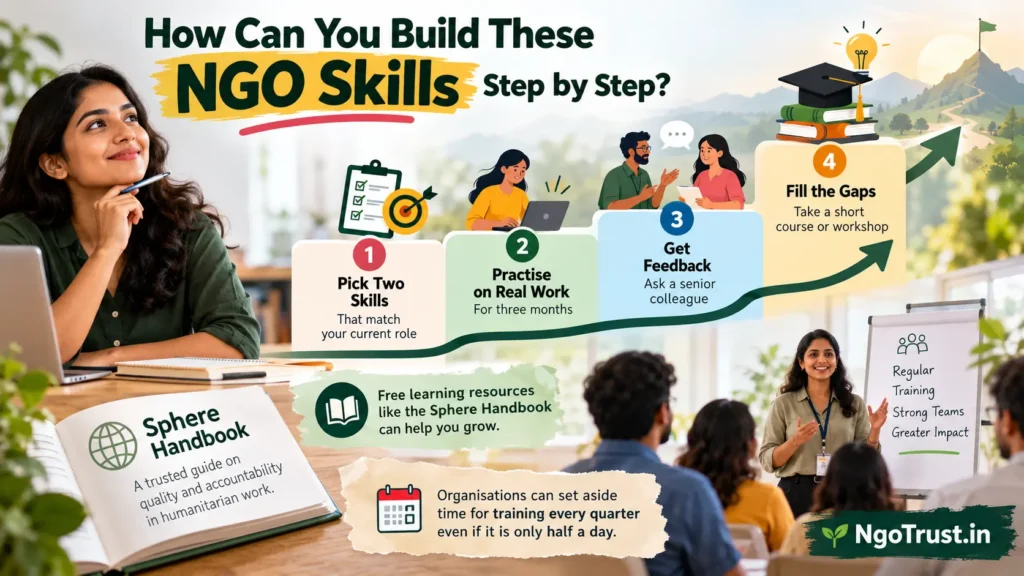
You do not need to master all ten at once. A simple approach works better:
- Pick two skills that match your current role
- Practise them on real work for three months
- Ask a senior colleague for honest feedback
- Take a short course or workshop to fill the gaps
Free learning material is widely available. For example, the Sphere Handbook is a respected guide on quality and accountability in humanitarian work, and it is a good reading habit for anyone in programme roles.
Organisations can also help their teams by setting aside time for training every quarter, even if it is only half a day.
When Should an NGO Ask for Professional Help?
Some of these skills, especially compliance, registration, and tax matters, are areas where a small mistake can be expensive. If your team is unsure about FCRA, 12A and 80G, annual filings, or setting up a new trust or society, speaking with a professional early is usually cheaper than fixing problems later.
If your NGO is stuck on any of this, the team at NGO Trust works with trusts, societies, and Section 8 companies on registration and compliance. You are welcome to reach out for a simple, no-pressure conversation about where you stand.
Frequently Asked Questions
What skills are most in demand for NGO jobs in India?
Grant writing, impact measurement, compliance knowledge, digital communication, and project management are among the most in-demand skills. Candidates who combine field experience with basic data and reporting skills usually stand out.
Do I need a degree in social work to work in an NGO?
No. Many NGO staff come from law, management, education, health, and technology backgrounds. Practical skills and a genuine commitment to the cause often matter more than the degree.
What is the most important skill for an NGO manager?
The ability to balance people, money, and compliance. A manager who can lead a team, read a budget, and understand the legal requirements keeps the organisation steady.
Is FCRA knowledge necessary for all NGO staff?
Only NGOs that receive foreign contributions must follow FCRA rules. Even so, programme and finance staff in such organisations should know the basics, since mistakes can lead to penalties or cancellation of registration.
How can small NGOs train staff on a low budget?
Use free online courses, government portals, peer learning sessions, and short internal workshops. Pairing newer staff with experienced colleagues also builds skills at almost no cost.
Can AI replace NGO staff?
No. AI can speed up writing and data tasks, but trust, empathy, and community relationships are human work. The best teams use AI as a helper and keep people in charge of decisions.
Where to Go From Here
The NGO sector in 2026 rewards people who care deeply and work carefully. You do not have to be perfect at all ten skills. Start with the ones your role needs most, keep improving, and ask for help when a topic is outside your reach.
If you are setting up a new organisation, or trying to fix gaps in an existing one, feel free to get in touch with the team at ngotrust.in. A short chat can save your team a lot of time.
Useful Links
- NGO Darpan (NITI Aayog): https://ngodarpan.gov.in
- FCRA Online Portal (Ministry of Home Affairs): https://fcraonline.nic.in
- National CSR Portal (Ministry of Corporate Affairs): https://www.csr.gov.in
- Ministry of Electronics and Information Technology (DPDP Act): https://www.meity.gov.in
- Sphere Handbook: https://spherestandards.org/handbook/
- NGO Trust: https://ngotrust.in