
SAI NGO & BUSINESS CONSULTANCY
Expert services for NGO, Trust, Society Registration & Compliance across India.
A volunteer training program for an NGO is a planned set of sessions, materials, and practice tasks that prepares volunteers to understand the mission, follow the rules, and do their assigned work safely and well.
To organize a successful volunteer training program for NGO teams, follow this order: define what each volunteer role needs, build a short onboarding plan, teach through real examples and practice, pair every new volunteer with a mentor, and collect feedback to improve the next batch. The sections below explain each step in plain language.
Most NGOs do not struggle to find volunteers. They struggle to keep them. A person walks in full of energy, gets a quick talk, is handed a task nobody explained properly, and quietly stops showing up two weeks later. Good training fixes this.
Why Does an NGO Volunteer Training Program Matter?
Volunteers give you time, and time is the one thing they cannot get back. If you waste it, they leave. If you respect it with a clear plan, they stay, work better, and often bring friends.
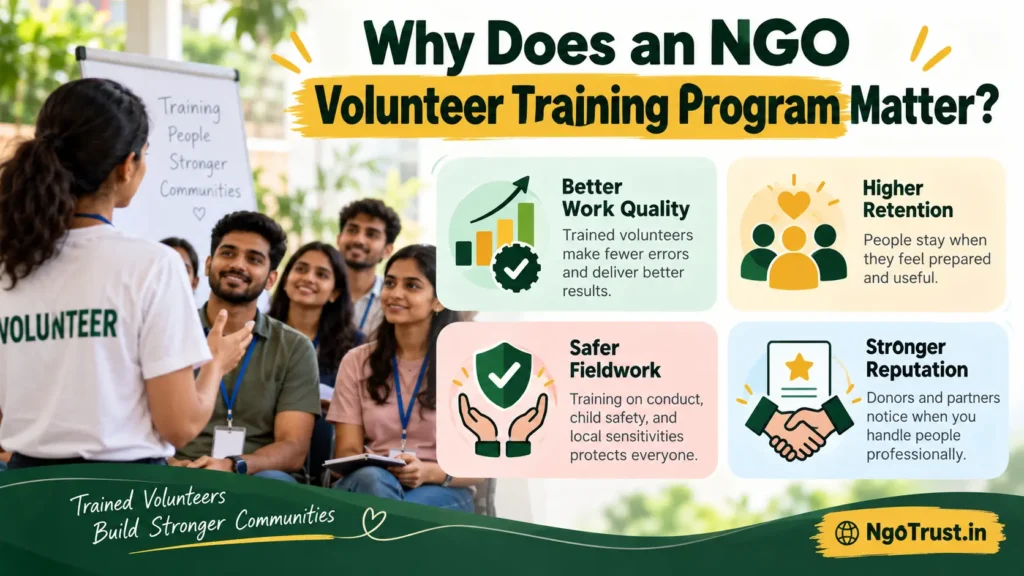
A well-run volunteer training program for an NGO helps in four practical ways:
- Better work quality. Volunteers who know the process make fewer errors in surveys, events, data entry, or field visits.
- Higher retention. People stay when they feel prepared and useful.
- Safer fieldwork. Training on conduct, child safety, and local sensitivities protects beneficiaries and your team.
- Stronger reputation. Donors and partners notice when an organization handles people professionally.
How Do You Organize a Volunteer Training Program Step by Step?
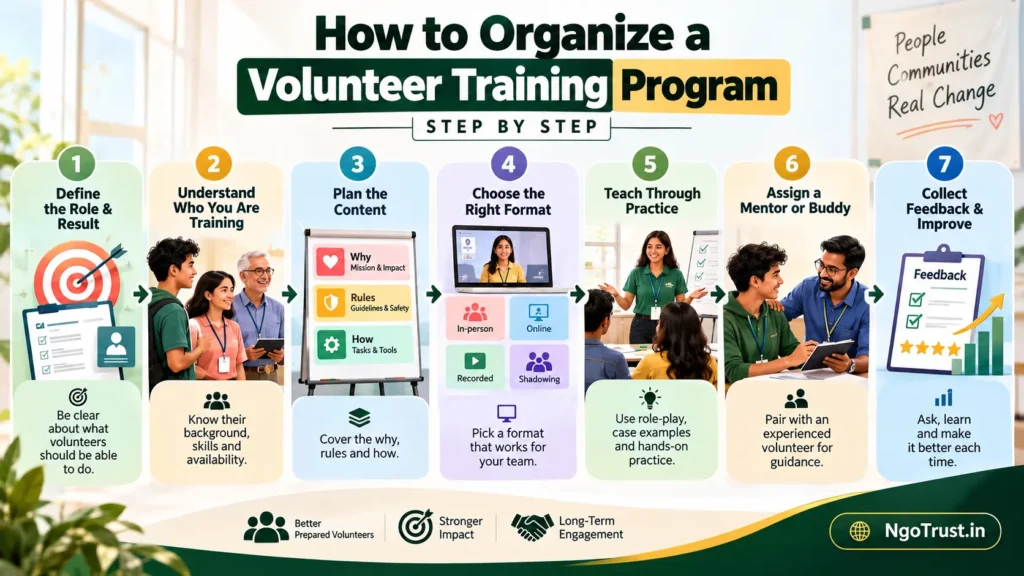
You do not need a big budget. You need a clear sequence. Here is one that works for small and mid-sized NGOs.
Step 1: Define the Role and the Result
Start with the task, not the training. Ask what a volunteer in this role must be able to do after two weeks. Write it in one sentence per role.
For example:
- A field volunteer should be able to run a 30-minute awareness session in a village using your flipchart.
- A digital volunteer should be able to update beneficiary records in your sheet without breaking formulas.
If you cannot describe the result, you are not ready to train anyone yet.
Step 2: Understand Who You Are Training
A college student, a retired teacher, and a corporate employee on a weekend visit need different things. Before the session, send a short form asking about their skills, available hours, language comfort, and why they want to volunteer.
This takes ten minutes to read and saves hours of confusion. It also tells you where to place each person.
Step 3: Plan the Content Around Three Layers
Keep the content simple. Every NGO volunteer training should cover three layers:
- The why. Your mission, your story, the communities you serve, and what changed because of your work.
- The rules. Code of conduct, attendance expectations, confidentiality, photo and data consent, and what to do in an emergency.
- The how. The exact tasks, tools, and steps for the volunteer’s role.
Many NGOs spend all their time on layer three and skip layer one. Yet the mission is what keeps people motivated when the work gets tiring.
Step 4: Choose a Format That Fits Your Reality
There is no single correct format. Pick what your team can actually deliver well.
- In-person orientation works best for field roles and for building team spirit.
- Short online sessions suit remote or part-time volunteers. Keep them under 45 minutes.
- Recorded videos and a one-page guide let volunteers revisit instructions anytime.
- Shadowing lets a new volunteer watch an experienced one for a day before working alone.
Most NGOs get the best results by mixing two or three of these.
Step 5: Teach Through Practice, Not Slides
Adults remember what they do. So cut the lecture and add role-play, case examples, and small supervised tasks.
If volunteers will talk to families during home visits, let them practice the conversation with a trainer first. If they will handle donations, have them fill a sample receipt. Mistakes made in a training room cost nothing. Mistakes made in the field can cost trust.
A simple one-day agenda could look like this:
- Welcome and mission story (30 minutes)
- Code of conduct and safety (45 minutes)
- Role-specific skills with hands-on practice (2 hours)
- Q&A and common situations (45 minutes)
- Task assignment and mentor introduction (30 minutes)
Step 6: Assign a Mentor or Buddy
Training does not end when the session does. The first few weeks decide whether a volunteer stays.
Pair each new person with an experienced volunteer or staff member. The mentor answers small questions that nobody wants to ask in a group, checks in after the first task, and flags problems early. A quick weekly message is often enough.
Step 7: Collect Feedback and Improve
After each batch, ask three questions: What was useful? What was confusing? What do you wish we had told you earlier?
A simple Google Form works fine. Review the answers with your team, change one or two things, and run the next batch. Over a few cycles, your program becomes sharp without ever needing a complete rewrite.
What Should an NGO Volunteer Training Include?
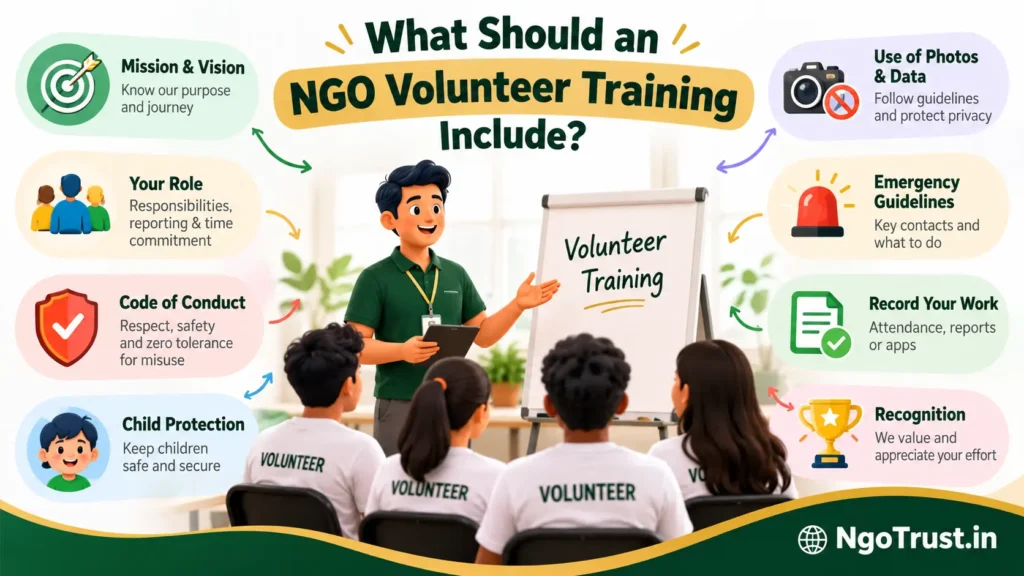
At minimum, include these items in your volunteer orientation:
- Your mission, vision, and a short history of the organization
- The volunteer’s role, reporting person, and weekly time commitment
- Code of conduct and zero-tolerance rules on harassment or misuse of funds
- Child protection and safeguarding basics, where relevant
- Rules on photos, videos, and sharing beneficiary data
- Emergency contacts and what to do when something goes wrong
- How to record work, such as attendance sheets, reports, or apps
- Recognition: how you will thank and acknowledge their effort
Put this in a short handbook of five to eight pages. Volunteers will read it if it is brief and written in simple language.
What Mistakes Should NGOs Avoid When Training Volunteers?
These are the problems we see most often:
- Training everyone the same way. A data volunteer and a field volunteer need different sessions.
- Giving too much information at once. Spread learning across the first two weeks instead of one long day.
- Skipping expectations. Be honest about hours, tasks, and the emotional weight of the work.
- Ignoring legal and safety basics. Informal teams often forget consent forms, insurance questions, or reporting rules.
- No follow-up. A volunteer who never hears from you after orientation will drift away.
- No thanks. A simple certificate, a message from the founder, or a mention at a team meeting goes a long way.
How Do You Know If Your Volunteer Training Is Working?
You do not need complicated dashboards. Track a few numbers every quarter:
- Retention rate: how many volunteers are still active after 30 and 90 days
- Task completion: how many assigned tasks are done correctly and on time
- Volunteer satisfaction: the average score from your feedback form
- Incident reports: whether safety or conduct issues are going down
If retention is weak, look at your follow-up and mentoring. If task quality is weak, look at the practice portion of your training.
Do Indian NGOs Need to Think About Compliance in Volunteer Programs?
Yes. Volunteer training is also a good moment to reinforce how your organization operates as a registered entity. Volunteers often represent you in public, so they should know your registered name, your activities, and what they can and cannot say or collect on your behalf.
If your NGO is registered, make sure its profile is current on the government’s NGO Darpan portal, since donors and partners often check it. Also keep your records, receipts, and consent forms organized. Clear paperwork protects both the NGO and the volunteer.
For global good practice, you can look at the volunteer management resources from Points of Light and the guidance on volunteering from United Nations Volunteers.
When Should an NGO Get Professional Help?
Many NGOs build their first training program alone, and that is perfectly fine. But outside help is worth considering when:
- You are scaling from a handful of volunteers to dozens
- You work with children, women in vulnerable situations, or sensitive data
- Your registration, compliance, or reporting is not in order
- Donors or CSR partners have asked for formal policies and documents
An experienced consultant can help you draft a volunteer policy, set up your records, and make sure your NGO’s legal foundation is solid before you grow.
Frequently Asked Questions
What is the first step in creating a volunteer training program for an NGO?
The first step is to define each volunteer role and the result you expect from it. Once the role is clear, you can decide what to teach, how long it should take, and who should teach it.
How long should NGO volunteer training take?
For most roles, a half-day or one-day orientation followed by two weeks of mentoring is enough. Technical or sensitive roles, such as counseling support or child-focused work, may need more time.
Can small NGOs run volunteer training on a low budget?
Yes. Use free tools like Google Meet, Google Forms, and shared documents. Ask your experienced volunteers to train new ones. A printed one-page guide and a mentor system cost very little and work well.
What is the difference between volunteer orientation and volunteer training?
Orientation introduces the NGO, its mission, and its rules. Training teaches the specific skills a volunteer needs for their task. Good programs include both.
How do you keep volunteers motivated after training?
Give them meaningful tasks, check in regularly, share the impact of their work, and thank them in public and in private. Volunteers stay when they feel seen and useful.
Do NGO volunteers need to sign any documents?
It is a good practice. A short volunteer agreement covering conduct, confidentiality, and consent for photos or data protects everyone. For exact legal wording, speak with a qualified professional.
Ready to Build a Training Program That Lasts?
A good volunteer training program does not need to be complicated. It needs clear roles, simple content, hands-on practice, and someone who checks in. Start with one role this month, test it with a small group, and improve it as you go.
If you would like a second pair of eyes on your volunteer policy, NGO registration, or compliance documents, our team at ngotrust.in is happy to talk it through. You can reach out for a simple consultation whenever you feel ready, and we will help you find the next sensible step for your organization.
Useful Links
- NGO Darpan: https://ngodarpan.gov.in
- Points of Light: https://www.pointsoflight.org
- United Nations Volunteers: https://www.unv.org
- ngotrust.in: https://ngotrust.in