
SAI NGO & BUSINESS CONSULTANCY
Expert services for NGO, Trust, Society Registration & Compliance across India.
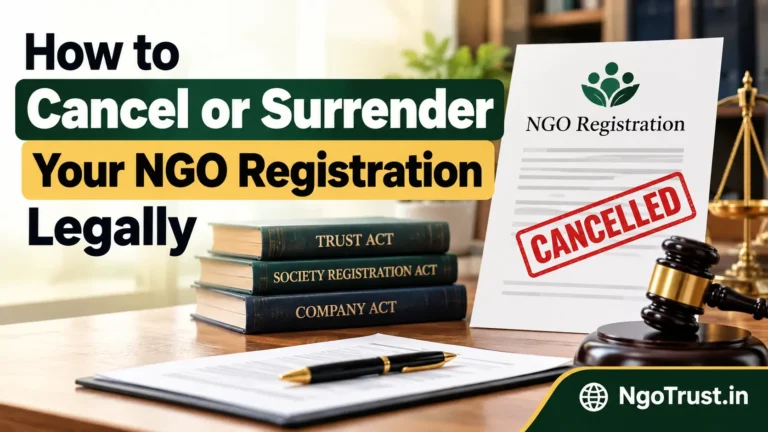
What does it mean to cancel or surrender an NGO registration? It means formally closing your NGO with the authority that registered it and ending its tax and compliance registrations, so the organisation no longer exists on record, and no filings or liabilities are left behind.
Short answer: you cannot simply stop filing returns and walk away. To close an NGO legally in India, follow the closure route for your NGO type (trust deed for a trust, a member vote for a society, strike off for a Section 8 company), clear all dues, pass leftover assets to another charitable organisation, and then surrender your 12A, 80G, FCRA, GST and other registrations.
Most NGO founders start an NGO with a lot of energy. Few think about how to end one. Then funding dries up, the team moves on, or the mission changes, and the registration sits there collecting penalties.
A registered NGO that is no longer active still has duties. Annual returns, income tax filings, and audit reports stay due until the NGO is formally closed. Missing them can mean heavy late fees and, for the people who signed the papers, personal trouble.
This guide explains how to cancel or surrender your NGO registration the right way, in plain words.
Why do NGOs close or surrender their registration?
There is no single reason, but a few come up again and again:
- The founders have left or lost interest, and nobody is running the NGO
- Funding has stopped, and the work cannot continue
- The NGO wants to merge with a larger organisation with the same goals
- The founders picked the wrong legal structure and want to restart with the right one
- The NGO has been inactive for years, and non-compliance is piling up
Whatever the reason, the legal process is similar in spirit. You wind up the affairs properly, protect the public money and assets, and tell every authority that the NGO is closing.
What is the difference between cancelling, surrendering and dissolving an NGO?
These words are often used as if they mean the same thing. They do not, and mixing them up can send you to the wrong office with the wrong form.
- Surrender is when you voluntarily hand back a registration or certificate, such as 12A, 80G, FCRA, or GST, to the authority that issued it.
- Cancellation is when the authority ends a registration. It can happen on your request, or as a penalty for non-compliance. The penalty route is the one you want to avoid.
- Dissolution or winding up is the end of the NGO itself under the law that governs it.
- Strike off is the removal of a company’s name from the Registrar of Companies records. It applies to Section 8 companies.
In practice, a full closure needs both: the NGO is dissolved under its own law, and each separate registration is surrendered.
What should you check before you start?
A few quiet hours with your paperwork can save months of trouble later.
- Read your governing document. The trust deed, the society’s memorandum and bye-laws, or the company’s MoA and AoA usually say how the NGO can be closed and who decides.
- List pending compliance. Unfiled annual returns, income tax returns, and audit reports should be cleared first, or at least listed.
- Take stock of money and assets. Know your bank balances, grants received, property, and any loans or unpaid bills.
- Hold a proper meeting. The governing body or members should pass a written resolution to close the NGO, with minutes signed by the right people.
How do you close or dissolve a trust legally?
A trust is closed by following the dissolution or revocation clause in its trust deed. If the deed has no such clause, the trustees usually need legal advice or even court approval, because a charitable trust is meant to last and its assets belong to the cause, not to the trustees.
When the deed allows closure, the process usually runs like this:
- The trustees meet and pass a resolution to dissolve the trust, as the deed requires.
- All debts, salaries, and dues are paid, and bank accounts are reconciled.
- Remaining assets are transferred to another charitable trust or NGO with similar objects. They cannot be shared among trustees or members.
- A deed of dissolution is drafted on stamp paper, signed by the trustees and, where needed, registered with the sub-registrar.
- Income tax, bank, and other closures follow (covered below).
In states with a Public Trusts Act, such as Maharashtra and Gujarat, the Charity Commissioner must also be informed, and approval is often required before the trust can be closed. The rules differ from state to state, so check what applies where your trust is registered.
The key point is the destination of the assets. Money and property raised for charity must stay in charity.
How do you dissolve a registered society?
A registered society can be dissolved when at least three-fifths of its members agree to it. This comes from Section 13 of the Societies Registration Act, 1860, which many states follow, sometimes with their own changes.
The usual steps are:
- Give members proper written notice of a general body meeting. The agenda must say that dissolution will be discussed.
- Pass the resolution with the required three-fifths vote and record it in signed minutes.
- Pay off all debts and liabilities.
- Hand over any leftover property to another society with similar objects, decided by the members’ vote. Section 14 of the Act says the surplus cannot be distributed among the members.
- Send the resolution, minutes, final accounts, and covering application to the Registrar of Societies, who records the dissolution.
Some states, including Tamil Nadu, Karnataka and Telangana, have their own societies laws. The broad idea stays the same, but forms, fees and timelines can change, so confirm the local rules before you file anything.
How do you close a Section 8 company?
A Section 8 company is closed either by strike-off under Section 248 of the Companies Act, 2013, or by winding up. Strike off is the simpler route and suits a company that has done no business or operations for the last two financial years. A company with real assets, loans or ongoing disputes should go for formal liquidation instead.
For the strike-off route on the Ministry of Corporate Affairs portal, the steps are:
- Clear all pending annual filings with the Registrar of Companies, so there is no default on record.
- Pass a special resolution, or get consent from at least 75% of members, to apply for strike-off.
- Pay all liabilities and close the books. Directors sign an indemnity bond and an affidavit, and a statement of accounts is prepared.
- File Form STK-2 with the supporting documents and the prescribed fee.
- The Registrar publishes a notice and waits for objections. If none are raised, the company name is struck off, and the closure is notified.
A Section 8 company is a charitable company, so its leftover assets cannot go to the directors or members. They must pass to another charitable company or NGO with similar objects.
The time this takes depends on how clean your records are. Companies with years of unfiled returns should expect to spend extra time on catch-up filings before the strike-off application is even accepted.
Which other registrations must you surrender when closing an NGO?
Every registration your NGO holds needs to be closed or surrendered separately. Dissolving the NGO does not cancel them automatically. Here are the ones that usually matter:
- Income tax, 12A and 80G: File the final income tax return up to the date of closure, clear TDS filings, and inform the department through the Income Tax e-filing portal so these registrations can be cancelled.
- FCRA: If you receive foreign donations, surrender the registration on the FCRA portal only after accounting for every foreign contribution. The Ministry of Home Affairs can direct how unspent funds and assets are handled.
- GST: If registered, apply for cancellation on the GST portal and file the final return.
- NGO Darpan: Update your profile on NGO Darpan so it does not show an active NGO.
- PF, ESI and local licences: Close any employer registrations and shop or establishment licences, if you have them.
- Bank accounts: Close these last, after dues are paid and funds are moved, and keep the closure letters.
- PAN: Surrender it only once every tax matter is settled.
Why does the 12-month asset rule matter?
Under Section 115TD of the Income Tax Act, a charitable organisation that dissolves must transfer its assets to another registered charitable organisation within 12 months of the end of the month of dissolution. If it does not, the tax department can charge a heavy exit tax on the accumulated income. This is the single most expensive mistake in NGO closures, and it is easy to avoid with a little planning.
What mistakes should you avoid when closing an NGO?
The biggest mistake is doing nothing. An NGO that is left inactive keeps collecting penalties, and the trustees, members, or directors on record stay responsible for them.
The next most common mistakes are:
- Sharing leftover funds among members or trustees, which is not allowed for a charitable body
- Closing the bank account before settling taxes, FCRA matters, and salaries
- Skipping the formal resolution and minutes, then being unable to prove the decision later
- Surrendering the registration but forgetting 12A, 80G, GST or FCRA, so returns keep falling due
- Filing the closure application while old annual returns are still pending
Keep a closure file with every resolution, receipt, acknowledgement, and letter. Years later, if a notice arrives, that file is your proof that the NGO was closed properly.
Is there an alternative to closing your NGO?
Sometimes. If the work has simply slowed down, a company can apply for dormant status, and a trust or society can bring in new trustees or members and carry on. If a bigger NGO shares your mission, a merger or a transfer of activities and assets to it may serve your cause better than a shutdown. It is worth a quick conversation before you commit to closing.
Frequently asked questions
Can I cancel my NGO registration online?
Partly. Section 8 company strike-off, GST cancellation, income tax, and FCRA surrender are handled on government portals. Closing a trust or society often involves a dissolution deed and filings with the local registrar, and the exact method depends on your state.
How long does it take to close an NGO in India?
There is no fixed timeline. A clean Section 8 strike-off can take a few months because of the notice period. Trusts and societies depend on the local office, and any NGO with pending filings or FCRA registration should expect more time.
Can I close an NGO that has pending returns?
It is risky. Registrars and tax authorities may refuse or delay the application while defaults remain. It is usually better to file the pending returns, pay the late fees, and then close the NGO in an orderly way.
What happens to the NGO’s money and assets after closure?
Once debts are paid, the remaining funds and property must go to another charitable organisation with similar objects. They cannot be shared among trustees, members or directors.
What happens if I just stop filing and ignore the NGO?
Penalties and late fees keep growing. A company can be struck off by the Registrar on its own, which does not erase the responsibility of its directors, and directors can face disqualification for long-running defaults.
Do I need a lawyer or CA to close an NGO?
The law does not make it compulsory, but closure involves legal drafting, tax compliance, and several authorities. A professional can catch problems, such as the 12-month asset rule, before they turn into penalties.
Not sure where to begin?
Closing an NGO is not a sign of failure. Many founders do it for good reasons, and doing it properly protects both the cause and the people behind it.
If your paperwork is messy, your registrations are spread across several departments, or you are simply unsure which route fits your NGO, it can help to talk it through with someone who handles this every day. The team at NGO Trust is happy to look at your situation and suggest a clear path. You are welcome to get in touch whenever you are ready, even if it is only to ask a few questions.
Useful links
- NGO Trust
- India Code (Societies Registration Act, 1860)
- Ministry of Corporate Affairs
- Income Tax e-filing portal
- FCRA portal
- GST portal
- NGO Darpan