
SAI NGO & BUSINESS CONSULTANCY
Expert services for NGO, Trust, Society Registration & Compliance across India.
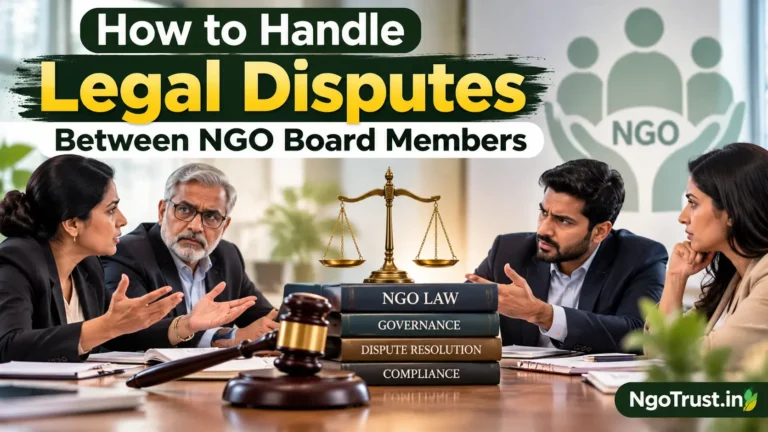
Definition: A legal dispute between NGO board members is a formal disagreement among trustees, directors, or governing body members over control, money, decisions, or duties. Depending on how the NGO is registered, it can be settled through internal talks, mediation, arbitration, or a court or tribunal.
Direct answer: To handle legal disputes between NGO board members, first check your governing document (trust deed, society bylaws, or Memorandum and Articles of Association). Then record the issue in writing, protect the NGO’s funds, and try a neutral process like mediation. Go to a court or tribunal only if talks fail, and speak to a professional early.
Every NGO board argues at some point. That is healthy. The trouble starts when the argument stops being about ideas and starts being about power, money, or rules.
This guide explains why board member conflict turns legal, what to do in the first few days, and which legal routes exist in India. It is written for trustees, founders, and office bearers who want a calm way through.
Why Do NGO Board Members End Up in Legal Disputes?
Most disputes do not appear overnight. They grow slowly from small cracks that nobody fixed.
The usual triggers are:
- Control of the bank account or signing powers
- Removing or appointing office bearers without following the bylaws
- Allegations of misused donations or grant money
- A conflict of interest, such as a board member’s relative getting a paid role
- A founder and newer members pulling in different directions
- Missing, late, or backdated meeting minutes
- Disputed elections or membership lists
Unclear paperwork sits behind many of these. A trust deed written fifteen years ago may say nothing about removing a trustee. Bylaws may not explain who can call a meeting. When the rules are vague, each side reads them in its own favour.
A disagreement becomes a legal dispute when someone claims a breach of duty, a rule is ignored, or the NGO’s money or registration is at risk. That is the point to slow down.
What Should You Do First When NGO Board Members Disagree?
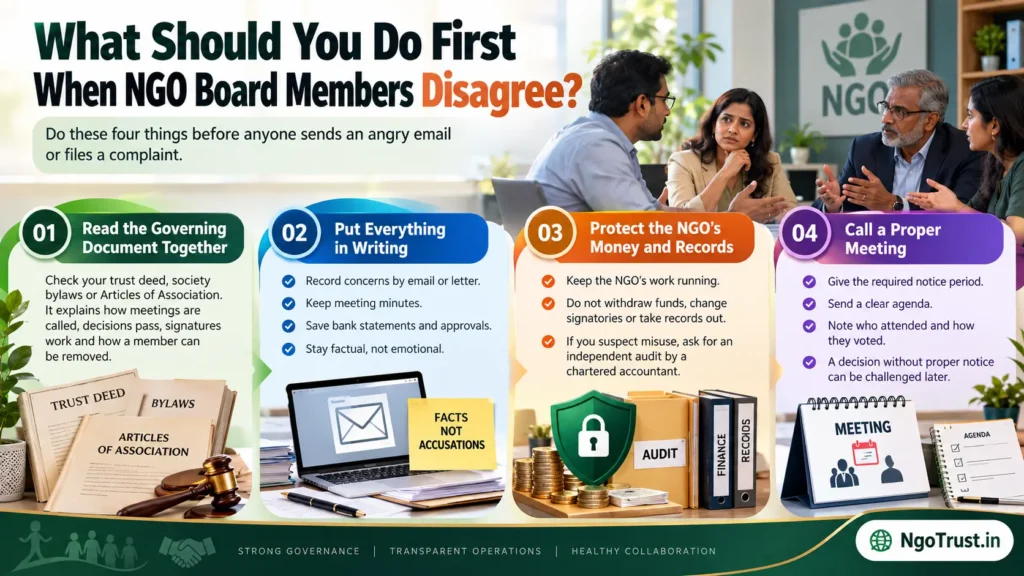
Do these four things before anyone sends an angry email or files a complaint.
Read the governing document together
Your trust deed, society bylaws, or Articles of Association is the rulebook. It usually explains how meetings are called, how decisions pass, who can sign cheques, and how a member can be removed. Many disputes shrink once everyone reads the same page.
Put everything in writing
Verbal promises are hard to prove. Record concerns by email or letter, keep meeting minutes, and save bank statements and approvals.
Stay factual. Write “the ₹2 lakh grant amount was moved without a board resolution,” not “he is stealing.” Facts help you later. Accusations make people defensive.
Protect the NGO’s money and records
Keep the NGO’s work running. Agree that nobody will withdraw funds, change signatories, or take records out of the office until the issue is settled.
If you suspect misuse, ask for an independent audit by a chartered accountant instead of accusing a colleague directly.
Call a proper meeting
Many disputes are really about process. Give the notice period your bylaws require, send a clear agenda, and note who attended and how they voted. A decision taken without proper notice can be challenged later, even if it was the right decision.
Also keep personal and organizational issues apart. A board member who disagrees with you on strategy is not automatically acting in bad faith.
How Do You Resolve an NGO Board Dispute Legally?
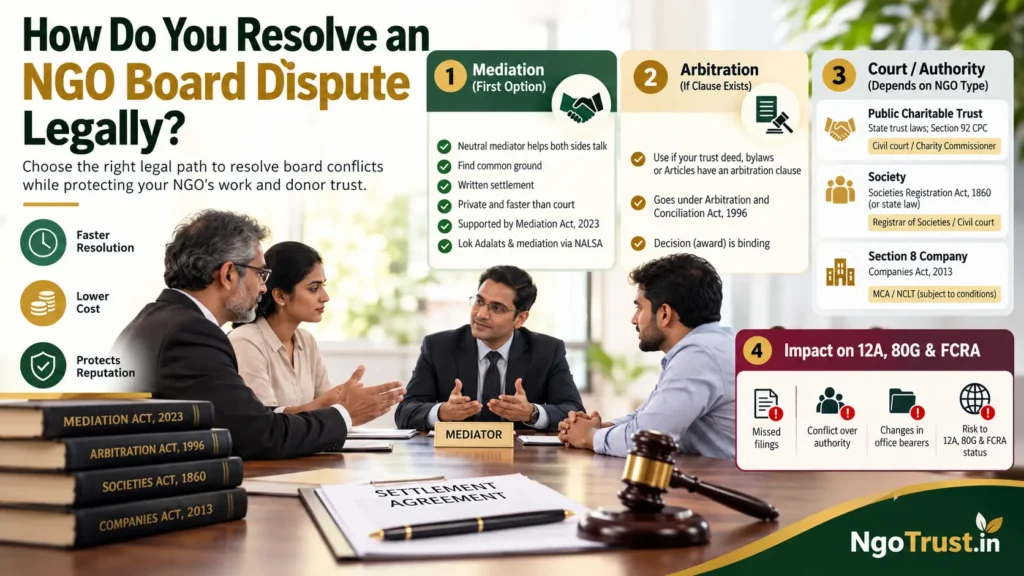
Use the lightest option that works. Court cases are slow and costly, and public fights shake donor trust.
Can mediation settle a board dispute?
Yes, and it often does. A neutral mediator helps both sides talk, find common ground, and sign a written settlement. It is private, faster than court, and protects working relationships.
India now has a dedicated law for it, the Mediation Act, 2023, and courts regularly encourage parties to try mediation first. District legal services authorities under NALSA also run Lok Adalats and mediation, which can be a low-cost starting point.
When does arbitration make sense?
If your trust deed, bylaws, or Articles contain an arbitration clause, the dispute may go to an arbitrator under the Arbitration and Conciliation Act, 1996. The award is binding. Check your documents before assuming this option exists.
Which court or authority handles the dispute?
It depends on how your NGO is registered.
| Type of NGO | Main law | Where disputes usually go |
| Public charitable trust | State public trust laws; Section 92 of the Code of Civil Procedure | Civil court; charity commissioner in some states |
| Society | Societies Registration Act, 1860 or the state’s version | Registrar of Societies for record issues; civil court for rights and elections |
| Section 8 company | Companies Act, 2013 | Registrar of Companies (MCA); NCLT for oppression and mismanagement, subject to conditions |
Rules differ from state to state, so confirm which law applies to you. For public charitable trusts, Section 92 of the Code of Civil Procedure lets two or more interested persons sue for a breach of trust, with the court’s permission.
Will a board dispute affect your 12A, 80G, or FCRA status?
It can. Tax registrations on the Income Tax portal and FCRA registration depend on timely, accurate filings. If two groups both claim authority to sign returns, access portals, or receive foreign contributions, deadlines get missed.
Changes in office bearers also have to be reported to the right authorities. A fighting board still has to file on time.
How Can You Prevent NGO Board Disputes?
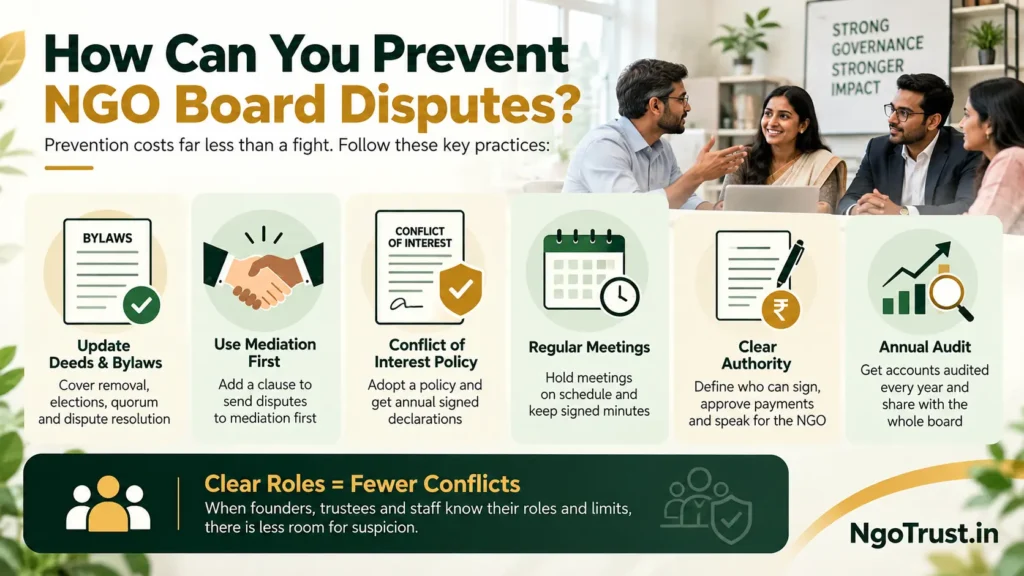
Prevention costs far less than a fight. These habits make the biggest difference:
- Update old deeds and bylaws so they cover removal, elections, quorum, and dispute resolution
- Add a clause that sends any dispute to mediation first
- Adopt a conflict of interest policy and ask every member to sign it each year
- Hold meetings on schedule and keep minutes signed by those present
- Spell out who can sign, approve payments, and speak for the NGO
- Get the accounts audited every year and share them with the whole board
Clear roles matter just as much. When founders, trustees, and staff know where their authority starts and ends, there is less room for suspicion.
When should you bring in a professional?
Get help if the other side has threatened legal action, funds are missing, records are being withheld, or registration filings are at risk.
A neutral expert can read your documents, explain your options, and keep emotions out of the process. The earlier this happens, the more choices you have.
Avoid drastic moves, such as locking members out or changing bank signatories, until you know your bylaws allow it. A hasty step can hand the other side a legal argument.
FAQs on Legal Disputes Between NGO Board Members
Can an NGO board member sue another board member?
Yes. A board member can approach a court if a colleague has breached their duties, misused funds, or ignored the governing document. Courts usually expect internal remedies and mediation to be tried first. The right forum depends on whether the NGO is a trust, society, or Section 8 company.
Can a board member be removed from an NGO?
Yes, but only through the process in the trust deed, bylaws, or Articles. That normally means proper notice, a chance to respond, and a valid vote. Removal outside that process can be challenged.
What happens to an NGO if board members keep fighting?
Work slows down, donors lose confidence, and compliance filings slip. In serious cases, a court or authority may step in, and registrations can come under question.
Is a mediation settlement legally binding?
Yes. A signed mediation settlement is binding on the parties and, under the Mediation Act, 2023, can be enforced like a court order, subject to the conditions in the Act.
How long does it take to resolve a board dispute?
Mediation can often finish in a few weeks to a few months. Court cases can run for years, which is why most NGOs are better off settling early.
Who should we speak to first?
Start with someone who understands both NGO law and day-to-day compliance. They can review your documents and tell you whether mediation, arbitration, or a legal filing fits your situation.
Stuck in a Board Dispute? Talk It Through First
If your board is split and you are not sure what your deed or bylaws allow, you do not have to work it out alone. At NGOTrust.in, our team works with NGOs on registration, compliance, and governance paperwork every day.
If you would like a calm outside view of your situation, get in touch for a consultation whenever you feel ready. There is no rush, only a clear next step.
Useful Links
- NGOTrust.in
- India Code (Societies Registration Act, Mediation Act)
- NALSA, National Legal Services Authority
- Ministry of Corporate Affairs (MCA)
- National Company Law Tribunal (NCLT)
- Income Tax Department of India
- FCRA Online, Ministry of Home Affairs