
SAI NGO & BUSINESS CONSULTANCY
Expert services for NGO, Trust, Society Registration & Compliance across India.
Scaling an NGO means reaching more people or opening in new locations while keeping your programme quality, compliance, and finances in good shape. It is not the same as simply getting bigger. An NGO that grows faster than its systems can handle usually ends up weaker, not stronger.
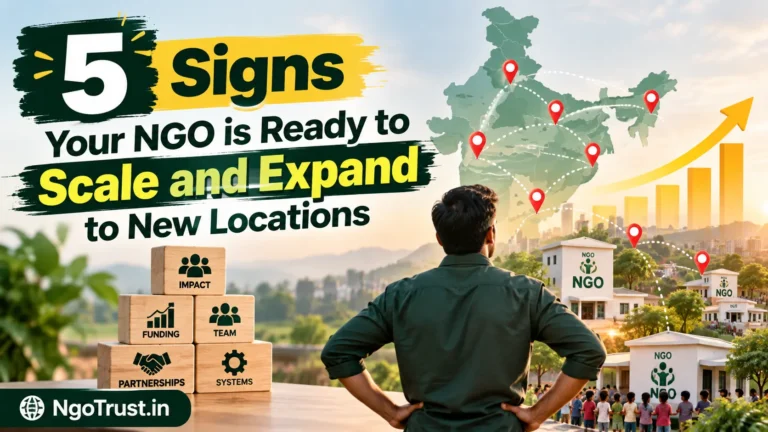
Your NGO is ready to expand when five things are true: your programme works and has proof, your funding is steady, your team can run without you in every room, your legal papers are in order, and new communities are asking for your help. If even one of these is missing, fix it before you open a new office.
Many founders feel the pull to expand after a good year. A new donor shows up, a district official asks for your help, or a local group offers space. These are good signs, but excitement is not a plan. The five signs below will help you check whether your NGO is truly ready to scale, or whether it needs a little more time.
5 Signs Your NGO Is Ready to Scale
Sign 1: Your Programme Works and You Can Prove It
The first sign is simple: your work produces results, and you have the records to show it. A programme that depends on one passionate coordinator is not ready to be copied. A programme with clear steps, a written method, and tracked outcomes is.
Ask yourself a few direct questions:
- Can someone else run this programme using only your written guide?
- Do you have data on who you served and what changed for them?
- Has the programme worked for at least two or three years?
If the answer is yes, you have something worth repeating. If not, spend the next few months documenting what you do before you take it anywhere new.
Sign 2: Your Funding Is Steady, Not Just Hopeful
A new location usually costs more than expected. Rent, staff, travel, and reporting all go up before any new funds arrive. So the second sign is a stable income base.
Look for funding that comes from more than one source, such as grants, CSR partners, and individual donors. Relying on a single donor for most of your budget is risky. If that donor leaves, your new branch and your old one both feel it.
A good rule of thumb is to hold enough reserve to run the new location for six to twelve months. Companies that fund through CSR also expect NGOs to be properly registered, so check the Ministry of Corporate Affairs requirements for CSR-eligible organisations before you apply.
Sign 3: Your Team and Systems Can Run Without You
Founders often hold everything together: the donor calls, the accounts, the field visits. That works at one location. It breaks at two.
You are ready to scale when your NGO has:
- A second layer of leaders who can make decisions on their own
- Written processes for hiring, purchasing, and reporting
- Proper accounting and regular internal reviews
Try stepping away for two weeks. If work continues smoothly, your systems are strong enough. If everything stops, build the team first.
Sign 4: Your Legal and Compliance Papers Are in Order
This is the sign most NGOs overlook, and it is the one that can stop an expansion fastest. Before you open a new location, check that your registration, tax exemptions, and filings are clean.
The key items to review:
- Registration type: Trusts, societies, and Section 8 companies follow different rules when working across states, so confirm what applies to your structure.
- 12A and 80G: These tax registrations should be active and renewed on time. You can check the process on the Income Tax Department portal.
- FCRA: If you receive foreign funds, your registration and reporting must be current. The FCRA portal lists the official requirements.
- NGO Darpan ID: Many government schemes ask for it, so keep your profile updated on NGO Darpan.
- Annual filings: Income tax returns, audit reports, and any state-level filings should be up to date.
A missed filing at your head office can follow you to every new branch. Clean it up first.
Sign 5: New Communities Are Asking for Your Help
The best reason to expand is demand, not ambition. When people in another district, a local government office, or a community group contact you and ask for your programme, that is a strong signal.
Demand also tells you something practical. A community that invites you is more likely to give local support, volunteers, and trust. Compare that with an area you chose from a distance, where you must build every relationship from nothing.
Before you say yes, do a simple needs check. Visit the area, speak with local leaders, and ask what already exists. If another NGO is doing the same work well, you may be better off partnering than opening a competing office.
What Mistakes Should NGOs Avoid When Expanding to New Locations?
The most common mistake is expanding because funds became available, not because the programme is ready. Money can open an office, but it cannot build trust with a community.
Two other mistakes show up often:
- Copying the programme without adapting it. What works in one village may need changes in another because of language, local habits, or available services.
- Skipping a pilot. Starting small, with one or two staff members for six months, tells you far more than a big launch does.
How Can Your NGO Prepare for Expansion?
Start with a short readiness check. Score yourself honestly on the five signs above and write down the gaps. Then pick the weakest area and fix it first.
A practical path looks like this:
- Document your programme and its results.
- Review your registrations, tax exemptions, and filings.
- Build a budget that covers at least six months of running costs in the new area.
- Run a small pilot with a local partner.
- Review the pilot, then decide whether to grow further.
This approach keeps risk low and gives you proof to share with donors, who like to see that growth is planned and not rushed.
Need a Hand Before You Expand?
Growing an NGO is rewarding, but the legal and paperwork side can feel heavy, especially when you work across more than one state. If you are unsure whether your registrations, 12A and 80G status, or FCRA setup can support a new location, a quick review by someone who handles this daily can save you months of trouble.
At NGO Trust, we help NGOs and organisations with registration, compliance, and documentation. If you would like a second pair of eyes on your expansion plan, you are welcome to get in touch or book a consultation whenever you feel ready. There is no pressure, and even a short conversation can make your next step clearer.
Frequently Asked Questions
When should an NGO expand to new locations?
An NGO should expand when its programme has proven results, its funding is stable, its team can work without constant founder support, and its legal papers are current. Demand from a new community is the strongest reason to start.
How much money does an NGO need to open a new branch?
There is no fixed number, because costs depend on the location and the programme. As a safe guide, keep enough funds to run the new branch for six to twelve months without relying on new grants.
Does an NGO need new registration to work in another state?
It depends on how your NGO is registered. Trusts, societies, and Section 8 companies have different rules, and some state laws ask for extra steps. Check with a professional before you begin work in a new state.
Do 12A and 80G registrations apply to new locations?
These are tax registrations given to the organisation, so they generally stay valid wherever you work, as long as you renew them on time and file your returns. Keep your records for each location separate and clear.
Is it better to open a new branch or partner with a local NGO?
Partnering is often safer and cheaper when a trusted local NGO already does similar work. Opening your own branch makes sense when no one serves that need, or when you must control programme quality closely.
When you are ready to look at your own plan, a short chat with the NGO Trust team can help you spot gaps before they become problems.
Useful Links