
SAI NGO & BUSINESS CONSULTANCY
Expert services for NGO, Trust, Society Registration & Compliance across India.
A monitoring and evaluation (M&E) plan is a written document that explains how your NGO will track the progress of a project (monitoring) and judge whether it is achieving its goals (evaluation). It lists what you will measure, how you will collect the data, who is responsible, and when results will be reported.
That is the whole idea. Everything else in this guide is about doing it well.
How Do You Create an M&E Plan for Your NGO?
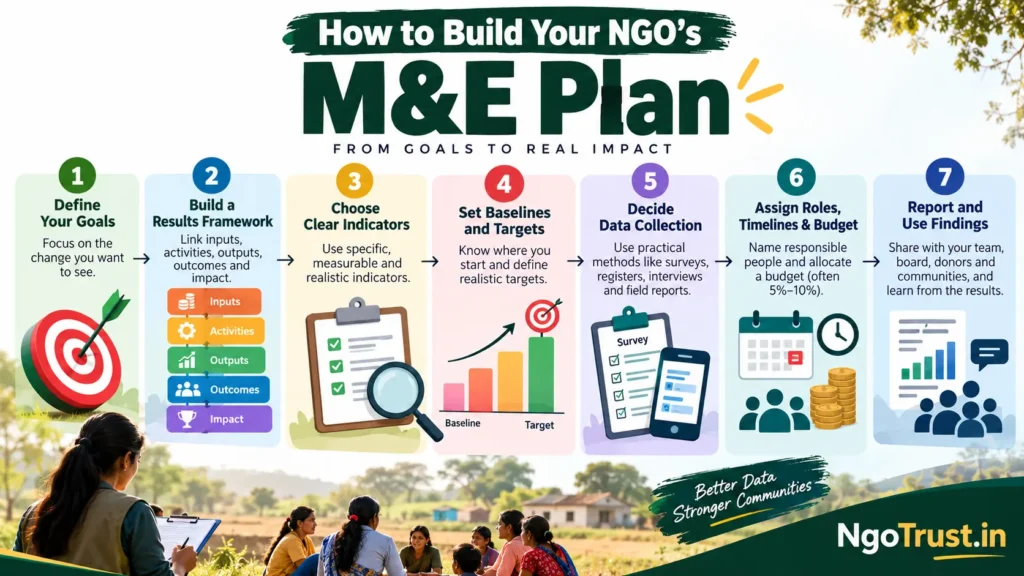
To create an M&E plan, follow these seven steps:
- Define your goals and expected results
- Build a simple results framework
- Choose clear indicators
- Set baselines and targets
- Decide how you will collect data
- Assign roles, timelines, and a budget
- Plan how you will report and use the findings
Each step is explained below in plain language, with examples you can adapt to your own programmes.
Why Does Your NGO Need an M&E Plan?
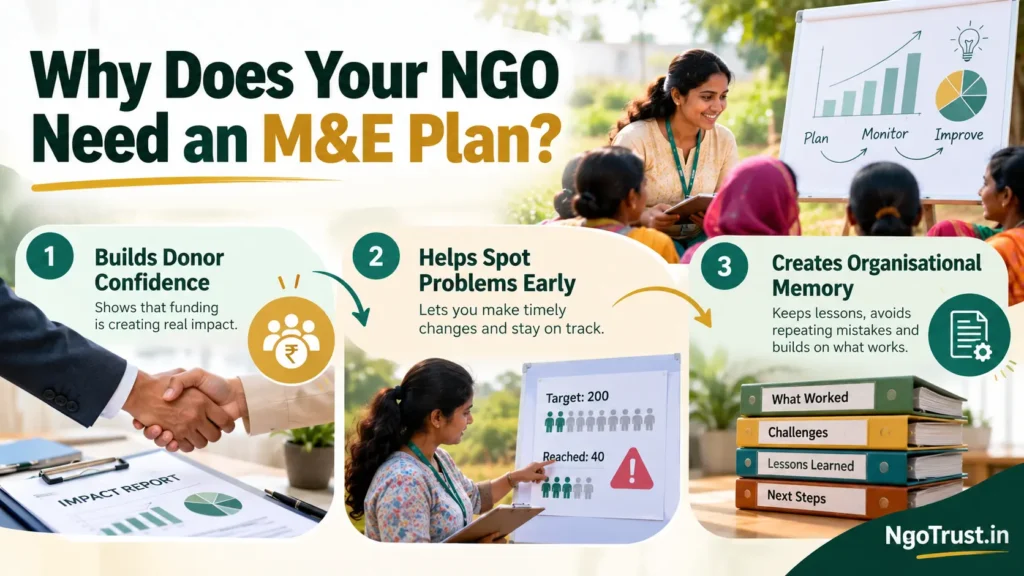
Many small NGOs treat M&E as paperwork that donors demand. In reality, it protects your work in three ways.
First, it shows donors and CSR partners that their money is making a difference. Most funders now expect a clear M&E framework in the proposal itself, not as an afterthought.
Second, it helps you catch problems early. If only 40 of the 200 women you planned to train have attended by month three, you want to know that in month three, not at the end of the year.
Third, it builds your own memory as an organisation. Staff change, but a good M&E system keeps the lessons. You stop repeating mistakes and start repeating what works.
What Is the Difference Between Monitoring and Evaluation?
People often mix these two terms, so here is a quick way to separate them.
- Monitoring is ongoing. You check regularly (weekly, monthly, quarterly) whether activities are happening on time and as planned.
- Evaluation is periodic. At the midpoint or end of a project, you step back and ask whether the project actually changed anything for the people you serve.
Monitoring tells you whether you are doing things right. Evaluation tells you whether you are doing the right things.
Step-by-Step: How to Build Your NGO’s M&E Plan
Step 1: Define Your Goals and Expected Results
Start with the change you want to see. Not the activities, the change.
For example, “conduct 20 health camps” is an activity. “Reduce untreated anaemia among adolescent girls in 10 villages” is a result. Your M&E plan should be built around results, because that is what donors and communities care about.
Write down one overall goal and two to four specific objectives. If you cannot explain an objective in one sentence, it is probably too broad.
Step 2: Build a Simple Results Framework
A results framework (often called a logical framework or logframe) connects your work to your goals in a clear chain:
- Inputs: money, staff, materials
- Activities: what you do (training sessions, health camps, distribution drives)
- Outputs: what you directly produce (200 women trained, 15 camps held)
- Outcomes: the short-term and medium-term changes (women start earning, anaemia rates drop)
- Impact: the long-term change in the community
You do not need a complicated chart. A one-page table is enough for most small and mid-sized NGOs. Organisations like BetterEvaluation and UNDP publish free guides if you want to see how larger agencies structure theirs.
Step 3: Choose Clear Indicators
An indicator is the measurable sign that tells you whether something is happening. Good indicators are specific, realistic, and easy to collect.
Compare these two:
- Weak: “Improved livelihoods of women”
- Strong: “Percentage of trained women earning at least ₹5,000 per month six months after training”
The second one tells you exactly what to count and when. A useful rule is to keep two or three indicators per objective. More than that, and your team will spend more time counting than working.
Use a mix of numbers (how many) and stories (how and why). Numbers satisfy auditors. Stories help people understand the change behind the numbers.
Step 4: Set Baselines and Targets
A baseline is where you stand before the project begins. Without it, you cannot prove change.
If you plan to improve school attendance, first record the current attendance rate. Then set a realistic target, such as raising it from 62% to 80% within two years. Be honest here. Overly bold targets look impressive in a proposal and painful in a progress report.
Step 5: Decide How You Will Collect Data
For each indicator, decide the method, the source, and the frequency. Common methods include:
- Attendance sheets and registers
- Household or beneficiary surveys
- Focus group discussions
- Interviews with community leaders
- Photos, field visit reports, and case stories
Keep it practical. If your field staff already fill a register, use that instead of creating a new form. Mobile tools such as KoBoToolbox are free for humanitarian and non-profit use and work well even with weak internet.
Also think about data quality early. Who checks the entries? How do you avoid duplicate beneficiaries? A short monthly review meeting solves most of these problems.
Step 6: Assign Roles, Timelines, and a Budget
An M&E plan that says “the team will collect data” will fail. Name a person for every task.
Your plan should answer these questions:
- Who collects the data?
- Who verifies it?
- Who analyses it and writes the report?
- When is each report due?
Also set aside money for M&E. Many funders suggest budgeting roughly 5% to 10% of the project cost for it, though the right share depends on the project size and donor rules. If you plan an external evaluation, include that cost from the start.
Step 7: Plan How You Will Report and Use the Findings
Data that sits in a folder helps nobody. Decide in advance who needs which information:
- Your team needs monthly updates to adjust the work
- Your board needs quarterly summaries to guide decisions
- Donors and CSR partners need structured reports in their own formats
- Communities deserve to hear what you found, in simple language
Schedule a short learning session after each reporting period. Ask what worked, what did not, and what should change. This is where M&E starts paying for itself.
What Should an M&E Plan Document Include?
Once you have worked through the seven steps, put everything into one document. A clear M&E plan usually contains:
- Project summary and objectives
- Results framework or logframe
- Indicator table with definitions, baselines, targets, and data sources
- Data collection methods and tools
- Roles, responsibilities, and timeline
- Reporting schedule
- Risks and assumptions
- M&E budget
Aim for a document your programme staff can actually use. Ten clear pages beat forty pages nobody opens.
What Are the Most Common M&E Mistakes NGOs Make?
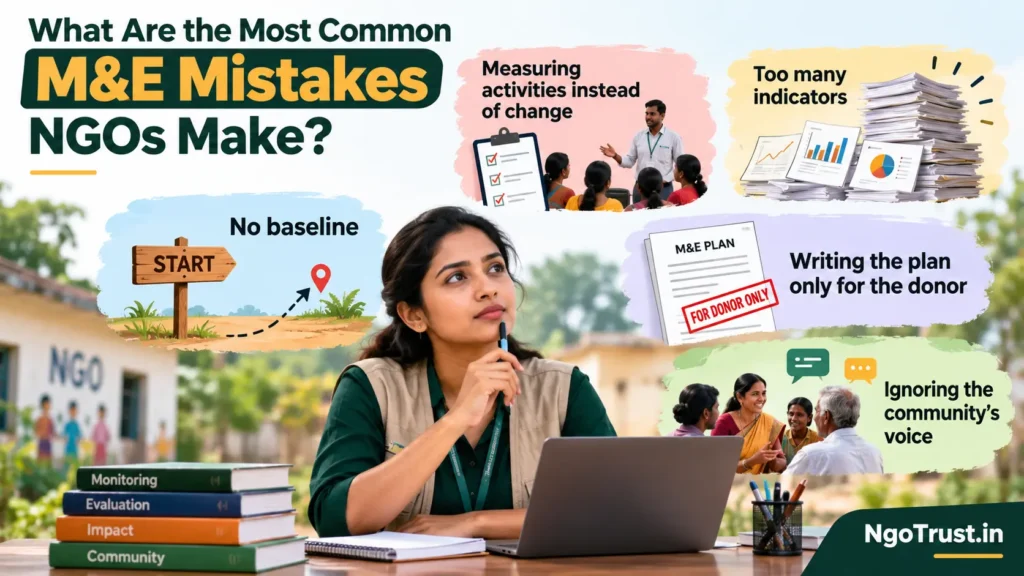
After working with many organisations, the same problems keep showing up:
- Measuring activities instead of change. Counting workshops is easy. Showing that behaviour changed takes more thought.
- Too many indicators. Teams get overwhelmed and stop collecting data.
- No baseline. You cannot show progress without a starting point.
- Writing the plan only for the donor. A plan made just to win a grant is often ignored once the project starts.
- Ignoring the community’s voice. The people you serve often notice results and problems before any report does.
If you spot two or three of these in your current approach, you are in good company. They are easy to fix once you see them.
When Should You Ask for Professional Help?
You can write a basic M&E plan on your own, especially for a small project. But expert support is worth considering when:
- A large donor or CSR partner has strict reporting formats
- You are applying for FCRA, 12A, 80G, or CSR-related approvals and need your documentation to look credible and consistent
- Your programmes have grown and your current record-keeping cannot keep up
- You want an independent review of your project’s results
When registration, compliance, and programme documentation are in order, funders tend to trust you faster. If you want a second pair of eyes on your plan, the team at SAI NGO & Business Consultancy is happy to talk it through with you. There is no pressure, and even a short conversation can save you weeks of rework.
Frequently Asked Questions
What is an M&E plan in simple words?
An M&E plan is a roadmap that shows how your NGO will measure its progress and results. It lists what you will track, how you will gather information, who will do it, and how you will report it.
Is an M&E plan mandatory for NGOs in India?
There is no single law that requires every NGO to have one. However, most institutional donors, foundations, and CSR partners ask for an M&E framework as part of the proposal or agreement. Under the CSR rules, companies also need to track and report on the projects they fund, so a clear M&E system makes you a stronger partner.
How long should an M&E plan be?
For most small and mid-sized NGOs, 8 to 15 pages is enough. Use tables for indicators and timelines so the document stays easy to read.
How many indicators should an NGO use?
Two or three indicators per objective is a good rule. Choose the ones you can realistically measure with your current staff and budget.
What is the difference between outputs and outcomes?
Outputs are the direct products of your work, such as 100 farmers trained. Outcomes are the changes that follow, such as those farmers raising their crop yield. Donors care most about outcomes.
How often should an NGO review its M&E data?
Review activity data monthly, programme progress quarterly, and overall results at the midpoint and end of the project.
Who should be responsible for M&E in a small NGO?
Ideally one person leads it, even if it is only part of their role. Field staff collect the data, and the leader checks quality and prepares reports. In very small teams, the programme manager often takes this on.
Do we need an external evaluator?
Not always. Small projects can use internal reviews. Larger or donor-funded projects often require an independent evaluation, so check your grant agreement.
Ready to Build Yours?
A good M&E plan does not need fancy software or a big team. It needs clear goals, a few honest indicators, and someone who owns the process. Start with one project, keep it simple, and improve as you go.
If you would like help shaping your plan or getting your NGO’s documentation ready for funders, feel free to reach out to us at ngotrust.in. We are glad to have a friendly conversation about where you are and what would help most.
Useful Links