
SAI NGO & BUSINESS CONSULTANCY
Expert services for NGO, Trust, Society Registration & Compliance across India.
Quick definition: Success story writing is the practice of turning a real result from your NGO’s work into a short, factual story. A good case study that attracts donors shows the problem, what your team did, and the measurable change that followed, with the beneficiary’s consent and proof to back it up.
Most NGOs have powerful stories. Very few document them well.
A program officer or CSR manager may read twenty proposals in a week. The ones that stay in memory are not the ones with the longest reports. They are the ones that show one real person, one real problem, and one clear result.
This guide explains how to write that kind of case study, step by step, in plain language.
What Is Success Story Writing for NGOs?
Success story writing means documenting a specific change your work created and presenting it so a stranger can understand it in two minutes.
It is different from an annual report. A report tells donors what you did across the year. A success story shows what happened to one person, family, or village because of what you did.
A strong NGO case study usually has four parts:
- A person or community with a clear problem
- Your intervention, explained in simple terms
- A result, ideally with numbers
- A short look at what happens next
That is it. No long introductions, no sector jargon.
Why Do Donors Pay Attention to Case Studies?
Donors want to know their money did something. Statistics prove scale, but stories prove meaning. When both appear together, trust goes up.
There is also a practical reason. Many funders, including companies spending under CSR rules, need to justify their choices to a board or an auditor. A well-documented case study gives them something concrete to point to.
In short, a good case study:
- Makes your impact easy to verify
- Helps a donor explain their decision internally
- Shows that your organization keeps proper records
- Gives your fundraising material a human face
How Do You Document a Case Study That Attracts Donors?
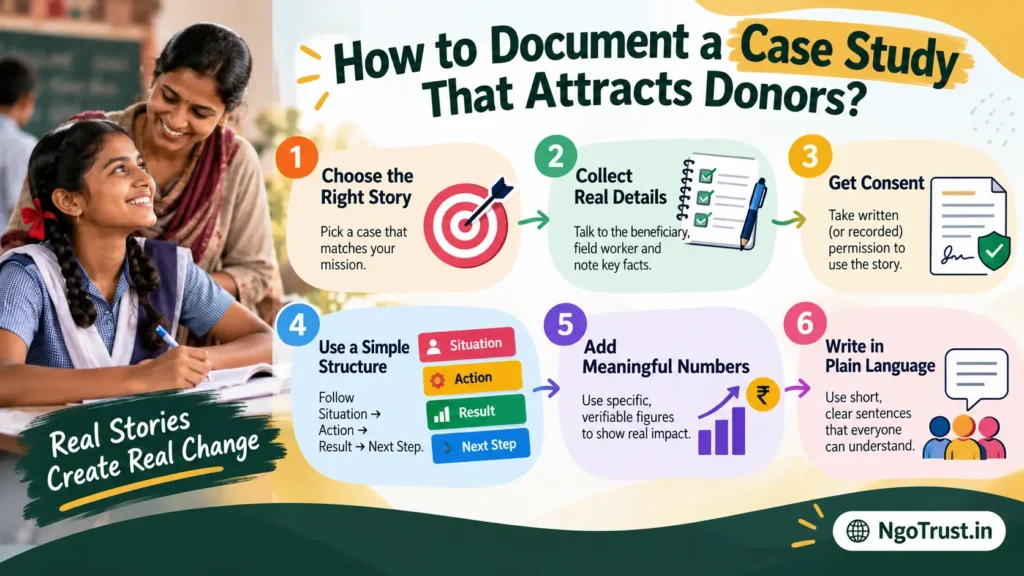
Start with the facts, then shape the story. Writers often do it the other way around and end up with a nice paragraph that cannot be checked.
Step 1: Choose a story that matches your mission
Pick a case that clearly connects to what you want to be funded for. If you are raising money for girls’ education, a story about a school dropout who returned to class fits. A story about a health camp does not, even if it went well.
Look for cases where:
- The before and after difference is easy to see
- The result can be verified through records or a third party
- The beneficiary is comfortable being featured
Step 2: Collect details before you write anything
Sit down with the beneficiary, the field worker, and if possible a local leader. Ask simple questions.
- What was life like before the program?
- What was the hardest part?
- What did our team do, and when?
- What is different today?
- What does the person want to do next?
Write down exact words. A single real sentence from a beneficiary often carries more weight than three paragraphs from you.
Also record the boring details: dates, locations, program name, number of sessions attended, amount of support given. These make the case study believable.
Step 3: Get consent in writing
This step protects both the person and your organization. Explain where the story will appear: your website, a donor deck, social media, or a grant application. Get a signed consent form, or a recorded verbal consent in the person’s own language.
For minors, take consent from a parent or guardian. If the story involves health, abuse, or legal trouble, change names and identifying details. A donor will respect your care. A privacy mistake can damage your reputation for years.
Step 4: Use a simple structure
The easiest format to follow is Situation, Action, Result, which many nonprofit writers call a SAR structure. Here is how it works:
- Situation: Who is this person and what problem did they face? Keep it to three or four sentences.
- Action: What exactly did your team do? Mention the program, the timeline, and the cost if relevant.
- Result: What changed? Add numbers wherever possible.
- Next step: What would more support make possible?
The last point matters. A story that ends without a direction gives a donor nothing to act on.
Step 5: Add numbers that matter
One person’s story gets attention. A number gives it weight. Compare these two lines:
- Weak: “Sunita’s life improved after joining our training.”
- Stronger: “After a six-month tailoring course, Sunita now earns about 9,000 rupees a month. She was earning nothing before.”
The second line is specific. A donor can picture it, repeat it, and check it.
Good numbers to include are income change, school attendance, number of people served, cost per beneficiary, and time taken to see results. Only use figures you can back up with records.
Step 6: Write in plain language
Write as if you are telling the story to a friend who has never heard of your NGO. Use short sentences. Avoid words like “stakeholders,” “capacity building,” and “holistic intervention” unless you explain them.
A quick test: if a high school student cannot follow your case study, rewrite it.
What Does a Good NGO Case Study Look Like?
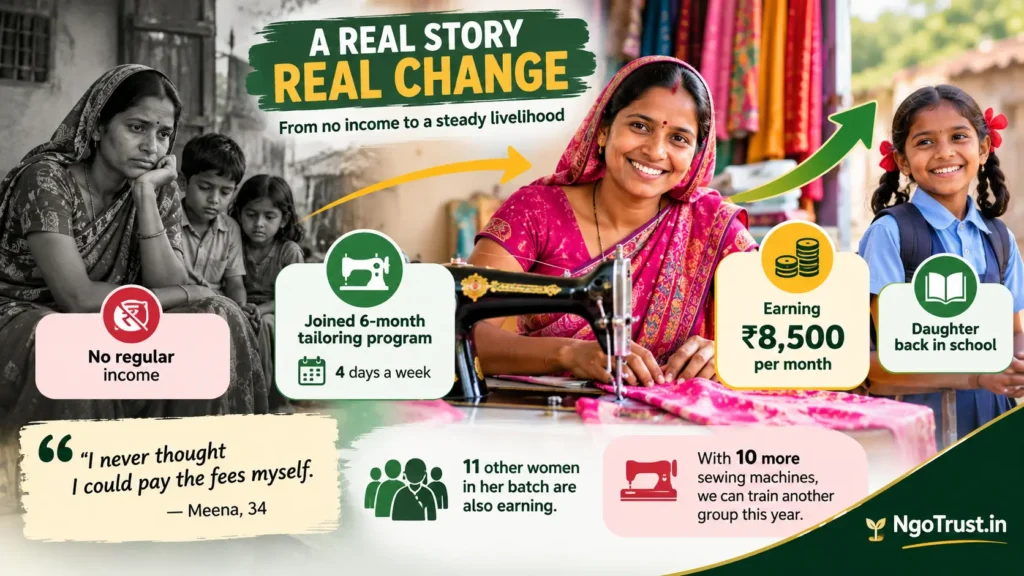
Here is a short sample, so you can see how the pieces fit together.
Meena’s tailoring shop: from no income to a steady livelihood
Meena, 34, lives in a small village in Jharkhand. After her husband lost his job, she had no regular income and two children to feed. In January, she joined our six-month tailoring program, attending four days a week.
By July, she had stitched her first 40 orders. Today she runs a small shop from her home and earns around 8,500 rupees a month. Her daughter is back in school after missing a year. “I never thought I could pay the fees myself,” Meena says.
Eleven other women in her batch have started earning too. With support for ten more sewing machines, we can train another group this year.
Notice what this does. It is short, it names real details, it uses one quote, and it ends with a clear need. Nothing is exaggerated.
What Makes a Case Study Believable to Donors?
Believability comes from specifics and honesty. Donors have read many stories that sound too perfect, so a little realism actually helps.
- Include a challenge. If everything went smoothly, the story sounds invented. Mention what was hard.
- Show your evidence. Link to attendance sheets, photos with dates, or a short video where possible.
- Be modest with claims. Say “our program contributed to” instead of claiming sole credit.
- Keep a record. Store the interview notes, consent forms, and data in one folder so you can answer follow-up questions quickly.
If your organization is registered and compliant, say so clearly on your website or in your pitch. Donors often check registration details on portals like NGO Darpan before they give.
What Mistakes Make Case Studies Fail?
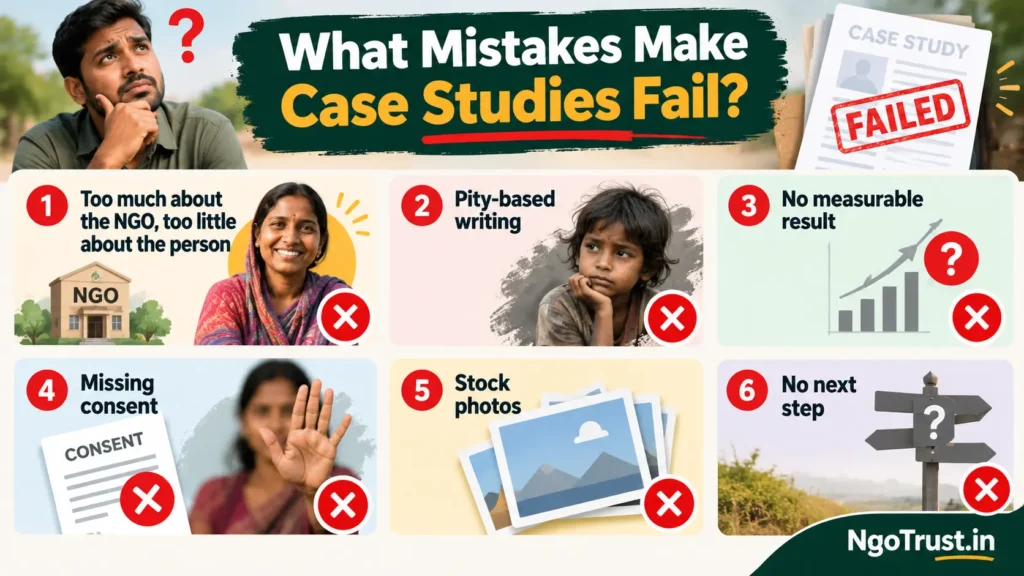
Most weak case studies fail for simple reasons. Check your draft against this list.
- Too much about the NGO, too little about the person. The beneficiary should be the center of the story, not your organization.
- Pity-based writing. Donors increasingly prefer dignity over sympathy. Show people as capable, not helpless.
- No measurable result. “Many women benefited” tells a reader nothing.
- Missing consent. This is both an ethical and a legal risk.
- Stock photos. Real photos from your own work build far more trust.
- No next step. If you never say what support is needed, donors will not guess.
Where Should You Publish and Reuse Your Case Studies?
One well-documented story can work in many places. Write it once, then adapt it.
- A dedicated page on your website, with a clear title and a few photos
- A one-page PDF for grant applications and CSR proposals
- A short post for social media with one quote and one number
- A paragraph in your newsletter or annual report
- A slide in your donor presentation
For search visibility, give each case study its own page, use a descriptive title, and add your location and program name in the text. This helps people find your work when they search for NGOs in your area or sector.
Aim to document at least one new story every month. Over a year, you will have a library of twelve verified examples, which makes every future proposal easier to write.
When Should an NGO Get Professional Help With Documentation?
Many small NGOs have a good field team but no time to write. That is normal, and it is a fair reason to ask for support.
Professional help is useful when:
- You are preparing a CSR or institutional grant proposal and need clean, verifiable material
- Your website has stories, but they are not structured for search engines or donors
- Your registrations, 12A and 80G status, or compliance documents need to be in order before you approach funders
- You have lots of field data but no clear way to turn it into stories
At SAI NGO & Business Consultancy, we help organizations with registration, compliance, and the documentation that supports credible fundraising. If you are not sure where your records stand, a short conversation is often enough to see what is missing. You can reach us through ngotrust.in whenever it suits you.
Frequently Asked Questions
What is a case study in an NGO?
An NGO case study is a short, factual account of how your work changed the situation of a person, family, or community. It includes the problem, your action, and a measurable result.
How long should a success story be?
For a website or donor proposal, 300 to 500 words is enough. A one-page PDF version works best for grant applications. Longer versions can be used for annual reports.
How do you write a success story for a nonprofit?
Choose a verified case, collect details through an interview, get written consent, and follow a Situation, Action, Result structure. Add real numbers and one direct quote from the beneficiary.
Do you need consent to publish a beneficiary’s story?
Yes. Always get written or recorded consent before publishing a story, photo, or name. For children, take consent from a parent or guardian, and change identifying details when the topic is sensitive.
What should a case study include to attract donors?
A clear problem, a specific intervention, measurable outcomes, a real quote, and a short note on what further funding can achieve. Evidence such as dated photos or records adds trust.
How often should an NGO publish new case studies?
One new story per month is a realistic target for most small organizations. Consistency matters more than volume, because donors want to see ongoing results.
Can small NGOs compete with larger ones for donor attention?
Yes. Donors often prefer small organizations that can show clear, local, well-documented results. A single honest case study can do more than a polished brochure.
Useful Links
- NGO Darpan (NITI Aayog): government portal where NGOs register and donors can verify them
- Candid: global nonprofit database and learning resources for fundraising
- Stanford Social Innovation Review: articles on nonprofit storytelling and impact measurement
- Ministry of Corporate Affairs CSR portal: official information on CSR rules in India