
SAI NGO & BUSINESS CONSULTANCY
Expert services for NGO, Trust, Society Registration & Compliance across India.
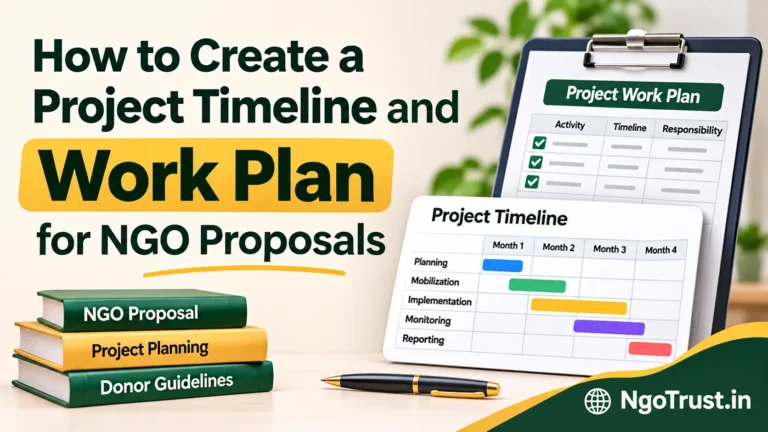
What is a project timeline and work plan for NGO proposals? It is the section of a proposal that shows what activities your NGO will carry out, who will do them, and when each one will be finished. The timeline gives the dates. The work plan gives the details behind those dates. Together, they show a donor that your project is realistic and ready to start.
Most NGOs spend weeks on the problem statement and the budget, then rush through the timeline on the last night. That is a costly habit. Donors read this section to decide one simple thing: can this team actually deliver what it promises?
This guide walks you through how to build a project timeline and work plan for NGO proposals, step by step, in plain language.
What Is a Project Timeline and Work Plan in an NGO Proposal?
A project timeline is a schedule. It shows the start and end of each major activity across the life of the project, usually in weeks or months.
A work plan is a more detailed document. It lists every activity, the person or team responsible, the resources needed, and the expected output.
Think of it this way. The timeline answers “when?” The work plan answers “what, who, and how?”
Most donors want both. Some ask for a single combined table. Others want a Gantt chart plus a written explanation. Always check the call for proposals before you decide on the format.
Why Do Donors Care About Your NGO Project Timeline?
A clear timeline tells a donor three things without you having to say them.
- You understand the scope of the work.
- You have thought about staff, time, and risks.
- You can be held accountable to dates.
Grant reviewers read dozens of proposals. A vague plan like “training will happen during the year” raises doubts right away. A specific plan like “training of 40 women farmers in Month 3 and Month 4” builds confidence.
If you are applying for CSR funding in India, this matters even more. Companies look for projects they can track and report on. You can read how CSR activities are defined under Schedule VII of the Companies Act on the Government of India’s CSR portal.
How Do You Create a Project Timeline for an NGO Proposal?
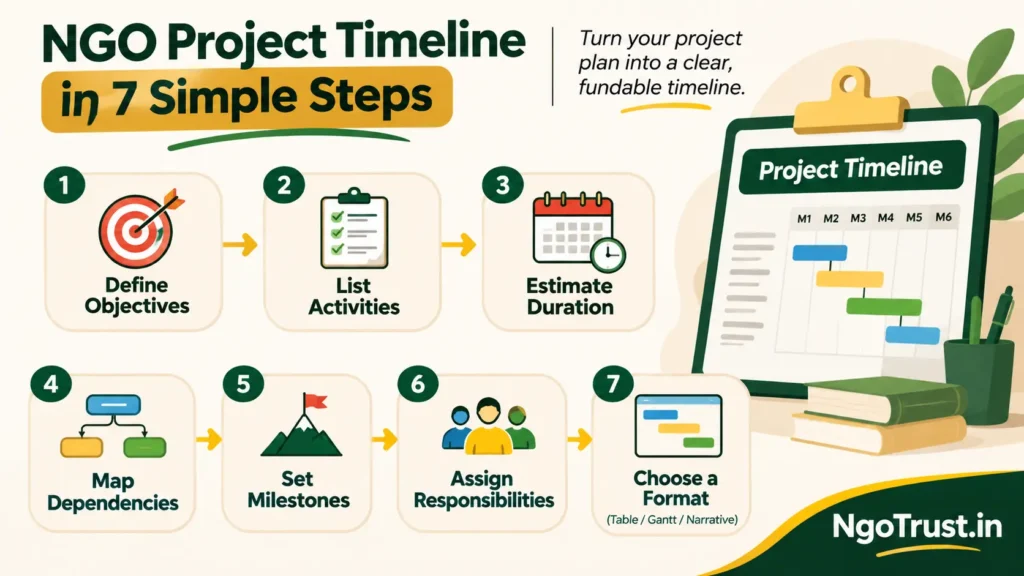
Here is a simple seven-step process that works for most small and mid-sized NGO proposals.
Step 1: Start With Your Objectives
Before you write a single date, go back to your project goals. Every activity in the work plan must connect to an objective.
If an activity does not help you reach an objective, remove it. If an objective has no activity behind it, you have a gap.
A useful tool here is the logical framework, often called a logframe. The BetterEvaluation guide to logic models and frameworks is a good reference if you are new to the idea.
Step 2: Break the Project Into Activities
List everything that needs to happen, from the first meeting to the final report. Do not worry about order yet.
A typical education or livelihood project might include:
- Hiring and training project staff
- Baseline survey
- Community meetings and registration of beneficiaries
- Core activities such as workshops, kits, or health camps
- Monitoring visits
- Mid-term review
- End-line survey and final report
Then break big activities into smaller tasks. “Run a skills workshop” is too broad. “Book venue, invite participants, print material, conduct sessions, collect feedback” is much easier to plan.
Step 3: Estimate How Long Each Activity Will Take
This is where most NGO timelines go wrong. People guess the best case and forget delays.
Use past projects as your guide. If your last health camp took six weeks to organize, do not promise three weeks this time.
Add a small buffer for things you cannot control, such as:
- Monsoon or festival seasons
- Government permissions
- Delays in fund release
- Staff recruitment
A buffer of 10 to 15 percent on the total schedule is a reasonable starting point.
Step 4: Check Which Activities Depend on Others
Some tasks cannot start until another one ends. You cannot train beneficiaries before you register them. You cannot distribute kits before you buy them.
Mark these links clearly. They help you spot the critical path, which is the chain of tasks that decides the earliest possible end date of the project.
If one task on that path slips, the whole project slips. Donors like seeing that you know which tasks those are.
Step 5: Add Milestones
A milestone is a checkpoint, not an activity. It marks something important being completed, such as “Baseline survey completed” or “500 beneficiaries enrolled.”
Milestones make your plan easy to monitor. They also give the donor natural points to review progress and release the next payment.
A 12-month project usually needs four to six milestones. More than that becomes hard to track.
Step 6: Assign Responsibilities and Resources
Next to each activity, write who is responsible. Use roles, not just names, because staff can change during the project.
For example:
- Project Coordinator: community meetings, monthly reports
- Field Officer: beneficiary registration, home visits
- Finance Officer: procurement and payment records
- M&E Officer: surveys and data checks
This small step shows donors that you have a real team behind the plan.
Step 7: Choose a Format and Keep It Clean
There are three common formats.
- Table: Best for small projects. Easy to read in a Word or PDF proposal.
- Gantt chart: Best for projects longer than six months. Shows overlap between tasks at a glance. The Project Management Institute has good material on scheduling methods.
- Narrative plus table: Best when the donor asks for a written explanation of your approach.
Whichever you pick, keep it to one or two pages if you can. A reviewer should understand your plan in two minutes.
What Should a Work Plan Include?
A good NGO work plan has six parts. Missing any of them makes the plan feel thin.
- Activity: What will be done
- Timeframe: Start and end dates, or months
- Responsible person or team: Who will do it
- Resources needed: Budget lines, materials, partners
- Output or deliverable: What exists when the task is complete
- Indicator: How you will measure success
Here is a simple example for one activity:
| Activity | Timeframe | Responsible | Output | Indicator |
| Skills training for women farmers | Month 3 to Month 4 | Field Officer, Trainer | 40 women trained | 80% attendance, 35 certificates issued |
Notice how specific each cell is. That is the standard donors expect.
How Long Should an NGO Project Timeline Be?
The length of your timeline should match the funding period. There is no fixed rule, but these ranges are common.
- Small grants and local donors: 6 to 12 months
- CSR projects: 12 to 36 months, often with yearly reviews
- Large institutional grants: 2 to 5 years, with phased plans
For longer projects, show a one-year detailed plan and a broader outline for the later years. Nobody expects you to predict month 40 with full accuracy.
If your project involves foreign funding, check the rules before you plan activities and dates. The FCRA online portal lists registration and reporting requirements that can affect your schedule.
What Are the Most Common Mistakes in NGO Work Plans?
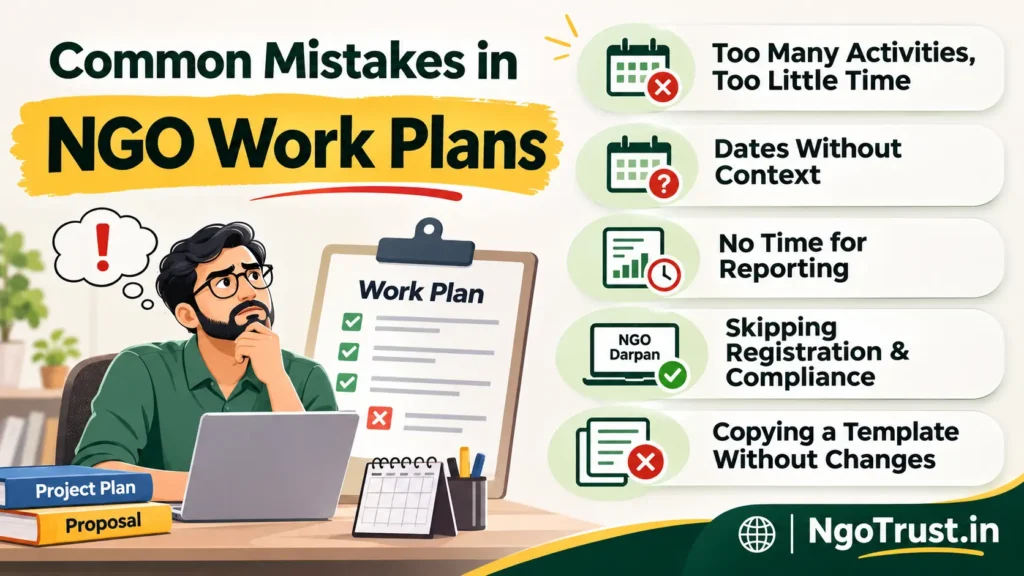
After reading many proposals, the same problems show up again and again.
Too Many Activities, Too Little Time
An overloaded plan looks unrealistic. It is better to promise less and deliver all of it.
Dates Without Context
Writing “January to March” without saying which year, or which project month, confuses reviewers. Use “Month 1 to Month 3” so the plan stays valid whenever funding starts.
No Time for Reporting
Many plans forget that reports, audits, and review meetings take time. Add them as real activities.
Ignoring the Registration and Compliance Side
Donors often check whether your organization is registered and listed on official platforms. If you are not yet listed, NGO Darpan is the government portal where NGOs register for a unique ID. Build that step into your timeline if you still need it.
Copying a Template Without Changing It
Reviewers can tell when a timeline was pasted from another proposal. Every project has its own pace, risks, and local conditions. Adjust the plan to match yours.
Quick Tips to Make Your Timeline Stronger
- Use simple verbs: “train,” “survey,” “distribute,” “review.”
- Keep activity names short and clear.
- Match every activity to a line in the budget.
- Show the monitoring and evaluation tasks, not just the field work.
- Ask someone outside the project to read it. If they cannot follow it, a donor may not either.
When Should You Ask for Professional Help?
Many NGOs can write a good timeline on their own, especially for small grants. But some situations are tricky enough to justify a second pair of eyes.
Those include large CSR proposals, projects with several partners, applications for foreign funding, or proposals where the NGO is still completing its registrations and compliance documents.
A consultant can check that your plan, budget, and legal documents all agree with each other. That consistency is something reviewers notice, even when they do not mention it.
At ngotrust.in, our team works with NGOs on registration, compliance, and proposal documents every day. If you would like a quick review of your timeline before you submit, you are welcome to get in touch.
Frequently Asked Questions
What is the difference between a project timeline and a work plan?
A project timeline shows when each major activity starts and ends. A work plan adds detail, including who is responsible, what resources are needed, and what output is expected. Most NGO proposals include both, often in one combined table.
How detailed should an NGO work plan be?
It should be detailed enough that a reviewer can see who does what, and when, without asking questions. For most proposals, one row per activity with a timeframe, owner, output, and indicator is enough.
What tool should I use to make an NGO project timeline?
For simple projects, a table in Word or Excel works well. For longer projects, a Gantt chart made in Excel, Google Sheets, or a free project tool is easier to read. Pick the tool your team can update easily.
Do I need a Gantt chart for every NGO proposal?
No. A Gantt chart is helpful for projects longer than six months or with many overlapping tasks. For short projects, a clear table is often better. Always follow the donor’s format if they specify one.
How far ahead should an NGO plan its project timeline?
Plan in detail for the first 12 months and in outline for later years. Detailed dates far in the future rarely stay accurate, and donors know that.
How many milestones should a project have?
For a 12-month project, four to six milestones are enough. Each one should mark something clear and checkable, such as a completed survey or a target number of beneficiaries reached.
Can a weak timeline get an NGO proposal rejected?
Yes. Even a strong idea can lose points if the plan looks unrealistic, vague, or disconnected from the budget. Reviewers often treat the timeline as a test of whether the NGO can actually deliver.
Ready to Make Your Next Proposal Stronger?
A clear timeline and work plan will not win a grant by themselves. But they remove doubt, and that is often what separates a funded proposal from a rejected one.
Start with your objectives, keep your activities realistic, and show who is doing what. If you get stuck, or simply want a second opinion before you hit submit, we are here to help you at ngotrust.in.
Useful Links
- ngotrust.in
- CSR Portal, Government of India
- BetterEvaluation
- Project Management Institute
- FCRA Online Portal
- NGO Darpan