
SAI NGO & BUSINESS CONSULTANCY
Expert services for NGO, Trust, Society Registration & Compliance across India.
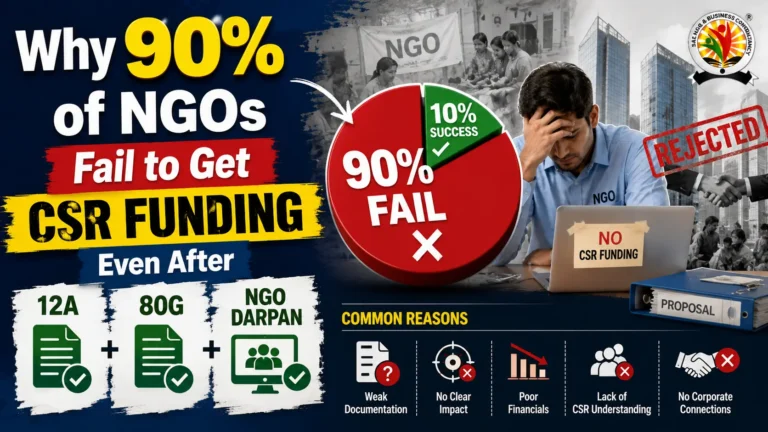
Most NGOs fail to get CSR funding not because they lack 12A, 80G, or NGO Darpan registration, but because they are missing CSR-1 registration with the Ministry of Corporate Affairs (MCA), have weak project documentation, no measurable impact data, and no visibility with corporate CSR teams. CSR funding rules under Section 135 of the Companies Act, 2013 require far more than tax registrations alone.
If you run an NGO in India, you have probably heard this advice a hundred times: “Get your 12A, get your 80G, register on NGO Darpan, and the CSR money will follow.”
It sounds simple. So why do so many well-meaning NGOs, with all three registrations in place, still struggle to land even one corporate CSR grant?
The honest answer is that 12A, 80G, and NGO Darpan are entry tickets, not the main event. They prove your NGO is legally compliant and eligible for tax benefits. But CSR funding works on a completely different set of rules, and most NGOs never learn what those rules actually are.
This post breaks down exactly why that gap exists, and what your NGO needs to do to actually start winning CSR funding, not just qualify for it on paper.
What Is CSR Funding and Why Does It Matter for NGOs?
CSR funding is money that companies are legally required to spend on social development activities under Section 135 of the Companies Act, 2013. Companies above a certain turnover, net worth, or profit threshold must spend at least 2% of their average net profit on CSR projects every year.
For NGOs, CSR funding is one of the largest and most reliable sources of project money in India. Thousands of crores are spent by Indian companies on CSR every year, and a meaningful share of that goes to NGOs that implement projects on the ground.
But here is the part most NGOs miss: a company cannot simply hand money to any registered NGO. The law lays down strict conditions on who is allowed to receive and implement that money, and 12A, 80G, and NGO Darpan are only a small part of that list.
Why 12A, 80G, and NGO Darpan Registration Are Not Enough
12A registration exempts your NGO’s income from tax. 80G lets your donors claim a tax deduction. NGO Darpan is a government database that gives your NGO a unique ID. All three are useful and necessary.
None of them, however, tell a company that your NGO is legally eligible to receive CSR funds. That eligibility comes from a completely separate registration that many NGOs simply do not know about.
The Missing Piece: CSR-1 Registration with the MCA
Since April 1, 2021, every NGO, trust, society, or Section 8 company that wants to implement CSR projects must file Form CSR-1 with the Ministry of Corporate Affairs (MCA). This is verified digitally by a practising Chartered Accountant, Company Secretary, or Cost Accountant, and approval generates a unique CSR Registration Number.
Without this CSR Registration Number, a company legally cannot count its contribution to your NGO as valid CSR spending, no matter how good your work is. This single missing form is the biggest, most overlooked reason NGOs get rejected before a company even looks at their projects.
Good to Know CSR-1 registration usually requires your NGO to already hold valid 12A and 80G registration, along with at least three years of operational track record for privately established entities. So 12A and 80G are prerequisites for CSR-1, not substitutes for it.
The Real Reasons NGOs Lose Out on CSR Funding

Once CSR-1 is sorted, the real competition begins. Corporate CSR teams receive hundreds of proposals every quarter and reject most of them for reasons that have nothing to do with registration certificates.
1. No Clear, Measurable Impact
Companies want to see numbers: how many children educated, how many trees planted, how many families supported, and how that translates into measurable change. NGOs that describe their work in vague, emotional terms without data tend to lose out to NGOs that present clear outcomes.
2. Weak or Generic Project Proposals
A proposal copied from last year’s template, with the company name changed, is easy to spot. CSR teams favour NGOs that tailor their pitch to the company’s specific CSR policy, focus areas, and the regions where that company operates.
3. Poor Financial Transparency
Companies and their CSR committees are personally accountable for how CSR money is spent. If your NGO cannot produce audited financial statements, utilisation certificates, or a clean track record of past grants, most corporates will not take the risk.
4. No Visibility with Corporate CSR Teams
Many strong NGOs simply never get noticed. They are not listed on CSR-focused platforms, do not attend CSR networking events, and have no one actively building relationships with corporate CSR or foundation teams. CSR funding rarely comes looking for you; you usually have to be found, or go find it.
5. Mismatch with the Company’s CSR Policy
Every company has a board-approved CSR policy that defines its focus areas under Schedule VII, such as education, healthcare, livelihood, or environment. NGOs that approach companies without checking this alignment first are rejected, regardless of how good their work is.
6. Governance and Compliance Gaps
Outdated board details, missing annual filings, inconsistent NGO Darpan information, or an inactive PAN and bank account can quietly disqualify an NGO during due diligence, even after the proposal stage looks promising.
How Can NGOs Actually Improve Their CSR Funding Chances?
None of this means CSR funding is out of reach. It simply means the approach needs to go beyond basic registrations.
• Complete CSR-1 registration on the MCA portal as soon as 12A and 80G are in place.
• Build a one-page impact summary with clear numbers, not just stories.
• Keep audited financials, utilisation certificates, and NGO Darpan details fully updated every year.
• Research each company’s CSR policy and Schedule VII focus area before reaching out.
• List your NGO on credible CSR and CSR implementing-agency platforms for visibility.
• Build long-term relationships with CSR teams instead of one-time funding requests.
12A, 80G, NGO Darpan vs CSR-1: What Each Registration Actually Does
| Registration | What It Does | Is It Enough for CSR Funding? |
|---|---|---|
| 12A | Exempts NGO income from income tax | No |
| 80G | Allows donors to claim tax deduction | No |
| NGO Darpan | Assigns a unique government ID to the NGO | No |
| CSR-1 (MCA) | Legally authorises the NGO to receive and implement CSR funds | Yes, this is mandatory |
Frequently Asked Questions About NGO CSR Funding
Is 12A and 80G registration enough to get CSR funding?
No. 12A and 80G only provide tax benefits. To legally receive CSR funds from a company, an NGO must also complete CSR-1 registration with the Ministry of Corporate Affairs.
What is CSR-1 registration and who needs it?
CSR-1 is a mandatory MCA form that registers an NGO, trust, society, or Section 8 company as an eligible CSR implementing agency. Any organisation that wants to receive CSR funds from companies under the Companies Act, 2013 needs this registration.
Why do companies reject NGOs with all the right registrations?
Registrations only confirm legal eligibility. Companies also evaluate project quality, measurable impact, financial transparency, and alignment with their CSR policy. NGOs that are weak in these areas get rejected even with complete paperwork.
How long does CSR-1 registration take?
CSR-1 is typically processed on a straight-through basis on the MCA portal once a Chartered Accountant, Company Secretary, or Cost Accountant digitally verifies the form, so approval is usually quick once the application is correctly filed.
Can a new NGO without a track record get CSR funding?
It is harder but not impossible. Most companies and CSR-1 rules favour NGOs with at least three years of activity, so newer NGOs often start with smaller grants, partnerships with established NGOs, or non-CSR funding sources while they build a track record.
Where can NGOs check official CSR funding rules?
The official rules, notifications, and CSR-1 form are available on the MCA portal and the Ministry of Corporate Affairs CSR section.
Getting CSR-Ready Takes More Than Paperwork
Having 12A, 80G, and NGO Darpan registration is a solid foundation, but it is only the starting point. CSR funding goes to NGOs that are fully compliant, well-documented, and genuinely visible to the companies looking to fund work like theirs.
If your NGO has the registrations but the funding still is not coming through, it may be worth getting a proper review of your CSR-1 status, your documentation, and your overall CSR readiness from someone who works with this regularly.
We work with NGOs on exactly this kind of compliance and CSR readiness support. If you would like a second opinion on where your NGO stands, feel free to reach out to us for a quick consultation.
Useful Links
- Ministry of Corporate Affairs (MCA) Portal
- NGO Darpan (NITI Aayog)
- Income Tax India (12A/80G registration)
- Companies Act, 2013, Section 135 (CSR) reference, MCA