
SAI NGO & BUSINESS CONSULTANCY
Expert services for NGO, Trust, Society Registration & Compliance across India.
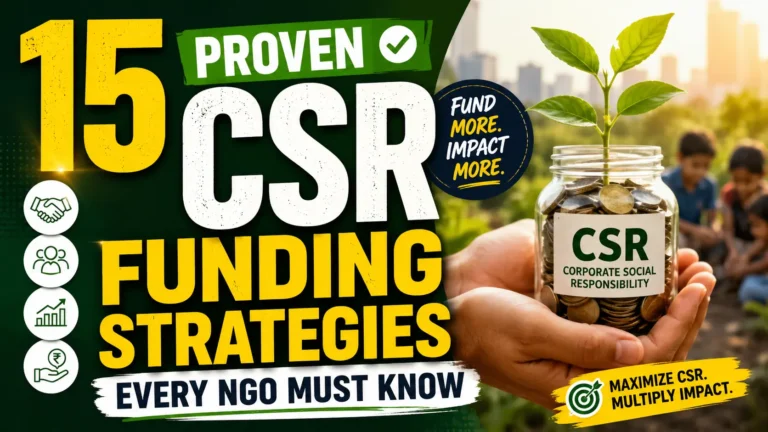
CSR Funding Strategies are practical approaches NGOs use to attract corporate social responsibility grants and partnerships. These strategies include compliance, impact reporting, networking, proposal writing, and relationship-building with companies.
CSR funding for NGOs refers to financial support that companies provide to non-profit organisations as part of their Corporate Social Responsibility obligations or voluntary giving programmes.
In India, companies with a net worth of Rs 500 crore or more, or an annual turnover of Rs 1,000 crore or more, or a net profit of Rs 5 crore or more are legally required under Section 135 of the Companies Act, 2013 to spend at least 2% of their average net profit on CSR activities.
For NGOs, this legal mandate has created a significant and growing pool of corporate funding. But accessing that funding is not automatic. You need the right strategy, the right relationships, and the right approach to make your case.
Why Most NGOs Struggle to Access CSR Funds
Thousands of NGOs are competing for the same CSR budgets every year. Companies receive hundreds of proposals but only fund a small percentage of them.
The NGOs that succeed are not always the ones doing the best work on the ground. They are the ones that communicate clearly, align with corporate priorities, and make it easy for companies to say yes.
The good news is that CSR funding strategies for NGOs are learnable. Whether you are approaching a company for the first time or trying to renew a partnership, the right approach makes all the difference.
15 CSR Funding Strategies That Work
1. Align Your Work With the Company’s CSR Focus Areas
Every company has defined CSR focus areas, whether it is education, healthcare, environment, women’s empowerment, or rural development. Before you approach any company, research what they have funded in the past. Look at their annual reports and CSR policy statements.
When your work genuinely fits their priorities, say so clearly. Do not try to stretch your proposal to cover everything. A focused, relevant pitch is far more effective than a broad one.
2. Register on the MCA CSR Portal and Key Platforms
The Ministry of Corporate Affairs (MCA) maintains a CSR portal where companies can find implementing organisations. Registering your NGO on this platform gives you visibility with companies that are actively looking for partners.
Also ensure your NGO is registered and active on:
- NGO Darpan (NITI Aayog)
- GuideStar India
- Credibility Alliance
- Give India
Companies use these platforms to verify NGO credibility and find partners. An incomplete or outdated profile is a missed opportunity.
3. Build a Strong, Transparent Track Record
Companies want to see that their money will be used well. Before approaching anyone, make sure your organisation has audited accounts, clear beneficiary data, impact reports, and documented project outcomes.
If you have past CSR partnerships, use those case studies. Numbers matter. Tell companies how many lives you have touched, what changed, and how you measured it.
4. Write Proposals That Speak the Corporate Language
A common mistake NGOs make is writing proposals that are too emotional or too vague. While your work is meaningful, corporate CSR teams are often evaluating multiple proposals at once.
Your proposal should include:
- A clear problem statement with data
- Specific, measurable outcomes
- A detailed budget with justifications
- A monitoring and evaluation framework
- Your organisation’s credentials and past impact
Think of it as a business case, not a charity appeal.
5. Identify the Right Contact Person
Most proposals get lost because they are sent to the wrong email address. Many companies have a dedicated CSR head or a CSR committee. Find out who that person is. LinkedIn is a great tool for this.
A warm introduction through a mutual contact is worth ten cold emails. Attend industry events, CSR forums, and conferences where corporate leaders are present.
6. Approach Local Businesses, Not Just Large Corporations
Smaller NGOs often make the mistake of only approaching Fortune 500 companies. But mid-sized and regional businesses also have CSR obligations and are often more accessible. They may be more willing to fund local causes, and they are less likely to be overwhelmed by competing proposals.
The competition for smaller company CSR funds is far lower. Start local. Build your portfolio. Then approach larger funders with a proven track record.
7. Offer Co-Branding and Visibility Opportunities
Companies are not just making donations; they are investing in their reputation. Show them what they get in return. This could include logo placement in reports, acknowledgement on social media, mentions in events, or photographs of funded projects for their annual reports.

When companies see that partnering with your NGO enhances their brand and satisfies their stakeholders, they become long-term supporters.
8. Focus on Long-Term Partnerships, Not One-Time Grants
One of the most effective CSR funding strategies for NGOs is to think beyond individual grants. Companies prefer to partner with organisations they trust over multiple years. A multi-year partnership provides more predictable funding for your NGO and less administrative work for the company.
When pitching, propose a 2 to 3 year roadmap with milestones. This shows that you are thinking strategically, not just looking for short-term support.
9. Leverage Employee Volunteering Programmes
Many companies run employee volunteering or pro-bono programmes alongside their CSR spending. Offering employee engagement opportunities, such as mentoring sessions, skill-building workshops, or community visits, can open the door to funding conversations.
When employees feel personally connected to an NGO, they often become internal advocates, which can significantly influence the company’s funding decisions.
10. Tap Into CSR Foundations and Implementing Agencies
Several large companies run their own foundations, such as the Tata Trusts, Azim Premji Foundation, or the Reliance Foundation. These foundations have dedicated grant programmes with published eligibility criteria.
Similarly, some companies work through CSR implementing agencies that distribute funds across multiple NGOs. Partnering with these intermediaries can help you access funding faster than approaching companies directly.
11. Respond to CSR Calls for Proposals (CFPs)
Many companies release formal calls for proposals, especially at the start of their financial year. Keep an eye on company websites, the MCA CSR portal, and platforms like DevNetJobs and Samhita for active CFPs.
Responding to a CFP shows initiative and gives you a structured opportunity to present your case without cold outreach.
12. Use Social Media and Digital Presence Strategically
CSR managers do their research. When they receive your proposal, they will look your organisation up online. A professional website, active social media presence, and regular impact updates build credibility before you even get into a room with them.
Share stories, data, and outcomes on LinkedIn, Twitter/X, and Instagram. Tag companies that have supported your work. This demonstrates accountability and keeps your organisation visible to potential funders.
13. Get Your Legal and Compliance Paperwork in Order
Companies cannot fund an NGO that does not have its documentation in order. Before approaching any funder, ensure you have:
- 12A and 80G registration under the Income Tax Act
- FCRA registration (if applicable)
- Audited financial statements for at least 3 years
- Society or trust registration certificate
- PAN and bank account details
These are basic requirements. Companies will ask for all of these, and being ready shows professionalism.
14. Submit Regular, Transparent Impact Reports
Once you receive CSR funding, the real work begins. The companies that fund you need to show their boards, auditors, and shareholders what the money achieved. Make their job easy.
Provide quarterly updates, clear financial utilisation reports, and beneficiary stories with photos. An NGO that reports well is an NGO that gets funded again.
15. Ask for a Renewal Before the Project Ends
Most NGOs wait until a project is over before requesting more funds. By then, the company has often already allocated its next round of CSR spending. Start conversations about renewal 3 to 4 months before the project ends.
Share early results, highlight what the second phase would achieve, and make it easy for them to say yes again. Renewal is far easier than starting from scratch.
Do You Need Professional Support?
Navigating the CSR funding landscape takes time, knowledge, and strong communication skills. Many NGOs have excellent programmes but struggle to present them in a way that resonates with corporate funders.
If you are finding it difficult to identify the right companies, structure your proposals, or build corporate relationships, working with a CSR consulting firm or a fundraising advisor can make a significant difference. They bring existing networks, know what companies are looking for, and can help you position your work more effectively.

It is not about outsourcing your mission. It is about getting the support that helps your mission reach more people.
Frequently Asked Questions
What are the best CSR funding strategies for a new NGO?
The most effective starting point for a new NGO is to get legal and compliance paperwork in order, register on platforms like NGO Darpan and GuideStar India, and approach local or mid-sized companies before targeting large corporations. Building a documented track record early makes it significantly easier to win larger CSR grants later.
How do I find companies that fund NGOs through CSR?
You can find potential CSR funders through the MCA CSR portal, company annual reports, platforms like Samhita and Dasra, and by tracking news about CSR activities in your sector. Look for companies whose stated CSR focus areas match your NGO’s work.
How much can an NGO receive from CSR funding?
There is no fixed upper limit per NGO. A company’s total CSR spend depends on its profits, but how that is distributed across NGOs varies. Some NGOs receive small project grants of Rs 5-10 lakhs, while established organisations may receive crores for multi-year programmes.
Is it necessary to be registered under 12A and 80G to receive CSR funds?
Yes, most companies require NGOs to have 12A and 80G registration before disbursing CSR funds. These registrations confirm your legal and tax-exempt status and give companies the ability to claim tax deductions, which is an important consideration for their finance teams.
What makes a CSR proposal stand out?
A standout CSR proposal clearly aligns with the company’s focus areas, presents measurable outcomes, includes a realistic budget, demonstrates past impact, and is easy to read. Avoiding jargon and being specific about what the company’s money will achieve are key factors that corporate CSR teams look for.
How do NGOs build long-term CSR partnerships?
Long-term CSR partnerships are built on transparency, regular communication, and demonstrated impact. Submit timely and detailed reports, involve corporate employees in project activities, celebrate milestones with the company publicly, and start renewal conversations early. Reliability and accountability are the foundations of any lasting relationship.
Ready to Strengthen Your CSR Funding Approach?
Getting CSR funding right takes time, strategy, and a clear understanding of what corporate partners are looking for. If you would like a second opinion on your proposal, help identifying potential funders, or guidance on structuring your CSR outreach, a short consultation can point you in the right direction.
Reach out for a no-obligation conversation about where your NGO stands and what practical steps can help you access more CSR funding. Sometimes a small shift in approach leads to a significant difference in results.
Useful Links
- MCA CSR Portal (Ministry of Corporate Affairs)
- NGO Darpan – NITI Aayog
- GuideStar India
- Give India – NGO Listing Platform
- Credibility Alliance
- Samhita – CSR and Social Sector Platform
- Dasra – Philanthropy Advisory
- DevNetJobs – Development Sector Opportunities
- Tata Trusts
- Azim Premji Foundation
- Reliance Foundation
- Companies Act, 2013 – Section 135 (CSR)
This blog post is for educational purposes. All company and regulatory links are publicly available resources.