
SAI NGO & BUSINESS CONSULTANCY
Expert services for NGO, Trust, Society Registration & Compliance across India.
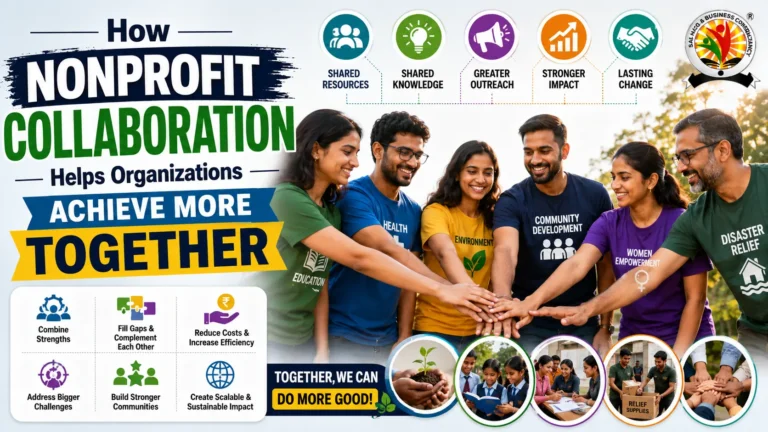
What Is Nonprofit Collaboration? Nonprofit collaboration is when two or more NGOs, social enterprises, government bodies, or corporate partners work together toward a shared social goal, combining their resources, skills, and networks to create a bigger, more lasting impact than any one organization could achieve alone.
If you run an NGO or work in the social sector, you have probably felt it: the pressure to do more with less, to compete for the same donors, and to prove your impact every single year.
But what if the answer was not to compete harder, but to collaborate more?
Across India and globally, forward-thinking nonprofits are proving that collaboration is not just a nice idea. It is a practical, powerful strategy for long-term growth, stronger funding, and deeper community impact.
Here is a clear-eyed look at why nonprofit collaboration is the future of the social sector, and how your organization can be a part of it.
The Nonprofit Sector Is Changing Fast
India alone has over 3 million NGOs registered across different legal structures. According to the Ministry of Statistics, the number of registered associations and charitable organizations in India has grown significantly over the past two decades.
Yet funding has not kept pace. CSR contributions, government grants, and international donor funds are spread thin across thousands of organizations, many of whom are working on the same problems in the same communities.
The result? Duplication of effort. Wasted resources. And in many cases, communities that remain underserved despite the presence of multiple NGOs.
Collaboration offers a real way out of this cycle.
Why Is Nonprofit Collaboration So Important Right Now?
Funders Are Actively Looking for Collaborative Proposals
This is not just a trend. It is a shift in how major funders think about impact.
Organizations like the Ford Foundation and India’s leading CSR departments now openly prefer grant proposals that show multi-organization partnerships. A single NGO competing against a consortium of three or four is at a real disadvantage.
Collaboration signals credibility. It shows donors that organizations are focused on the mission, not just the money.
Complex Problems Need Collective Solutions
Issues like rural education, malnutrition, climate resilience, or women’s safety are too layered for any single organization to solve alone.
A healthcare NGO might reach a village, but without a livelihood NGO providing income support, the health interventions may not stick. A legal rights organization might train women, but without a shelter partner, those women may have nowhere to go.
Collaboration allows organizations to plug into each other’s strengths, creating a whole that is greater than the sum of its parts.
It Reduces Costs and Increases Reach
When NGOs collaborate, they share overheads. Joint field teams. Shared monitoring systems. Co-branded awareness campaigns.
This is not just good management. It is what makes scale possible without proportionally increasing costs.
What Does Nonprofit Collaboration Actually Look Like?
Collaboration in the social sector is not one-size-fits-all. It can take many forms depending on the size, sector, and goals of the organizations involved.
• Program Partnerships: Two or more NGOs co-implement a project in the same geography, with each handling a defined set of activities.
• Resource Sharing: Sharing office space, field staff, vehicles, or monitoring systems to reduce costs.
• Advocacy Coalitions: Multiple organizations joining together to push for a policy change or amplify a social message.
• Knowledge Networks: NGOs coming together to share best practices, research, and training resources.
• Consortium Funding: A group of NGOs applying jointly for large government or CSR grants that none could apply for individually.
Each model has its own dynamics, but all of them require trust, clear agreements, and defined roles.
Common Challenges in Nonprofit Collaboration (And How to Handle Them)
Collaboration sounds good in theory. In practice, it comes with real challenges.
Fear of Losing Credit or Visibility
Many NGOs worry that partnership will dilute their brand or allow others to take credit for their work. This is a legitimate concern, especially in a competitive funding environment.
The solution lies in clear written agreements that define who does what, and how impact is attributed. A well-drafted memorandum of understanding (MOU) between partners can address this upfront.
Differences in Vision or Values
When two organizations have different ideas about how to serve communities, tensions can arise. It is important to align on goals and methods before formalizing any partnership.
Legal and Compliance Complexity
In India, NGOs operating under different legal structures (Trust, Society, Section 8 Company) may face unique challenges when entering formal partnerships. Handling FCRA compliance, shared fund accountability, and reporting requirements across organizations requires careful planning.
This is an area where professional guidance can save organizations significant time and risk.
How the Indian Government and Global Bodies Are Supporting Collaboration
India’s NITI Aayog has consistently pushed for NGO networks and federated approaches to social sector work. Its Darpan portal, for example, was set up specifically to bring NGOs into formal coordination with government programs.
Globally, the United Nations Sustainable Development Goals (SDGs) explicitly call for multi-stakeholder partnerships as a core strategy. SDG 17 is entirely focused on partnerships for the goals.
This means collaboration is not just a best practice. It is increasingly a requirement for NGOs that want to access government funding, international grants, or participate in large-scale social programs.
The Future Belongs to NGOs That Build Bridges
Over the next decade, the nonprofit sector in India will look very different from what it does today.
Organizations that invest in building genuine partnerships with other NGOs, with government bodies, with corporate CSR departments, and with academic institutions will be the ones that grow, scale, and sustain their impact.
Those that stay isolated, protecting their turf, and duplicating efforts will struggle to survive as funders become more selective and communities demand more accountability.
The shift is already happening. NGOs across states like Maharashtra, Tamil Nadu, and Karnataka are forming issue-based networks. District-level coalitions are working on nutrition, education, and livelihood goals together.
The question is not whether collaboration will shape the future of nonprofits. It already is. The question is whether your organization will be a part of it.
Thinking About Formalizing a Partnership?
If your NGO is considering a collaborative initiative, whether that means drafting an MOU, setting up a consortium for a funding proposal, or navigating the legal aspects of a multi-organization project, getting the structure right from the start matters a great deal.
At SAI NGO & Business Consultancy, we work with nonprofits across India to help them structure compliant, effective, and sustainable partnerships. From legal documentation to compliance support, we are here to help your organization move forward with confidence.
You are welcome to reach out to us at aqua-pony-237497.hostingersite.com to talk through your goals. No pressure, just a straightforward conversation.
Frequently Asked Questions (FAQ)
What is nonprofit collaboration?
Nonprofit collaboration is when two or more organizations in the social sector join forces to work toward a common goal. This can involve sharing resources, co-implementing programs, or jointly applying for funding.
Why should NGOs collaborate instead of working independently?
Collaboration allows NGOs to pool resources, reduce costs, expand their reach, and build stronger cases for funding. It helps avoid duplication of effort and creates more comprehensive solutions for complex social problems.
Is nonprofit collaboration legally recognized in India?
Yes. NGOs in India can formalize collaborations through MOUs, consortium agreements, or by forming umbrella networks. Organizations must ensure that any shared funding arrangements comply with FCRA regulations and their own governing documents.
How do NGOs find partners for collaboration?
NGOs can connect with potential partners through NITI Aayog’s Darpan portal, issue-based networks, district-level coordination meetings, and platforms like GuideStar India. Attending conferences and workshops in the social sector is also a good way to build relationships.
What are the risks of nonprofit collaboration?
Common risks include credit disputes, misaligned values, fund mismanagement, and compliance issues. These can be minimized with clear written agreements, defined roles, joint accountability mechanisms, and proper legal guidance.
Do funders prefer collaborative proposals?
Yes. Many major funders, including international donors and large CSR programs, actively prefer proposals that show multi-organization partnerships. Consortium applications often access larger grant amounts than individual applications.
Useful Links
1. Ford Foundation – International philanthropic organization supporting civil society and social change initiatives.
2. NITI Aayog – India’s premier policy think tank; promotes NGO-government collaboration through the Darpan portal.
3. United Nations SDGs – SDG 17 – Global goals framework that emphasizes partnerships as a key strategy for development.
4. NGO Darpan Portal – Official NITI Aayog portal for NGO registration and government coordination in India.
5. GuideStar India – Platform for NGO transparency and networking in India.
6. SAI NGO & Business Consultancy (NGOTrust.in) – Legal and compliance support for NGOs across India, including partnership structuring and registration.