
SAI NGO & BUSINESS CONSULTANCY
Expert services for NGO, Trust, Society Registration & Compliance across India.
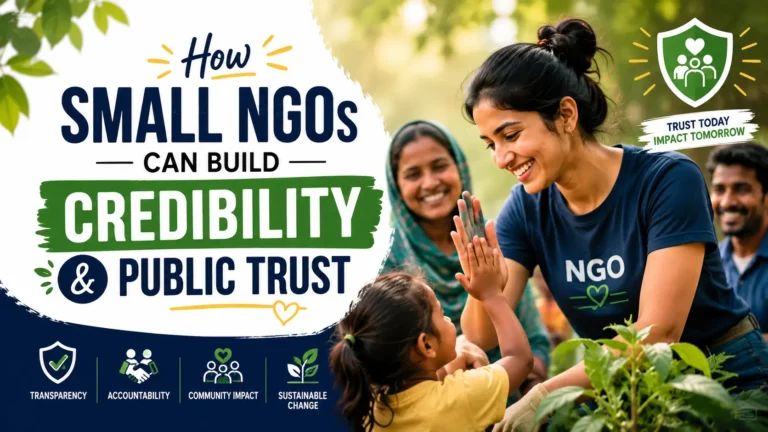
NGO credibility is the degree to which donors, beneficiaries, government bodies, and the general public trust that your organization is genuine, well-managed, and delivering real impact. For a small NGO, it means being seen as honest, compliant, and worthy of support — even without a large brand name or decades of history behind you.
Trust is not automatic. It is earned.
If you run a small NGO, you already know this feeling. You are doing meaningful work in your community, but people hesitate to donate. Corporates ask for documents you are still figuring out. Government officials want certificates you have not obtained yet. Beneficiaries are cautious.
The problem is not your work. The problem is visibility and verification. People cannot see what you are doing, and they have no easy way to verify that your NGO is legitimate.
The good news? Building credibility and public trust as a small NGO is absolutely possible. It takes some deliberate steps, but none of them are out of reach.
Why Public Trust Is the Foundation of Every Successful NGO
Before we talk about how to build trust, it helps to understand why it matters so deeply for small organizations.
A large, well-known NGO benefits from decades of brand recognition. When someone hears the name, they already have a mental picture of reliability. Small NGOs do not have that luxury. Every interaction — a conversation at a community event, a visit to your website, a WhatsApp message asking for donations — is a trust-building opportunity.
Here is what lack of trust costs you:
- Donors hold back their contributions
- CSR departments skip you for larger, more ‘safe’ organizations
- Volunteers are unsure whether to commit time
- Government schemes and grants become harder to access
- Communities hesitate to engage with your programs
Trust, simply put, is what turns goodwill into action.
Start with Legal Registration — It Signals You Are Serious

The single most effective first step a small NGO can take to build credibility is to get properly registered.
In India, NGOs can be registered as a Trust, Society, or Section 8 Company. Each structure has its own advantages, but all of them give your organization a legal identity — something a donor, government authority, or CSR committee can look up and verify.
Beyond basic registration, there are key certifications that dramatically increase your NGO’s credibility:
12A Registration
This registration from the Income Tax Department certifies your NGO as a non-profit entity. It allows your organization’s income to be exempt from tax under the Income Tax Act, 1961. Donors recognize this as a sign of formal recognition by the Government of India.
80G Certification
This is often the certification that moves individual donors from interested to committed. Under 80G, donors can claim a tax deduction on the amount they donate to your NGO. When you hold this certification, you are no longer just asking someone for money. You are also giving them a financial benefit. That changes the conversation entirely.
Darpan Registration (NITI Aayog)
The NITI Aayog NGO Darpan portal is a government-maintained database of registered NGOs in India. Getting listed here is a public signal that your organization is real, registered, and accountable. Government agencies and CSR departments often check this portal before partnering with an NGO.
Be Transparent About How You Use Funds
Transparency is not just a good practice. It is the most direct path to public trust.
People want to know where their money goes. Many small NGOs fail to communicate this clearly, and donors are left wondering. That silence breeds doubt.
Here are practical ways to show financial transparency:
- Publish an annual report — even a simple PDF shared on WhatsApp and your website goes a long way
- Share fund utilization statements with donors after each campaign or project
- Maintain proper audited accounts and share summary results publicly
- Use platforms like GiveIndia or Milaap that show how donations are spent in real time
- Post regular project updates with photos, numbers, and honest reflections
When you show the math — even imperfect, even small — people respect it. A Rs. 50,000 project report that clearly shows where every rupee went builds more trust than a vague claim of impact.
Tell Real Stories — Not Just Numbers
Facts inform. Stories move people.
When someone reads ‘we helped 200 children’, it is a number. When they read about one child — her name, her village, what changed for her after your program — that is something they feel.
Real stories of real beneficiaries do more for small NGO credibility than any brochure. You do not need polished videos. A genuine photo and two paragraphs shared on Facebook or Instagram can create a connection that lasts.
Content to consider sharing regularly:
- Before-and-after stories from your community programs
- Volunteer experiences and testimonials
- Challenges your team faced and how you solved them
- Behind-the-scenes work: field visits, team meetings, logistics
- Quotes from community members in their own words
Authenticity is your competitive advantage as a small NGO. Use it.
Build a Simple, Credible Online Presence
If someone cannot find your NGO online, it raises immediate red flags. A basic but well-maintained web presence tells the world that your organization is real and active.
You do not need an expensive website. You need:
- A clean website with your mission, team photos, registration details, and contact information
- A Google Business Profile — free, easy to set up, and it shows up when someone searches your NGO’s name
- Active social media pages (even just Facebook or Instagram) with consistent updates
- A listed profile on the NGO Darpan portal and GuideStar India
Put your registration numbers on your website. Many NGOs hesitate to share this information publicly, but visible registration numbers — Trust Deed number, 12A certificate number, 80G approval number — are trust signals, not risks.
Work With Your Community, Not Just For Them
One of the quietest but most powerful ways to build NGO trust is to involve the community itself in your decision-making.
When local people see their neighbors on your team — as volunteers, advisors, or even just regular attendees at your meetings — they feel seen and included. That sense of inclusion is the deepest form of trust.
Practical ideas:
- Form a local advisory committee with community elders or residents
- Hold community meetings before starting new programs
- Ask for feedback and show how you acted on it
- Celebrate community milestones — school enrolment increases, health camp outcomes
- Partner with local schools, panchayats, or self-help groups
When the community owns the mission alongside you, your NGO’s credibility becomes community credibility — and that is very difficult to question.
Stay Compliant — Consistency Builds Long-Term Trust
Compliance is not just a legal obligation. It is a trust-building tool.
Filing your annual returns on time, renewing your 12A and 80G certifications, maintaining proper accounts, and keeping your Darpan profile updated — these actions send a consistent message: we are serious, we are organized, and we are here for the long run.
NGOs that miss compliance deadlines — even accidentally — face reputational damage that takes years to recover from. A single lapse in filing can raise questions that take months of clean records to answer.
Key compliance areas for small NGOs in India:
- Annual filing with the Registrar (Trusts, Societies, or ROC for Section 8)
- Income Tax Return (ITR-7) filing every year
- Renewal of 12A and 80G registrations as required
- FCRA compliance if you receive foreign donations
- CSR-1 registration if you seek corporate CSR funds
- Annual report submission on the NGO Darpan portal
Frequently Asked Questions
How can a small NGO build trust with donors?
A small NGO can build trust with donors by getting legally registered, obtaining 12A and 80G certifications, publishing transparent financial reports, sharing real beneficiary stories, and maintaining consistent social media updates. Donors trust what they can verify and relate to.
Is NGO registration necessary for building credibility?
Yes. NGO registration is the first and most important step toward credibility. Without it, your organization has no legal identity, which makes it very difficult for donors, government bodies, and corporate CSR departments to trust or support you.
What is the role of transparency in NGO public trust?
Transparency is central to public trust. When an NGO openly shares how it spends funds, who benefits from its programs, and what challenges it faces, it removes the doubt that keeps potential supporters on the sidelines. Transparency signals nothing to hide.
How does 80G registration help NGOs attract more donors?
80G registration allows donors to claim a tax deduction on their contributions. This makes donating financially beneficial for individuals and businesses, removing one of the most common reasons people hold back. It also signals that your NGO is recognized and approved by the Income Tax Department of India.
Can a small NGO with limited resources still build public trust?
Absolutely. Building NGO credibility does not require a large budget. Consistent communication, honest storytelling, proper legal compliance, and genuine community engagement cost very little money but deliver enormous trust. Many of the most trusted grassroots NGOs in India operate with minimal resources.
Need Help Getting Started?
Building credibility takes consistent effort, but the foundation — proper legal registration and certification — is something you can put in place relatively quickly.
If you are unsure about which registration is right for your NGO, or if you need help with 12A, 80G, Darpan registration, or annual compliance, a short conversation with an experienced consultant can save you months of confusion.
At SAI NGO & Business Consultancy, we work with small NGOs across India to help them get the registrations and certifications they need — clearly, affordably, and correctly. Feel free to get in touch if you have questions or just want to talk through your options.
Visit us at aqua-pony-237497.hostingersite.com or reach out through our contact page to start a conversation.
Useful Links
- NITI Aayog NGO Darpan Portal: https://ngodarpan.gov.in
- Income Tax Department India (12A / 80G): https://www.incometax.gov.in
- GuideStar India (NGO Transparency Platform): https://www.guidestarindia.org
- GiveIndia (Fundraising Platform for NGOs): https://give.do
- Milaap (Crowdfunding for Nonprofits): https://milaap.org
- Ministry of Corporate Affairs (Section 8 Registration): https://www.mca.gov.in
- FCRA Registration (Ministry of Home Affairs): https://fcraonline.nic.in
- SAI NGO & Business Consultancy: https://ngotrust.in