
SAI NGO & BUSINESS CONSULTANCY
Expert services for NGO, Trust, Society Registration & Compliance across India.
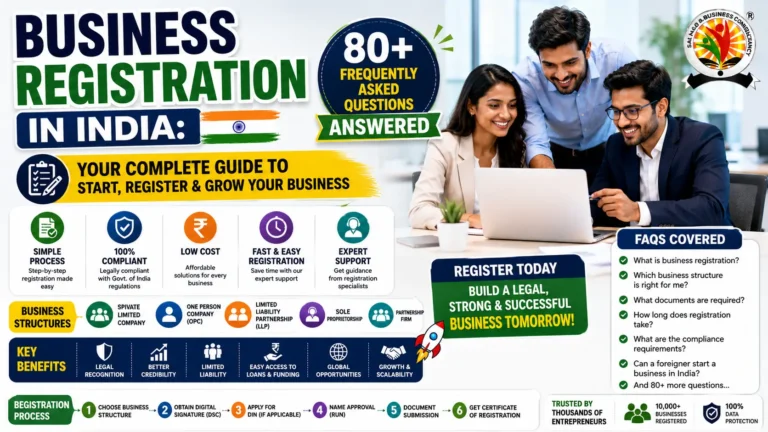
Looking for answers about business registration in India? This Business Registration FAQs guide covers Company Registration, LLP Registration, Partnership Firm Registration, Trademark Registration, GST Registration, MSME/Udyam Registration, Startup India Registration, compliance requirements, ITR filing, bookkeeping services, and other commonly asked questions by entrepreneurs and business owners.
Starting and managing a business involves more than just a great idea. Choosing the right business structure, obtaining the necessary registrations, and staying compliant with legal and tax requirements are essential for long-term success. Whether you are an entrepreneur, startup founder, freelancer, professional, or small business owner, understanding these registrations and compliance obligations can help you build a legally compliant and growth-oriented business.
From Company Registration and LLP incorporation to GST, Trademark, MSME, and Startup India Registration, each registration serves a unique purpose and offers specific benefits. However, many business owners have questions about eligibility, required documents, registration costs, timelines, compliance obligations, and the advantages of each registration.
In this comprehensive Business Registration FAQ guide, we answer the most frequently asked questions related to business registration and compliance in India. You’ll learn about different business structures, registration processes, government schemes, tax compliance requirements, bookkeeping practices, and much more.
Whether you’re planning to start a new business, formalize an existing venture, protect your brand, obtain tax registrations, or ensure ongoing compliance, this guide will help you make informed decisions and confidently navigate India’s business registration and regulatory landscape.
Company Registration FAQs
1. What Is Company Registration and Why Is It Important?
Company Registration is the legal process of incorporating a business as a separate legal entity under the Companies Act, 2013. Once registered with the Ministry of Corporate Affairs (MCA), the company receives a Certificate of Incorporation and becomes legally recognized by the Government of India.
Registering a company is important because it provides legal identity, limited liability protection, enhanced credibility, and better growth opportunities. A registered company can enter into contracts, own assets, open bank accounts, hire employees, and raise funds in its own name.
For startups and growing businesses, company registration helps build trust among customers, investors, suppliers, and financial institutions. It also ensures compliance with Indian laws and provides access to various government schemes and business benefits.
| Benefit | Description |
|---|---|
| Legal Recognition | Business becomes a recognized legal entity |
| Limited Liability | Personal assets of owners remain protected |
| Better Credibility | Increases trust among customers and investors |
| Fundraising Opportunities | Easier access to loans and investments |
| Perpetual Succession | Company continues despite ownership changes |
2. How Can I Register My Own Company in India?
Registering a company in India is a completely online process through the Ministry of Corporate Affairs (MCA) portal. Entrepreneurs can either complete the process themselves or seek professional assistance for documentation and compliance support.
Steps to Register a Company
- Choose the appropriate business structure.
- Obtain Digital Signature Certificates (DSC) for directors.
- Apply for Director Identification Number (DIN).
- Reserve a unique company name.
- Prepare incorporation documents.
- File the SPICe+ incorporation form with MCA.
- Receive the Certificate of Incorporation, PAN, and TAN.
| Step | Activity |
|---|---|
| 1 | Select company structure |
| 2 | Obtain DSC |
| 3 | Apply for DIN |
| 4 | Name reservation |
| 5 | Document preparation |
| 6 | MCA filing |
| 7 | Certificate of Incorporation |
Small businesses and startups commonly register as Private Limited Companies or One Person Companies (OPCs) depending on their ownership structure and growth plans.
3. Can I Register a Private Limited Company Myself?
Yes, you can register a Private Limited Company yourself through the MCA portal. The registration process is digital and allows entrepreneurs to submit incorporation applications online.
However, the process involves legal documentation, name approval requirements, director details, and compliance procedures. Any mistakes in the application may result in delays or rejection by the authorities.
While self-registration may reduce initial costs, many entrepreneurs prefer professional assistance to ensure accurate documentation, faster processing, and compliance with legal requirements.
| Factor | Self Registration | Professional Assistance |
|---|---|---|
| Initial Cost | Lower | Professional fee applicable |
| Documentation Support | Limited | Complete support |
| Risk of Errors | Higher | Lower |
| Processing Efficiency | Moderate | Faster |
| Compliance Guidance | Self-managed | Expert assistance |
4. What Documents Are Required for Company Registration?
The documents required for company registration vary slightly depending on the business structure, but most registrations require identity proof, address proof, and registered office documents.
Documents Required for Directors
- PAN Card
- Aadhaar Card
- Passport-size photograph
- Mobile number
- Email ID
Registered Office Documents
- Electricity bill or utility bill
- Rent agreement (if rented)
- No Objection Certificate (NOC) from property owner
- Property ownership documents (if owned)
| Document Type | Examples |
|---|---|
| Identity Proof | PAN Card, Passport |
| Address Proof | Aadhaar Card, Voter ID |
| Office Proof | Utility Bill, Rent Agreement |
| Contact Details | Mobile Number, Email ID |
Proper documentation helps ensure smooth and timely approval of the incorporation application.
5. What Are the Main Types of Companies in India?
India offers several company structures to suit different business requirements. The most common types include Private Limited Companies, One Person Companies (OPCs), Public Limited Companies, and Section 8 Companies.
| Company Type | Suitable For |
|---|---|
| Private Limited Company | Startups and growing businesses |
| One Person Company (OPC) | Solo entrepreneurs |
| Public Limited Company | Large businesses seeking public investment |
| Section 8 Company | Non-profit organizations |
Choosing the right company structure depends on factors such as ownership, investment plans, compliance requirements, and business objectives.
6. Which Is Better: OPC or Private Limited Company?
The choice between an OPC and a Private Limited Company depends on the number of founders, growth plans, and funding requirements.
An OPC is suitable for a single entrepreneur who wants limited liability protection and a separate legal identity. A Private Limited Company is generally preferred for startups planning to raise investment and scale their operations.
| Feature | OPC | Private Limited Company |
|---|---|---|
| Owners | 1 | Minimum 2 |
| Separate Legal Entity | Yes | Yes |
| Limited Liability | Yes | Yes |
| Investment Potential | Limited | Higher |
| Compliance Requirements | Lower | Moderate |
| Suitable For | Solo founders | Growing startups |
Businesses expecting external funding and rapid expansion usually choose a Private Limited Company.
7. How Long Does Company Registration Take in India?
The timeline for company registration depends on document readiness, name approval, and government processing time.
In most cases, a Private Limited Company can be registered within 7 to 15 working days.
| Registration Stage | Estimated Time |
|---|---|
| DSC & DIN | 1–3 Days |
| Name Approval | 1–3 Days |
| Incorporation Filing | 3–7 Days |
| Certificate of Incorporation | 1–3 Days |
Delays may occur due to incomplete documentation, name rejection, or additional clarification requests from authorities.
8. What Is the Minimum Capital Required to Start a Company?
There is currently no mandatory minimum capital requirement for incorporating most companies in India.
Entrepreneurs can start a Private Limited Company or OPC with any reasonable amount of capital depending on their business needs. However, sufficient capital should be available to cover operational expenses, compliance costs, and business activities.
The authorized capital can also be increased later as the business grows.
9. What Are the Benefits of a Private Limited Company?
A Private Limited Company is one of the most popular business structures in India because it offers legal protection, credibility, and growth opportunities.
Key Benefits
- Limited liability protection
- Separate legal identity
- Better credibility in the market
- Easier access to funding
- Perpetual succession
- Improved business continuity
- Easier ownership transfer
| Benefit | Advantage |
|---|---|
| Limited Liability | Protects personal assets |
| Separate Legal Entity | A company can own assets and enter contracts |
| Funding Access | Easier to attract investors |
| Credibility | Builds trust among stakeholders |
| Continuity | Business survives ownership changes |
These benefits make Private Limited Companies particularly attractive for startups and expanding businesses.
10. What Compliances Are Required After Company Registration?
After incorporation, companies must comply with various legal, tax, and regulatory requirements to maintain good standing with authorities.
Common Post-Registration Compliances
- Annual ROC filings
- Income Tax Return filing
- GST return filing (if applicable)
- Accounting and bookkeeping
- Board meetings and statutory records
- TDS compliance (if applicable)
| Compliance | Frequency |
|---|---|
| ROC Annual Filing | Annually |
| Income Tax Return | Annually |
| GST Returns | Monthly/Quarterly |
| Accounting Records | Ongoing |
| TDS Filing | Quarterly |
Failure to comply with statutory requirements may result in penalties, notices, and legal complications. Therefore, businesses should establish a compliance system or seek professional assistance to ensure timely filings and regulatory compliance.
Partnership Firm FAQs
1. What Is a Partnership Firm?
A Partnership Firm is a business structure in which two or more individuals agree to carry on a business together and share its profits and losses according to mutually agreed terms. The relationship between the partners is governed by the Indian Partnership Act, 1932.
A partnership firm is one of the simplest and most affordable forms of business organization in India. It is commonly chosen by small businesses, family-owned enterprises, professional firms, traders, and service providers.
The rights, responsibilities, profit-sharing ratio, and management structure of the firm are usually defined in a Partnership Deed. Although registration of a partnership firm is not mandatory, a registered firm enjoys greater legal protection and credibility.
| Particular | Details |
|---|---|
| Governing Law | Indian Partnership Act, 1932 |
| Minimum Partners | 2 |
| Maximum Partners | 50 (generally) |
| Separate Legal Entity | No |
| Liability | Unlimited |
| Registration | Optional but recommended |
2. How Can I Register a Partnership Firm in India?
Registering a Partnership Firm involves preparing a Partnership Deed and submitting the required documents to the Registrar of Firms of the respective state.
Steps to Register a Partnership Firm
- Choose a unique business name.
- Draft a Partnership Deed.
- Obtain the signatures of all partners.
- Notarize the Partnership Deed.
- Submit the registration application to the Registrar of Firms.
- Provide the required identity and address proofs.
- Obtain the Certificate of Registration.
| Step | Activity |
|---|---|
| 1 | Select business name |
| 2 | Draft Partnership Deed |
| 3 | Execute deed with partners |
| 4 | Notarization |
| 5 | Application filing |
| 6 | Document verification |
| 7 | Registration Certificate |
A registered partnership firm gains legal recognition and can more easily enforce its rights in court.
3. Is Partnership Firm Registration Mandatory?
No, Partnership Firm Registration is not mandatory under the Indian Partnership Act, 1932. Partners can legally operate an unregistered partnership firm.
However, registration is highly recommended because an unregistered firm faces certain legal limitations. For example, it cannot enforce contractual rights against third parties in a court of law.
A registered partnership firm enjoys better legal standing, business credibility, and easier access to banking and financial services.
| Aspect | Registered Firm | Unregistered Firm |
|---|---|---|
| Legal Recognition | Higher | Limited |
| Ability to Sue | Yes | Restricted |
| Business Credibility | Higher | Moderate |
| Bank Account Opening | Easier | Possible but may face challenges |
| Government Registrations | Easier | Limited in some cases |
4. What Documents Are Required for Partnership Firm Registration?
To register a Partnership Firm, partners must submit documents related to the firm, partners, and business address.
Documents Required
For Partners
- PAN Card
- Aadhaar Card
- Passport-size photographs
- Mobile number and email ID
For Business Address
- Electricity bill or utility bill
- Rent agreement (if rented)
- No Objection Certificate (NOC) from property owner
- Property ownership proof (if owned)
Business Documents
- Partnership Deed
- Registration application form
| Document Type | Examples |
|---|---|
| Identity Proof | PAN Card, Passport |
| Address Proof | Aadhaar Card, Voter ID |
| Office Proof | Utility Bill, Rent Agreement |
| Business Document | Partnership Deed |
Ensuring accurate documentation helps avoid delays during the registration process.
5. How Many Partners Are Required to Form a Partnership Firm?
A minimum of two partners is required to form a Partnership Firm in India. There is no partnership without at least two individuals agreeing to conduct business together.
The partners can be individuals, and each partner contributes capital, skills, expertise, or resources to the business. The rights and responsibilities of each partner are determined by the Partnership Deed.
| Requirement | Details |
|---|---|
| Minimum Partners | 2 |
| Maximum Partners | Generally 50 |
| Partnership Deed Required | Yes |
| Profit Sharing | As agreed in deed |
Businesses with a single owner should consider a Sole Proprietorship or One Person Company (OPC) instead.
6. What Are the Advantages of a Partnership Firm?
A Partnership Firm offers several advantages, making it a popular choice among small and medium-sized businesses.
Key Advantages
- Easy to establish
- Lower registration and compliance costs
- Shared responsibilities among partners
- Greater capital contribution
- Better decision-making through combined expertise
- Operational flexibility
- Simplified management structure
| Advantage | Benefit |
|---|---|
| Easy Formation | Minimal legal formalities |
| Shared Risk | Business risk distributed among partners |
| More Capital | Multiple partners can contribute funds |
| Better Expertise | Diverse skills and experience |
| Cost Effective | Lower compliance burden |
These advantages make partnership firms suitable for businesses that value flexibility and collaborative management.
7. How Long Does Partnership Firm Registration Take?
The registration timeline varies from state to state and depends on document readiness and verification procedures.
In most cases, Partnership Firm Registration can be completed within 7 to 15 working days.
| Registration Stage | Estimated Time |
|---|---|
| Partnership Deed Drafting | 1–2 Days |
| Notarization | 1 Day |
| Application Filing | 1 Day |
| Verification and Approval | 5–12 Days |
Incomplete documents or errors in the application may extend the processing time.
8. Can a Partnership Firm Be Converted into an LLP?
Yes, a Partnership Firm can be converted into a Limited Liability Partnership (LLP) under the provisions of the Limited Liability Partnership Act, 2008.
Many businesses choose LLP conversion when they want limited liability protection, improved credibility, and a separate legal identity while retaining operational flexibility.
Benefits of LLP Conversion
- Limited liability protection for partners
- Separate legal entity status
- Better business credibility
- Easier access to funding opportunities
- Perpetual succession
| Feature | Partnership Firm | LLP |
|---|---|---|
| Legal Entity | No | Yes |
| Liability | Unlimited | Limited |
| Compliance | Lower | Moderate |
| Credibility | Moderate | Higher |
| Business Continuity | Limited | Better |
LLP conversion is often considered by growing businesses seeking legal protection and long-term scalability.
LLP / OPC Registration FAQs
1. What Is an LLP?
A Limited Liability Partnership (LLP) is a business structure that combines the flexibility of a traditional partnership with the benefits of limited liability protection. It is governed by the Limited Liability Partnership Act, 2008.
In an LLP, the partners are not personally liable for the debts or liabilities of the business beyond their agreed contribution. This makes LLPs a popular choice for professional firms, consultants, service providers, startups, and small businesses.
Unlike a traditional partnership firm, an LLP has a separate legal identity, which means it can own property, enter into contracts, and continue to exist regardless of changes in partners.
| Particular | LLP |
|---|---|
| Governing Law | LLP Act, 2008 |
| Separate Legal Entity | Yes |
| Liability | Limited |
| Minimum Partners | 2 |
| Perpetual Succession | Yes |
| Compliance Level | Moderate |
2. What Is an OPC?
A One Person Company (OPC) is a type of company that can be formed by a single entrepreneur under the Companies Act, 2013. It provides the benefits of a Private Limited Company while allowing a single individual to own and manage the business.
OPC is ideal for solo entrepreneurs, freelancers, consultants, and small business owners who want limited liability protection and a separate legal identity without requiring additional shareholders.
The owner must appoint a nominee who can take over the company in the event of death or incapacity.
| Particular | OPC |
|---|---|
| Governing Law | Companies Act, 2013 |
| Separate Legal Entity | Yes |
| Liability | Limited |
| Minimum Members | 1 |
| Nominee Required | Yes |
| Suitable For | Single entrepreneurs |
3. Which Is Better: LLP or OPC?
The choice between LLP and OPC depends on your business goals, ownership structure, and future growth plans.
An LLP is generally preferred when two or more individuals want to start a business together and enjoy operational flexibility. An OPC is suitable for a single entrepreneur seeking complete ownership and corporate status.
| Feature | LLP | OPC |
|---|---|---|
| Owners | Minimum 2 Partners | 1 Member |
| Separate Legal Entity | Yes | Yes |
| Liability Protection | Yes | Yes |
| Management Flexibility | Higher | Moderate |
| Compliance Burden | Lower | Higher |
| Suitable For | Partnerships | Solo entrepreneurs |
Businesses planning to add multiple partners often prefer LLPs, while individual founders may find OPCs more suitable.
4. What Is the Difference Between LLP and OPC?
Although both LLPs and OPCs offer limited liability protection, they differ in ownership, legal framework, compliance requirements, and management structure.
| Particular | LLP | OPC |
|---|---|---|
| Governing Law | LLP Act, 2008 | Companies Act, 2013 |
| Minimum Owners | 2 Partners | 1 Member |
| Maximum Owners | No statutory limit | 1 Member |
| Legal Structure | Partnership | Company |
| Compliance Requirements | Lower | Higher |
| Ownership Transfer | Easier | More regulated |
| Suitable For | Professional firms and partnerships | Individual entrepreneurs |
Understanding these differences can help entrepreneurs choose the most suitable business structure.
5. Can I Register an LLP by Myself?
Yes, you can register an LLP yourself through the Ministry of Corporate Affairs (MCA) portal. The registration process is conducted online and involves obtaining Digital Signature Certificates (DSC), applying for Designated Partner Identification Numbers (DPIN/DIN), reserving the LLP name, and filing incorporation documents.
However, LLP registration requires legal documentation and compliance with MCA guidelines. Errors in forms or documentation may delay approval.
Many entrepreneurs seek professional assistance to ensure smooth registration and avoid compliance issues.
| Factor | Self Registration | Professional Assistance |
|---|---|---|
| Initial Cost | Lower | Professional fee applicable |
| Documentation Support | Limited | Comprehensive |
| Risk of Errors | Higher | Lower |
| Processing Time | Variable | Faster |
6. Can I Register an OPC Online?
Yes, OPC registration can be completed entirely online through the MCA portal. The government has simplified the incorporation process through the SPICe+ form, enabling entrepreneurs to register their companies electronically.
The process generally includes:
- Obtaining DSC.
- Applying for DIN.
- Reserving the company name.
- Filing incorporation documents.
- Obtaining the Certificate of Incorporation.
Most OPC registrations can be completed without visiting any government office, provided all documents are properly submitted.
7. What Documents Are Required for LLP or OPC Registration?
The documentation requirements for LLP and OPC registration are largely similar.
Documents for Promoters/Partners
- PAN Card
- Aadhaar Card
- Passport-size photographs
- Mobile number
- Email ID
Registered Office Documents
- Electricity bill or utility bill
- Rent agreement (if applicable)
- No Objection Certificate (NOC)
- Property ownership proof
| Document Category | Examples |
|---|---|
| Identity Proof | PAN Card, Passport |
| Address Proof | Aadhaar Card, Voter ID |
| Office Proof | Utility Bill, Rent Agreement |
| Contact Details | Mobile Number, Email ID |
Accurate documentation is essential for timely approval of the registration application.
8. Can an OPC Be a Partner in an LLP?
No, an OPC itself cannot become a partner in an LLP because an OPC is a separate legal company structure and LLP partnership provisions do not generally permit an OPC to act as a partner in the same manner as individuals or corporate entities under applicable regulations.
However, the individual who owns the OPC may participate in other business structures subject to legal requirements and eligibility criteria.
Business owners should seek professional advice before planning complex ownership structures involving multiple entities.
9. How Long Does LLP or OPC Registration Take?
The registration timeline depends on document readiness, name approval, and government processing.
Typically, LLP and OPC registration can be completed within 7 to 15 working days.
| Registration Stage | Estimated Time |
|---|---|
| DSC Application | 1–2 Days |
| Name Approval | 1–3 Days |
| Document Preparation | 1–2 Days |
| Incorporation Filing | 3–7 Days |
| Final Approval | 1–3 Days |
Incomplete documents or name objections may increase the processing time.
10. What Annual Compliances Are Required for LLPs and OPCs?
Both LLPs and OPCs must comply with certain statutory filing and reporting requirements after registration.
LLP Compliance Requirements
- Annual Return Filing
- Statement of Accounts and Solvency
- Income Tax Return Filing
- Accounting Records Maintenance
OPC Compliance Requirements
- Annual Financial Statements
- Annual Return Filing
- Income Tax Return Filing
- Statutory Record Maintenance
| Compliance | LLP | OPC |
|---|---|---|
| Annual Return | Yes | Yes |
| Financial Statements | Limited | Mandatory |
| Income Tax Return | Yes | Yes |
| Accounting Records | Yes | Yes |
| ROC Compliance | Applicable | Applicable |
Timely compliance helps avoid penalties and ensures that the business remains in good legal standing with the authorities.
Trademark Registration FAQs
1. What Is Trademark Registration?
Trademark Registration is the legal process of protecting a brand name, logo, slogan, symbol, design, or combination of these elements under the Trade Marks Act, 1999. A registered trademark gives the owner exclusive rights to use the mark for specified goods or services and prevents others from using a similar mark without permission.
A trademark helps distinguish your products or services from competitors and plays a vital role in building brand recognition and customer trust. Once registered, the trademark becomes an intellectual property asset that can be licensed, sold, or transferred.
Businesses of all sizes, including startups, MSMEs, companies, NGOs, and sole proprietors, can apply for trademark registration in India.
| Particular | Details |
|---|---|
| Governing Law | Trade Marks Act, 1999 |
| Registration Authority | Controller General of Patents, Designs & Trade Marks |
| Protection Type | Brand Name, Logo, Slogan, Symbol |
| Validity | 10 Years |
| Renewal | Unlimited Renewals |
2. Why Is Trademark Registration Important?
Trademark Registration is important because it provides legal ownership and protection for your brand identity. Without trademark protection, competitors may use a similar brand name or logo, causing confusion among customers and potentially damaging your reputation.
A registered trademark strengthens brand value, enhances customer confidence, and gives the owner exclusive rights to take legal action against infringement.
Benefits of Trademark Registration
- Exclusive rights to use the trademark
- Legal protection against unauthorized use
- Increased brand value and recognition
- Nationwide protection
- Valuable business asset
- Easier licensing and franchising opportunities
| Benefit | Advantage |
|---|---|
| Brand Protection | Prevents unauthorized use |
| Legal Ownership | Establishes exclusive rights |
| Business Value | Increases brand worth |
| Customer Trust | Builds credibility |
| Competitive Advantage | Protects market identity |
3. Can I Register My Trademark by Myself?
Yes, individuals and businesses can apply for trademark registration directly through the Intellectual Property India portal. The application process is online and can be completed without hiring a professional.
However, trademark registration involves selecting the correct trademark class, conducting a trademark search, preparing the application accurately, and responding to any objections or examination reports that may arise.
Many applicants choose professional assistance to reduce the risk of rejection and ensure proper protection of their brand.
| Factor | Self Registration | Professional Assistance |
|---|---|---|
| Initial Cost | Lower | Professional fee applicable |
| Trademark Search | Self-managed | Expert guidance |
| Error Risk | Higher | Lower |
| Objection Handling | Self-managed | Professional support |
| Success Rate | Variable | Generally higher |
4. What Are the Requirements for Trademark Registration?
To register a trademark, the mark must be distinctive and capable of distinguishing your goods or services from those of others. Generic, descriptive, misleading, or prohibited marks may not qualify for registration.
Basic Requirements
- Unique brand name, logo, or slogan
- Correct trademark classification
- Applicant details
- Business activity details
- Required supporting documents
The trademark should not be identical or confusingly similar to an existing registered trademark within the same class.
| Requirement | Description |
|---|---|
| Distinctiveness | Must be unique and identifiable |
| Applicant Information | Individual or business details |
| Trademark Class | Relevant goods/services category |
| Supporting Documents | Identity and business proof |
Conducting a trademark search before filing is highly recommended.
5. What Documents Are Required for Trademark Registration?
The required documents depend on the applicant type, but most applications require basic identity and business information.
For Individuals
- PAN Card
- Aadhaar Card
- Passport-size photograph
For Businesses
- Business registration certificate
- GST registration (if available)
- Authorized signatory details
Trademark Documents
- Brand name or logo
- User affidavit (if applicable)
- Power of Attorney (if filing through an agent)
| Document Type | Examples |
|---|---|
| Identity Proof | PAN Card, Aadhaar Card |
| Business Proof | Company/LLP Registration Certificate |
| Trademark Representation | Logo or Brand Name |
| Additional Documents | User Affidavit, Authorization Letter |
Providing complete documentation helps avoid delays during examination.
6. What Is the Cost of Trademark Registration in India?
Trademark registration costs include government fees and professional charges, if any.
The government fee depends on the applicant category.
| Applicant Category | Government Fee (Per Class) |
|---|---|
| Individual, Startup, MSME | ₹4,500 |
| Other Entities | ₹9,000 |
Additional costs may apply for professional services, trademark searches, objection replies, hearings, and renewals.
Businesses should consider trademark registration as a long-term investment in brand protection rather than simply a legal expense.
7. What Is the Difference Between TM and ®?
TM and ® are both trademark symbols, but they have different meanings.
The TM symbol can be used immediately after filing a trademark application or even before registration to indicate a claim over the mark.
The ® symbol can only be used after the trademark has been officially registered by the Trademark Registry.
| Symbol | Meaning |
|---|---|
| TM | Trademark claimed but not necessarily registered |
| ® | Registered trademark officially approved |
Using the ® symbol without obtaining registration may lead to legal consequences.
8. Which Is Better: TM or ®?
The ® symbol offers stronger legal protection because it indicates that the trademark has been officially registered.
However, businesses typically use the TM symbol during the application process while waiting for registration approval.
| Feature | TM | ® |
|---|---|---|
| Registration Required | No | Yes |
| Legal Protection | Limited | Strong |
| Usage Stage | Application/Pending | After Registration |
| Credibility | Good | Higher |
Therefore, ® is generally considered better because it signifies complete legal ownership and registration of the trademark.
9. How Long Does Trademark Registration Take?
Trademark registration is a multi-stage process involving filing, examination, publication, and registration.
The trademark application number is usually generated immediately after filing. However, final registration may take several months depending on objections, oppositions, and examination procedures.
| Stage | Approximate Timeline |
|---|---|
| Application Filing | 1–2 Days |
| Examination | 1–6 Months |
| Journal Publication | Varies |
| Registration Certificate | 6–18 Months |
Applicants can generally begin using the TM symbol immediately after filing the application.
10. What Is the Validity of a Registered Trademark?
A registered trademark in India remains valid for 10 years from the date of registration.
After the initial validity period, the trademark can be renewed for additional 10-year periods indefinitely by paying the prescribed renewal fee.
| Particular | Details |
|---|---|
| Initial Validity | 10 Years |
| Renewal Period | Every 10 Years |
| Number of Renewals | Unlimited |
| Protection Duration | Potentially Perpetual |
Timely renewal ensures continuous legal protection and prevents the trademark from being removed from the register. Businesses should monitor renewal deadlines to maintain uninterrupted ownership rights.
GST Registration FAQs
1. What Is GST Registration?
GST Registration is the process of obtaining a Goods and Services Tax Identification Number (GSTIN) from the Goods and Services Tax (GST) Department. Businesses registered under GST are authorized to collect GST from customers and remit it to the government.
Introduced on 1 July 2017, GST replaced multiple indirect taxes and created a unified tax system across India. GST registration is mandatory for certain businesses based on turnover, business activities, and legal requirements.
A GST-registered business can claim Input Tax Credit (ITC), improve business credibility, and legally conduct taxable transactions.
| Particular | Details |
|---|---|
| Governing Law | GST Act, 2017 |
| Registration Authority | GST Department |
| Registration Number | GSTIN |
| Registration Mode | Online |
| Validity | Lifetime (subject to compliance) |
2. Who Is Eligible for GST Registration?
Any person or business engaged in the supply of goods or services may be eligible for GST registration if they meet the prescribed criteria under GST law.
Eligibility depends on factors such as annual turnover, interstate transactions, e-commerce activities, and specific business categories.
Eligible Applicants
- Sole Proprietorships
- Partnership Firms
- LLPs
- Private Limited Companies
- Public Limited Companies
- Trusts and NGOs
- E-commerce Sellers
- Freelancers and Professionals
| Applicant Type | Eligible for GST Registration |
|---|---|
| Individual Business Owner | Yes |
| Partnership Firm | Yes |
| LLP | Yes |
| Company | Yes |
| Trust/NGO | Yes |
| E-commerce Seller | Yes |
3. Who Needs to Register for GST?
GST registration becomes mandatory for certain businesses and taxpayers under specific circumstances.
Businesses That Must Register
- Businesses exceeding the prescribed turnover threshold.
- Interstate suppliers of goods or services.
- E-commerce operators and sellers.
- Casual taxable persons.
- Non-resident taxable persons.
- Businesses liable under reverse charge provisions.
| Category | GST Registration Requirement |
|---|---|
| Above Threshold Turnover | Mandatory |
| Interstate Supply | Usually Mandatory |
| E-commerce Sellers | Mandatory in many cases |
| Casual Taxable Persons | Mandatory |
| Voluntary Registration | Allowed |
Even businesses below the turnover threshold may choose voluntary GST registration to claim Input Tax Credit and enhance credibility.
4. Should I Register for GST if My Income Is Below ₹7 Lakh?
If your annual turnover is below ₹7 lakh, GST registration is generally not mandatory solely based on turnover. However, eligibility depends on the nature of your business and other GST provisions.
You may still consider voluntary GST registration if:
- You want to claim Input Tax Credit (ITC).
- Your customers prefer dealing with GST-registered suppliers.
- You plan to expand your business.
- You engage in activities where GST registration becomes mandatory.
| Scenario | GST Registration |
|---|---|
| Below ₹7 Lakh Turnover | Usually Optional |
| Interstate Business | May Be Required |
| E-commerce Selling | May Be Required |
| Voluntary Registration | Allowed |
Businesses should review current GST threshold limits and applicable rules before making a decision.
5. What Are the Different Types of GST in India?
India’s GST system consists of four primary components designed to distribute tax revenue between the Central and State Governments.
| Type of GST | Full Form | Applicable On |
|---|---|---|
| CGST | Central Goods and Services Tax | Intra-State Transactions |
| SGST | State Goods and Services Tax | Intra-State Transactions |
| IGST | Integrated Goods and Services Tax | Inter-State Transactions |
| UTGST | Union Territory Goods and Services Tax | Union Territory Transactions |
Example
If a product is sold within the same state, CGST and SGST are charged. If the sale occurs between two different states, IGST is charged.
Understanding GST types helps businesses correctly calculate and report tax liabilities.
6. What Is a GSTIN?
GSTIN stands for Goods and Services Tax Identification Number. It is a unique 15-digit registration number issued to businesses registered under GST.
The GSTIN helps authorities track tax payments, return filings, and business transactions.
GSTIN Structure
| GSTIN Component | Description |
|---|---|
| First 2 Digits | State Code |
| Next 10 Digits | PAN Number |
| 13th Digit | Entity Number |
| 14th Digit | Default Character |
| 15th Digit | Check Code |
Businesses must mention their GSTIN on invoices, GST returns, and official documents.
7. What Documents Are Required for GST Registration?
GST registration requires identity proof, business proof, and address-related documents.
Documents for Proprietors
- PAN Card
- Aadhaar Card
- Passport-size photograph
- Mobile number
- Email ID
Business Documents
- Business registration certificate (if applicable)
- Partnership Deed (for firms)
- Certificate of Incorporation (for companies)
Address Proof
- Electricity bill
- Rent agreement
- Property tax receipt
- NOC from property owner
| Document Type | Examples |
|---|---|
| Identity Proof | PAN Card, Aadhaar Card |
| Business Proof | Registration Certificate |
| Address Proof | Utility Bill, Rent Agreement |
| Bank Proof | Cancelled Cheque or Bank Statement |
Accurate documentation helps avoid registration delays.
8. What Are the Benefits of GST Registration?
GST registration offers several operational and financial advantages for businesses.
Key Benefits
- Legal authorization to collect GST.
- Eligibility to claim Input Tax Credit (ITC).
- Improved business credibility.
- Easier participation in government tenders.
- Better compliance with tax laws.
- Expanded business opportunities.
| Benefit | Advantage |
|---|---|
| Input Tax Credit | Reduces tax burden |
| Legal Compliance | Avoids penalties |
| Business Credibility | Builds customer trust |
| Market Expansion | Facilitates interstate business |
| Tender Eligibility | Helps secure contracts |
For growing businesses, GST registration often becomes an important step toward professionalization and expansion.
9. How Long Does GST Registration Take?
GST registration is typically processed online through the GST portal. If all documents are properly submitted and verified, registration is generally completed within a few working days.
| Registration Stage | Estimated Time |
|---|---|
| Application Submission | Same Day |
| Document Verification | 1–5 Days |
| Clarification (If Required) | Additional Time |
| GST Certificate Issuance | 3–7 Working Days |
Delays may occur if documents are incomplete, incorrect information is provided, or additional clarification is requested by the GST Department. To ensure faster approval, applicants should carefully review all documents and information before submitting their GST registration application.
MSME / Udyam Registration FAQs
1. What Is MSME / Udyam Registration?
MSME (Micro, Small and Medium Enterprises) Registration, now known as Udyam Registration, is a government recognition issued by the Ministry of Micro, Small and Medium Enterprises. It provides official identification to eligible businesses and allows them to access various government schemes, subsidies, financial assistance, and business benefits.
Udyam Registration replaced the earlier Udyog Aadhaar system and is completely online. Businesses registered under Udyam receive a unique Udyam Registration Number (URN) and a digital certificate.
The registration is available to manufacturing, trading, and service enterprises that meet the prescribed investment and turnover criteria.
| Particular | Details |
|---|---|
| Governing Authority | Ministry of MSME |
| Registration Name | Udyam Registration |
| Registration Mode | Online |
| Registration Fee | No Government Fee |
| Certificate Issued | Udyam Registration Certificate |
2. Who Is Eligible for MSME or Udyam Registration?
Any business engaged in manufacturing, trading, or providing services can apply for Udyam Registration if it falls within the MSME classification limits prescribed by the Government of India.
Eligible entities include:
- Sole Proprietorships
- Partnership Firms
- LLPs
- Private Limited Companies
- Public Limited Companies
- Hindu Undivided Families (HUFs)
- Co-operative Societies
- Trusts
| Business Entity | Eligible for Udyam Registration |
|---|---|
| Proprietorship | Yes |
| Partnership Firm | Yes |
| LLP | Yes |
| Private Limited Company | Yes |
| Trust | Yes |
| Society | Yes |
Businesses must meet the applicable investment and turnover criteria to qualify as Micro, Small, or Medium Enterprises.
3. How Do I Get Udyam Registration?
Udyam Registration can be obtained through the official Udyam Registration Portal by providing basic business and Aadhaar-related information.
Steps to Obtain Udyam Registration
- Visit the Udyam Registration portal.
- Enter Aadhaar details of the proprietor or authorized person.
- Verify the Aadhaar-linked mobile number through OTP.
- Enter business information.
- Provide PAN and GST details, if applicable.
- Submit the application.
- Receive the Udyam Registration Certificate.
| Step | Activity |
|---|---|
| 1 | Aadhaar Verification |
| 2 | Business Information Entry |
| 3 | PAN Verification |
| 4 | Application Submission |
| 5 | Certificate Generation |
The registration process is generally simple and paperless.
4. Can I Get Udyam Registration Without a Business?
No. Udyam Registration is intended for businesses engaged in manufacturing, trading, or service activities.
An individual cannot obtain Udyam Registration without operating a legitimate business or economic activity. During registration, business-related information such as business name, activity type, and PAN details are required.
If you are planning to start a business, you may first establish the business and then apply for Udyam Registration.
| Situation | Udyam Registration Eligibility |
|---|---|
| Active Business | Eligible |
| Proposed Business Only | Generally Not Eligible |
| No Business Activity | Not Eligible |
5. Is Udyam Registration Mandatory for MSMEs?
No, Udyam Registration is not mandatory for all MSMEs. Businesses can operate without obtaining Udyam Registration.
However, registration is highly recommended because it enables businesses to access various government benefits, subsidies, priority sector lending, and MSME-specific schemes.
| Particular | Udyam Registration |
|---|---|
| Mandatory by Law | No |
| Recommended | Yes |
| Government Scheme Benefits | Available After Registration |
| MSME Recognition | Provided |
Businesses seeking growth opportunities often choose to register voluntarily.
6. What Documents Are Required for Udyam Registration?
One of the advantages of Udyam Registration is its simplified documentation process.
Common Requirements
- Aadhaar Number
- PAN Card
- Mobile Number
- Email ID
- Business Details
- GSTIN (if applicable)
Since the process is integrated with government databases, extensive documentation is generally not required.
7. What Are the Benefits of Udyam Registration?
Udyam Registration provides several benefits that help businesses improve growth, financing opportunities, and competitiveness.
Key Benefits
- Access to government schemes
- Easier bank loan approvals
- Subsidies and incentives
- Priority sector lending benefits
- Participation in government tenders
- Protection against delayed payments
- Reduced fees for intellectual property registrations
| Benefit | Advantage |
|---|---|
| Government Schemes | Access to MSME support programs |
| Loans | Easier financing opportunities |
| Subsidies | Cost savings |
| Tender Eligibility | Better business opportunities |
| Delayed Payment Protection | Improved cash flow security |
For small businesses, Udyam Registration can significantly improve access to growth resources.
8. Who Is Eligible for MSME or Udyam Loans?
Businesses registered under Udyam and meeting the lending institution’s eligibility requirements may apply for MSME loans.
Loan eligibility depends on factors such as:
- Business type
- Revenue and turnover
- Credit profile
- Repayment capacity
- Banking history
| Eligible Applicant | Can Apply for MSME Loan |
|---|---|
| Proprietorship | Yes |
| Partnership Firm | Yes |
| LLP | Yes |
| Company | Yes |
| Registered MSME | Preferred |
Obtaining Udyam Registration may improve credibility during loan applications, although approval remains subject to lender assessment.
9. How Long Does Udyam Registration Take?
Udyam Registration is generally processed quickly because the system is integrated with Aadhaar, PAN, and GST databases.
In many cases, the registration certificate is generated shortly after successful submission and verification.
| Registration Stage | Estimated Time |
|---|---|
| Aadhaar Verification | Few Minutes |
| Application Submission | Same Day |
| Certificate Generation | Same Day to 2 Days |
Timelines may vary if there are discrepancies in Aadhaar, PAN, or business information.
10. Is Udyam Registration Valid for a Lifetime?
Yes, Udyam Registration does not have a fixed expiry date and generally remains valid for the lifetime of the business, provided the enterprise continues to operate and maintains accurate information.
Businesses should ensure that their details remain updated whenever there are significant changes in business structure, turnover, or other relevant information.
| Particular | Details |
|---|---|
| Validity Period | Lifetime |
| Renewal Requirement | Not Required |
| Information Updates | Required When Applicable |
| Certificate Status | Remains Active |
This makes Udyam Registration a valuable long-term recognition for eligible businesses seeking MSME benefits and government support.
Startup India Registration FAQs
1. What Is Startup India Registration?
Startup India Registration is a government initiative launched by the Government of India to promote innovation, entrepreneurship, and startup growth. Eligible startups can obtain recognition from the Department for Promotion of Industry and Internal Trade (DPIIT), which provides access to various benefits, including tax exemptions, funding support, easier compliance, networking opportunities, and participation in government programs.
The Startup India initiative aims to create a supportive ecosystem for entrepreneurs and encourage the development of innovative products, services, and business models.
| Particular | Details |
|---|---|
| Governing Authority | DPIIT |
| Scheme Name | Startup India |
| Registration Mode | Online |
| Recognition Certificate | DPIIT Recognition Certificate |
| Primary Objective | Promote Innovation and Entrepreneurship |
2. How Can I Register a Startup in India?
Registering a startup under Startup India involves obtaining legal registration for the business and then applying for DPIIT recognition through the Startup India portal.
Steps to Register a Startup
- Register your business as a Private Limited Company, LLP, or Partnership Firm.
- Obtain PAN and other required registrations.
- Create an account on the Startup India portal.
- Submit business details and supporting documents.
- Provide information about innovation, scalability, or business objectives.
- Apply for DPIIT recognition.
- Receive the Startup India Recognition Certificate.
| Step | Activity |
|---|---|
| 1 | Business Registration |
| 2 | Create Startup India Account |
| 3 | Submit Application |
| 4 | Document Verification |
| 5 | DPIIT Recognition |
Proper documentation and accurate business information help ensure a smooth approval process.
3. Is Startup India Registration Free?
Yes, there is no government fee for obtaining DPIIT Startup India Recognition. Eligible startups can apply through the Startup India portal without paying any government registration charges.
However, businesses may incur expenses related to:
- Company or LLP registration
- Professional consultation fees
- Trademark registration
- Compliance and legal services
| Particular | Cost |
|---|---|
| DPIIT Recognition Fee | Nil |
| Government Fee for Recognition | Nil |
| Professional Assistance | Optional |
Entrepreneurs can complete the application process themselves or seek professional assistance.
4. How Much Does a Startup India Certificate Cost?
The Startup India Recognition Certificate itself does not have any government fee. Once the application is approved, DPIIT issues the certificate free of cost.
However, startups may need to bear costs associated with business incorporation, legal documentation, compliance services, and professional assistance if required.
| Expense Type | Applicable Cost |
|---|---|
| DPIIT Recognition | Free |
| Company Registration | Varies |
| LLP Registration | Varies |
| Professional Services | Optional |
The overall cost depends primarily on the business structure chosen before applying for Startup India recognition.
5. Who Is Eligible for Startup India Registration?
To qualify for Startup India recognition, a business must satisfy the eligibility criteria prescribed by DPIIT.
Basic Eligibility Criteria
- Must be registered as a Private Limited Company, LLP, or Partnership Firm.
- Should not be older than 10 years from incorporation.
- Annual turnover should not exceed the prescribed limit.
- Business should focus on innovation, improvement, development, or scalable business models.
| Eligibility Factor | Requirement |
|---|---|
| Entity Type | Company, LLP, Partnership |
| Age of Entity | Up to 10 Years |
| Innovation Requirement | Yes |
| Turnover Limit | As per DPIIT Guidelines |
Meeting these conditions improves the likelihood of obtaining recognition.
6. Which Business Structure Is Best for a Startup?
The ideal business structure depends on the startup’s objectives, ownership model, and future funding plans.
Most startups seeking investment prefer a Private Limited Company because investors generally favor corporate structures with clear ownership and governance frameworks.
| Structure | Suitable For |
|---|---|
| Private Limited Company | Fundraising and Growth |
| LLP | Professional Services and Small Startups |
| Partnership Firm | Small Businesses |
| Proprietorship | Individual Entrepreneurs |
For startups planning rapid growth, Private Limited Company registration is often considered the most suitable option.
7. Can an LLP Apply for Startup India Recognition?
Yes, an LLP can apply for Startup India recognition if it meets the eligibility criteria prescribed by DPIIT.
Many startups choose the LLP structure because it offers limited liability protection, operational flexibility, and lower compliance requirements compared to companies.
| Requirement | Applicable to LLP |
|---|---|
| Legal Registration | Required |
| Innovation Criteria | Required |
| DPIIT Recognition | Available |
| Tax Benefits | Subject to Eligibility |
LLPs engaged in innovative and scalable business activities may qualify for Startup India benefits.
8. Can a Private Limited Company Apply for Startup India Recognition?
Yes, a Private Limited Company is one of the most common entities applying for Startup India recognition.
In fact, many startups seeking investment, venture capital funding, or business expansion choose the Private Limited Company structure because it is widely accepted by investors and financial institutions.
| Requirement | Applicable to Pvt Ltd Company |
|---|---|
| DPIIT Recognition | Available |
| Funding Opportunities | High |
| Investor Preference | High |
| Startup Benefits | Available |
Private Limited Companies that satisfy DPIIT criteria can access Startup India benefits and support programs.
9. What Are the Benefits of Startup India Registration?
Startup India recognition provides several benefits designed to support startup growth and innovation.
Key Benefits
- Recognition by DPIIT
- Easier compliance procedures
- Access to government schemes
- Networking opportunities
- Participation in startup events
- Intellectual property support
- Tax-related benefits subject to eligibility
| Benefit | Advantage |
|---|---|
| Government Recognition | Enhanced credibility |
| Tax Incentives | Potential tax savings |
| Funding Support | Access to schemes and investors |
| Networking | Business growth opportunities |
| IP Support | Reduced intellectual property costs |
These benefits help startups build credibility and accelerate growth.
10. Is It Difficult to Get a Startup India Certificate?
Obtaining a Startup India certificate is generally straightforward if the business meets the prescribed eligibility criteria and provides accurate information.
Applications are reviewed based on factors such as innovation, scalability, business objectives, and compliance with DPIIT guidelines.
Common Reasons for Delays
- Incomplete information
- Incorrect documentation
- Lack of clarity regarding innovation
- Inconsistencies in application details
| Factor | Impact on Approval |
|---|---|
| Complete Documentation | Positive |
| Accurate Information | Positive |
| Innovation Focus | Important |
| Incomplete Application | May Cause Delay |
Proper preparation significantly improves the chances of successful recognition.
11. What Is the ₹20 Lakh Grant for Startups?
The term “₹20 lakh grant” is often used in reference to startup funding opportunities, incubation support programs, government-backed innovation schemes, or accelerator programs that may provide financial assistance to eligible startups.
However, Startup India recognition itself does not automatically provide a ₹20 lakh grant to every startup.
Funding opportunities may be available through:
- Government schemes
- Startup incubators
- Innovation challenges
- State startup missions
- Private funding programs
| Funding Source | Possible Support |
|---|---|
| Incubators | Seed Funding |
| Government Schemes | Grants and Support |
| Startup Programs | Financial Assistance |
| Investors | Equity Funding |
Eligibility and funding amounts vary by program.
12. How Long Does Startup India Registration Take?
The processing time for Startup India recognition depends on document verification and application review.
In many cases, eligible startups receive DPIIT recognition within a few working days after successful submission of the application.
| Registration Stage | Estimated Time |
|---|---|
| Application Submission | Same Day |
| Document Verification | 1–5 Days |
| DPIIT Review | Few Working Days |
| Recognition Certificate | Upon Approval |
Timelines may vary depending on application quality, verification requirements, and government processing. Submitting complete and accurate information helps ensure faster approval.
Business Compliance FAQs
1. What Is Business Compliance?
Business compliance refers to the process of following all legal, regulatory, tax, and statutory requirements applicable to a business. These obligations are imposed by various government authorities such as the Ministry of Corporate Affairs (MCA), Income Tax Department, GST Department, Labour Departments, and other regulatory bodies.
Compliance requirements vary depending on the type of business entity, industry, turnover, and business activities. They may include filing annual returns, maintaining financial records, paying taxes, conducting audits, and complying with labor laws.
Maintaining proper compliance helps businesses operate legally, avoid penalties, and build trust with customers, investors, and government authorities.
| Particular | Description |
|---|---|
| Purpose | Ensure legal and regulatory adherence |
| Applicable To | Companies, LLPs, Firms, Proprietorships, NGOs |
| Governing Authorities | MCA, GST, Income Tax, Labour Departments |
| Frequency | Monthly, Quarterly, Annual |
2. Why Is Compliance Important for Businesses?
Compliance is important because it helps businesses avoid legal issues, financial penalties, and reputational damage. A compliant business demonstrates professionalism, transparency, and accountability.
Investors, lenders, government agencies, and customers often prefer dealing with businesses that maintain proper statutory compliance.
Benefits of Compliance
- Avoids penalties and legal action
- Maintains good business reputation
- Supports business growth
- Improves investor confidence
- Ensures uninterrupted operations
- Facilitates loan approvals and funding
| Benefit | Advantage |
|---|---|
| Legal Protection | Reduces regulatory risk |
| Business Credibility | Builds stakeholder trust |
| Funding Access | Improves investor confidence |
| Operational Stability | Ensures smooth business operations |
| Growth Opportunities | Supports expansion plans |
3. What Compliances Are Required for LLPs?
Limited Liability Partnerships (LLPs) have fewer compliance requirements than companies, but certain filings remain mandatory.
Key LLP Compliances
- Annual Return Filing
- Statement of Accounts and Solvency
- Income Tax Return Filing
- Maintenance of financial records
- Audit requirements (where applicable)
| Compliance | Requirement |
|---|---|
| Annual Return | Mandatory |
| Statement of Accounts | Mandatory |
| Income Tax Return | Mandatory |
| Audit | Subject to applicability |
| Accounting Records | Mandatory |
Failure to file LLP returns on time may result in penalties and additional filing fees.
4. What Compliances Are Required for GST-Registered Businesses?
Businesses registered under GST must regularly file returns and maintain proper records of transactions.
Common GST Compliances
- GST Return Filing
- Tax Payment
- Invoice Maintenance
- Input Tax Credit Reconciliation
- Record Keeping
- Annual GST Compliance (where applicable)
| Compliance | Frequency |
|---|---|
| GST Return Filing | Monthly/Quarterly |
| GST Payment | As Applicable |
| Invoice Records | Ongoing |
| Reconciliation | Periodic |
| Annual Compliance | Annual |
Proper GST compliance helps businesses avoid notices, penalties, and disputes with tax authorities.
5. What Happens if a Business Misses Compliance Deadlines?
Missing compliance deadlines can lead to late fees, penalties, notices from regulatory authorities, and legal complications.
In severe cases, continued non-compliance may result in restrictions on business operations, prosecution, or disqualification of directors and designated partners.
Possible Consequences
- Late filing fees
- Financial penalties
- Government notices
- Loss of business credibility
- Additional compliance burden
- Legal action in serious cases
| Consequence | Potential Impact |
|---|---|
| Late Fees | Additional cost |
| Penalties | Financial burden |
| Notices | Regulatory scrutiny |
| Compliance Issues | Operational challenges |
| Legal Risks | Potential prosecution |
Businesses should monitor deadlines carefully to avoid unnecessary complications.
6. What Penalties Can Arise from Non-Compliance?
The penalties for non-compliance depend on the type of law violated and the duration of the default.
Common penalties may include:
- Late filing fees
- Monetary fines
- Interest on unpaid taxes
- Suspension of registrations
- Director disqualification in certain situations
- Legal proceedings
| Type of Non-Compliance | Possible Consequence |
|---|---|
| ROC Filing Default | Additional fees and penalties |
| GST Return Delay | Late fee and interest |
| Income Tax Non-Filing | Penalties and notices |
| Record Maintenance Failure | Compliance violations |
| Repeated Defaults | Enhanced penalties |
The financial impact of non-compliance can often exceed the cost of maintaining proper compliance systems.
7. Why Should Businesses Outsource Compliance Management?
Many businesses choose to outsource compliance management because compliance requirements frequently change and involve multiple regulatory authorities.
Professional compliance service providers help businesses manage deadlines, prepare filings, maintain records, and reduce the risk of errors.
Benefits of Outsourcing Compliance
- Expert guidance
- Timely filing of returns
- Reduced compliance risks
- Better record management
- Cost-effective administration
- More focus on core business activities
| Advantage | Benefit |
|---|---|
| Expert Support | Accurate compliance management |
| Time Savings | Reduced administrative burden |
| Risk Reduction | Fewer errors and penalties |
| Cost Efficiency | Lower long-term compliance costs |
| Business Focus | More time for growth activities |
Outsourcing compliance allows business owners to focus on operations while ensuring that all legal and regulatory obligations are fulfilled efficiently and on time.
ITR Filing FAQs
1. What Is Income Tax Return (ITR) Filing?
Income Tax Return (ITR) Filing is the process of reporting your income, deductions, taxes paid, and other financial information to the Income Tax Department of India. Taxpayers submit an ITR annually to declare their taxable income and calculate their tax liability.
ITR filing helps the government track income and tax payments while allowing taxpayers to claim refunds, deductions, and exemptions under the Income Tax Act, 1961.
Individuals, businesses, companies, LLPs, professionals, and other eligible taxpayers may be required to file an income tax return based on their income and applicable legal provisions.
| Particular | Details |
|---|---|
| Governing Law | Income Tax Act, 1961 |
| Filing Authority | Income Tax Department |
| Filing Mode | Online |
| Filing Frequency | Annually |
| Purpose | Reporting Income and Taxes |
2. Who Is Required to File an Income Tax Return?
The requirement to file an ITR depends on factors such as income level, business activities, legal structure, and other specified conditions under tax laws.
Generally, the following categories may be required to file an ITR:
- Individuals exceeding the applicable basic exemption limit.
- Companies and LLPs.
- Partnership firms.
- Businesses and professionals.
- Taxpayers claiming refunds.
- Individuals meeting specific reporting requirements.
| Taxpayer Category | ITR Filing Requirement |
|---|---|
| Individual Taxpayer | Subject to eligibility |
| Partnership Firm | Generally Required |
| LLP | Required |
| Company | Mandatory |
| Business Owner | Subject to provisions |
| Professional | Subject to provisions |
Taxpayers should review current income tax rules to determine their filing obligations.
3. What Documents Are Required for ITR Filing?
The documents required for ITR filing vary depending on the taxpayer’s income sources and tax profile.
Common Documents Required
- PAN Card
- Aadhaar Card
- Bank account details
- Form 16 (for salaried individuals)
- TDS certificates
- Investment proofs
- Interest certificates
- Business income records (if applicable)
- Financial statements (for businesses)
| Document Type | Examples |
|---|---|
| Identity Proof | PAN Card, Aadhaar Card |
| Salary Documents | Form 16 |
| Tax Documents | TDS Certificates |
| Banking Records | Bank Statements |
| Business Records | Profit & Loss Statement |
Maintaining accurate records helps ensure smooth and error-free filing.
4. What Is the Due Date for Filing an ITR?
The due date for filing an Income Tax Return depends on the type of taxpayer and whether audit requirements apply.
Generally, different due dates are prescribed for:
- Individual taxpayers
- Businesses
- Audit cases
- Companies and LLPs
| Taxpayer Type | Typical Due Date Category |
|---|---|
| Individuals | Annual Due Date |
| Businesses | As Prescribed |
| Audit Cases | Extended Due Date |
| Companies | Applicable Due Date |
Since due dates may change through government notifications, taxpayers should verify the applicable deadline each financial year.
5. What Happens if I Miss the ITR Filing Deadline?
Missing the ITR filing deadline may result in financial and compliance consequences depending on the taxpayer’s situation.
Possible consequences include:
- Late filing fees
- Interest on outstanding tax liabilities
- Delayed tax refunds
- Loss of certain benefits
- Additional scrutiny by tax authorities
Taxpayers should file their returns as early as possible to avoid unnecessary complications.
6. Can I File My ITR Online?
Yes, Income Tax Returns can be filed online through the Income Tax Department’s e-filing portal.
The online filing system allows taxpayers to:
- Submit returns electronically
- Verify returns online
- Track refund status
- Access tax records
- Download filed returns
Online filing has made the tax compliance process faster, simpler, and more accessible.
7. Can I File a Revised Income Tax Return?
Yes, taxpayers can file a revised return if they discover mistakes, omissions, or incorrect information in their originally filed return.
Common reasons for filing a revised return include:
- Incorrect income reporting
- Missing deductions
- Wrong tax calculations
- Omitted bank accounts
- Errors in personal information
The revised return must generally be filed within the time limits prescribed under the Income Tax Act.
8. What Are the Benefits of Filing ITR on Time?
Filing your Income Tax Return on time offers several financial and compliance advantages.
Key Benefits
- Avoids late filing fees
- Reduces risk of penalties
- Facilitates faster refund processing
- Improves financial credibility
- Supports loan and credit applications
- Assists with visa applications
- Maintains tax compliance history
| Benefit | Advantage |
|---|---|
| Timely Compliance | Avoids penalties |
| Faster Refunds | Quicker processing |
| Loan Applications | Stronger financial profile |
| Visa Applications | Useful supporting document |
| Financial Credibility | Better reputation |
Regular and timely ITR filing demonstrates financial discipline and helps individuals and businesses maintain a strong compliance record with the Income Tax Department.
Accounting & Bookkeeping FAQs
1. What Is Bookkeeping?
Bookkeeping is the process of recording, organizing, and maintaining a business’s financial transactions on a regular basis. It serves as the foundation of a company’s financial management system and helps track income, expenses, assets, liabilities, and overall business performance.
Every financial transaction, including sales, purchases, payments, receipts, and bank transactions, should be accurately recorded through bookkeeping. Proper bookkeeping enables businesses to prepare financial statements, manage cash flow, comply with tax laws, and make informed business decisions.
Whether a business is a sole proprietorship, partnership firm, LLP, or company, maintaining accurate books of accounts is essential for long-term success.
2. Why Is Bookkeeping Important for Businesses?
Bookkeeping plays a crucial role in maintaining the financial health of a business. Without proper bookkeeping, business owners may struggle to track income, expenses, profits, taxes, and cash flow.
Accurate bookkeeping helps businesses monitor financial performance, prepare budgets, comply with legal requirements, and make strategic decisions based on reliable financial data.
Benefits of Bookkeeping
- Tracks business income and expenses
- Improves cash flow management
- Supports tax compliance
- Simplifies audits and assessments
- Helps identify financial trends
- Improves business decision-making
3. What Is the Difference Between Bookkeeping and Accounting?
Although bookkeeping and accounting are closely related, they serve different purposes.
Bookkeeping focuses on recording daily financial transactions, while accounting involves analyzing, interpreting, summarizing, and reporting financial information generated through bookkeeping.
| Particular | Bookkeeping | Accounting |
|---|---|---|
| Purpose | Record transactions | Analyze financial data |
| Scope | Daily record keeping | Financial reporting and analysis |
| Focus | Data entry | Financial decision-making |
| Reports | Basic records | Financial statements |
| Complexity | Lower | Higher |
Bookkeeping forms the foundation upon which accounting functions are performed.
4. Do Small Businesses Need Bookkeeping Services?
Yes, small businesses greatly benefit from bookkeeping services. Even businesses with limited transactions need accurate financial records to monitor profitability, manage expenses, and comply with tax regulations.
Many small business owners initially manage bookkeeping themselves, but professional bookkeeping services can save time, reduce errors, and improve financial accuracy.
Small Businesses That Benefit from Bookkeeping
- Retail shops
- Service providers
- Consultants
- Freelancers
- Startups
- E-commerce businesses
Proper bookkeeping helps small businesses establish a strong financial foundation for future growth.
5. What Financial Records Should a Business Maintain?
Every business should maintain complete and organized financial records to ensure transparency, compliance, and effective financial management.
Important Financial Records
- Sales invoices
- Purchase invoices
- Expense records
- Bank statements
- Cash book
- GST records
- Payroll records
- Tax documents
- Financial statements
Maintaining proper records helps businesses respond efficiently to audits, assessments, and financial reviews.
6. How Often Should Bookkeeping Be Updated?
Bookkeeping should ideally be updated regularly to ensure accurate financial reporting and timely decision-making.
The frequency depends on the size and nature of the business.
Regular updates help businesses avoid backlogs, reduce errors, and maintain up-to-date financial information.
Waiting until year-end to update records can lead to inaccuracies and compliance challenges.
7. Can Bookkeeping Help with GST Compliance?
Yes, bookkeeping plays a vital role in GST compliance. Accurate bookkeeping ensures that all taxable transactions are properly recorded and categorized, making GST return filing easier and more accurate.
Good bookkeeping practices help businesses:
- Track GST collected on sales
- Monitor GST paid on purchases
- Calculate Input Tax Credit (ITC)
- Reconcile GST records
- Prepare GST returns
Proper bookkeeping reduces the risk of GST notices, errors, and compliance issues.
8. Can Bookkeeping Help with Income Tax Filing?
Yes, bookkeeping significantly simplifies Income Tax Return (ITR) filing by providing organized financial records throughout the year.
Accurate bookkeeping helps determine:
- Business income
- Allowable expenses
- Taxable profits
- Tax deductions
- Financial position
Benefits for Income Tax Filing
- Faster return preparation
- Accurate tax calculations
- Reduced filing errors
- Better documentation support
- Easier response to tax notices
Businesses with well-maintained books of accounts can complete tax filings more efficiently while reducing the risk of penalties and disputes with tax authorities.