
SAI NGO & BUSINESS CONSULTANCY
Expert services for NGO, Trust, Society Registration & Compliance across India.
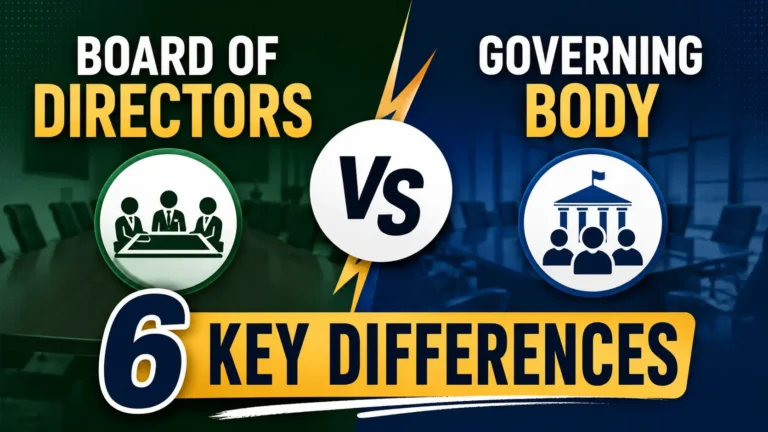
A Governing Body is the group that manages a Trust or Society, while a Board of Directors is the group that manages a Section 8 Company. Both guide the organisation, but they work under different laws, have different legal duties, and are formed differently. If you are setting up an NGO in India, knowing this difference helps you pick the right structure and stay compliant from day one.
If you have ever read two NGO websites side by side, you may have noticed that one talks about its “Governing Body” and another talks about its “Board of Directors.” At first glance, these terms seem interchangeable. They are not.
The difference matters because it decides how your NGO is legally structured, who can be held responsible for its decisions, and which laws apply to it. This post breaks down the Board of Directors vs Governing Body question in plain language, so you can make an informed choice for your organisation.
What Is a Governing Body?
A Governing Body is the managing team of a Trust or a Registered Society in India.
It is usually made up of a Chairperson, Secretary, Treasurer, and a few members. The exact structure depends on the Trust Deed or the Memorandum of Association (MoA), which is drafted at the time of registration.
The Governing Body:
- Takes major decisions about the organisation’s activities and finances
- Approves budgets, projects, and partnerships
- Appoints staff and reviews their work
- Represents the Trust or Society in legal and financial matters
Trusts are governed by state-specific Trust Acts or the Indian Trusts Act, 1882 (for private trusts), while Societies are governed by the Societies Registration Act, 1860, or the relevant state amendment.
What Is a Board of Directors?
A Board of Directors is the managing team of a Section 8 Company, which is a nonprofit registered under the Companies Act, 2013.
A Section 8 Company works much like a regular company, except its profits must be used only for its stated charitable or social objectives. That is why its governance structure follows company law rather than trust or society law.
The Board of Directors:
- Must have a minimum of two directors for a private limited Section 8 Company, or three for a public limited one
- Is responsible for statutory compliance under the Companies Act, 2013
- Reports to the Registrar of Companies (RoC) regularly
- Holds Board Meetings and an Annual General Meeting (AGM) as required by law
You can read more about Section 8 Company compliance requirements directly on the Ministry of Corporate Affairs website.
Board of Directors vs Governing Body: Key Differences

Here is a simple side-by-side comparison to make the distinction clear.
| Point | Governing Body | Board of Directors |
| Applies to | Trust, Society | Section 8 Company |
| Governing law | Trust Acts, Societies Registration Act, 1860 | Companies Act, 2013 |
| Formation document | Trust Deed, MoA & Bye-laws | Memorandum & Articles of Association |
| Regulator | Sub-Registrar / Registrar of Societies | Registrar of Companies (RoC) |
| Compliance filings | Comparatively simpler | Detailed annual filings, audits, resolutions |
| Member titles | Chairperson, Secretary, Treasurer | Director, Managing Director, Whole-time Director |
Who Needs a Governing Body?
If you are registering a Charitable Trust or a Society, you will need a Governing Body in place before you can complete registration.
This structure works well for organisations that want:
- Simpler compliance requirements
- Lower ongoing paperwork
- A quicker registration process in most states
Many grassroots NGOs, community groups, and religious or educational trusts prefer this route because it is easier to manage without a large administrative team.
Who Needs a Board of Directors?
If you plan to register a Section 8 Company, a Board of Directors is mandatory.
This structure suits organisations that:
- Plan to raise CSR funding from corporates, since many companies prefer funding Section 8 entities
- Want a formal, company-style governance system
- Expect to scale operations across multiple states
- Need stronger credibility with international donors and government bodies
A Section 8 Company generally has higher transparency requirements, which can build more trust with large funders, but it also comes with more compliance work.
Roles and Responsibilities Compared
Both the Governing Body and the Board of Directors exist to guide the organisation responsibly. Their day-to-day responsibilities overlap in many ways.
Shared responsibilities include:
- Setting the organisation’s mission, vision, and long-term goals
- Approving annual budgets and financial statements
- Making sure funds are used only for the stated charitable purpose
- Hiring and supervising senior staff
- Filing statutory returns and renewals on time
Where they differ:
- A Governing Body typically has more flexibility in how often it meets and how decisions are recorded, depending on the Trust Deed or bye-laws.
- A Board of Directors must follow stricter procedural rules, including proper notice periods for meetings, minutes in a prescribed format, and resolutions passed as per the Companies Act, 2013.
Legal Duties You Cannot Ignore

Whether you call it a Governing Body or a Board of Directors, members of both groups carry real legal responsibility. This is not just a title on a letterhead.
Fiduciary Duty
Members must act in good faith and in the best interest of the organisation, not for personal gain. Misusing funds or assets can lead to personal liability.
Duty of Care
Decisions should be made with reasonable care and diligence, the way a responsible person would manage their own affairs.
Duty of Compliance
Both structures must file annual returns, maintain proper books of accounts, and renew registrations such as 12A and 80G under the Income Tax Act where applicable. You can check current exemption rules on the Income Tax Department website.
Duty of Accountability
Trusts and Societies working with foreign funds must also comply with the Foreign Contribution (Regulation) Act, and both structures are increasingly expected to register on the NGO Darpan portal, run by NITI Aayog, for transparency and grant eligibility.
Failing to meet these duties can lead to penalties, loss of tax exemption status, or in serious cases, removal of members from their positions.
Common Mistakes NGOs Make With Governance Structures
Many new NGO founders run into avoidable problems because they did not fully understand the governance structure they signed up for. Some common mistakes:
- Choosing a Trust structure without checking if the state requires a minimum number of trustees
- Appointing family members only, which can raise red flags during FCRA or CSR fund applications
- Not holding regular Governing Body or Board meetings, leading to compliance gaps
- Mixing up the terms and using “Board of Directors” for a Trust in official documents, which can cause confusion during audits or registration
- Forgetting to update the Registrar or Sub-Registrar when members change
How to Choose the Right Governance Structure
There is no single “best” option. It depends on your goals.
Ask yourself:
- Do you want simpler setup and lower compliance, or are you prepared for detailed company-style filings?
- Are you likely to seek CSR funding, which often favours Section 8 Companies?
- How many people are realistically available to serve as trustees, society members, or directors?
- What is common practice for similar organisations in your state or sector?
Getting this decision right at the start can save a lot of restructuring effort later.
A Quick Word on Getting Professional Support
Registration rules, minimum member requirements, and compliance formats differ from state to state and can change over time.
If you are still deciding between a Trust, Society, or Section 8 Company, it can help to have someone who works with these registrations regularly walk you through the pros and cons for your specific situation. A short consultation before you start the paperwork is often enough to avoid rework later.
Frequently Asked Questions
Is a Governing Body the same as a Board of Directors?
No. A Governing Body manages a Trust or Society, while a Board of Directors manages a Section 8 Company. They serve similar functions but operate under different laws.
Can a Trust have a Board of Directors instead of a Governing Body?
No. A Trust is legally required to have a Governing Body as per its Trust Deed. The term “Board of Directors” applies only to companies registered under the Companies Act, 2013.
How many members are required in a Governing Body?
Most states require a minimum of two to three trustees for a Trust, and Societies typically need at least seven members, though this varies by state law.
How many directors does a Section 8 Company need?
A private Section 8 Company needs a minimum of two directors, and a public Section 8 Company needs a minimum of three directors, as per the Companies Act, 2013.
Are Governing Body members personally liable for NGO debts?
Generally, liability is limited to their role and duty of care, but members can be held personally responsible if funds are misused or duties are seriously neglected.
Which structure is better for receiving foreign donations?
All three structures, Trust, Society, and Section 8 Company, can apply for FCRA registration, but Section 8 Companies are often seen as more transparent by larger international donors due to stricter compliance norms.
Useful Links