
SAI NGO & BUSINESS CONSULTANCY
Expert services for NGO, Trust, Society Registration & Compliance across India.
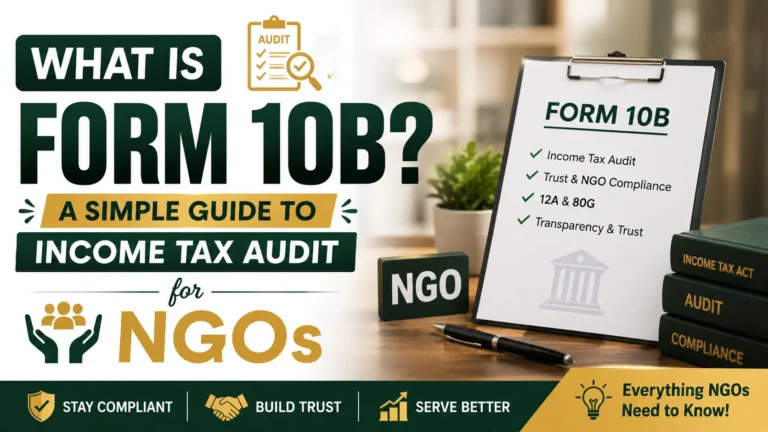
Think of Form 10B as a report card that a Chartered Accountant (CA) writes about your NGO’s finances, and hands over to the Income Tax Department every year.
If your NGO enjoys tax exemption under Section 12A or Section 10(23C), the tax department wants proof that you are actually using the money the way you promised, on charitable work, not on anything else. Form 10B is that proof.
Without it, your NGO could lose the very tax exemption that makes donations, grants, and foreign funding work in the first place.
Why Does an NGO Need a Tax Audit at All?
Most people assume audits are only for companies that want to make profits. NGOs are different. They don’t exist to earn profits, so why audit them?
The answer is trust. An NGO handles public money, donor money, and sometimes foreign contributions. The government allows this money to grow tax-free only if it is applied for genuine charitable purposes. A CA’s audit report is the independent check that confirms this.
- Confirms your income and expenses match your books of account
- Verifies you have applied at least 85% of your income for charitable purposes
- Flags related-party transactions, investments, and any income applied outside India
- Protects your 12A registration and 80G donor-benefit status
Who Is Required to File Form 10B?
Not every NGO files Form 10B. There are two forms, Form 10B and Form 10BB, and the one you use depends on the size and nature of your trust, under Rule 16CC of the Income-tax Rules.
You must file Form 10B if:
- Your trust’s total income, before claiming exemption under Sections 11 and 12, exceeds ₹5 crore in the year
- Your NGO has received any foreign contribution during the year
- Your NGO has applied any part of its income outside India
You should file Form 10BB if:
- None of the above three conditions apply, and your income stays below the ₹5 crore threshold
This condition-based split came in from Assessment Year 2023-24 onwards, after the CBDT notified new formats for both forms through Notification No. 7/2023.
Filing the wrong form is treated the same as not filing at all, which can put your entire exemption claim at risk. You can read the official notification on the Income Tax India website for the exact wording.
What Information Does Form 10B Actually Cover?
Form 10B is detailed. Your CA will need to go through your accounts closely before signing it. Broadly, it covers:
- A basic profile of the trust or institution, its registration details, and objects
- Income and application of income, including the 85% application requirement
- Details of any accumulation of income and how it was invested
- Investments held, and whether they follow the modes specified under Section 11(5)
- Related party or specified-person transactions, if any
- Foreign contribution details, where applicable
- Any income applied outside India
Because so much detail feeds into your final tax return, most of the figures your NGO reports in ITR-7 are actually pulled straight from Form 10B. A mistake here tends to show up later as a bigger problem.
When Is Form 10B Due?
Form 10B must be filed one month before the due date for filing your income tax return (ITR-7).
- For most NGOs and trusts, the audit report (Form 10B or 10BB) is due by 30th September of the assessment year
- ITR-7 then follows by 31st October of the same assessment year
- If your NGO needs a transfer pricing audit under Section 92E, the audit report deadline moves to 31st October, and ITR-7 to 30th November
The safest order of steps is: finalise your books, complete the audit, file and get Form 10B accepted using your CA’s digital signature, and only then file ITR-7. Filing the return before the audit report is accepted almost always leads to a correction later.
Who Prepares and Files Form 10B?
Form 10B is not something a trustee fills out on their own. It must be:
- Prepared and audited by a practising Chartered Accountant holding a valid Certificate of Practice
- Filed online through the e-filing portal, using the accountant’s login after the NGO assigns the form to them
- Digitally signed by the CA using a valid, portal-registered Digital Signature Certificate
You can find the step-by-step filing process on the Income Tax Department’s Form 10B user manual, which is a useful reference if your CA needs to confirm portal steps.
What Happens If Form 10B Is Not Filed on Time?
Missing this filing is more serious than most NGOs realise, because the consequences touch your exemption, not just a penalty amount.
- Your NGO can lose the tax exemption under Sections 11 and 12 for that year
- The income tax department may treat your audit report as defective, which affects your entire return
- Repeated non-filing over three consecutive years can even risk cancellation of your registration as a Registered Non-Profit Organisation
- You may lose the ability to issue valid 80G receipts, which affects your donors and their own tax benefits
None of this is meant to alarm you. It is simply why NGOs that stay organised around this one filing tend to have far fewer compliance headaches through the year.
Form 10B vs Form 10BB: A Quick Comparison
Form 10B: for larger trusts, income above ₹5 crore, foreign contributions received, or income applied outside India. It asks for more detailed disclosures.
Form 10BB: for smaller, purely domestic trusts below the ₹5 crore threshold, with simpler income and expenditure verification.
Both forms serve the same basic purpose, confirming that your NGO’s income was applied correctly, just at different levels of detail.
A Simple Checklist Before Your Audit
A little preparation before your CA begins the audit saves everyone time. Here is what generally helps:
- Books of account fully updated and reconciled for the year
- Receipts and payments account, income and expenditure account, and balance sheet ready
- Details of donations received, especially foreign contributions, if any
- Investment records matching Section 11(5) permitted modes
- Records of any related party transactions
- Prior year’s Form 10B or 10BB, and 12A/80G registration documents, for reference
Common Questions People Ask About Form 10B
Is Form 10B mandatory for every NGO?
No. It is mandatory only if your trust’s income before exemption crosses ₹5 crore, or if you received foreign contributions, or applied income outside India. Otherwise, Form 10BB usually applies instead.
Can a trustee sign Form 10B without a CA?
No. It must be audited and digitally signed by a practising Chartered Accountant holding a valid Certificate of Practice. A trustee cannot self-file this form.
What is the last date to file Form 10B?
It must be filed one month before your ITR-7 due date, which usually means by 30th September of the assessment year, with ITR-7 following on 31st October.
Does a small NGO with income below ₹5 lakh still need an audit?
Yes, if your income exceeds the basic exemption limit of ₹2.5 lakh, an audit is required to claim exemption under Section 12A, though you may fall under Form 10BB rather than Form 10B.
What if my NGO filed the wrong form by mistake?
This is treated as if no audit report was furnished at all, so your exemption claim can be denied. It is worth having a CA review your filing before the deadline to confirm the correct form was used.
Is Form 10B the same as an FCRA audit?
No. Form 10B is an income tax filing under the Income-tax Act. If your NGO holds FCRA registration, you separately need to file Form FC-4 with the Ministry of Home Affairs, even in a year with no foreign funds received.
A Gentle Word Before You File
Form 10B looks like paperwork on the surface, but underneath it, it’s really about protecting something your NGO has worked hard to build: the trust of your donors, your board, and the government.
Every year the form, the deadlines, and even the disclosure requirements get a little more detailed, and getting even one figure wrong can create problems that take months to sort out.
If you’re unsure whether your NGO needs Form 10B or Form 10BB, or you simply want a second pair of eyes on your accounts before the deadline, it may help to sit down with a Chartered Accountant who works with NGOs regularly. A short conversation now is usually far easier than a correction later.
If it would help, we’re happy to go through your NGO’s registration status, past filings, and this year’s numbers together, at whatever pace works for your team.
Useful Links