
SAI NGO & BUSINESS CONSULTANCY
Expert services for NGO, Trust, Society Registration & Compliance across India.
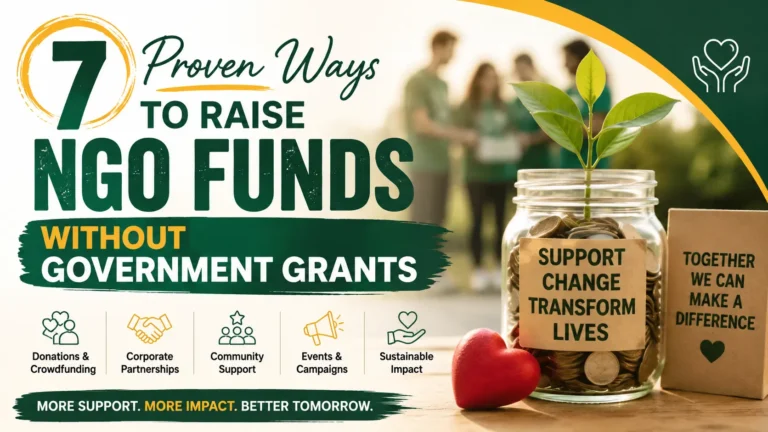
NGO funds without government grants means money a nonprofit raises through non-government sources, such as corporate CSR contributions, individual donations, crowdfunding, foreign contributions under FCRA, private foundation grants, and income from fee-based services, instead of depending on central or state government schemes.
Can an NGO Raise Money Without Government Grants?
Yes. Most NGOs in India already do it. Government grants are useful, but they are slow, competitive, and often tied up in paperwork that can take months to clear.
The good news is that government money is only one of many ways to fund your work. Corporate CSR budgets, individual donors, crowdfunding platforms, foreign contributions, and service-based income together support thousands of Indian nonprofits every year, many of whom never receive a single rupee from the government.
If your NGO is stuck waiting on a grant approval, this guide walks you through the other funding routes that are open to you right now, along with what you need to get started.
Why Should NGOs Look Beyond Government Grants?
Government schemes come with real limits that most NGOs run into sooner or later:
- Long approval cycles that leave programs waiting for months
- Heavy eligibility criteria, including years of operation and audited financial history
- High competition, since thousands of registered NGOs apply for the same limited pool of schemes
- Restrictive fund usage, where money can only be spent on specific approved activities
- Uncertain renewal, since a scheme active this year may be discontinued the next
This is exactly why financial advisors recommend that NGOs build at least three to four income streams instead of leaning on one source. A mixed funding model protects your programs even if one channel slows down.
How Can NGOs Raise Money Without Government Grants?
Here are the funding channels that work well for Indian NGOs, regardless of size or age.
1. Corporate Social Responsibility (CSR) Funding
Under Section 135 of the Companies Act, 2013, large companies must spend a fixed percentage of their profits on social causes. This has created one of the biggest pools of nonprofit funding in the country.
To be eligible for CSR funds, your NGO typically needs:
- Valid registration as a Trust, Society, or Section 8 Company
- 12A and 80G certification from the Income Tax Department
- CSR-1 registration with the Ministry of Corporate Affairs (mandatory since FY 2020-21)
- At least three years of operational history in most cases
Once these are in place, you can approach companies directly or list your NGO on CSR-matching platforms that connect nonprofits with corporate donors.
2. Individual and High-Net-Worth Donor Contributions
Everyday donors and wealthy individuals remain one of the most stable sources of NGO income. A donor base built over time gives you predictable, recurring funds that do not depend on any scheme or deadline.
This works best when your NGO:
- Holds valid 80G registration, so donors get a tax deduction on their contribution
- Shares clear, honest updates on how donations are used
- Offers simple ways to give, such as monthly giving programs, not just one-time donations
3. Crowdfunding Platforms
Online crowdfunding has changed fundraising for small and mid-sized NGOs. Platforms let you tell your story to thousands of potential donors without needing an existing network.
Popular platforms Indian NGOs use include:
- Ketto for cause-based and medical crowdfunding
- Milaap for social impact campaigns
- GiveIndia for verified nonprofit fundraising
Most of these platforms ask for verified 12A and 80G certificates before onboarding, and they typically charge a platform fee, so factor that into your fundraising target.
4. Foreign Contributions Under FCRA
If your NGO wants to accept funds from foreign donors, foundations, or diaspora networks, you need FCRA (Foreign Contribution Regulation Act) registration. This route generally requires at least three years of existence and a minimum spend on core charitable activities before you can apply.
FCRA funding suits NGOs working with international partners or foreign foundations, but it comes with strict reporting rules, so proper bookkeeping matters from day one.
5. Grants From Private Foundations and Trusts
Government is not the only body that gives grants. Private and family-run foundations, corporate trusts, and international philanthropic organizations also fund nonprofit work, often with fewer bureaucratic hurdles than government schemes. Many of these foundations publish open calls for proposals on their own websites, so it is worth building a shortlist relevant to your cause area.
6. Membership Fees and Fee-Based Services
Some NGOs generate part of their income through membership fees or by charging a modest fee for services like training programs, workshops, or consultancy in their area of expertise. This is not suitable for every NGO, but for those with specialized skills, it adds a steady, self-generated income stream that does not depend on external approval at all.
7. Fundraising Events and Campaigns
Charity runs, cultural evenings, auctions, and awareness campaigns still work, especially for building local visibility and donor relationships. These events rarely raise huge sums on their own, but they are excellent for turning first-time supporters into long-term donors.
What Documents Does an NGO Need to Attract Non-Government Funding?
Most CSR partners, crowdfunding platforms, and serious individual donors will ask for the same basic paperwork before they commit funds:
- Trust Deed, Society Registration Certificate, or Section 8 Company incorporation documents
- 12A registration (income tax exemption for the NGO)
- 80G registration (tax deduction for donors)
- PAN and bank account in the NGO’s name
- NGO Darpan registration, useful even for non-government funders as a credibility marker
- Audited financial statements for the past one to three years
Keeping these documents current is often the single biggest factor separating NGOs that get funded quickly from those that get turned away.
How Can NGOs Build Donor Trust Without Government Backing?
Without a government seal of approval, donors rely on other signals to judge whether your NGO is trustworthy. These matter most:
- Publishing annual reports and audited accounts on your website
- Sharing real, specific stories and outcomes instead of vague claims
- Keeping 12A and 80G certificates valid and visible to donors
- Responding openly when donors ask how funds were used
- Maintaining a simple, functioning website and active social media presence
Trust, once built, tends to bring repeat donations, referrals, and stronger CSR partnerships over time.
Is It Possible to Run an NGO Sustainably Without Any Government Grants?
Yes, and many well-known Indian nonprofits do exactly this. Sustainability usually comes from combining two or three of the channels above rather than depending on a single one.
A typical mix might look like individual donations for everyday running costs, CSR partnerships for larger projects, and crowdfunding for specific, time-bound campaigns.
The NGOs that struggle most are usually the ones waiting on one grant application while their programs stall. The ones that grow steadily are the ones that treat fundraising as an ongoing, year-round activity across multiple channels.
Frequently Asked Questions
Can an NGO survive without government funding?
Yes. Thousands of NGOs across India run entirely on CSR contributions, individual donations, crowdfunding, and foreign contributions, without ever receiving a government grant.
What is the easiest way for a new NGO to raise funds without a grant?
For a new NGO, individual donations and crowdfunding are usually the fastest starting points, since they do not require years of operational history. Getting 80G registration early makes both of these much easier.
Do NGOs need 80G and 12A registration for CSR or crowdfunding?
In almost all cases, yes. CSR partners and crowdfunding platforms generally require valid 12A and 80G certificates before they will onboard an NGO or release funds.
Is FCRA registration required for all foreign donations?
Yes. Any NGO that wants to legally receive funds from a foreign source, individual, or organization needs FCRA registration, along with a minimum operational history and spending record on core activities.
How much can crowdfunding realistically raise for an NGO?
This depends heavily on your story, network, and campaign quality. Small, well-told campaigns with verified documentation and genuine donor updates tend to perform far better than generic appeals, regardless of NGO size.
Getting Your NGO Ready for Non-Government Funding
Raising funds without government grants is entirely possible, but it does depend on having the right registrations, certificates, and documentation in place first.
If your NGO’s 12A, 80G, FCRA, or Darpan status needs a review, or you are not sure where your paperwork currently stands, it can help to have someone experienced take a look before you approach a CSR partner or crowdfunding platform.
If you would like a second opinion on your NGO’s compliance and funding readiness, feel free to reach out to us for a quick consultation. We are happy to help you figure out the right next step.
Useful Links
- NGO Darpan portal (NITI Aayog): https://ngodarpan.gov.in
- Ministry of Corporate Affairs, CSR-1 filing information: https://www.mca.gov.in
- Income Tax Department, 12A and 80G registration: https://www.incometax.gov.in
- FCRA online registration and compliance: https://fcraonline.nic.in
- Ketto crowdfunding platform: https://www.ketto.org
- Milaap crowdfunding platform: https://www.milaap.org
- GiveIndia nonprofit fundraising platform: https://www.giveindia.org