
SAI NGO & BUSINESS CONSULTANCY
Expert services for NGO, Trust, Society Registration & Compliance across India.
NGO Guidelines: Everything You Need to Know to Stay Compliant and Build Trust.
Running a non-governmental organization (NGO) is deeply fulfilling. You’re working to change lives, support communities, and drive real impact. But behind every successful NGO is a solid foundation of legal compliance, transparent governance, and adherence to proper guidelines.
Whether you’re just starting out or have been operating for years, understanding NGO guidelines is not optional — it’s essential. Non-compliance can lead to loss of tax benefits, cancellation of licenses, frozen funds, or even closure of your organization.
This guide breaks down everything you need to know about NGO guidelines in simple, practical language. We’ll cover what they are, why they matter, the key rules you must follow, and the most common mistakes organizations make — so you don’t have to learn the hard way.
What Are NGO Guidelines?
NGO guidelines refer to the legal, financial, and operational rules that govern how a non-profit organization must register, operate, manage funds, and report its activities. These guidelines exist at both the national and state level, and in many countries, there are additional rules for NGOs that receive foreign funding.
In India, for example, NGOs operate under several laws including the Societies Registration Act, the Indian Trusts Act, the Companies Act (Section 8), the Foreign Contribution Regulation Act (FCRA), and the Income Tax Act (Sections 12A and 80G).
Who Needs to Follow NGO Guidelines?
NGO compliance guidelines apply to:
- Newly registered NGOs and trusts
- Charitable societies and foundations
- Section 8 companies (non-profit companies)
- Religious and educational institutions receiving donations
- Organizations applying for CSR funds or government grants
- NGOs receiving foreign donations under FCRA
In short — if you run any kind of non-profit, charitable, or social impact organization, these rules apply to you.
Key Benefits of Following NGO Guidelines
Compliance is not just about avoiding penalties. When done right, following NGO regulations brings genuine, long-term benefits for your organization:
| Benefit | Explanation |
|---|---|
| Tax Exemptions | Registration under Section 12A allows NGOs to claim exemption from income tax on surplus funds. |
| Donor Tax Benefits | With 80G certification, your donors can claim deductions on their contributions — making your NGO more attractive to individual and corporate donors. |
| CSR Funding Eligibility | Government and corporate CSR grants often require NGOs to be fully compliant with 12A, 80G, and FCRA norms. |
| Legal Protection | Proper registration protects trustees and board members from personal liability in case of disputes. |
| Increased Credibility | Donors, grant agencies, and government bodies trust NGOs that follow the rules. Compliance = credibility. |
| Foreign Funding Access | FCRA registration allows you to legally receive donations from international sources — a major funding opportunity. |
| Long-Term Sustainability | Organizations that maintain proper compliance, financial discipline, and transparency are more likely to sustain operations, attract consistent funding, and grow their impact over time. |
Practical Steps to Comply With NGO Guidelines
Here’s a step-by-step breakdown to help you understand what compliance looks like in practice:
| Step | Detailed Explanation |
|---|---|
| Step 1: Choose the Right Legal Structure |
Before registering, decide on the structure that best suits your organization’s goals:
|
| Step 2: Register Your Organization |
Once you’ve chosen your structure, file the appropriate registration documents with the relevant state or central authority.
For a society, this is the Registrar of Societies. For a trust, it’s the local Sub-Registrar. For Section 8, it’s the Ministry of Corporate Affairs (MCA). |
| Step 3: Apply for 12A and 80G Registration |
These are income tax registrations that provide tax exemption for your NGO and tax benefits for your donors.
Apply through the Income Tax portal with the required documents — registration certificate, PAN, audited accounts, and activity reports. |
| Step 4: Open a Dedicated Bank Account |
Your NGO must have a separate bank account in the organization’s name.
All transactions — incoming donations, grants, and expenses — must go through this account. Mixing personal and NGO finances is a serious compliance violation. |
| Step 5: Maintain Proper Books of Accounts |
Accurate financial records are non-negotiable. Maintain:
|
| Step 6: Get Annual Audits Done |
All NGOs must get their accounts audited annually by a Chartered Accountant (CA).
The audit report must be submitted along with your income tax return (ITR-7 for NGOs). |
| Step 7: File Annual Returns and Reports |
Filing obligations include:
|
| Step 8: Renew Registrations on Time |
FCRA registration must be renewed every 5 years.
Similarly, 12A and 80G registrations (now provisional, then permanent) need to be renewed as per the latest Income Tax rules. Missing renewal deadlines can result in automatic cancellation. |
Common Mistakes NGOs Make (And How to Avoid Them)
Even well-meaning organizations fall into compliance traps. Here are the most frequent pitfalls:
| Common Mistake | Impact / Explanation |
|---|---|
| Not maintaining separate bank accounts | Mixing personal and organizational funds is a red flag during audits and can cost you your tax exemptions. |
| Ignoring FCRA rules | Many NGOs receive foreign donations without realizing they need FCRA registration. This is illegal and can result in heavy penalties. |
| Delaying annual filings | Late filing of ITR-7 or FC-4 can lead to penalties and loss of registration status. |
| Not updating registration details | Changes in trustees, address, or objectives must be reported to the relevant authority promptly. |
| Poor documentation of activities | Many NGOs struggle to prove that funds were used for charitable purposes. Always maintain project reports, photographs, beneficiary records, and vouchers. |
| Overlooking the Darpan Portal | NGOs seeking government grants must register on the NGO Darpan portal managed by NITI Aayog. This is often missed. |
| Non-compliance with CSR rules | If you receive CSR funds, there are specific utilization and reporting norms under the Companies Act that you must follow. |
Expert Tips to Keep Your NGO Compliant
Here are some practical tips from experienced compliance professionals:
- Hire a CA familiar with NGO law: Not all chartered accountants are well-versed in nonprofit regulations. Find one who specializes in NGO audits and filings.
- Create a compliance calendar: Track all renewal dates, filing deadlines, and audit timelines in a shared calendar with reminders.
- Digitize all records: Cloud-based storage for receipts, vouchers, and reports makes audits easier and protects against data loss.
- Conduct internal reviews quarterly: Don’t wait for the annual audit to check your finances. A quarterly review catches errors early.
- Train your board on governance norms: Trustees and board members should understand their legal responsibilities. Ignorance is not a defense.
- Stay updated on regulatory changes: NGO laws — especially FCRA and income tax rules — change frequently. Subscribe to government circulars or consult a legal advisor regularly.
- Register on CSR and grant portals: Beyond Darpan, register on portals like GuideStar India, Credibility Alliance, and relevant state CSR portals to improve visibility and credibility.
Final Thoughts: Compliance Is Not a Burden — It’s Your Foundation
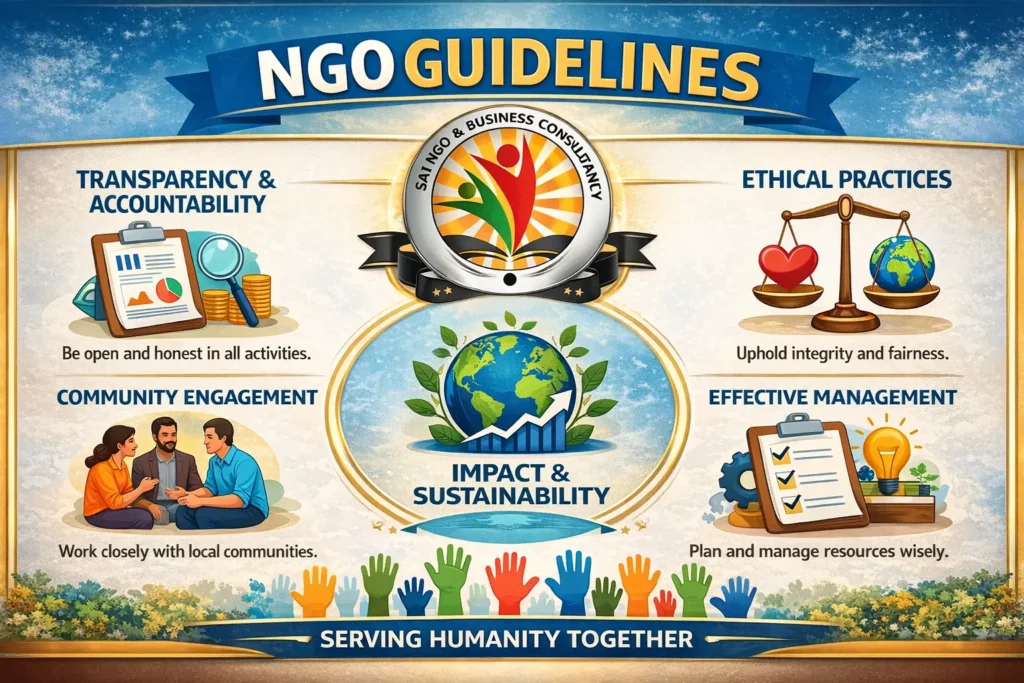
NGO guidelines can seem overwhelming at first glance. But once you understand the purpose behind each rule — transparency, accountability, and trust — compliance starts to feel less like a legal obligation and more like a value your organization already holds.
When your NGO is compliant, you can pursue your mission with confidence. Donors give more freely, grants come more easily, and your team operates without fear of legal trouble.
If you’re unsure about your current compliance status or want to set up your NGO the right way from the start, it’s always a good idea to get a professional review. A qualified NGO consultant or legal advisor can quickly identify gaps, help you file overdue returns, and put a compliance system in place that works for your size and type of organization.
Not sure if your NGO is fully compliant? Reach out for a free initial consultation. A 30-minute conversation with the right expert can save your organization months of unnecessary stress — and keep your mission moving forward.