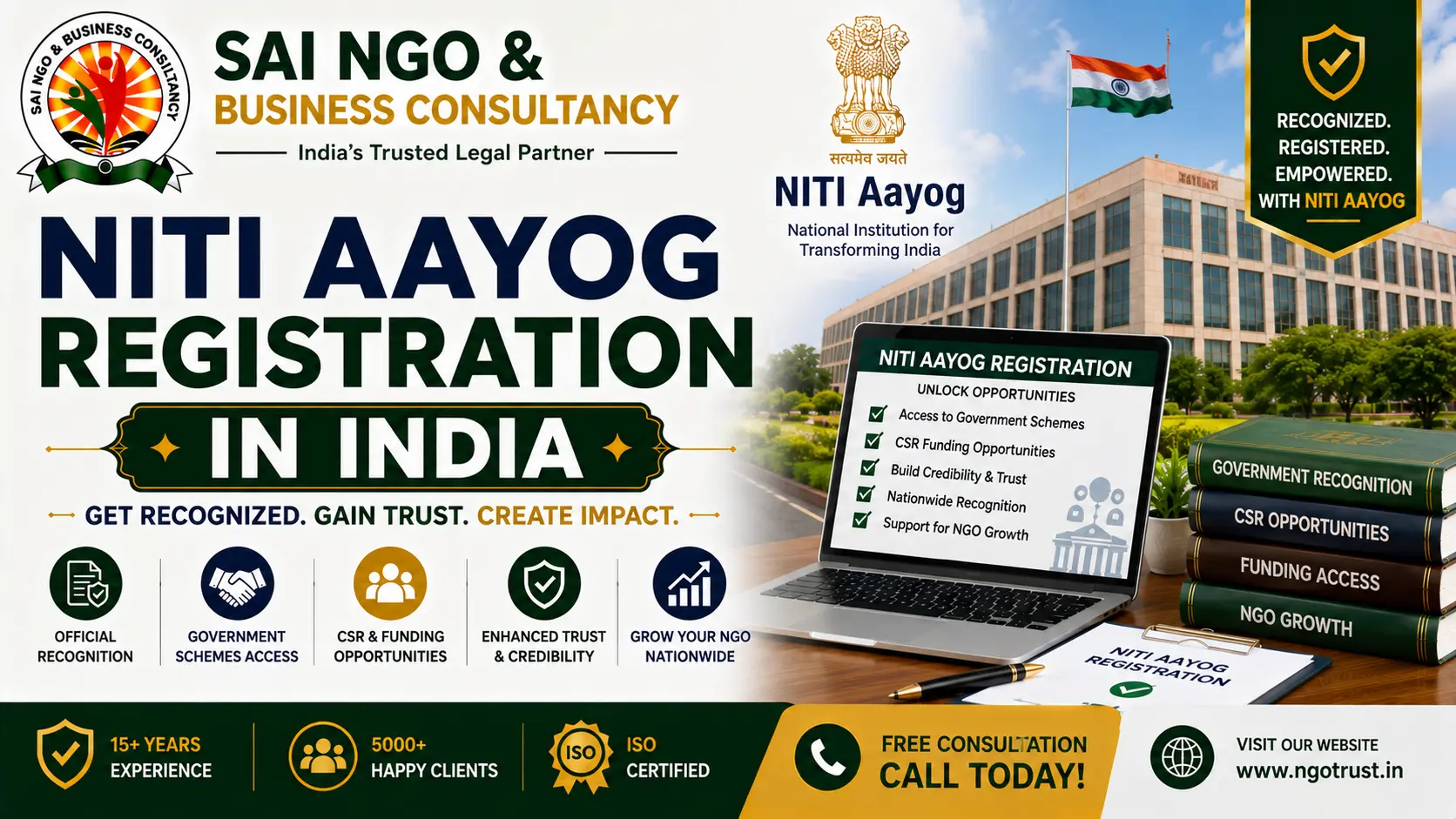
NITI Aayog registration, commonly called NGO Darpan registration, is the process of listing your NGO, Trust, Society, or Section 8 Company on the government portal ngodarpan.gov.in to get a unique Darpan ID. This ID is needed for government grants, CSR funding, and FCRA registration or renewal. The registration is free, fully online, and usually takes a few days once your documents are ready.
If you run an NGO in India, chances are someone has already told you to "get your Darpan ID." It sounds like just another government formality. It is not. NITI Aayog registration has quietly become one of the most important steps for any NGO that wants to work with the government, apply for CSR funds, or even keep its FCRA registration active.
In this guide, we will walk you through what NITI Aayog registration actually means, why it matters, who needs it, and how to complete the process without the usual back-and-forth and rejections.
What Is NITI Aayog Registration (NGO Darpan)?
NITI Aayog registration refers to enrolling your organization on the NGO Darpan portal, a platform built by NITI Aayog along with the National Informatics Centre. It was launched in 2015 to bring NGOs and government departments onto one shared, transparent system.
Once your NGO completes NITI Aayog registration, you get a unique identification number, often called the Darpan ID or Unique ID. Think of it as your NGO's government-recognized digital identity. Ministries, funding agencies, and CSR teams use this ID to check whether an NGO is genuine and active before working with it.
It is worth being clear about one thing here: NGO Darpan registration is different from registering your NGO as a legal entity. Your Trust Deed, Society Certificate, or Section 8 incorporation certificate proves your organization legally exists. NITI Aayog registration is a separate, additional step that connects your already-registered NGO to the government's system.
Is NITI Aayog Registration Mandatory for NGOs?
Strictly speaking, NGO Darpan registration is not mandatory for every NGO to simply exist. But in practice, it has become unavoidable for any NGO that wants to grow beyond small, local donations.
Here is why so many NGOs treat it as a non-negotiable step:
- It is required to apply for most central and state government grants.
- It is a prerequisite for FCRA registration, renewal, or any change in FCRA details, since the Ministry of Home Affairs asks for a valid Darpan ID before processing FCRA-related requests.
- Many corporates check for a Darpan ID before approving an NGO for CSR partnerships.
- It adds a layer of credibility when you approach donors, foundations, or government bodies for support.
So while you technically can run an NGO without it, skipping NITI Aayog registration usually means closing the door on government funding and formal partnerships.
Who Should Apply for NGO Darpan Registration?
Any legally registered non-profit entity in India can apply for NITI Aayog registration, including:
- Trusts registered under state Trust Acts
- Societies registered under the Societies Registration Act
- Section 8 Companies registered under the Companies Act, 2013
Both new and existing NGOs are eligible. Informal groups, unregistered community initiatives, or individual-led projects cannot apply, since a valid registration certificate is one of the basic requirements.
Documents Required for NITI Aayog Registration
Keeping your documents ready before you start saves a lot of time. Most rejections happen not because of the process itself, but because of mismatched or incomplete paperwork. Here is what you typically need:
- PAN card of the organization (the name on it must exactly match your registration certificate)
- Registration certificate, such as the Trust Deed, Society Registration Certificate, or Section 8 Certificate of Incorporation
- Aadhaar and PAN of at least two to three key office bearers, usually the President, Secretary, and Treasurer
- A short written statement of your organization's main objectives, taken from your Trust Deed, Memorandum, or bye-laws
- Address proof of the registered office
- Active mobile number and email ID for OTP verification
- Photograph and signature of the authorized signatory
Keep scanned copies in PDF format, generally under 2MB each, ready before you begin. This one step alone prevents most of the delays we see NGOs run into.
How to Complete NITI Aayog Registration: Step by Step
The entire NGO Darpan registration process happens online through ngodarpan.gov.in. Here is how it works, broken into simple steps.
Step 1: Visit the Official NGO Darpan Portal
Go to the official NITI Aayog NGO Darpan website. Avoid third-party sites that ask for payment, since this registration is completely free.
Step 2: Create Your Login
Click on "Register" and set up your login using a unique mobile number and email address. You will receive separate OTPs on both for verification.
Step 3: Enter Organization and PAN Details
Enter your NGO's name exactly as it appears on your PAN card. The system checks this against the Income Tax database, so even a small spelling mismatch can cause a rejection here.
Step 4: Fill in Organizational Information
Add your registration type (Trust, Society, or Section 8 Company), registration number, date of registration, registered address, and your organization's objectives.
Step 5: Add Details of Key Office Bearers
Provide the Aadhaar and PAN details of your President, Secretary, and Treasurer, along with their contact information.
Step 6: Declare Source of Funds
Mention whether your NGO receives foreign funding under FCRA or has previously received any government grants.
Step 7: Upload Documents
Upload all required documents in the specified format and size. Double-check file names and clarity before submitting, since blurry or mismatched scans are a common reason for delays.
Step 8: Submit and Track Your Application
Once submitted, your application moves to the verification stage. You can log back in anytime to check your status or complete your profile if you left it midway.
A quick tip
Many portals, including NGO Darpan, purge incomplete applications after a set number of days of inactivity. If you start your NITI Aayog registration, try to finish it in one or two sittings rather than leaving it half done for weeks.
How Long Does NITI Aayog Registration Take?
Once your documents are in order, verification is usually completed within a few days to a couple of weeks. NGOs with clean, matching documentation tend to get approved faster, while mismatched names or unclear scans can stretch the timeline considerably.
Common Mistakes That Delay NGO Darpan Registration
Most NITI Aayog registration delays are avoidable. Here are the mistakes we see most often:
- Organization name on PAN not matching the registration certificate exactly
- Uploading blurry, oversized, or wrong-format documents
- Missing Aadhaar or PAN details for one of the required office bearers
- Using a mobile number or email that changes hands later, making OTP verification impossible
- Leaving the application incomplete for too long, causing the saved data to expire
- Entering the objectives section carelessly, without aligning it with the actual Trust Deed or Memorandum
Reviewing every field twice before submission genuinely saves weeks of back and forth with the portal's verification team.
NITI Aayog Registration and the New Income Tax Rules
It helps to know that NGO Darpan registration and income tax registration are two separate approvals, even though NGOs often confuse them. Your Darpan ID does not replace the registration your NGO needs from the Income Tax Department for tax exemption benefits, and vice versa. Under the newer Income Tax Act framework, previously separate tax-exemption approvals for charitable and religious organizations have been brought under a single unified category, so it is worth checking with a professional whether your NGO's existing tax registration needs any renewal or update alongside your NITI Aayog registration.
Benefits of Completing Your NITI Aayog Registration
Beyond ticking a compliance box, NGO Darpan registration genuinely opens doors:
- Eligibility to apply for central and state government grants
- A smoother path to FCRA registration or renewal
- Higher visibility and credibility with CSR teams and corporate donors
- A verified digital profile that ministries and departments can reference directly
- Better coordination with government schemes relevant to your area of work
Getting Professional Help With NITI Aayog Registration
On paper, NITI Aayog registration looks like a simple online form. In practice, a single mismatched name or missing document can send an NGO back to square one, sometimes losing weeks in the process. If you would rather have someone who handles NGO registrations regularly take care of the details, it may be worth having a quick conversation with a consultant before you begin. A short call can often save far more time than it costs.
If you are setting up a new NGO or getting an existing one ready for grants, CSR funding, or FCRA approval, feel free to reach out to us for guidance on your NITI Aayog registration and the steps that follow it.
Useful Links
NGO Darpan Portal, NITI Aayog
NITI Aayog, Government of India
Ministry of Home Affairs, FCRA Online Services
Income Tax Department, Government of India