
SAI NGO & BUSINESS CONSULTANCY
Expert services for NGO, Trust, Society Registration & Compliance across India.
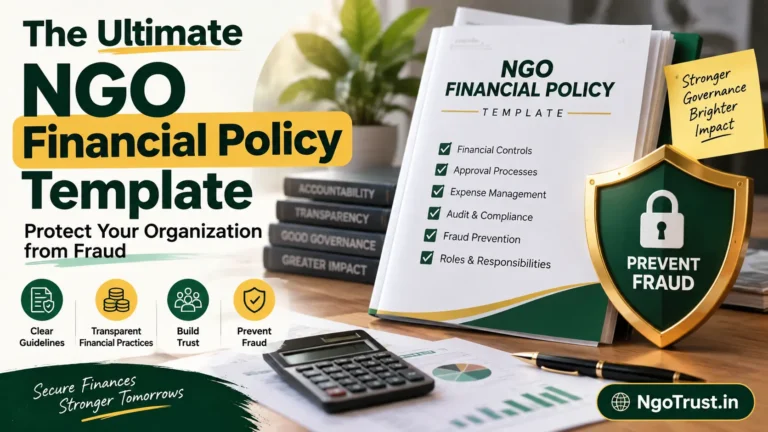
An NGO financial policy template is a written rulebook that lays out how your organization handles money — from approving expenses to signing cheques to reporting to donors. A good one closes the small gaps where fraud usually creeps in: single-signature payments, missing receipts, and no one checking the books but the person who keeps them. Every registered NGO, whether a Trust, Society, or Section 8 Company, needs one before the first big grant lands.
If you run an NGO in India, you already know the drill. A donor asks for a “financial policy document” before releasing funds. Your auditor asks for one during the 12A or FCRA renewal.
And somewhere in the back of your mind, you’re aware that NGOs — even well-run ones — occasionally end up in the news for the wrong reasons: missing funds, fudged bills, a treasurer who “forgot” to record a transaction.
This guide walks you through what a financial policy should actually contain, why fraud happens even in NGOs with good intentions, and how to build a policy that protects your organization instead of just sitting in a folder nobody reads.
What Is an NGO Financial Policy?
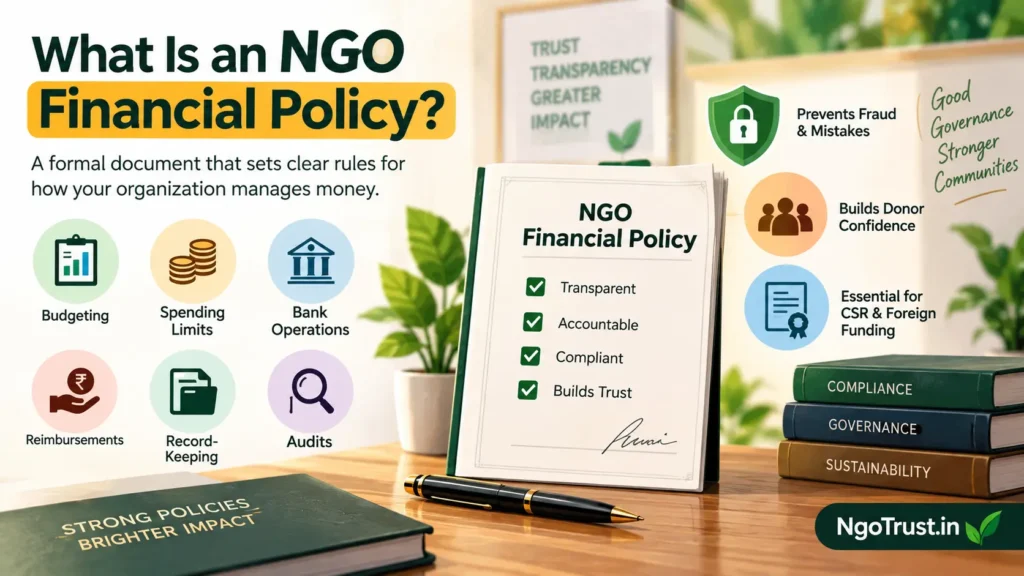
A financial policy is a formal document, usually approved by your governing board, that sets rules for how money moves in and out of your organization. It covers budgeting, spending limits, bank operations, reimbursements, record-keeping, and audits.
Think of it as the difference between “we trust everyone here” and “here’s exactly how money is handled, so trust isn’t the only thing holding it together.” Both can be true at once. Good policies don’t mean you doubt your team — they mean no single person, however honest, is ever in a position where a mistake or a bad day can’t be caught.
Donors, especially institutional ones, expect this document before they release CSR or foreign funds. Under the Companies Act, 2013, and FCRA rules, having documented financial controls is close to a requirement for organizations that want to receive CSR funding or foreign donations.
Why NGOs Are More Vulnerable to Financial Fraud Than You’d Think
Most fraud in the nonprofit sector isn’t dramatic. It’s not a villain plotting in the shadows — it’s a gap that nobody closed.
Small teams wear too many hats. In a lot of grassroots NGOs, the same person raises funds, spends them, and records the spending. That’s not dishonesty; that’s just how small teams work. But it’s also exactly the setup that makes fraud easy and hard to detect.
Cash still moves without paper trails. Field programs, especially in rural areas, often run on cash. Without a clear reimbursement and receipt policy, cash has a way of disappearing into “miscellaneous expenses.”
Boards meet quarterly, not monthly. By the time a board reviews the accounts, three months of transactions have already happened. If nobody flagged an issue in real time, it’s much harder to unwind later.
Trust is assumed, not verified. Many NGOs are built by friends, family members, or long-time volunteers. That trust is valuable, but it isn’t a control. A financial policy adds the missing layer without adding suspicion.
The Association of Certified Fraud Examiners has found repeatedly that organizations without basic financial controls — separation of duties, regular reviews, an anonymous reporting channel — lose significantly more to fraud, and take far longer to catch it, than those that have these basics in place. You can read more about how these patterns play out globally on the ACFE’s report page.
What Should an NGO Financial Policy Template Include?
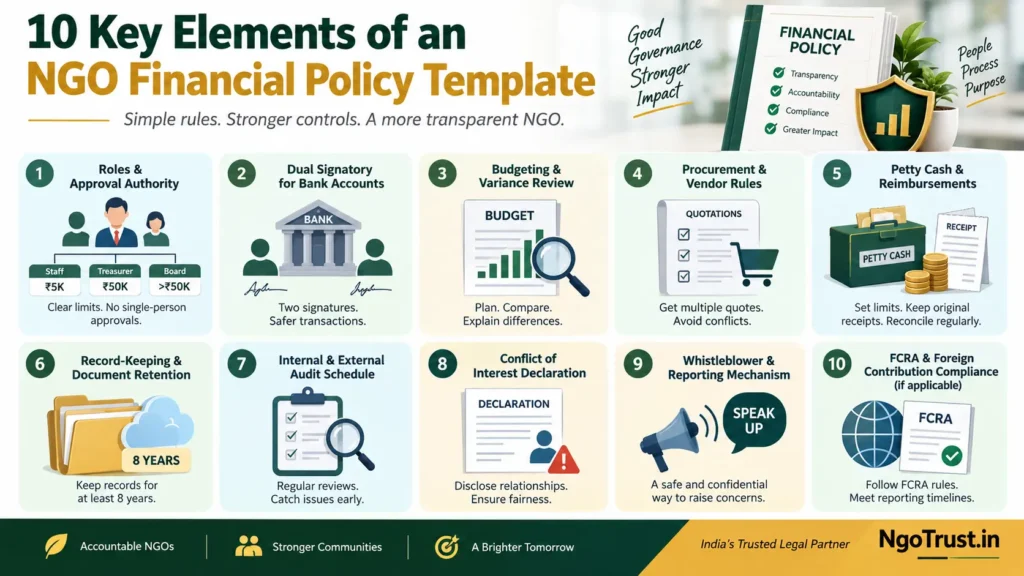
A financial policy doesn’t need to be fifty pages. It needs to cover the right ground. Here’s what a solid template should include, section by section.
1. Roles and Approval Authority
Spell out who can approve what. A common structure looks like this:
- Expenses under a set limit (say ₹5,000) — approved by the programme head
- Expenses up to a higher limit — approved by the treasurer or finance officer
- Anything above that — needs board or committee sign-off
This single section stops more fraud than any other part of the policy, because it removes the possibility of one person approving their own spending.
2. Dual Signatory Rule for Bank Accounts
Every NGO bank account should require two signatures for any transaction above a defined threshold. This is the single most effective, lowest-effort control against fraud. If your organization currently runs on one signatory “for convenience,” that convenience is exactly where risk lives.
3. Budgeting and Variance Review
A yearly budget, approved by the board, gives you something to measure against. The policy should require a quarterly comparison of actual spending against the budget, with an explanation for anything that’s off by more than a set percentage — 10% is common.
4. Procurement and Vendor Rules
For any purchase above a threshold, require at least two or three quotations. This prevents the classic pattern where a staff member routes every purchase through a vendor they have a personal relationship with, often at inflated prices.
5. Petty Cash and Reimbursement Rules
Set a cap on petty cash, require original receipts (not photocopies) for reimbursement, and reconcile the petty cash register weekly, not monthly. Petty cash is small by design, but it’s also where a lot of unrecorded spending happens simply because nobody watches it closely.
6. Record-Keeping and Document Retention
Specify how long financial records, receipts, and bank statements must be kept — the Income Tax Act generally expects records to be retained for at least eight years. Also specify who is responsible for maintaining them and where (physical and digital).
7. Internal and External Audit Schedule
Beyond the mandatory annual statutory audit, many well-run NGOs also run an internal review twice a year. This isn’t about distrust — it’s about catching small errors before they become large ones.
8. Conflict of Interest Declaration
Board members and senior staff should declare, in writing, any financial relationship with vendors, contractors, or grant recipients connected to the organization. This one clause prevents a surprising share of fraud cases, because most financial misconduct in NGOs involves someone with decision-making power benefiting a related party.
9. Whistleblower and Reporting Mechanism
Staff and volunteers need a safe, confidential way to raise concerns about financial irregularities without fear of losing their position or standing. Even a simple, clearly communicated email address reviewed by an independent board member is enough to start.
10. FCRA and Foreign Contribution Compliance (if applicable)
If your NGO receives foreign funding, the policy must separately address FCRA bank account rules, utilization certificates, and reporting timelines, since FCRA has its own strict compliance calendar separate from general accounting.
How Do NGOs Prevent Fraud Without Creating a Culture of Suspicion?
This is the question most founders quietly worry about. Nobody wants their team to feel policed.
The honest answer is that good controls protect honest people more than they catch dishonest ones. A treasurer who has to get a second signature isn’t being accused of anything — they’re being protected from ever being wrongly accused, and from the temptation that comes with unchecked access.
Frame the policy as something the whole team helped shape, not something imposed from above. Walk new staff and volunteers through it during onboarding, not just during an audit scare. And revisit it once a year — an NGO that grows from ₹5 lakh to ₹50 lakh in annual spending needs different controls than it did at the start.
When Should Your NGO Create or Update a Financial Policy?
- Before applying for 12A, 80G, or FCRA registration
- Before accepting your first CSR grant or foreign donation
- After any change in leadership, especially the treasurer or accountant
- Any time annual spending crosses a new threshold
- After any audit finding, even a minor one
If your NGO doesn’t have a documented policy yet, this is a good moment to write one — not after a donor asks for it under deadline pressure.
Common Mistakes NGOs Make With Financial Policies
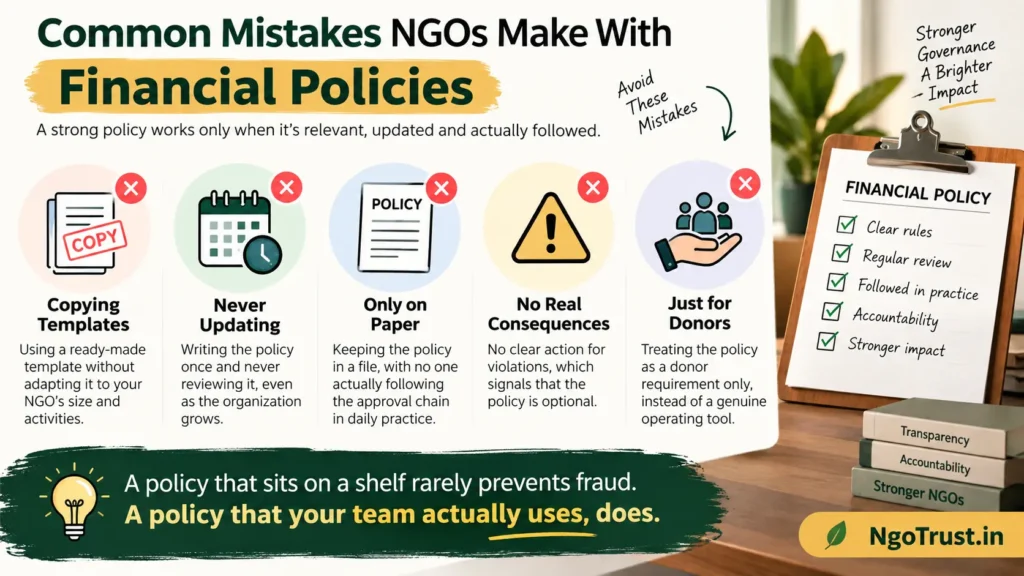
- Copying a template word-for-word without adjusting it to the organization’s actual size and activities
- Writing a policy once and never updating it, even as the NGO grows
- Keeping the policy only on paper, with no one actually following the approval chain in daily practice
- No real consequence for violations, which quietly signals that the policy is optional
- Treating the policy as a donor requirement only, instead of a genuine operating tool
A financial policy that exists only to satisfy a funder’s checklist rarely prevents fraud. One that the team actually uses, does.
Frequently Asked Questions
Is a financial policy legally required for NGOs in India?
There’s no single law that mandates a document called a “financial policy,” but FCRA registration, 12A/80G approval, and CSR eligibility all effectively require documented financial controls, so in practice it’s close to mandatory for any NGO seeking funding.
How often should an NGO update its financial policy?
At minimum, once a year during board review, and immediately after any major change — a new funding source, a change in leadership, or an audit finding.
Who should approve an NGO’s financial policy?
The governing board or managing committee should formally approve it, since board members carry ultimate fiduciary responsibility for the organization’s funds.
Can a small NGO with 2–3 staff members still follow these controls?
Yes, on a smaller scale. Even a two-person team can separate approval and payment roles, require two signatures on the bank account, and keep receipts organized. The size of the controls should match the size of the organization, not the size of a template.
What’s the difference between a financial policy and an accounting manual?
A financial policy sets the rules — who approves what, and under what conditions. An accounting manual explains the process — how entries are recorded, which software is used, and how books are closed each month. NGOs typically need both, but the financial policy comes first.
Does having a financial policy actually stop fraud?
It doesn’t eliminate the risk entirely, but it removes the easiest opportunities — unchecked single-signature accounts, no receipt trail, no second review — which is where the vast majority of NGO fraud cases start.
Building a financial policy from scratch can feel like one more thing on an already long list, especially when you’re focused on programme work, not paperwork. If you’d rather have someone walk through your NGO’s specific structure and put a policy in place that actually fits — instead of adapting a generic template — our team at SAI NGO & Business Consultancy is happy to help you think it through.