
SAI NGO & BUSINESS CONSULTANCY
Expert services for NGO, Trust, Society Registration & Compliance across India.
Running an NGO in India is an act of great service — but every rupee of public goodwill and foreign support you receive also brings a long list of legal and financial obligations.
Poor compliance doesn’t just attract penalties; it can strip your organisation of its tax exemption, freeze your bank accounts, and even cost you your FCRA registration.
Whether you are a registered trust, a society, or a Section 8 company, staying on top of financial compliance is the single most important thing you can do to protect your mission.
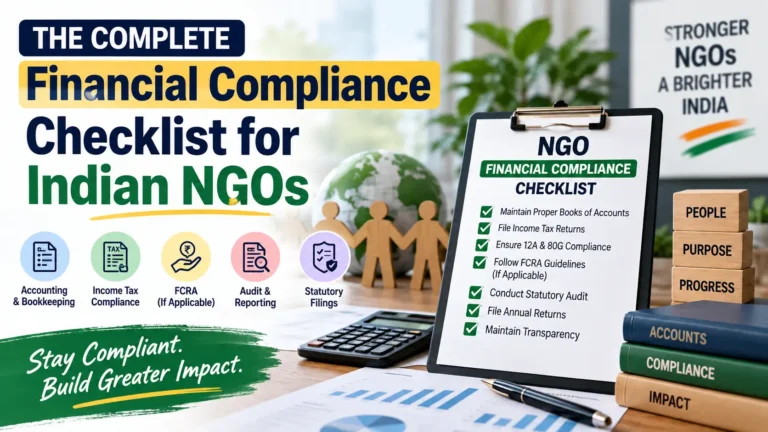
This guide is a complete, practical, and up-to-date financial compliance checklist for Indian NGOs — from registration and tax exemption to TDS, GST, FCRA, CSR, labour laws, and internal governance. Bookmark it, share it with your finance team, and use it every quarter.
Why Financial Compliance Matters
Compliance is not paperwork for its own sake. It serves three critical purposes:
- Protecting tax exemption: A single violation under Section 13 of the Income-tax Act — such as a payment to a trustee — can result in the denial of exemption and full taxation of your income.
- Maintaining donor trust: Donors, grantors, and CSR boards increasingly audit the compliance records of every NGO they fund. Clean, transparent accounts win repeat funding.
- Avoiding penalties: Interest and penalties on late TDS, GST, and income tax filings can quietly eat into your program budget.
Think of this checklist as the financial spine of your NGO. Each section tells you what to do, when to do it, and what happens if you don’t.
1. Registration & Legal Status
Your compliance obligations begin before you receive a single rupee. This is the foundation everything else rests on.
Checklist Items
- Core registration: Confirm the legal entity type — a Trust (Indian Trusts Act, 1882 or the Bombay Public Trusts Act, 1950), a Society (Societies Registration Act, 1860), or a Section 8 Company (Companies Act, 2013). Your books, audit, and filings must align with this structure.
- 12AB registration: Every NGO claiming exemption under Sections 11 and 12 must hold a valid 12AB registration issued by the Income-tax Department. It is valid for five years and must be renewed before expiry by applying online using Form 10A on the incometax.gov.in portal.
- 80G registration: This lets your donors claim deductions on their contributions (50% or 100% depending on your category). Like 12AB, it is now granted for five years and is renewed through the same online process.
- PAN & TAN: Ensure your PAN is active, linked with Aadhaar, and that you hold a TAN (Tax Deduction and Collection Account Number) if you are required to deduct tax.
- Dividend / DPIN details: Directors/Trustees should be up to date with their DIN/DSC filings, especially for Section 8 companies.
- NGO Darpan (NITI Aayog): Registration on the NGO Darpan portal opens access to Central and State government grants and is becoming a prerequisite for many funding sources.
- State registrations: Depending on your State, you may need registration under the Shops and Establishments Act, the local Public Trust Act (for annual returns to the Charity Commissioner), and professional tax — remember, many States are moving to e-filing on a monthly/quarterly basis.
2. Income Tax & Exemption Compliance
Your tax exemption is not automatic. It is conditional, and the Income-tax Act gives you strict conditions to satisfy every financial year.
Checklist Items
- Bookkeeping method: Maintain books on an accrual basis. Even if your turnover is small, keeping month-wise books avoids last-minute year-end chaos.
- Maintain income & expenditure account: Along with receipts, payments, and a balance-sheet, this is mandatory for trust assessment.
- Compute exempt income correctly: Only income applied (spent) for charitable purposes qualifies for exemption under Section 11. Keep a running computation of “income applied” versus “income accrued”.
- The 85/15 rule: You must apply at least 85% of your income to charitable purposes within India in the same year. The remaining 15% may be accumulated.
- Section 11(2) accumulation: If you intend to accumulate more than 15% (for a project, capital asset, or corpus), you must file Form 10 online and specify the objects and period. Do this before the return is filed, not after.
- Avoid Section 13 traps: No personal benefit to trustees, founders, or their relatives; no violation of the investment restriction of Section 11(5); and no application of income outside India. Any of these can end your exemption.
- File ITR-5: Trusts and societies file Form ITR-5 every year. The due date is typically 31 July, extended to 31 October when a tax audit under Section 44AB applies. Link your bank account and pre-validate your bank for faster refunds.
- Response to notices: Track e-notices via the income tax portal and the ITR status dashboard. Non-response is one of the most common reasons NGOs lose exemption.
3. Audit & Reporting — Form 10B / 10BB
Every NGO claiming exemption under Section 11/12 must get its accounts audited and its audit report filed electronically before its return due date.
- Determine which form applies: Rule 17A distinguishes between Form 10B and Form 10BB. Form 10B applies where an audit is statutorily required because gross receipts exceed the limit specified under Section 44AB (₹1 crore for a business, ₹10 lakh or ₹50 lakh for professions, depending on the year). Form 10BB is the simpler form for NGOs whose audit is not statutorily mandatory.
- Get the audit well in advance: Do not wait for August. Run a trial balance and bank reconciliation by May/June so the auditor can complete by July.
- File the audit report online: The chartered accountant will upload the report through the income tax portal under the heading “Audit Reports” before the prescribed due date.
- Year-end caveat: Capital assets, grants, and restricted funds (earmarked donor funds) must be classified properly in the income & expenditure account so the auditor can certify net application of income without ambiguity.
4. TDS & Withholding Taxes
If your NGO pays salaries, rent, professional fees, or contracts, you are a deductor and must withhold tax. Non-compliance is one of the most heavily penalised areas for NGOs.
- Obtain TAN: If you deduct at source, you must hold a TAN and quote it on TDS challans and returns.
- Download Form 16/16A: Provide TDS certificates to employees and vendors. Form 16 for salaried staff; Form 16A for non-salary payments.
- Deposit TDS by the 7th: TDS deducted in a month must be deposited by the 7th of the following month (30 April for the month of March).
- File quarterly returns (24Q / 26Q): Salaried TDS goes in Form 24Q; non-salaried in Form 26Q. Due dates: 31 July (Q1), 31 October (Q2), 31 January (Q3), and 31 May (Q4).
- Common rates to remember: Contractors’ payments 1% (individual/HUF) or 2% (other); professional fees under 194J 10%; rent 10% under 194-I; interest under 194A 10%. Always check the current-year rates and thresholds — rates move with the Finance Act.
- Track Form 26AS / AIS: Reconcile your TDS deposits and the AIS (Annual Information Statement) to ensure no mismatch with what the department shows on your PAN.
5. GST Compliance
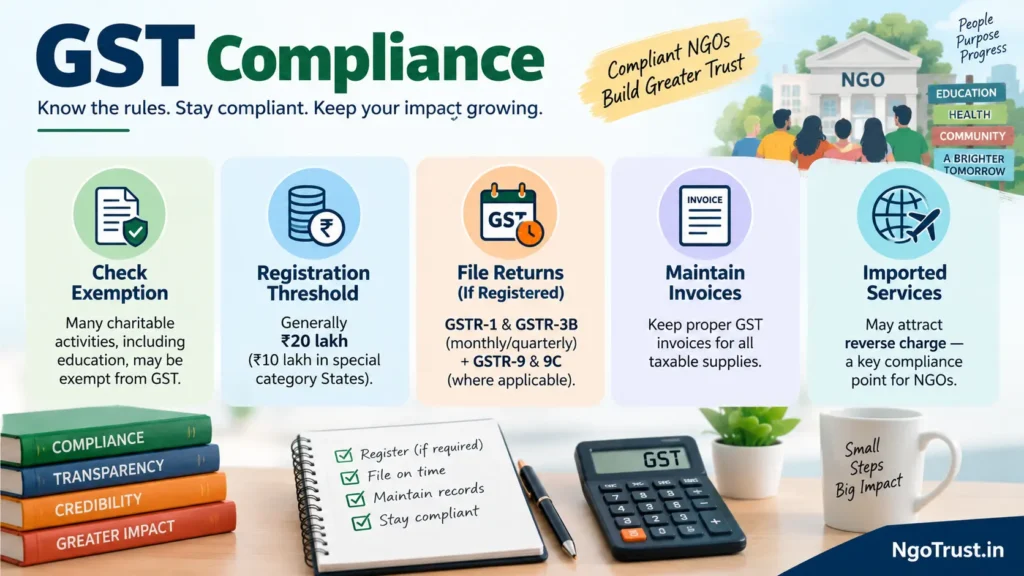
GST applies to NGOs in a nuanced way. Many NGO activities are exempt, but registration is required once taxable turnover crosses the threshold.
- Check the exemption: Services supplied to undergraduate education and various charitable activities specified under Notification 12/2017 & 25/2019 (para 1 & 2) may be exempt from GST.
- Registration threshold: Aggregate turnover threshold for registration is generally ₹20 lakh (₹10 lakh in special category States). Cross it — you register.
- File returns if registered: Monthly/quarterly GSTR-1 and GSTR-3B, with GSTR-9 (annual return) and GSTR-9C (reconciliation) where applicable. Late fees can accrue quickly, so set reminders.
- Attendance to invoices: Maintain proper GST invoices for any taxable supplies (e.g., sales of goods, training fees not covered by exemption).
- Watch imported services: If your NGO imports services from abroad (software, consultancy), you may be liable under reverse charge — a compliance point often missed by grant-funded NGOs.
6. FCRA — Foreign Contributions
If your NGO receives any foreign contribution, the Foreign Contribution (Regulation) Act, 2010 rules your existence. The 2020 amendments made the regime significantly stricter.
- FCRA registration or prior permission: You cannot accept foreign funds without either a valid FCRA registration or prior permission in the specific case. Receiving foreign money without FCRA validity is a serious offence.
- Designated FCRA bank account: Foreign contributions must be received only in the designated FCRA account (the SBI New Delhi main branch account is the statutory option). Keep it separate — never co-mingle FCRA funds with local funds.
- Renewal every 5 years: FCRA certificates now expire after five years and must be renewed through Form FC-5 at least six months before expiry.
- Utilise within 2 years: Foreign contributions must be utilised within two years of receipt. Any unutilised balance must be transferred to your designated account or used for a specified purpose; failure is treated seriously.
- File FC-3 annual return: The FC-3 annual return for the previous financial year must be submitted online at fcraonline.mha.gov.in by 31 December every year.
- Minimal social media usage: Post-2020 rules limit the use of foreign funds to 20% of the total administrative expenses — track admin spend carefully.
- Separate books: Maintain distinct books of account for foreign contributions, and ensure the auditor certifies the utilisation statement.
7. CSR Compliance
Companies that meet the Section 135 thresholds must spend 2% of their average net profits on CSR. As the implementing partner, your NGO has its own obligations.
- Register on CSR-1: An NGO implementing CSR projects needs a CSR-1 registration with a unique CSR registration number, filed with the Ministry of Corporate Affairs (MCA).
- Get a CSR project number: Every CSR project now gets a CSR Project Number that tracks the project through implementation.
- Comply with the CSR rules: CSR spent through intermediaries can be risky for the corporate; ensure your NGO has the capacity, audited accounts of the last year, and a formal project agreement with the corporate.
- Track utilisation reports: Under CSR Rules, project monitoring, utilisation certificates, and the CSR-2 filing (by companies) all depend on your NGO maintaining clean, verifiable project books.
8. Labour, PF & ESI Compliance
Once you have employees, labour compliance applies. The size of your team decides how much of this applies.
- Shops & Establishments: Register under the local Shops and Establishments Act (every employee, regardless of size, is typically covered) and maintain statutory registers.
- EPF (Employees’ Provident Fund): Mandatory when you have 20+ employees. File ECR (Electronic Challan cum Return) monthly and deposit contributions by the 15th.
- ESI (Employee State Insurance): Mandatory for establishments with 10+ employees earning up to the wage ceiling. File contributions against the 21st of the following month.
- Professional tax: In States that levy it, register and file monthly/quarterly returns (e.g., Maharashtra, Karnataka, West Bengal).
- Minimum Wages & Payment of Wages: Pay at least the notified minimum wage and maintain muster/wage registers.
- POSH (Prevention of Sexual Harassment) Act: 10+ employees requires an Internal Committee and annual compliance statements.
- Gratuity: Under the Payment of Gratuity Act, establishments with 10+ employees are covered for gratuity liability.
9. Internal Governance & Documentation
Financial compliance is only as strong as the governance behind it. Regulators, auditors, and donors look at your documentation trail.
- Board minutes: Record every board/trustee meeting on fund utilisation, resolutions, investments, and appointment of office bearers.
- Statutory registers: Maintain registers of members, minutes, resolutions (for Section 8 companies and societies), and appointment records.
- Annual returns to the Registrar: Societies must file annual returns with the Registrar of Societies; trusts under the Bombay Public Trusts Act file annual returns to the Charity Commissioner. Losing these — even if your income tax is in order — is a common failure.
- Bank signatories & mandate: Keep authorized signatories current; any change in trustees/directors should be mirrored in bank and in registration records immediately.
- Maintain an internal controls memo: Define who approves expenses, purchase limits, and who reconciles bank accounts. Segregation of duties protects your staff as much as your funds.
10. Fund Utilisation, Transparency & Donor Reporting
- Earmark restricted funds: Grant funds are often restricted by purpose; keep them in separate ledger heads and project schedules.
- Grants & advances: Ensure timely completion certificates, utilisation certificates, and matching grant income with expenditure.
- Public transparency: Publish annual reports, audited financials, and donors’ listings. Transparent NGOs convert better in grants and attract CSR partners.
- Ratio monitoring: Track admin-to-program ratio carefully — FCRA caps admin expenditure at 20% to 50% (depending on nature), and many donors cap it at 10-15%.
- Deadline hygiene: Use a compliance calendar (below) with owner names. Missed deadlines cost penalties and credibility.
Annual Compliance Calendar for Indian NGOs
| Deadline | Compliance |
|---|---|
| 7th of every month | Deposit the TDS deducted in the previous month |
| 15th of every month | EPF/ECR contribution deposit and return |
| 16th-21st of every month | ESI contribution deposit |
| 31 July | Q1 (April-June) TDS returns 24Q & 26Q |
| 31 October | Q2 (July-September) TDS returns; ITR-5 due date when audit applies |
| 31 December | FC-3 FCRA annual return (previous financial year) |
| 31 January | Q3 (October-December) TDS returns 24Q & 26Q |
| 31 May | Q4 (January-March) TDS returns; GSTR-9/GSTR-9C annual GST returns where applicable |
| July-September | Form 10B/10BB audit reports and ITR-5 (by 31 October if audited) |
| Before expiry (5 yrs) | Renew 12AB, 80G, and FCRA registration |
Note: due dates sometimes shift with Finance Act amendments — always confirm the current-year circular for the exact date.
Common Mistakes NGOs Make (and How to Avoid Them)
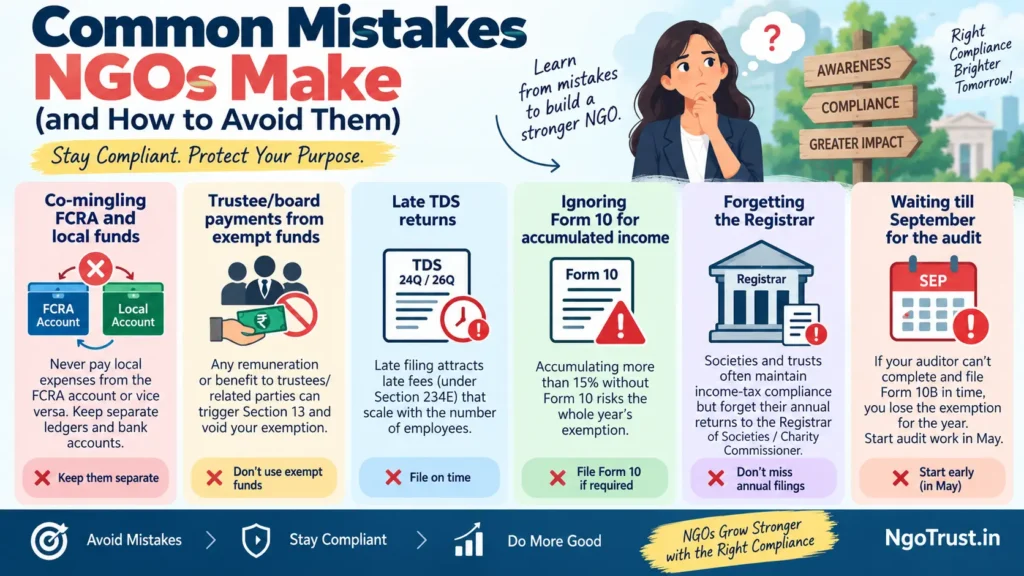
- Co-mingling FCRA and local funds: Never pay local expenses from the FCRA account or vice versa. Keep two completely separate ledgers and bank accounts.
- Spending trustee/board payments from exempt funds: Any remuneration or benefit to trustees/related parties can trigger Section 13 and void your exemption.
- Late TDS returns: Late filing of 24Q/26Q attracts late fees (under Section 234E) that scale with the number of employees.
- Ignoring Form 10 for accumulated income: Accumulating more than 15% without Form 10 risks the whole year’s exemption.
- Forgetting the Registrar: Societies and trusts often maintain income-tax compliance but forget their annual returns to the Registrar of Societies / Charity Commissioner.
- Waiting till September for the audit: If your auditor can’t complete and file Form 10B in time, you lose the exemption for the year. Start audit work in May.
How NgoTrust Helps You Stay Compliant
You don’t have to manage this alone. NgoTrust is built specifically for Indian NGOs, with a ready reckoner for compliance timelines, guidance on registrations (12AB, 80G, FCRA, CSR-1, NGO Darpan), and support from a community of finance professionals who work with NGOs every day.
Use the platform to keep your compliance calendar, set reminders, and connect with specialists who can review your fund utilisation and audit-readiness before the year-end rush.
Conclusion
Financial compliance is not bureaucracy imposed on your good work — it is the backbone that makes your good work sustainable. A well-registered, correctly reported, transparently managed NGO attracts more donors, gets grants faster, and survives regulatory scrutiny without drama.
The checklist above is comprehensive but not static: regulations change every Finance Act, every MCA notification, and every FCRA circular. Review this checklist each financial year, assign owners for each deadline, and build compliance into your routine rather than your year-end panic.
Start today. Pick one section — say, registrations — and confirm your 12AB, 80G, and FCRA status this week. Small steps, taken regularly, keep your mission protected for the long run.