
SAI NGO & BUSINESS CONSULTANCY
Expert services for NGO, Trust, Society Registration & Compliance across India.
Most NGOs don’t land in legal trouble because they did something dishonest. They land in trouble because of ordinary bookkeeping mistakes: mixing personal and NGO funds, missing donation receipts, late FCRA filings, weak cash records, and no audit trail. These gaps invite tax notices, frozen bank accounts, and, in serious cases, cancelled registration. Fixing them early is far easier than defending an NGO after a notice arrives.
If you run an NGO, a trust, or a Section 8 company in India, you already know the paperwork never really stops. Grants come in, expenses go out, volunteers change, and somewhere in between, bookkeeping quietly slips down the priority list.
That gap is where legal trouble usually begins. Income tax officers, FCRA authorities, and even donors are increasingly checking how NGOs manage their books, not just how they spend their money. A missing receipt or a delayed filing that seems minor today can turn into a show-cause notice, a frozen account, or a cancelled 12A or FCRA registration a year later.
This post walks through the seven bookkeeping mistakes we see most often in Indian NGOs, why each one creates legal risk, and what a founder or trustee can do to fix it before it becomes a bigger problem.
Why Does Bookkeeping Cause Legal Trouble for NGOs?
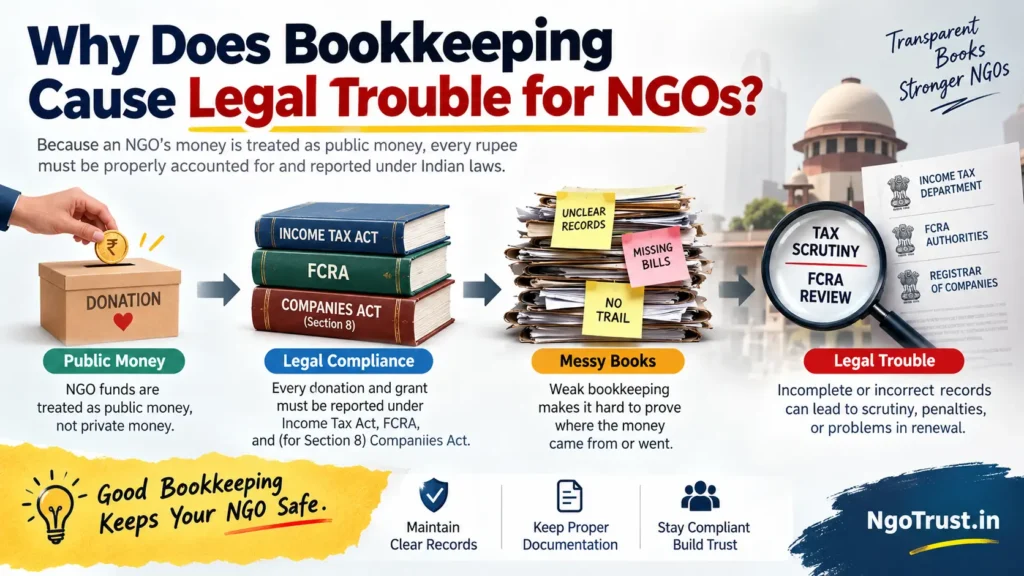
Bookkeeping causes legal trouble for NGOs because Indian law treats an NGO’s money as public money, not private money. Every rupee that comes in as a donation or grant has to be accounted for and reported correctly under the Income Tax Act, the Foreign Contribution (Regulation) Act (FCRA), and, for Section 8 companies, the Companies Act.
When the books are messy, an NGO cannot prove where the money came from or where it went. That’s exactly what tax officers and FCRA authorities look for during scrutiny or renewal. Weak bookkeeping doesn’t just look unprofessional; it removes the paper trail an NGO needs to defend itself if questioned.
7 Common Bookkeeping Mistakes That Get NGOs into Legal Trouble
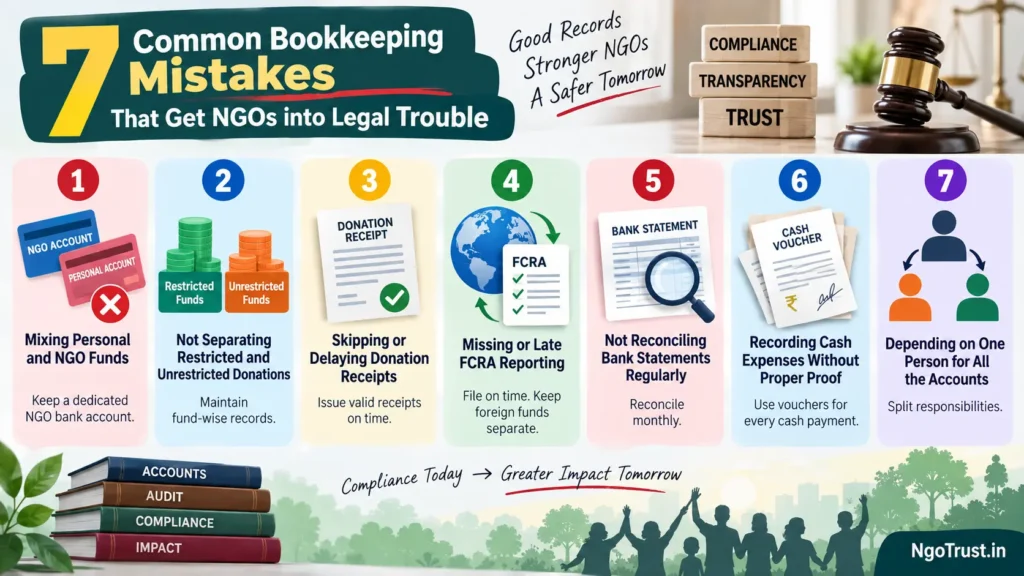
Here are the mistakes that show up again and again when NGO accounts are reviewed, along with why each one carries legal weight.
1. Mixing Personal and NGO Funds in the Same Account
This is the most common mistake, especially in smaller or newly registered NGOs. A founder pays for a workshop out of pocket, gets reimbursed later, or routes a donation through a personal account because the NGO’s bank account isn’t ready yet.
Under income tax law, this is a red flag. Section 8 companies, trusts, and societies claiming tax exemption under Section 12A must show that their income is used only for the organisation’s charitable purpose. Once personal and NGO funds mix, that separation breaks down, and the exemption itself can be questioned during assessment.
The fix: keep a dedicated bank account for the NGO from day one, and never route donations through a personal account, even temporarily.
2. Not Separating Restricted and Unrestricted Donations
Donors often give money for a specific purpose, a scholarship fund, a disaster relief drive, or a particular project. That money is called a restricted fund and legally has to be used only for what it was given for.
Many NGOs pool all donations into one account and spend from it as needed, without tracking which rupee belongs to which project. If a donor or auditor later asks how their contribution was used, the NGO often can’t answer clearly. This is a common trigger for donor complaints and, in FCRA cases, for regulatory action.
The fix: maintain fund-wise or project-wise ledgers so every donation can be traced from receipt to spend.
3. Skipping or Delaying Donation Receipts
Every donor who wants to claim an 80G deduction needs a valid receipt, and since 2022, NGOs also have to file Form 10BD and issue Form 10BE certificates for donations received in a financial year. Miss this, and the donor loses their tax benefit, not the NGO. But the NGO carries the reputational and compliance damage.
Some NGOs issue receipts weeks or months late, or with incomplete details like a missing PAN or donation date. During an 80G renewal, mismatched or missing receipts are one of the first things scrutinised.
The fix: issue receipts immediately, and reconcile them against Form 10BD before the annual filing deadline.
4. Missing or Late FCRA Reporting
NGOs that receive foreign contributions have some of the strictest bookkeeping obligations in Indian nonprofit law. Every foreign donation must go through a designated FCRA bank account, and annual returns (Form FC-4) have to be filed on time with proper utilisation details.
Late or incorrect FCRA filings are one of the leading reasons FCRA registrations get suspended or cancelled. Once that happens, an NGO can’t legally receive foreign funding at all, sometimes for years.
The fix: track foreign and domestic funds separately from the start, and treat FCRA filing deadlines as non-negotiable.
5. Not Reconciling Bank Statements Regularly
Bank reconciliation sounds boring, and that’s exactly why it gets skipped. But it’s the simplest way to catch errors early, a duplicate payment, an unrecorded expense, or worse, unauthorised transactions.
NGOs that reconcile only once a year, right before audit season, often discover discrepancies too late to explain them properly. Auditors flag this, and unresolved discrepancies can invite closer scrutiny from tax authorities.
The fix: reconcile bank statements monthly, not annually. It takes an hour a month and saves days of explanation later.
6. Recording Cash Expenses Without Proper Proof
NGOs working in rural or grassroots settings often deal in cash, paying a local vendor, a daily-wage worker, or transport costs where digital payment isn’t practical. The problem isn’t the cash itself; it’s recording that expense without a bill, voucher, or signed acknowledgment.
Under the Income Tax Act, cash expenses above certain limits also attract disallowance, meaning the NGO can’t claim them as legitimate spending at all. Weak cash documentation is one of the first things an assessing officer questions.
The fix: use simple cash vouchers with a signature for every cash payment, however small, and keep them filed by date.
7. Depending on One Person for All the Accounts
In many NGOs, one trusted person, often a founder, a family member, or a single accountant, handles everything: cash, bank, receipts, and filings. It feels efficient, but it removes any internal check on errors or misuse.
If that person leaves suddenly, falls ill, or simply makes a mistake, there’s no second set of eyes to catch it. Auditors and regulators view a lack of internal control as a governance weakness, and it can make an NGO look less credible during registration renewals or CSR fund audits.
The fix: even in a small team, split responsibilities; one person records transactions, another reviews and approves them, even if that review happens monthly rather than daily.
How NGOs Can Stay Ahead of These Mistakes
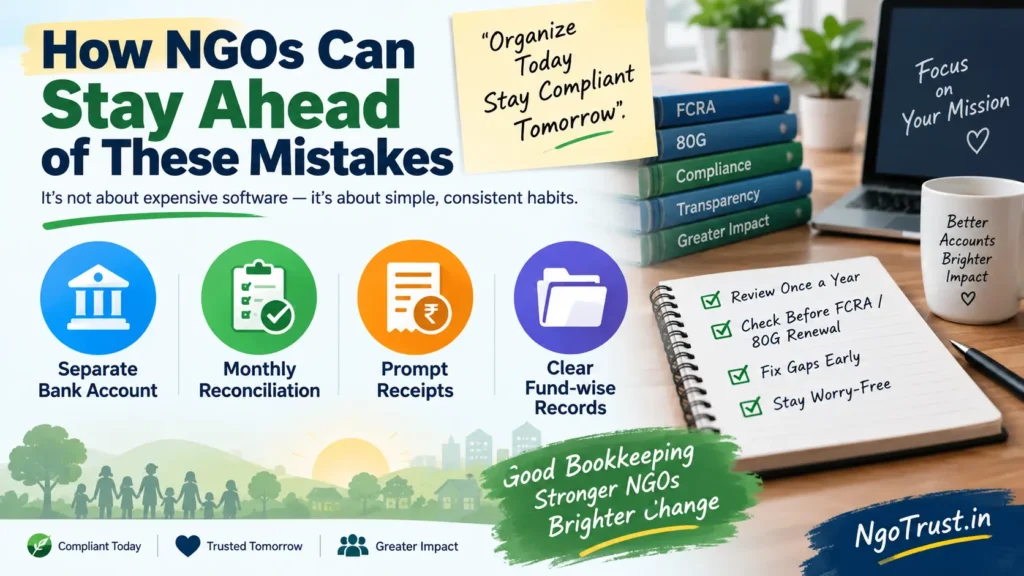
None of these seven mistakes require expensive software or a full finance department to fix. What they need is consistency: a separate bank account, monthly reconciliation, prompt receipts, and clear fund-wise records.
Most NGOs we work with didn’t set out to get their bookkeeping wrong. They were focused on the mission, and the accounts fell into a routine that quietly drifted out of compliance over a few years. A short review once a year, ideally before FCRA or 80G renewal season, is usually enough to catch these gaps before they turn into notices.
Frequently Asked Questions
Can bad bookkeeping alone cancel an NGO’s registration?
Yes. Repeated non-compliance, missing records, or an inability to explain fund usage during a renewal or audit is enough grounds for authorities to suspend or cancel 12A, 80G, or FCRA registration, even without any proven misuse of funds.
How often should an NGO reconcile its bank account?
Monthly is the practical minimum. Annual reconciliation, done only before audit season, is too late to catch or explain discrepancies properly.
Do small NGOs really need to worry about FCRA bookkeeping?
Any NGO that receives even a single foreign donation, however small, falls under FCRA rules. Size doesn’t exempt an NGO from maintaining a separate FCRA account and filing accurate annual returns.
What is the safest way to handle cash donations and expenses?
Issue a receipt for every cash donation received, and use a signed voucher for every cash expense paid out, however small the amount. Keep both filed by date so they’re easy to produce during an audit.
Is it enough to fix bookkeeping only before an audit?
No. Fixing books just before an audit often creates more red flags than it solves, since backdated entries and sudden documentation are easy for auditors to spot. Ongoing, monthly bookkeeping is what actually protects an NGO.
Getting Your NGO’s Books in Order
Bookkeeping isn’t the most exciting part of running an NGO, but it’s the part that keeps everything else- your registration, your donor trust, your CSR eligibility- standing on solid ground.
If any of these seven mistakes sound familiar, it usually doesn’t take a major overhaul to fix them- just a proper review of where the gaps are and a simple system going forward. That’s the kind of support we help NGOs with at SAI NGO & Business Consultancy, from setting up clean fund-wise records to staying current on FCRA and 80G filings.
If you’d like a second pair of eyes on your NGO’s books, you can reach out to us for a straightforward conversation about where things stand.
Useful Links
- Income Tax Department of India: incometaxindia.gov.in
- FCRA Online Services, Ministry of Home Affairs: fcraonline.nic.in
- NGO Darpan, NITI Aayog: ngodarpan.gov.in
- Ministry of Corporate Affairs (Section 8 Companies): mca.gov.in
- Institute of Chartered Accountants of India: icai.org
- SAI NGO & Business Consultancy: ngotrust.in