
SAI NGO & BUSINESS CONSULTANCY
Expert services for NGO, Trust, Society Registration & Compliance across India.
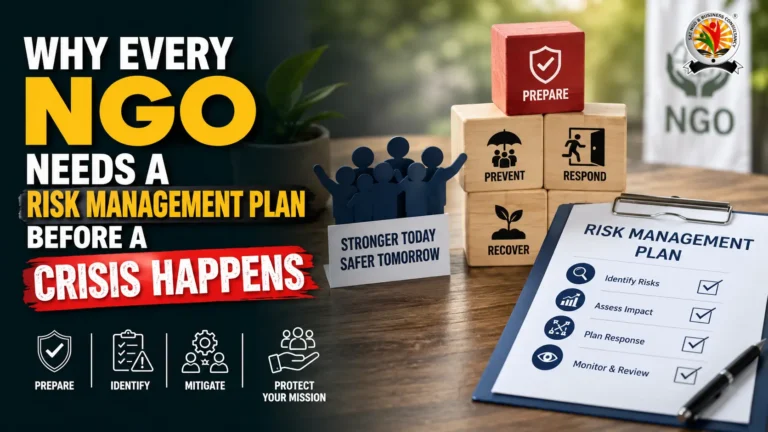
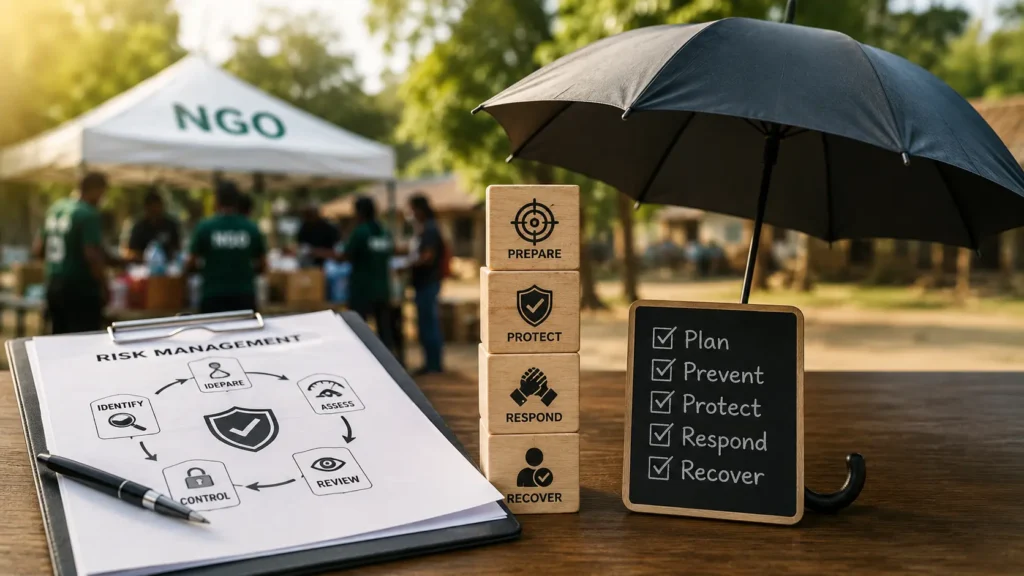
A risk management plan is a written document that helps an NGO identify possible problems, such as funding gaps, legal trouble, data breaches, or natural disasters, before they happen, and lays out clear steps to prevent or respond to them. Every NGO needs one because nonprofits in India work with public trust, government compliance, and donor money, and a single unmanaged crisis can damage all three within days.
If you run an NGO in India, you already know how unpredictable this sector can be. One day you are filing your annual compliance reports, and the next day a flood hits your project area, a donor pulls out, or a volunteer incident lands you in the news for the wrong reasons.
Most organisations only start thinking about risk after something has already gone wrong. That is the expensive way to learn this lesson.
This post breaks down what NGO risk management actually means, why it matters more than most founders realise, and how to build a simple plan that protects your people, your funding, and your reputation.
What Is NGO Risk Management, Exactly?
NGO risk management is the ongoing process of spotting threats to your organisation, judging how serious they are, and putting safeguards in place before those threats turn into real damage. It covers far more than just safety hazards at field sites.
A complete plan usually looks at five areas:
• Financial risk: cash flow gaps, donor dependency, fraud, or misuse of funds
• Legal and compliance risk: FCRA violations, late tax filings, or registration lapses
• Operational risk: project delays, staff turnover, or supply chain breakdowns
• Reputational risk: bad press, social media backlash, or loss of community trust
• Safety and disaster risk: accidents, natural calamities, or security threats during fieldwork
A good plan does not try to eliminate every risk. That is impossible. Instead, it helps your team see problems coming early and react in a calm, organised way instead of in panic mode.
Why Do NGOs Need a Risk Management Plan Before a Crisis Hits?
Because NGOs run on trust, and trust is fragile. Donors, government bodies, and the communities you serve are all watching how you handle problems, not just how you handle success.
1. Compliance Failures Can Shut You Down Overnight
Indian NGOs operate under a strict compliance framework, including the Foreign Contribution Regulation Act (FCRA), Income Tax rules, and state-level trust or society registration laws. Missing a renewal date or filing an incorrect return is not a small mistake. It can freeze your bank accounts or cancel your registration entirely.
You can check current FCRA rules and deadlines directly on the FCRA portal, since requirements are updated from time to time.
2. Funding Can Disappear Fast
Many NGOs depend heavily on one or two major donors or a single CSR partner. If that funder changes priorities, faces its own financial trouble, or simply stops renewing the grant, an unprepared NGO can run out of operating funds within months. A risk plan forces you to map this dependency and build a buffer or backup funding strategy in advance.
3. A Single Bad Headline Can Undo Years of Goodwill
Reputational damage spreads faster than ever because of social media. A complaint from a beneficiary, a staff misconduct case, or even a rumour can go viral before your team has had time to respond. Without a communication protocol ready in advance, most NGOs respond too slowly or say the wrong thing under pressure.
4. Field Work Comes With Real Safety Risks
NGOs working in remote areas, disaster zones, or with vulnerable populations face genuine safety risks for staff and volunteers. A risk plan that includes emergency contacts, evacuation steps, and insurance coverage protects people, not just paperwork.
What Happens to NGOs That Skip Risk Planning?
The short answer is that they survive on luck, until the luck runs out. Common consequences of having no risk management plan include:
• Frozen bank accounts due to FCRA non-compliance
• Sudden project shutdowns when a key donor exits
• Loss of community trust after a poorly handled incident
• Legal notices or penalties from missed regulatory deadlines
• Staff burnout and turnover from constant fire-fighting
None of these failures happen because the team did not care. They happen because nobody had the time, or the structured process, to look ahead. That is exactly what a risk management plan is built to fix.
How to Build a Simple Risk Management Plan for Your NGO
You do not need a 50-page corporate document. A practical NGO risk management plan can be built in four steps.
Step 1: List Out Your Risks
Sit down with your core team and write out every possible risk across funding, compliance, operations, reputation, and safety. Be honest. The goal is to surface problems, not hide them.
Step 2: Rate Each Risk
For every risk, rate how likely it is to happen and how serious the damage would be if it did. This helps you focus your limited time and budget on the risks that matter most, instead of spreading effort thin.
Step 3: Assign Clear Ownership
Every risk needs one person responsible for watching it and acting on it. A compliance officer can track filing deadlines. A finance lead can monitor donor concentration. Without a named owner, even a written plan gathers dust.
Step 4: Write Down Your Response Steps
For your top five or six risks, write a short action plan: who does what, in what order, and who needs to be informed. This single step is what separates an organised response from chaos when something actually goes wrong.
Once the plan exists, review it at least twice a year, or any time your organisation grows, changes funding sources, or starts a new type of project.
Where Does Legal and Compliance Risk Fit In?
Compliance is one of the most overlooked parts of NGO risk management in India, mainly because the rules change often and the penalties are not always well publicised. Areas worth reviewing regularly include:
• Trust, society, or Section 8 company registration status
• FCRA registration and annual return filings
• Income Tax exemption certificates under 12A and 80G
• Annual audits and statutory filings
• State-specific NGO regulations, which vary across India
Because these rules genuinely change from state to state and year to year, it helps to have someone track them on your behalf rather than relying on memory or outdated templates found online. This is exactly the kind of gap a periodic compliance review can close before it becomes a crisis.
How Often Should an NGO Review Its Risk Plan?
Most NGOs should review their risk management plan at least every six months, and immediately after any major change such as a new project location, a new funding source, or a leadership change. A plan that is never updated quietly becomes outdated, which can be just as risky as having no plan at all.
Frequently Asked Questions
Is a risk management plan legally required for NGOs in India?
No single law mandates a formal risk management plan for every NGO. However, good governance practices, donor due diligence checks, and CSR funding requirements increasingly expect one, so it has become a practical necessity rather than a legal formality.
How long should an NGO risk management plan be?
There is no fixed length. A small NGO can manage with two to four pages covering its top risks and response steps. What matters is that the plan is actually used, not how long it is.
Who should be involved in creating the plan?
Ideally, your founder or director, finance lead, programme manager, and a compliance advisor should all contribute. Each person sees different risks based on their role.
Can a small NGO with limited staff still create one?
Yes. Even a one-page document listing your top five risks, who owns each one, and what to do if it happens is far better than having no plan at all.
Does risk management cost a lot of money?
Building the plan itself costs mainly time. The ongoing cost comes from items like insurance, compliance filing support, or professional advisory fees, which are usually far smaller than the cost of recovering from an unmanaged crisis.
A Few Honest Final Words
Most NGOs we work with did not plan to skip risk management. They were simply busy running programmes, raising funds, and serving their communities, and risk planning kept getting pushed to next month.
The good news is that building a basic plan does not take long once you sit down to do it, and it pays for itself the first time it helps you avoid a compliance penalty, a funding gap, or a reputational mess.
If you would like a second pair of expert eyes on your NGO’s compliance status or want help putting together a practical risk management plan, our team at SAI NGO & Business Consultancy works with NGOs across India on exactly this kind of groundwork. Feel free to reach out for a conversation whenever it suits you, no pressure either way.
Useful Links
FCRA Online Portal: https://fcraonline.nic.in/