
SAI NGO & BUSINESS CONSULTANCY
Expert services for NGO, Trust, Society Registration & Compliance across India.
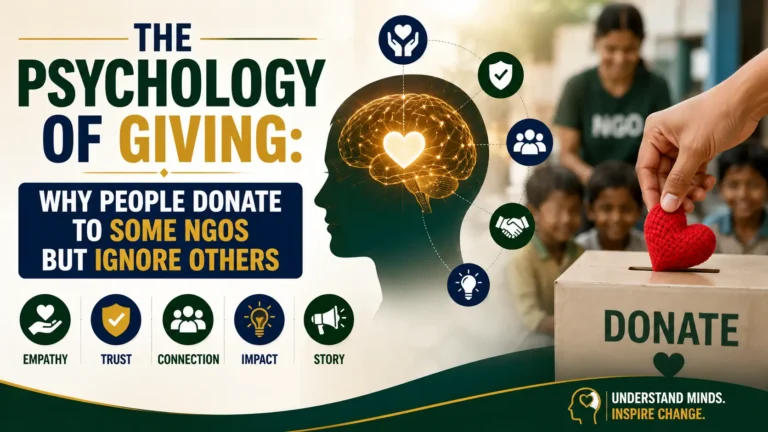
People donate to NGOs that make them feel an emotional connection, show clear proof of impact, and earn trust through transparency. They ignore NGOs that feel distant, vague about results, or unclear about where the money goes. Donation behaviour is driven less by logic and more by feelings of empathy, trust, identity, and a personal sense of purpose.
What Is the Psychology of Giving?
The psychology of giving is the study of the emotional and mental reasons behind why people choose to donate money, time, or resources to a cause. It looks at what happens in a donor’s mind before they open their wallet, not just what the NGO says in its appeal.
Research shows giving is rarely a cold, calculated decision. It is shaped by feelings such as empathy, guilt, pride, belonging, and the simple human need to feel useful. Economist James Andreoni described this as the “warm glow” effect, the genuine personal satisfaction people feel after donating, separate from pure altruism.
For NGOs, understanding this psychology is not just academic. It directly affects whether a donation page converts or gets closed without a second look.
Why Do People Donate to Some NGOs and Not Others?
This is the question every NGO founder eventually asks. The honest answer is that donors are not choosing causes the way they choose products. They are responding to a handful of psychological triggers, and most NGOs only get a few of them right.
1. Emotional Connection Comes Before Logic
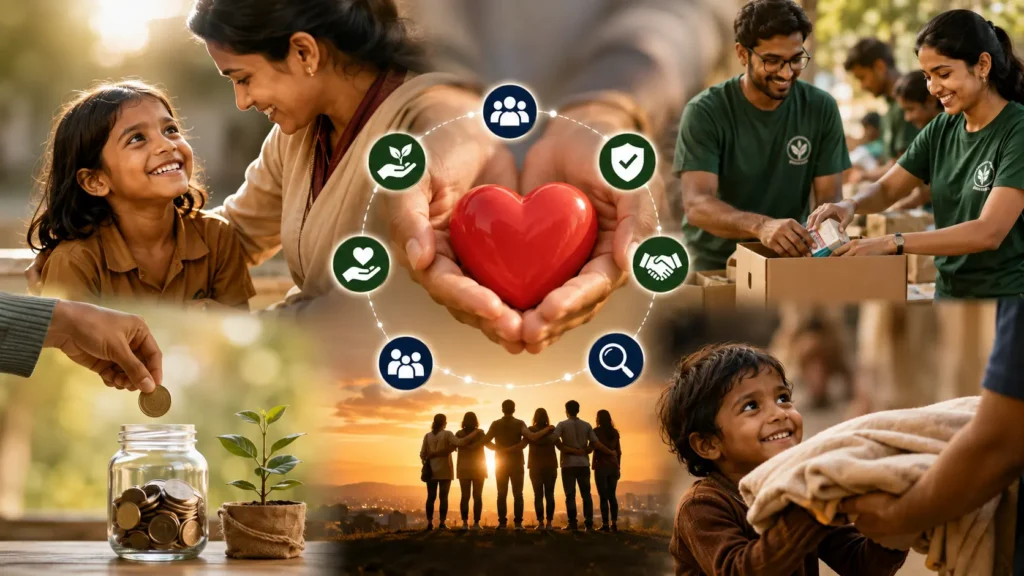
People give with their hearts first and justify it with their heads later. A well-told story about one child, one family, or one specific situation moves people far more than a page full of statistics.
Researchers call this the “identified victim effect.” Donors respond more strongly to one named, visible person in need than to a large, faceless number of people in the same situation. This is why a single photo and a short story often outperform a paragraph of impact data.
NGOs that lead with a real face, a real name, and a real moment tend to receive more support than those that lead with mission statements alone.
2. Trust Is the Real Currency
Even the most emotional appeal fails if the donor does not trust the organisation behind it. People want to know:
1. Where exactly does my money go?
2. Is this NGO registered and compliant?
3. Has anyone verified their claims?
This is why registration details, 12A and 80G certificates, audited financials, and third-party ratings matter so much in India’s NGO sector. A donor who sees a vague “donate now” button with no proof of legitimacy will usually hesitate, even if the cause moves them.
Government resources like NGO Darpan and registration platforms exist precisely because trust signals reduce donor hesitation. The more transparent an NGO is about its legal status, the less resistance a donor feels before clicking “pay.”
Trust is not built with one big gesture. It is built with small, consistent signals stacked on top of each other: a working website, a real address, a phone number that someone actually answers, and a donation receipt that arrives within minutes instead of weeks. Donors notice these details even when they do not consciously think about them. A single broken link or an outdated “last updated 2019” notice on a donation page can quietly undo months of goodwill.
3. People Want to See Proof, Not Promises
Donors today are more skeptical than they were a decade ago. They have seen enough vague “help us help them” campaigns to ask a fair question: what actually happened to the last donation?
NGOs that share before-and-after results, short videos, photos from the field, or simple impact numbers (“your ₹500 fed 10 children this month”) tend to build longer donor relationships. Vague language without proof reads as a red flag, even to generous people.
4. Proximity Makes a Cause Feel Real
Distance changes everything in giving psychology. A cause that feels close, geographically, culturally, or emotionally, feels more “fixable” to a donor than one that feels far away and abstract.
This is backed by behavioural research from Kellogg School of Management, which found that when people see donation recipients as close by, they believe their donations will exert more influence and are more likely to open their wallets. Interestingly, the study found that it is the perception of closeness that matters, not actual physical distance, so the way an NGO frames its story matters more than geography alone.
A national NGO that shows local impact in the donor’s own city or state often outperforms one that talks only in broad national terms.
5. Shared Values and Mission Fit
People give to causes that reflect who they already believe themselves to be. A donor who values education will respond to literacy campaigns. A donor who cares about animal welfare will tune out a request for legal aid funding, no matter how worthy the cause is.
According to a U.S. Trust survey cited by Reading Partners, believing in an organisation’s mission is one of the most commonly cited reasons people give. NGOs that clearly communicate what they stand for, not just what they do, attract donors whose personal identity aligns with that mission.
6. Social Proof and Belonging
Humans copy behaviour they see in their social circle. If a donor’s friends, colleagues, or community members are visibly supporting an NGO, that NGO instantly feels safer and more credible to support.
This is why testimonials, visible donor counts, and “join 5,000 supporters” type messaging work. It is not about pressure. It is about reassurance that other reasonable people have already trusted this organisation.
7. Guilt and Duty Play a Smaller, but Real, Role
Not all giving comes from warmth. Some of it comes from a sense of obligation, civic duty, religious responsibility, or mild guilt about one’s own privilege. This is a legitimate and common motivator, but it tends to produce smaller, one-time gifts rather than long-term donor relationships.
NGOs that rely only on guilt-based messaging often see high bounce rates and low repeat donations. Guilt opens the wallet once. Trust and connection keep it open.
What Turns a One-Time Donor into a Repeat Donor?

Getting a first donation is hard. Getting a second one is, in many ways, harder. Psychologically, the first gift is driven by a spark, a story, a moment of empathy. The second gift depends on something different: whether the donor felt acknowledged.
Studies on donor behaviour consistently point to a simple but often-ignored truth. People who give again are people who felt seen the first time. A personal thank-you message, a short update on what their specific contribution supported, or even a simple “here’s what your ₹1,000 did this month” email can be the difference between a one-time gift and a five-year relationship.
NGOs that treat the first donation as the end of a transaction usually lose that donor quietly. NGOs that treat it as the start of a relationship tend to build the loyal, recurring donor base that keeps an organisation financially stable year after year.
Why Do People Ignore Certain NGOs Completely?

It is just as useful to understand the reverse pattern. Donors do not usually reject a cause outright, they simply disengage quietly. Common reasons include:
- Unclear messaging: the donor can’t tell in five seconds what the NGO does or who it helps
- No visible proof of legitimacy: missing registration numbers, certificates, or basic transparency
- Generic, templated appeals: content that feels copy-pasted instead of genuine
- Too much distance: the cause feels far away and abstract
- No follow-up: a donor gives once, hears nothing back, and assumes the NGO doesn’t value them
- Confusing donation process: too many steps, unclear payment options, or a slow website
Most NGOs lose donors not because their cause is weak, but because the experience around the cause feels untrustworthy or impersonal.
How NGOs Can Use Donor Psychology Ethically
Understanding donor psychology is not about manipulating people. It is about removing the friction and confusion that stops genuinely generous people from supporting a cause they would otherwise care about. Some practical, honest approaches:
- Lead with one real story before presenting broader statistics
- Display registration details (12A, 80G, NGO Darpan ID) clearly on every donation page
- Share specific, regular updates on how past donations were used
- Make the local or regional impact visible, even for national campaigns
- Keep the donation process to as few steps as possible
- Thank donors personally, not with a generic auto-reply
None of this requires exaggeration. It simply requires clarity, consistency, and proof, the same three things that build trust in any relationship.
A Quiet Word on Getting This Right
If you are running an NGO or planning to register one, most of what’s described above starts with the basics: correct registration, the right certifications, and a website that reflects your credibility honestly. Donors can sense, almost instinctively, whether an organisation has its foundations in order.
If you are unsure whether your NGO’s registration, compliance, or online presence is sending the right trust signals to potential donors, it may help to talk it through with someone who works in this space regularly. A short consultation is often enough to spot the gaps that are quietly costing you donations.
Frequently Asked Questions
Why do people donate to charity?
People donate mainly because of emotional connection to a cause, a desire to make a real difference, personal values aligning with the mission, and the psychological satisfaction (the “warm glow”) that comes from helping others.
What makes someone trust an NGO enough to donate?
Visible registration and compliance details, transparent financials, clear communication about how funds are used, and proof of past impact are the strongest trust signals for donors.
Why do some donors give once and never come back?
Usually because they received no follow-up or acknowledgment after their first donation, or because the NGO never showed them what their money actually achieved.
Does storytelling really increase donations?
Yes. Research on the identified victim effect shows that one specific, real story about a named individual usually generates more donations than statistics about large groups of people in the same situation.
Is it ethical for NGOs to use psychology in fundraising?
Yes, as long as it is based on honesty and real impact. Using clear stories, transparency, and proof to help genuinely generous people make a confident decision is not manipulation, it is good communication.
Useful Links
- NGO Darpan: Government of India NGO Registration Portal
- Reading Partners: The Psychology of Giving
- Kellogg Insight: Take 5: The Psychology of Charitable Giving
- Harvard Gazette: How We Make Donation Decisions