
SAI NGO & BUSINESS CONSULTANCY
Expert services for NGO, Trust, Society Registration & Compliance across India.
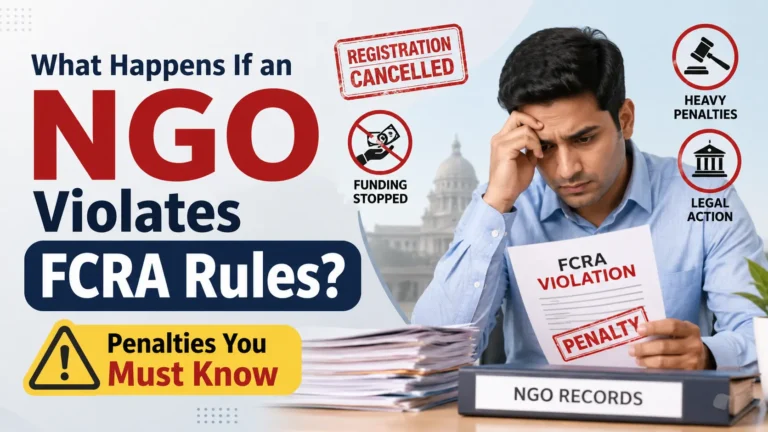
If an NGO violates FCRA rules, it can face suspension or cancellation of its FCRA registration, freezing of its bank account, heavy monetary penalties, a ban on receiving foreign funds for up to three years, and in serious cases, criminal prosecution against the people in charge. Even small compliance slips, like late filing of FC-4 returns or using foreign funds for the wrong purpose, can trigger action from the Ministry of Home Affairs.
If your NGO receives donations from outside India, the Foreign Contribution Regulation Act, or FCRA, is not something you can afford to ignore. It decides who can accept foreign money, how that money can be used, and what happens if the rules are broken.
In this post, we will walk through exactly what happens when an NGO violates FCRA rules, the common mistakes that lead to trouble, and how your organisation can stay safely on the right side of the law.
What Is FCRA, in Simple Terms?
FCRA stands for the Foreign Contribution Regulation Act, 2010. It is the law that regulates how Indian NGOs, trusts, and societies can receive and use donations from foreign sources.
Any organisation that wants to accept funding from outside India must first register under FCRA, or take prior permission for a specific project. Once registered, the NGO must follow strict rules on reporting, fund utilisation, and bank account management.
You can check the official rules and forms on the government’s FCRA Online Services portal, which is managed by the Ministry of Home Affairs.
What Counts as an FCRA Violation?
Many NGOs get into trouble not because they intend to break the law, but because they miss small procedural details. Some of the most common FCRA violations include:
- Not filing the annual FC-4 return on time
- Using foreign contributions for a purpose other than what was declared
- Mixing foreign funds with local funds in the same bank account
- Receiving foreign donations without a valid FCRA registration or prior permission
- Spending more than the permitted limit on administrative expenses
- Not updating changes in the organisation’s name, address, key members, or bank details with the authorities
- Transferring foreign contributions to another NGO without permission
Even one of these, if left unaddressed, is enough to invite scrutiny from the government.
What Happens If an NGO Violates FCRA Rules?
This is the part every NGO founder and trustee should read carefully. The consequences of an FCRA violation depend on how serious the breach is, but they generally fall into these categories.
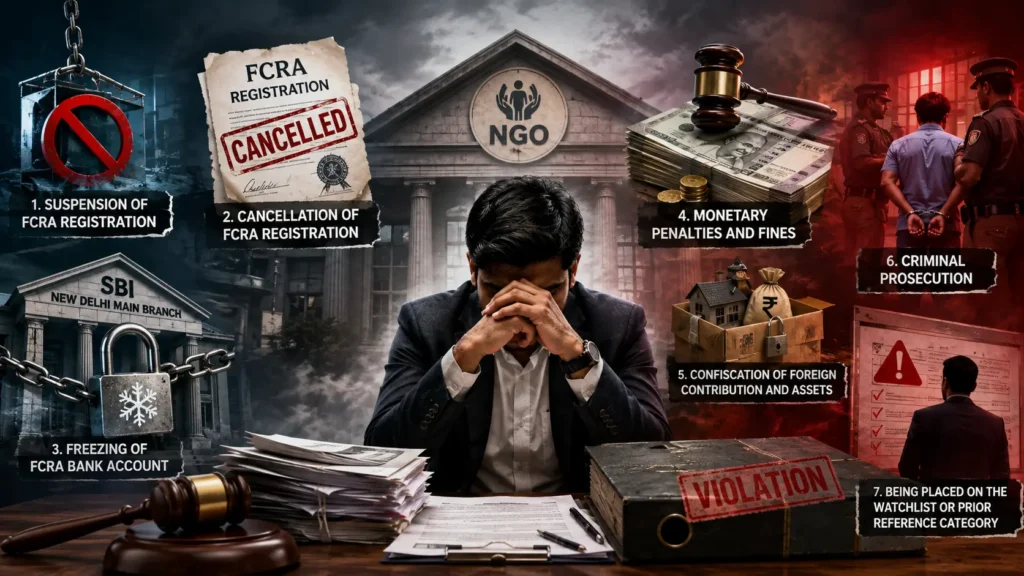
1. Suspension of FCRA Registration
The Ministry of Home Affairs can suspend an NGO’s FCRA registration for up to 180 days while it investigates a suspected violation. During this period, the NGO cannot receive any new foreign contributions, though it can usually still spend from funds already in the account, with permission.
2. Cancellation of FCRA Registration
If the violation is confirmed and considered serious, the government can cancel the NGO’s FCRA registration altogether. Once cancelled, the organisation cannot apply for fresh FCRA registration for three years.
3. Freezing of the FCRA Bank Account
Every FCRA-registered NGO must keep foreign funds in a designated FCRA account with the State Bank of India, New Delhi Main Branch. If rules are violated, this account can be frozen, cutting off access to existing funds as well.
4. Monetary Penalties and Fines
FCRA violations can attract financial penalties. Depending on the nature of the offence, this could mean a fine equal to a percentage of the foreign contribution involved, or a fixed penalty amount set by the department.
5. Confiscation of Foreign Contribution and Assets
In cases of serious misuse, the government has the power to confiscate the foreign contribution itself, along with any property or assets purchased using those funds.
6. Criminal Prosecution
For deliberate or repeated violations, such as accepting funds without registration or diverting funds for unlawful activities, office bearers can face criminal charges. This may include imprisonment, in addition to fines, under the provisions of the Act.
7. Being Placed on the Watchlist or Prior Reference Category
NGOs with a history of non-compliance are often flagged for closer monitoring. This means future applications, renewals, or transactions may face longer delays and extra scrutiny.
Why FCRA Violations Hurt More Than Just Legally
Legal penalties are only part of the story. An FCRA violation can quietly damage the things an NGO depends on most.
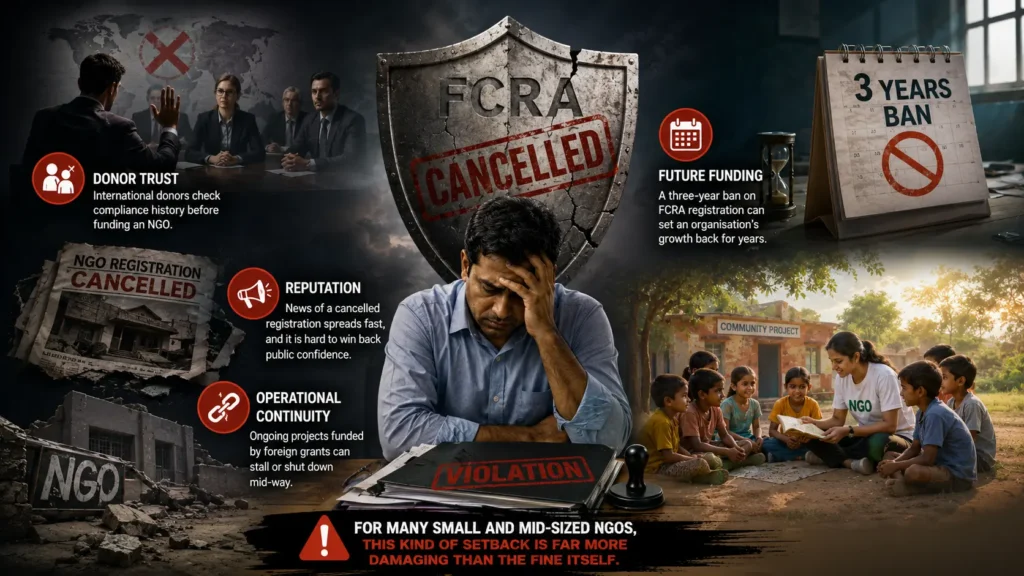
- Donor trust: International donors and grant-making bodies check compliance history before funding an NGO.
- Reputation: News of a cancelled registration spreads fast, and it is hard to win back public confidence.
- Operational continuity: Ongoing projects funded by foreign grants can stall or shut down mid-way.
- Future funding: A three-year ban on FCRA registration can set an organisation’s growth back for years.
For many small and mid-sized NGOs, this kind of setback is far more damaging than the fine itself.
How Can an NGO Avoid FCRA Violations?
The good news is that most FCRA violations are avoidable with a bit of discipline and planning. Here is what helps:
- File annual returns (FC-4) before the due date, every year, without exceptions
- Keep foreign funds strictly separate from domestic donations
- Maintain clear, updated records of every foreign donation received and spent
- Get board approval before changing key details like address, name, or governing body members
- Take prior permission before transferring funds to another organisation
- Review administrative expense limits regularly to stay within the permitted cap
- Conduct an internal compliance check at least once a year, ideally with professional support
A simple compliance calendar, with reminders for filing dates and renewal deadlines, prevents most of the common mistakes NGOs make.
What Should an NGO Do If It Receives an FCRA Notice?
If your NGO receives a notice or query from the Ministry of Home Affairs regarding FCRA compliance, do not ignore it or delay your response.
- Read the notice carefully and note the exact deadline for reply
- Gather all relevant records, bank statements, and utilisation reports
- Respond within the given timeline, with complete and honest information
- Consult a professional familiar with FCRA law before submitting your reply
A timely, well-documented response often resolves the matter before it escalates into suspension or cancellation.
Frequently Asked Questions
What is the penalty for violating FCRA rules?
The penalty depends on the violation. It can range from monetary fines and suspension of FCRA registration to cancellation, freezing of bank accounts, and in severe cases, imprisonment for the people responsible.
Can an NGO reapply for FCRA registration after cancellation?
No. Once an NGO’s FCRA registration is cancelled, it cannot apply for fresh registration for a period of three years from the date of cancellation.
What happens if an NGO does not file its FCRA annual return on time?
Late or missed FC-4 filings can lead to a late fee, a compliance notice, and repeated defaults can trigger suspension of the FCRA registration.
Can foreign contribution be used for any purpose?
No. Foreign contribution must be used only for the purpose declared at the time of registration or prior permission. Using it for anything else is a direct violation of FCRA rules.
Is a small NGO also required to follow FCRA rules?
Yes. FCRA rules apply to every NGO, trust, or society that receives foreign contribution, regardless of its size or the amount of funding involved.
Who investigates FCRA violations in India?
FCRA compliance is monitored and enforced by the Ministry of Home Affairs, Government of India, through its FCRA division.
A Quick Word on Staying Compliant
FCRA compliance is not something to figure out after a problem shows up. The rules are detailed, the deadlines are strict, and the cost of a mistake can affect years of hard work.
If your NGO is unsure about its current FCRA status, upcoming filing dates, or whether a recent activity might count as a violation, it helps to get an expert set of eyes on your records before the Ministry does.
At SAI NGO & Business Consultancy, we help NGOs review their FCRA compliance, prepare accurate filings, and respond to notices the right way. If you would like a second opinion on where your NGO stands, feel free to reach out for a consultation.
Useful Links
- FCRA Online Services (Ministry of Home Affairs): https://fcraonline.nic.in
- NGO Darpan (NITI Aayog): https://ngodarpan.gov.in
- Ministry of Home Affairs, Government of India: https://www.mha.gov.in