
SAI NGO & BUSINESS CONSULTANCY
Expert services for NGO, Trust, Society Registration & Compliance across India.
What are activities for people with disabilities? Activities NGOs can organize for people with disabilities are planned programs, camps, classes, and events that improve health, build skills, create income options, and bring people into community life. The best ones are accessible by design and shaped together with the people they serve.
The most useful activities NGOs can organize for people with disabilities fall into four groups: health and wellbeing, skill building, creative and social events, and rights and awareness. Start with one activity from each group, make the venue accessible, and ask participants what they actually need before you plan anything.
The need is large. The World Health Organization estimates that about 1.3 billion people, or 1 in 6 worldwide, live with a significant disability. In India, the 2011 Census counted around 2.68 crore people with disabilities, and that figure is more than a decade old.
Most of these people do not lack ability. They lack access to a ramp, a school that teaches in sign language, a fair job interview, or simply an invitation. NGOs are well placed to close that gap because they work close to the community and can move faster than large systems.
Below are 15 practical ideas, grouped by what they achieve. Most can be run by a small team on a modest budget.
What Makes an Activity Truly Accessible?
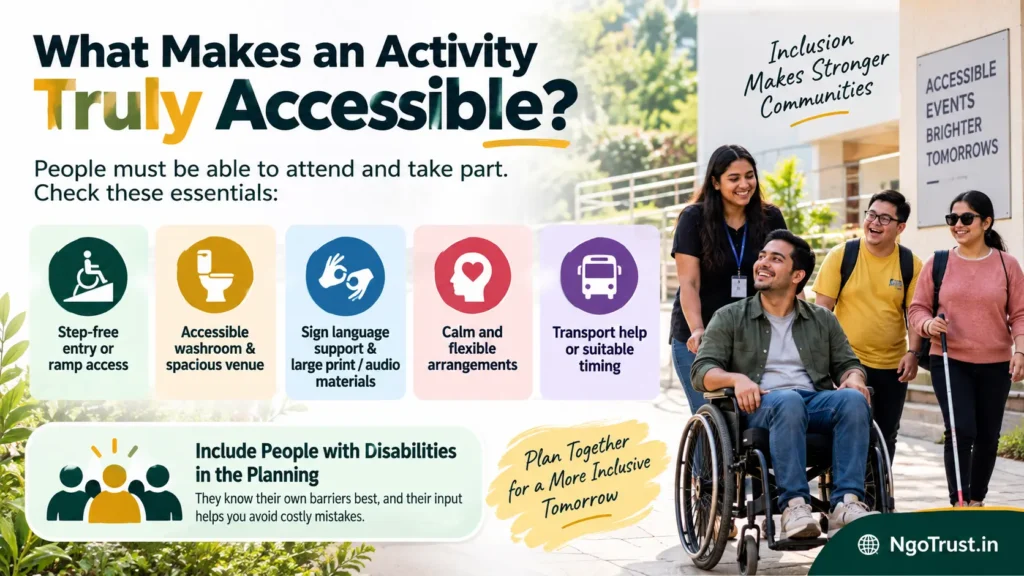
One point decides whether any event works: people must be able to attend and take part. Check these basics first:
- A step-free entry, ramp, or ground-floor venue
- An accessible washroom and enough room for wheelchairs and walkers
- A sign language interpreter for deaf participants, and large print or audio material for people with low vision
- Calm, flexible arrangements for people with autism or intellectual disabilities
- Transport help, or a start time that suits people travelling from far
Then invite participants to help plan the activity. People with disabilities know their own barriers better than any organizer, and their input saves you from costly mistakes.
Which Health and Wellbeing Activities Can NGOs Organize for People With Disabilities?
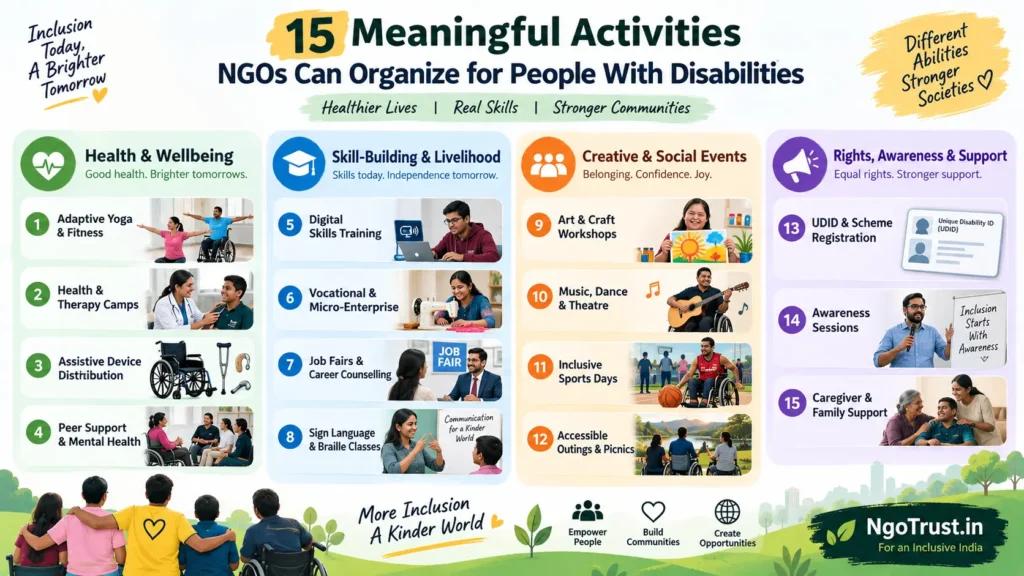
Good health is the base for everything else, yet many people with disabilities skip routine care because of cost, distance, or clinics that are hard to use.
1. Adaptive Yoga and Fitness Sessions
Chair yoga, stretching, and breathing sessions improve mobility, sleep, and mood. Work with an instructor or physiotherapist who has adaptive training, and keep groups small. Weekly sessions do more good than one big event.
2. Free Health and Therapy Camps
Partner with a local hospital or rehabilitation center for eye checkups, hearing tests, physiotherapy, and speech therapy. Even one camp every quarter can catch problems early and connect families to ongoing treatment.
3. Assistive Device Distribution Camps
Wheelchairs, crutches, hearing aids, white canes, and artificial limbs change daily life. Many people qualify for devices under the government’s ADIP scheme, listed on the disability affairs portal, but never apply. Your NGO can help with assessment, paperwork, and follow-up so the device actually reaches them.
4. Peer Support and Mental Health Circles
Isolation hurts as much as any physical barrier. A monthly circle led by a trained counselor gives people a safe place to share problems and solutions. Keep it relaxed, with tea and conversation instead of lectures.
Which Skill-Building Activities Help People With Disabilities Earn and Grow?
Income brings independence. These activities aim at real work, not just a certificate.
5. Digital Skills Training
Basic computer use, smartphone banking, email, and data entry open real job options. Free screen readers like NVDA let blind learners use a computer, so visual impairment need not block the course.
6. Vocational and Micro-Enterprise Training
Tailoring, candle making, food processing, mobile repair, and handicrafts work well because they can start at home with low investment. Add a session on pricing and selling, and help participants form a small self-help group so they can buy materials together.
7. Job Fairs and Career Counselling
The Rights of Persons with Disabilities Act, 2016 reserves 4% of government posts for persons with benchmark disabilities, and many private companies want to hire inclusively but do not know where to find candidates. Prepare participants with mock interviews and resume help, and brief employers on simple workplace adjustments.
8. Sign Language and Braille Classes
Communication works both ways, so invite family members, teachers, and neighbors too. The Indian Sign Language Research and Training Centre publishes Indian Sign Language resources you can use in class.
Which Creative and Social Events Bring People Together?
Not every activity needs a measurable outcome. Belonging matters too.
9. Art and Craft Workshops
Painting, pottery, and paper craft give people a way to express themselves and, if they wish, earn from their work. End the workshop with a small exhibition and let participants set their own prices.
10. Music, Dance, and Theatre
Inclusive performances build confidence and change how audiences see disability. Adapt the format, not the person: seated dance, sign-supported songs, or quiet shows for people who are sensitive to noise.
11. Inclusive Sports Days
Seated volleyball, wheelchair races, and simple relay games make a fun day. Special Olympics Bharat runs programs for people with intellectual disabilities and can guide you on coaching and events.
12. Accessible Outings and Picnics
A trip to a park, museum, or temple sounds simple, yet many people with disabilities rarely get one. Check the route and venue beforehand, carry a first aid kit, and keep the pace slow.
How Can NGOs Support Rights, Awareness, and Families?
13. UDID and Scheme Registration Camps
The Unique Disability ID (UDID) card is the main proof of disability for pensions, scholarships, and travel concessions. Set up a help desk where volunteers guide people through the application on the Swavlamban portal and collect the required documents.
14. Awareness Sessions in Schools and Workplaces
One session can shift attitudes. Invite a speaker with lived experience, teach basic etiquette (speak to the person, not their companion, and ask before helping), and explain what the law says.
15. Caregiver and Family Support Meetings
Parents and caregivers carry a heavy load, often without rest or guidance. Monthly meetings with a therapist or social worker, plus a chance to meet other families, reduce stress and improve care at home.
How Can a Small NGO Plan These Activities on a Budget?
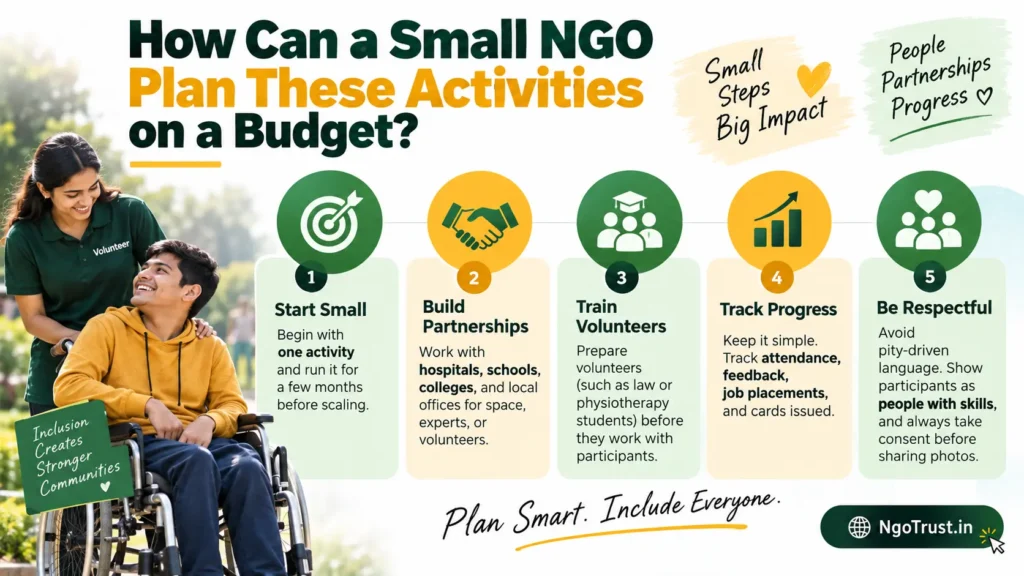
You do not need to run all 15. A few habits keep things realistic:
- Start with one activity per group and run it for three months before adding more
- Partner with hospitals, schools, colleges, and local offices, since many will offer space, experts, or volunteers
- Train volunteers, such as law or physiotherapy students, before they meet participants
- Track simple numbers: attendance, feedback, job placements, and cards issued
- Avoid pity-driven language, show participants as people with skills, and take consent before sharing photos
Do NGOs Need Registration to Run Disability Programs?
Anyone can start helping informally. Once you want to accept donations, apply for grants, or offer tax benefits to donors, you need a proper legal structure, such as a Trust, Society, or Section 8 Company.
Registration under 12A exempts your income from tax, 80G lets donors claim a deduction, and FCRA registration is required to receive foreign contributions. A profile on NGO Darpan is needed for many government grants. Companies can also fund work on skills and education for differently abled persons through CSR, provided your NGO has the right registrations in place.
The paperwork can feel confusing at first. If you are still choosing a structure or stuck on an application, it helps to talk with people who handle this every day. The team at ngotrust.in guides NGOs through registration, 12A, 80G, FCRA, and ongoing compliance.
Frequently Asked Questions
What are the best activities NGOs can organize for people with disabilities?
Health camps, assistive device distribution, skill training, job fairs, inclusive sports, and UDID registration camps give the most lasting benefit. Pair one practical activity, like skill training, with one social activity, like an art workshop, so participants gain both income options and community.
How can a small NGO start a disability program with a low budget?
Begin with one weekly activity, such as a peer support circle or chair yoga, in an accessible community hall. Borrow space and expertise from local hospitals, colleges, and schools, and use trained volunteers. Add new activities only after the first one runs smoothly.
How many disabilities are recognised in India?
The Rights of Persons with Disabilities Act, 2016 recognises 21 conditions, including blindness, deafness, locomotor disability, autism, intellectual disability, cerebral palsy, and mental illness. Plan activities that can work for more than one type.
Do NGOs need registration to organize activities for people with disabilities?
Informal meetings do not need registration. To receive donations, grants, or CSR funds, you need a registered Trust, Society, or Section 8 Company, and usually 12A and 80G. Foreign funding also needs FCRA registration.
How do you make an NGO event accessible?
Choose a ramped or ground-floor venue, arrange an accessible washroom, book a sign language interpreter, prepare large print or audio material, and ask participants about their needs before the event.
Where to Start
Pick one activity from this list and run it next month. Talk to ten people in your community first, listen to what they say, and let that decide your choice. A small program done well earns trust faster than a big one done in a hurry.
When you are ready to give your work a solid legal base, or you have questions about registration and funding, you are welcome to reach out to ngotrust.in for a short consultation. It is a simple conversation, and you can decide what to do next in your own time.
Useful Links
- World Health Organization: Disability and Health: https://www.who.int/news-room/fact-sheets/detail/disability-and-health
- Disability Affairs Portal (ADIP scheme and RPwD Act): https://disabilityaffairs.gov.in
- Indian Sign Language Research and Training Centre: https://islrtc.nic.in
- Special Olympics Bharat: https://specialolympicsbharat.org
- Swavlamban Portal (UDID card): https://www.swavlambancard.gov.in
- NGO Darpan: https://ngodarpan.gov.in
- ngotrust.in: https://ngotrust.in