
SAI NGO & BUSINESS CONSULTANCY
Expert services for NGO, Trust, Society Registration & Compliance across India.
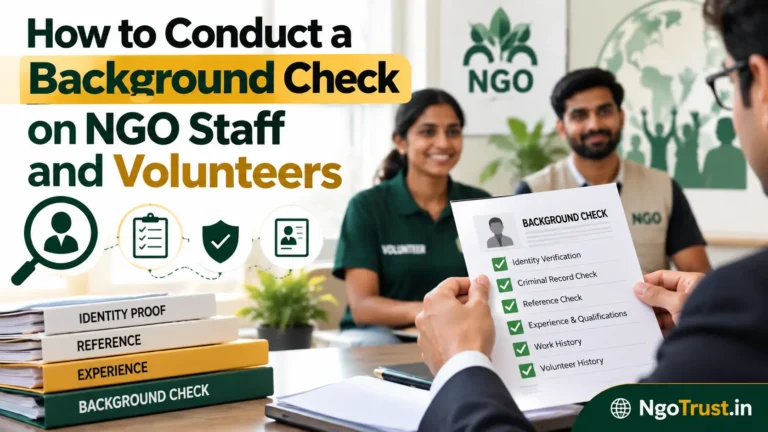
A background check on NGO staff and volunteers is a set of verification steps, done with written consent, that confirms who a person is and whether they are safe to work with your beneficiaries, funds and data. It usually covers identity, address, education, past jobs, police or court records and references.
One wrong hire can undo years of good work in an NGO. A staff member who misuses funds can put your FCRA or 12A status at risk. A volunteer with a history of harming children can hurt the very people you exist to serve.
Most of this is preventable. A proper background check on NGO staff and volunteers does not need a big budget. It needs a clear process and the habit of following it every time, even when you are short of hands.
Why Do NGOs Need Background Checks?
NGOs run on trust. Donors trust you with money, families trust you with their children, and communities trust you with their stories. Screening the people who carry that trust is part of basic governance.
- Safety of beneficiaries: Children, women, elderly people and patients are often the most exposed. Verification lowers the chance of harm.
- Protection of funds: Financial fraud in small NGOs usually comes from someone who was never checked. Trustees can be held answerable for it.
- Donor and CSR confidence: Many funders ask about safeguarding and hiring practices during due diligence. A written screening process gives you a good answer.
- Your reputation: One news story about a badly handled case can close doors that took ten years to open.
How Do You Conduct a Background Check on NGO Staff and Volunteers?
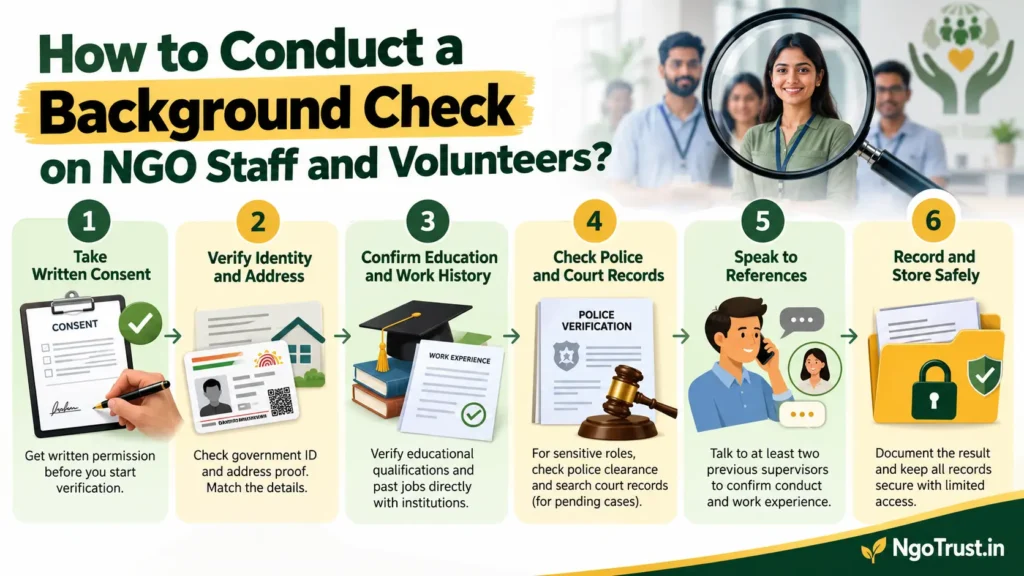
Short answer: Get written consent first. Then verify identity and address, confirm education and past jobs, check police and court records, and speak to at least two references. Go deeper for roles that involve children, cash or sensitive data. Keep every record safe and share it only with people who need it.
Here is how each step works in practice.
Step 1: Take written consent
Screening involves personal data, so ask before you check. A short consent form is enough. It should say what you will verify, why, who will see the results and how long you will keep them.
The Digital Personal Data Protection Act, 2023 expects organisations to handle personal data lawfully and with consent. This step protects you as much as the candidate. If someone refuses to sign, you have learned something useful too.
Step 2: Verify identity and address
Ask for a government photo ID and a recent address proof. Match the name, date of birth and photo across documents. Check originals where you can and note the date you saw them.
If a candidate shares Aadhaar, ask for a masked copy through the UIDAI website. Documents pulled from DigiLocker come straight from the issuing body, which makes them easier to trust than a photocopy.
Step 3: Confirm education and work history
Contact the school, college or previous employer yourself. Do not rely only on a phone number the candidate gives you. Find the number independently.
Ask three simple things: dates of joining and leaving, the designation held, and the reason for leaving. For senior roles such as a finance head or programme director, also ask for experience letters and relieving letters. A gap in a CV is not a problem by itself. Ask about it politely and listen to the answer.
Step 4: Check police and court records
For roles that involve children, women in distress, elderly people or money, ask for a police clearance certificate or a police verification report from the local police station.
You can also search the candidate’s name on the eCourts services website to see whether any case is pending. Name searches are not perfect, because common names create false matches. Treat a result as a reason to ask questions, not as proof. Give the person a fair chance to explain before you decide.
Step 5: Speak to references
Two references are enough. Choose people who supervised the candidate, not friends. A phone call works better than an email.
Ask direct questions. Would you work with this person again? Did you ever have a concern about their honesty or conduct? Pay attention to pauses and careful wording. They often say more than the words do.
Step 6: Record the result and store it safely
Write a one line outcome for each person: cleared, cleared with a note, or not cleared. Keep the file in a locked cabinet or a password-protected folder. Limit access to the HR lead and trustees, and decide in advance when the records will be deleted.
Do Volunteers Need the Same Screening as Paid Staff?
Short answer: Not the same depth, but every volunteer needs some screening. Match the checks to the risk of the role.
- Low risk (one day drives, event help, always supervised): photo ID and a signed code of conduct.
- Medium risk (regular fieldwork, handling donations, teaching support): ID, address proof, one reference and a short interview.
- High risk (time alone with children, elderly or vulnerable people, or access to money and data): the full check, including police verification and two references.
Whatever the level, start new volunteers with a trial period and supervision. Never leave a new volunteer alone with children, however friendly or well recommended they seem.
What Does Indian Law Say About NGO Background Verification?
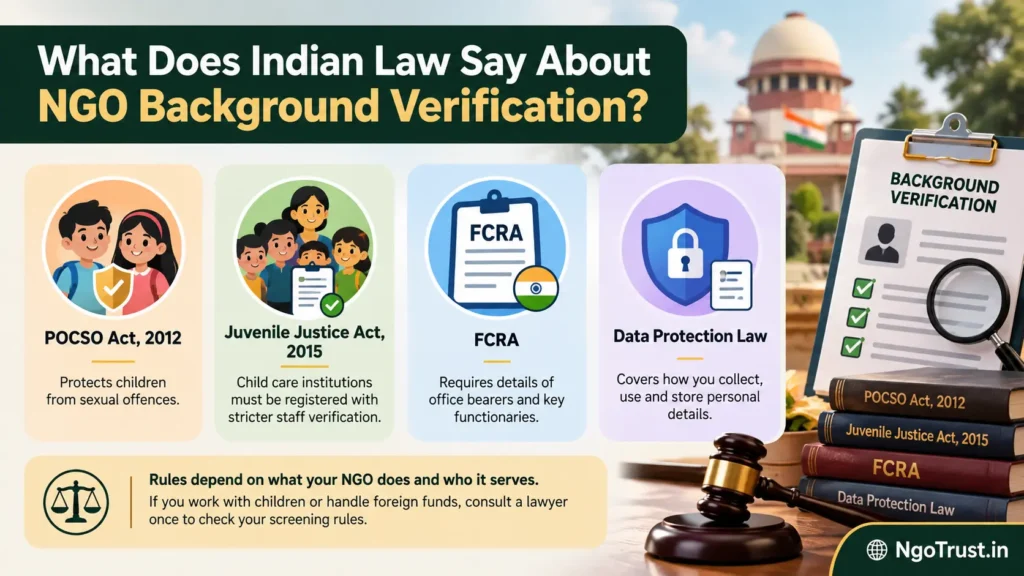
There is no single law that tells every NGO exactly how to screen its people. The rules depend on what your NGO does and who it serves. A few laws are worth knowing:
- POCSO Act, 2012: Protects children from sexual offences and puts a duty on people to report abuse. NGOs working with children need strong safeguards. The National Commission for Protection of Child Rights publishes guidance you can use.
- Juvenile Justice (Care and Protection of Children) Act, 2015: Child care institutions must be registered and face stricter expectations on staff verification.
- FCRA: Foreign contribution registration and renewal require details of office bearers and key functionaries. Misuse of funds can lead to suspension or cancellation. See the FCRA portal for current rules.
- Data protection law: Covers how you collect, use and store the personal details you gather during screening.
You can read these Acts on India Code. If your NGO works with children or handles foreign funds, ask a lawyer to check your screening rules once.
What Red Flags Should You Watch For?
One red flag is a reason to ask more questions, not to reject someone. A pattern of them is a different matter.
- Documents that do not match on name, date of birth or address
- A previous employer who cannot be reached or gives different dates
- Reluctance to sign consent or share references
- Grand titles at very small organisations, with no way to confirm them
- Pressure to skip checks because “we need someone urgently”
- Pending cases involving fraud, abuse or violence
What Mistakes Do NGOs Make During Volunteer Screening?
- Checking only new hires. Trustees, long serving volunteers and people who joined “informally” often escape the process.
- Trusting personal recommendations. “He is known to our board member” is not verification.
- Collecting too much data. Full Aadhaar copies with no clear need create risk for you.
- Treating it as a one time task. For high risk roles, repeat the check every few years.
- Having no written policy. Without one, decisions look random and can feel unfair to candidates.
How Can You Build a Simple Screening Policy?
A one or two page policy is enough for most small and mid sized NGOs. It should state who gets checked, which checks apply to which role, who approves the outcome, how long records are kept and what happens after a bad result.
Have the trustees approve it in a meeting and record it in the minutes. Train one person to run it, and review it once a year. A policy that people actually use beats a perfect one that sits in a drawer.
Frequently Asked Questions About NGO Background Checks
What is included in a background check for NGO employees?
A standard check includes identity and address verification, education and employment confirmation, a police or court record check and reference calls. Roles with higher risk may also need a police clearance certificate.
How long does NGO background verification take?
Basic document and reference checks can take a few days. Police verification depends on the local station and state, so it can take one to several weeks. Plan for this before the person starts work with vulnerable groups.
Is police verification mandatory for NGO staff in India?
No single rule covers every NGO. It is expected or required in some settings, such as child care institutions, and some donors ask for it. For any role with close contact with vulnerable people, it is good practice.
Can an NGO reject a volunteer because of a criminal record?
Yes, especially where the role involves children or money. Look at the nature and age of the offence, its link to the role and the person’s explanation. Apply the same standard to everyone and write down your reason.
Should trustees and board members be checked too?
Yes. Trustees control funds and decisions, so basic identity, address and conflict of interest checks apply to them as well.
Can we look at a candidate’s social media?
Public profiles can show conduct concerns, but only check them the same way for every candidate and tell people you may do so. Never ask for passwords.
Need a Hand Setting This Up?
Writing a screening policy, consent forms and role wise checklists takes time, and the legal side can feel confusing when you are also running programmes. If it would help to have an expert look over your process, the team at ngotrust.in works with NGOs on registration, compliance and legal documentation every day.
If you would like a second opinion on your current hiring and volunteer process, you are welcome to contact us or book a consultation. There is no pressure. A short conversation is often enough to spot the gaps.
Useful Links
- Ministry of Electronics and IT (Digital Personal Data Protection Act): https://www.meity.gov.in/
- UIDAI (Masked Aadhaar): https://uidai.gov.in/
- DigiLocker: https://www.digilocker.gov.in/
- eCourts Services: https://ecourts.gov.in/
- National Commission for Protection of Child Rights (NCPCR): https://ncpcr.gov.in/
- FCRA Online Portal: https://fcraonline.nic.in/
- India Code (Central Acts): https://www.indiacode.nic.in/