
SAI NGO & BUSINESS CONSULTANCY
Expert services for NGO, Trust, Society Registration & Compliance across India.
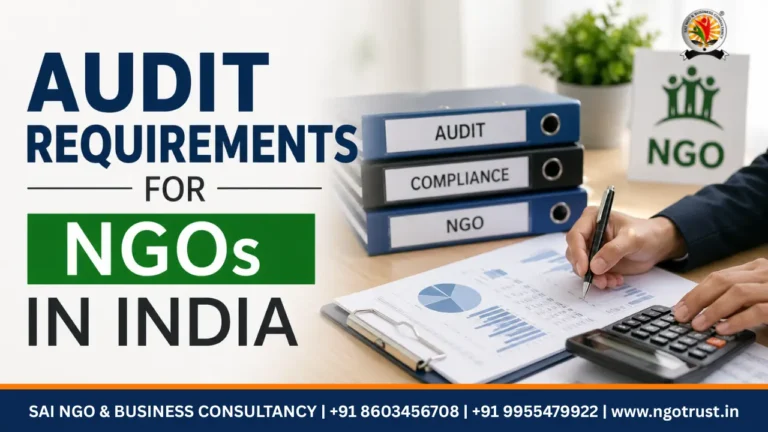
Running a non-governmental organisation (NGO) in India is deeply meaningful work. But behind every impactful project is a layer of legal and financial responsibility that cannot be ignored. One of the most important aspects of that responsibility is compliance with Audit Requirements for NGOs in India.
If your NGO is registered in India — whether as a Trust, Society, or Section 8 Company — you are legally required to get your accounts audited. Missing this step, or doing it incorrectly, can lead to penalties, cancellation of registrations, and loss of donor trust.
This guide breaks down everything you need to know about NGO audit requirements in India, in plain and simple language.
What Is an NGO Audit and Why Does It Matter?

An NGO audit is an independent examination of your organisation’s financial statements and records by a qualified Chartered Accountant (CA). The goal is to verify that the funds received and spent have been properly accounted for and that the organisation is complying with applicable laws.
For NGOs, this is not just a good practice — it is a legal requirement under multiple laws in India.
Here is why it matters:
- Regulatory compliance: Various laws in India mandate that NGOs maintain proper books of accounts and get them audited annually.
- Donor confidence: Donors — especially institutional donors and corporate CSR departments — look for audited financial statements before releasing funds.
- Tax benefits: Registrations like 80G and 12A/12AB require annual compliance, including audit submissions.
- FCRA compliance: NGOs receiving foreign contributions must comply with strict audit requirements under the Foreign Contribution (Regulation) Act, 2010.
- Accountability to beneficiaries: Transparent finances show that public trust has been honoured.
Simply put, a proper audit protects your NGO from legal trouble and builds the credibility you need to grow.
Who Needs to Get an NGO Audit Done?
Almost every registered NGO in India is required to get its accounts audited. Here is a quick breakdown:
Trusts
Public Charitable Trusts are governed by state-specific laws like the Bombay Public Trusts Act, 1950, or equivalent legislation in other states. Most of these laws require annual audited accounts to be submitted to the relevant charity commissioner.
Societies
Societies registered under the Societies Registration Act, 1860, or state-level equivalents, are also required to maintain audited financial records. Many states mandate submission of audited accounts to the Registrar of Societies.
Section 8 Companies
These are companies registered under the Companies Act, 2013, for charitable purposes. They must comply with full company audit requirements, including submission of financial statements to the Ministry of Corporate Affairs (MCA) through the Registrar of Companies (ROC).
NGOs with 12A/12AB Registration
Organisations registered under Section 12A or 12AB of the Income Tax Act, 1961, must file an annual income tax return (ITR-7) along with audited financial statements. If gross receipts exceed Rs. 2.5 lakh in a financial year, a tax audit under Section 12A(b) is mandatory.
NGOs with FCRA Registration
If your NGO is registered under the Foreign Contribution (Regulation) Act, 2010, and receives foreign donations, you are required to submit a separate audited FCRA return to the Ministry of Home Affairs every year, regardless of the amount received.
Key Laws Governing NGO Audits in India
Understanding which laws apply to your organisation is the first step toward compliance. The major ones are:
- Income Tax Act, 1961 (Sections 12A, 12AB, 80G, 11, 13): Governs tax exemptions and annual filing requirements.
- Foreign Contribution (Regulation) Act, 2010 (FCRA): Governs receipt and utilisation of foreign funds. Mandatory annual return filing on the FCRA portal.
- Companies Act, 2013: Applies to Section 8 Companies. Full statutory audit required.
- Societies Registration Act, 1860: Governs societies; audit requirements vary by state.
- State Trust Acts: Such as the Bombay Public Trusts Act, 1950, for public charitable trusts.
Each law has its own specific requirements, deadlines, and filing portals. This is why working with a CA who specialises in NGO compliance is strongly recommended.
Key Benefits of Staying Compliant with Audit Requirements
Staying on top of your NGO’s audit requirements does far more than keep you out of legal trouble.
| Key Benefit | Explanation |
|---|---|
| Uninterrupted funding | Grant agencies, CSR donors, and government bodies require audited reports before releasing grants. |
| Retaining tax exemptions | Failure to file audit-related returns on time can result in the cancellation of 12A/12AB or 80G registration, making all donations taxable. |
| Avoiding penalties | Non-submission of FCRA returns, for instance, can lead to suspension or cancellation of FCRA registration — effectively stopping foreign funding permanently. |
| Stronger governance | Regular audits help your board spot financial irregularities early and improve internal controls. |
| Better reputation | An NGO with clean, audited financials builds long-term credibility with donors, government bodies, and the communities it serves. |
| Ease in future registrations | Any new government scheme, certification (like DARPAN registration ), or institutional partnership will require a clean financial track record. |
Step-by-Step Guide: How to Meet NGO Audit Requirements in India
Step 1: Maintain Proper Books of Accounts Throughout the Year
Audit starts with good bookkeeping. Maintain separate ledgers for each project, receipt book records, bank statements, bills, vouchers, and donor receipts. Mixing personal and organisational finances is a common and costly mistake.
Step 2: Close Your Books at the End of the Financial Year
India’s financial year runs from April 1 to March 31. Before getting an audit done, your accounts must be finalised — meaning all income and expense entries are recorded, bank accounts are reconciled, and outstanding liabilities are noted.
Step 3: Appoint a Qualified Chartered Accountant
Your auditor must be a practicing CA registered with the Institute of Chartered Accountants of India (ICAI). For FCRA audits, the CA must be specifically familiar with FCRA reporting formats. Avoid using general-purpose tax consultants for specialised NGO audits.
Step 4: Prepare Financial Statements
The CA will help prepare or verify your Balance Sheet, Income and Expenditure Account (or Profit and Loss Account for Section 8 Companies), Receipts and Payments Account, and Notes to Accounts.
Step 5: Get the Audit Report Signed
The CA will issue an Audit Report (and where applicable, a Tax Audit Report in Form 10B or 10BB under the Income Tax Act). This is a formal document — make sure it is signed, stamped, and dated correctly.
Step 6: File Returns on Time
Key filing deadlines:
- ITR-7 (Income Tax Return): Due by October 31 each year (for NGOs requiring tax audit); September 30 for others.
- FCRA Annual Return (FC-4): Must be filed online on the FCRA portal by December 31 each year for the preceding financial year.
- MCA Annual Filing (Section 8 Companies): AOC-4 (Financial Statements) due within 30 days of AGM; MGT-7A within 60 days.
- Charity Commissioner Returns: Deadlines vary by state.
Missing any of these deadlines attracts penalties or statutory notices.
Common Mistakes NGOs Make During Audits
Even well-meaning NGOs run into compliance trouble. Here are the most frequent errors:
- Not maintaining separate bank accounts for FCRA funds. The FCRA law requires a designated FCRA account — ideally with State Bank of India, New Delhi Main Branch — separate from domestic funds.
- Delaying bookkeeping until year-end. Rushed, inaccurate records are a red flag for auditors and tax authorities.
- Using wrong ITR form. NGOs registered under 12A/12AB must file ITR-7, not ITR-5 or ITR-6.
- Missing Form 10B/10BB filing. This is the mandatory audit report under the Income Tax Act and must be filed before submitting the ITR.
- Commingling project funds. Donor-restricted funds must be tracked separately. Mixing them is both an audit issue and a donor trust issue.
- Not updating CA-related details on FCRA portal. If your auditor changes, the FCRA portal must be updated.
- Forgetting state-level compliance. Trusts and societies often focus on income tax and FCRA but miss annual filings required by the state charity commissioner or registrar.
Expert Tips for Smooth NGO Audit Compliance
These tips come from the ground reality of working with NGOs across India:
1. Start early. Do not wait for March 31 to reconcile your books. Conduct quarterly internal reviews so your year-end closing is quick and clean.
2. Use dedicated accounting software. Tools like Tally, Zoho Books, or QuickBooks can be configured for fund-based accounting, which makes NGO audit preparation significantly easier.
3. Maintain a compliance calendar. Create a shared document or calendar with all filing deadlines — income tax, FCRA, ROC, state charity commissioner — and assign ownership within your team.
4. Keep auditor communication open year-round. Do not contact your CA only at year-end. Regular check-ins ensure compliance issues are caught early.
5. Separate restricted and unrestricted funds clearly. Every grant comes with specific conditions. Tracking these separately from general funds is both a legal requirement and a governance best practice.
6. Keep donor documentation updated. For 80G receipts, donor PAN must be recorded. For FCRA, donor details including country and purpose of donation must be maintained meticulously.
7. Train your accounts staff. Many compliance errors happen not out of negligence, but because finance staff are unaware of NGO-specific rules. Investing in training pays off significantly.
When Should You Seek Professional Help?
If your NGO is:
- Receiving foreign contributions under FCRA
- Registered under 12A/12AB or 80G
- A Section 8 Company
- Applying for government grants or CSR funding
- Dealing with multiple restricted donor funds
- Operating across multiple states
…then managing audit compliance on your own becomes increasingly complex. The laws are layered, the deadlines are tight, and the consequences of non-compliance can be severe — including loss of registration.
This is where a CA or legal firm that specialises in NGO compliance can make a real difference. They do not just file returns — they help you build the systems and habits that keep your organisation clean and audit-ready throughout the year.
If you are unsure whether your NGO is fully compliant, a professional compliance review is a worthwhile investment. Many firms offer an initial consultation to assess your current status and identify any gaps.
Wrapping Up
Audit requirements for NGOs in India are not a bureaucratic burden — they are the foundation of a credible, trustworthy organisation. When your books are clean, your returns are filed on time, and your auditor’s report is in order, you are not just avoiding penalties. You are signalling to the world that your NGO is serious, transparent, and worthy of support.
The path to compliance is not complicated, but it does require attention, planning, and the right professional guidance. Start by understanding which laws apply to your NGO, get your books in order, and work with a CA who knows the NGO landscape in India.
If you would like help assessing your NGO’s current compliance status or guidance on audit requirements specific to your registration type, consider reaching out to a qualified professional. A short conversation could save your organisation from significant legal and financial trouble down the road.
Useful Links
| Authority / Portal | Purpose | Official Website |
|---|---|---|
| Income Tax Department India | ITR-7 Filing, 12A/12AB Registration, 80G Certification | Visit Website |
| FCRA Online Portal | Annual Return Filing (FC-4) | Visit Website |
| Ministry of Corporate Affairs (MCA) Portal | Section 8 Company Filings | Visit Website |
| Institute of Chartered Accountants of India (ICAI) | Find a Chartered Accountant (CA) | Visit Website |
| NGO Darpan Portal (NITI Aayog) | NGO Registration and Government Grants | Visit Website |
| Bombay Public Trusts Act Guidance | Maharashtra Charity Commissioner Portal | Visit Website |
| Ministry of Home Affairs — FCRA Division | Foreign Contribution Regulation Act (FCRA) Guidelines | Visit Website |