
SAI NGO & BUSINESS CONSULTANCY
Expert services for NGO, Trust, Society Registration & Compliance across India.
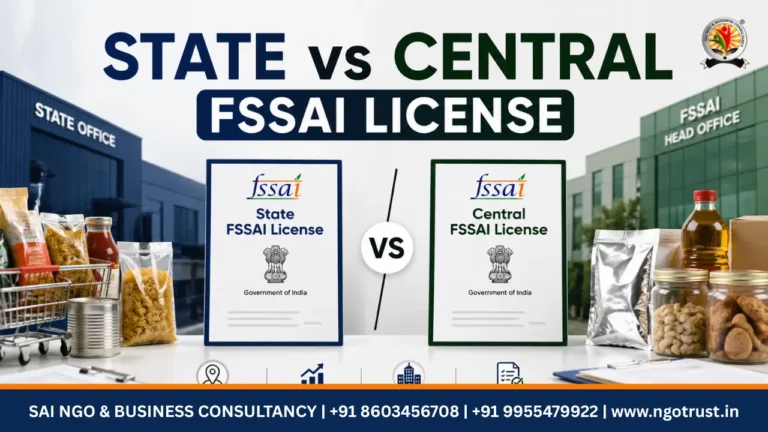
State vs Central FSSAI License is one of the most important decisions for food business owners in India. If you run a food business, you already know that getting an FSSAI license is not optional—it is a legal requirement under the Food Safety and Standards Act, 2006. However, this is where many businesses get confused: there are two main types of FSSAI licenses, and choosing the wrong one can lead to delays, rejections, and unnecessary complications.
So, what exactly is the difference between State FSSAI license and Central FSSAI license? Which one applies to your business? And what happens if you apply for the wrong type?
This guide answers all of that in simple, plain language.
What Is FSSAI and Why Does It Matter?
FSSAI stands for the Food Safety and Standards Authority of India. It is the central government body that regulates everything related to food safety in the country. From small tea stalls to large food manufacturers, every food business that deals in production, processing, distribution, storage, or sale of food products needs to be registered or licensed under FSSAI.
The license ensures that your food products meet the required safety and quality standards. Without it, you cannot legally operate, and you risk penalties, seizure of goods, or even a shutdown. You can read the full regulations on the FSSAI official website.
There are actually three categories under FSSAI: Basic Registration, State FSSAI License, and Central FSSAI License. Basic Registration is for very small businesses with an annual turnover of up to Rs 12 lakh. The real question for most growing businesses is whether they need a State license or a Central license.
The Difference Between State FSSAI License and Central FSSAI License
The core difference between State and Central FSSAI license comes down to the size of your business, your annual turnover, and the geographic scale of your operations.
State FSSAI License
A State FSSAI license is issued by the State Food Safety Authority and is meant for mid-sized food businesses that operate within a single state. Here is when a State license applies:
- Annual turnover is between Rs 12 lakh and Rs 20 crore
- The business operates in one state only
- Includes small to medium manufacturers, processors, retailers, distributors, hotels, and restaurants
- Dairy units with a capacity of up to 500 litres per day
- Slaughterhouses with a capacity of up to 50 large animals or 150 small animals per day
- Food catering businesses
The State license is generally appropriate for businesses that are growing but are not yet operating at a national level.
Central FSSAI License
A Central FSSAI license is issued by the central government body and is meant for large-scale food businesses, importers, exporters, and businesses operating in multiple states. A Central license is required when:
- Annual turnover exceeds Rs 20 crore
- The business has operations in more than one state
- You are involved in the import or export of food products
- You supply food to the central government or defence establishments
- Dairy units processing more than 50,000 litres per day
- Large manufacturers, food chains, and e-commerce food businesses operating nationally
- Airports, seaports, and container depots involved in food handling
A simple way to remember it: if your business crosses state borders or your turnover crosses Rs 20 crore, you most likely need a Central FSSAI license.
Key Benefits of Getting the Right FSSAI License
Getting the correct FSSAI license is not just about legal compliance. It has real business benefits:
- Legal protection: Protects your business from fines, raids, and shutdowns
- Consumer trust: An FSSAI-licensed business is seen as credible and trustworthy by customers
- Expansion-ready: A Central license lets you scale nationally without re-applying
- Export eligibility: Without a Central FSSAI license, you cannot export food products legally
- Better business opportunities: Many retailers, distributors, and supermarkets only work with FSSAI-licensed vendors
- Access to government contracts: Supply to hospitals, canteens, and government bodies requires proper licensing
- Brand reputation: The FSSAI logo on your packaging builds customer confidence
How to Apply: A Practical Step-by-Step Guide
Applications for both State and Central FSSAI licenses are submitted through the FoSCoS portal (Food Safety Compliance System). Here is a general step-by-step process:
- Step 1: Determine your license type based on turnover and operations
- Step 2: Register on the FoSCoS portal and create your account
- Step 3: Fill out Form B (for both State and Central licenses)
- Step 4: Upload required documents (see list below)
- Step 5: Pay the applicable fee online
- Step 6: Submit and await verification by the designated Food Safety Officer
- Step 7: Receive your FSSAI license number and certificate
Documents Commonly Required
- Proof of identity and address of the proprietor or partners
- Food Safety Management System (FSMS) plan or certificate
- List of food products to be manufactured or handled
- Form IX (nomination of responsible person)
- NOC from municipality or local body
- Blueprint or layout plan of the food processing unit
- Certificate from Ministry of Commerce for import/export businesses
You can check the complete, updated document checklist on the FSSAI FoSCoS portal.
Common Mistakes Food Business Owners Make
Many applicants waste weeks or months because of avoidable errors. Here are the most common ones:
1. Applying for the Wrong License Type
This is the most frequent mistake. A business with a turnover of Rs 25 crore applies for a State license. It gets rejected. They restart the process. Weeks are lost. Always check your turnover and operational scope before applying.
2. Uploading Incorrect or Outdated Documents
The FSSAI portal requires specific, current documents. Using old GST certificates, expired pan cards, or incorrect NOCs leads to delays in approval.
3. Selecting the Wrong Food Category
FSSAI has detailed product categories. Selecting the wrong category means your license may not cover the full range of products you sell or manufacture. This can create compliance issues later.
4. Not Renewing on Time
Both State and Central FSSAI licenses are valid for 1 to 5 years depending on your choice at the time of application. Many businesses forget to renew and end up operating illegally without realising it.
5. Ignoring Multi-State Operations
If you have warehouses, production units, or distribution centres in multiple states, you may need a Central license, not State. Operating with a State license in this scenario is a violation.
Expert Tips to Get It Right
- Always calculate your annual turnover accurately before deciding on license type
- Use the FSSAI Licensing and Registration System guidelines to cross-check your eligibility
- If your business is growing quickly, consider applying for a Central license from the start to avoid switching later
- Keep all documents in a single folder and ensure nothing is expired before you upload
- Photograph your premises properly. A clear, well-lit layout plan speeds up approval
- Track your application status on the FoSCoS portal regularly
- If you operate in the e-commerce food space, you almost certainly need a Central FSSAI license
One more thing worth noting: the fees for State and Central licenses differ. State license fees can range from Rs 2,000 to Rs 5,000 depending on the type and scale of business. Central license fees are generally higher, starting around Rs 7,500. The exact fee structure is available on the official FSSAI portal.
When Should You Consider Professional Help?
Most food business owners are experts in their food and their craft. They are not always familiar with regulatory filing, document compliance, or category classification. Mistakes here are genuinely costly, not just in terms of money but in time.
If you are unsure about which FSSAI license applies to your business, or if your previous application was rejected, speaking to a FSSAI license consultant can save you a great deal of stress. A professional can assess your exact situation, tell you the right license type, prepare the documents correctly, and file the application on your behalf.
You do not have to figure all of this out alone, especially when a small error can delay your business by weeks.
If you would like to speak with someone who handles FSSAI applications regularly and can guide you based on your specific food business, feel free to get in touch for a free consultation. No pressure, just clarity.
Quick Comparison: State vs Central FSSAI License
Here is a quick summary to keep things clear:
- Turnover up to Rs 20 crore + single state operations: State FSSAI License
- Turnover above Rs 20 crore OR multi-state operations: Central FSSAI License
- Import/export food businesses: Central FSSAI License
- Defence and central government supplies: Central FSSAI License
- Small local food businesses: FSSAI Basic Registration (not a license)
Useful Links
| Resource Name | Official Link |
|---|---|
| FSSAI Official Website | https://www.fssai.gov.in |
| FoSCoS Application Portal | https://foscos.fssai.gov.in |
| FSSAI Licensing and Registration Guidelines | https://www.fssai.gov.in/home/fssai-licensing-registration-system.html |
| Ministry of Commerce and Industry (for import/export) | https://commerce.gov.in |
| Food Safety and Standards Act, 2006 (PRS India) | https://prsindia.org/acts/food-safety-and-standards-act-2006 |