
SAI NGO & BUSINESS CONSULTANCY
Expert services for NGO, Trust, Society Registration & Compliance across India.
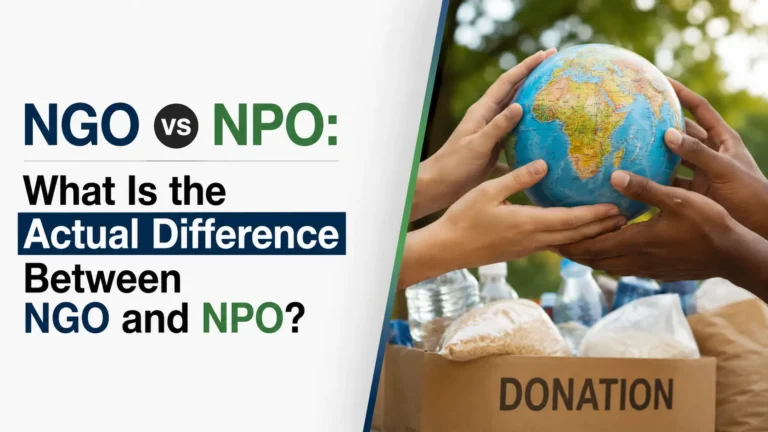
An NGO (Non-Governmental Organization) is a type of non-profit that operates independently of government influence, often focused on humanitarian or development work. An NPO (Non-Profit Organization) is a broader legal and financial category: any organization that does not distribute profits to owners or shareholders. In short, all NGOs are NPOs, but not all NPOs are NGOs.
If you have ever filled out a registration form, applied for a grant, or tried to set up a charitable organization, you have probably run into this question: what exactly is the difference between an NGO and an NPO?
The terms get used interchangeably all the time, even by people who work in the sector. But they are not the same thing, and mixing them up can cause real problems when it comes to legal registration, funding eligibility, and compliance.
This guide gives you a straightforward, jargon-free breakdown of both terms, what makes them different, where they overlap, and what it all means if you are starting or running an organization.
What Is an NGO (Non-Governmental Organization)?
An NGO, or Non-Governmental Organization, is an organization that:
- Is not part of any government body
- Does not operate for profit
- Works toward a social, environmental, humanitarian, or developmental mission
- Is typically funded through donations, grants, or membership fees
The term “NGO” became widely used after the United Nations formally recognized it in 1945. Today, it is most commonly associated with organizations working in areas like human rights, poverty alleviation, education, healthcare, disaster relief, and environmental conservation.
Well-known examples include Amnesty International, Greenpeace, Doctors Without Borders (MSF), and CARE India. These organizations operate across countries, often filling gaps that governments either cannot or choose not to address.
In India, NGOs are typically registered under the Societies Registration Act 1860, the Indian Trusts Act 1882, or as a Section 8 Company under the Companies Act 2013. They may also seek FCRA registration to receive foreign funds.
What Is an NPO (Non-Profit Organization)?
An NPO, or Non-Profit Organization, is any organization structured so that it does not generate profit for its owners, members, or shareholders. Any surplus revenue must be reinvested into the organization’s mission rather than distributed as profit.
NPO is primarily a legal and financial classification. It covers a much wider range of organizations than NGOs do, including:
- Hospitals and healthcare providers
- Educational institutions and universities
- Religious organizations
- Cultural and arts institutions
- Sports clubs and community associations
- Foundations and endowments
- NGOs themselves
In countries like the United States, NPOs often register as 501(c)(3) or similar tax-exempt entities. In India, the term is used broadly to describe any organization registered under relevant Acts that qualifies for tax exemption under Section 12A or 80G of the Income Tax Act.
NGO and NPO: Side-by-Side Comparison
| Feature | NGO (Non-Governmental Organization) | NPO (Non-Profit Organization) |
|---|---|---|
| Primary Focus | Social, humanitarian, development causes | Any non-profit mission (social, educational, religious, cultural) |
| Government Ties | Operates independently of government | May receive government funding |
| Scope | Often national or international | Can be local, national, or international |
| Legal Status | Varies by country | Formally registered with tax-exempt status |
| Examples | Amnesty International, WWF, CARE India | Red Cross, local food banks, hospitals |
Is an NGO the Same as an NPO?
Not exactly. Here is the simplest way to think about it:
Every NGO is an NPO. But not every NPO is an NGO.
An NGO is a specific type of NPO, one that is independent of government and focused on social or humanitarian goals. An NPO is the broader category that includes NGOs, charities, hospitals, religious bodies, schools, and many other organizations.
Think of it like this: all mangoes are fruits, but not all fruits are mangoes. Similarly, all NGOs are non-profits, but not all non-profits are NGOs.
The key distinctions come down to three things: independence from government, the nature of the mission, and how the organization is classified legally.
Why Does the Difference Between NGO and NPO Actually Matter?
1. Legal Registration Requirements
If you plan to register your organization, the classification matters. In India, for example, an organization aiming to receive foreign contributions needs to register as an NGO under FCRA rules. An NPO focused purely on domestic activities may not need that registration, which simplifies compliance considerably.
2. Funding and Grant Eligibility
Many international grant-making bodies and CSR funds specifically target NGOs rather than general NPOs. If your organization addresses human rights, climate, public health, or development, registering and positioning as an NGO can open doors to a wider range of funding sources.
On the other hand, some government schemes in India only provide support to registered Section 8 companies or Societies, which fall under the NPO umbrella. Knowing which category you belong to helps you apply for the right opportunities.
3. Tax Exemptions and Compliance
Both NGOs and NPOs may qualify for tax exemptions, but the documentation and compliance requirements differ based on your registration type. Organizations registered under 12A get income tax exemption; those with 80G certification allow donors to claim deductions. These apply to NPOs broadly, but the path to getting them depends on your structure.
4. Public Perception and Credibility
The word “NGO” carries significant public trust, especially in sectors like human rights, disaster relief, and community development. Using the right terminology builds credibility with donors, partners, and beneficiaries.
Key Types of NGOs You Should Know
Within the NGO category, there are several subtypes worth understanding:
- BINGO (Business-Friendly NGO): Works closely with corporations on development or CSR projects
- INGO (International NGO): Operates across borders, like the International Red Cross
- GONGO (Government-Organized NGO): Set up by governments but structured as independent bodies
- ENGO (Environmental NGO): Focused specifically on environmental causes, like WWF
- CBONGO (Community-Based NGO): Grassroots organizations serving local communities
Understanding which type fits your work helps you communicate your mission clearly and align with the right funding and partnership opportunities.
How Are NGOs and NPOs Registered in India?
Common Registration Options
- Society: Under the Societies Registration Act 1860, suitable for cultural, educational, and charitable groups
- Trust: Under the Indian Trusts Act 1882, often used for philanthropic and religious purposes
- Section 8 Company: Under the Companies Act 2013, preferred for organizations requiring a more formal corporate structure
Additional Registrations
- 12A Registration: Provides income tax exemption on surplus income
- 80G Certificate: Allows donors to claim deductions, encouraging contributions
- FCRA Registration: Required if the organization receives foreign funding
- DARPAN Registration: Mandatory for NGOs seeking government grants through the NITI Aayog portal
The Ministry of Corporate Affairs and NITI Aayog both play important roles in regulating these entities. Getting the right registrations from the start saves a lot of paperwork later.
Common Mistakes People Make When Using These Terms
- Using “NGO” and “NPO” as if they mean exactly the same thing in legal documents
- Registering as an NPO when the work actually requires NGO-specific compliance like FCRA
- Assuming that tax exemption is automatic once you register as a non-profit
- Forgetting to renew FCRA registration (now required every five years)
- Not applying for 80G certification, which can significantly affect donor willingness
Frequently Asked Questions (FAQ)
What is the main difference between an NGO and an NPO?
An NGO specifically operates independently of any government and focuses on social or humanitarian issues. An NPO is a broader classification for any organization that does not distribute profits to owners. All NGOs are NPOs, but NPOs include hospitals, universities, religious groups, and other bodies that may not be NGOs.
Can an organization be both an NGO and an NPO?
Yes. In fact, most NGOs are also classified as NPOs. An organization that is independent of government and operates for a social cause without distributing profits fits both definitions.
Is the Red Cross an NGO or NPO?
The International Committee of the Red Cross (ICRC) is both. It is a non-profit organization and, given its independence from governments, it also qualifies as an NGO. However, national Red Cross societies may have different legal statuses depending on their country.
Do NGOs pay taxes in India?
NGOs registered under 12A are generally exempt from paying income tax on surplus funds used for their stated objectives. However, they still need to file annual income tax returns and comply with audit requirements.
What is the difference between NGO and NPO registration in India?
There is no single “NGO registration” in India. Organizations registered as Trusts, Societies, or Section 8 Companies can all function as NGOs or NPOs depending on their objectives. The key differentiator is the additional compliance layer (like FCRA for foreign funding) that applies specifically to organizations engaging in government-independent humanitarian work.
Which is better: registering as an NGO or NPO?
Neither is universally “better.” It depends entirely on your mission, funding sources, and operational scope. If your work involves international partnerships and foreign grants, NGO-style registration with FCRA is important. If your focus is domestic and institutional, a standard NPO structure may be more efficient.
A Practical Note Before You Decide
Choosing the right organizational structure from the beginning can save years of legal headaches and missed funding opportunities. The difference between NGO and NPO may seem like a technicality, but when it comes to grants, tax filings, board governance, and donor reporting, every detail counts.
If you are in the early stages of setting up a non-profit entity or are not sure which path is right for your mission, it really is worth sitting down with someone who works in this space regularly. A good compliance consultant or NGO legal advisor can help you map out the right registration route, applicable exemptions, and ongoing obligations before you commit.
Need clarity on which structure suits your work? Reach out to a qualified professional who specializes in non-profit law and compliance. A short conversation can prevent years of costly rework.
Useful Links
Ministry of Corporate Affairs (Section 8 Companies)
FCRA Online (Foreign Contribution Regulation)
Income Tax India (12A and 80G)
Societies Registration Act 1860 (India Code)
Amnesty International (NGO Example)
Greenpeace India (Environmental NGO)
IRS 501(c)(3) Overview (US NPO Reference)
This article is for informational purposes only and does not constitute legal or financial advice. Please consult a qualified professional for guidance specific to your situation.