
SAI NGO & BUSINESS CONSULTANCY
Expert services for NGO, Trust, Society Registration & Compliance across India.
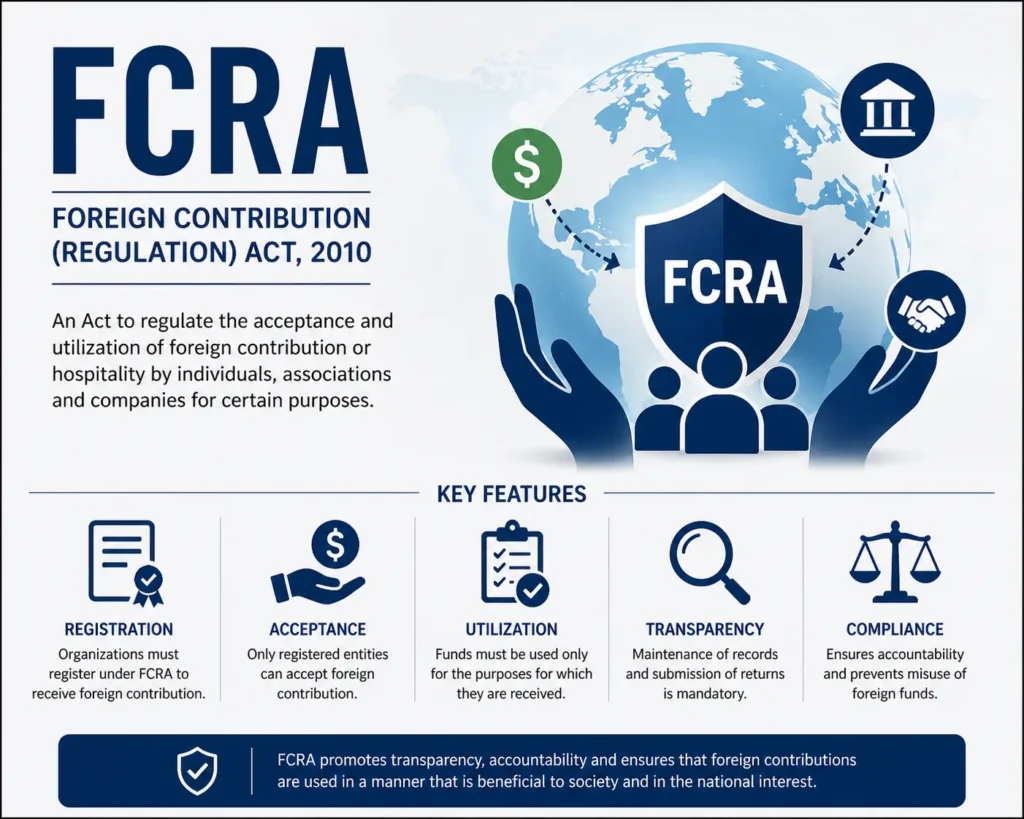
FCRA Registration is a mandatory legal certification granted by India’s Ministry of Home Affairs (MHA) under the Foreign Contribution (Regulation) Act, 2010. It allows eligible organisations, NGOs, and nonprofits to legally receive foreign donations, grants, and contributions for social, cultural, educational, religious, or economic purposes.
If your organisation works on social causes and relies on international funding, FCRA registration is not optional. It is a legal requirement. Without it, accepting even a single rupee from a foreign source can result in severe penalties, account freezing, or cancellation of your registration.
Yet, many NGOs apply without fully understanding the process, and they pay the price in delays, rejections, and compliance headaches. This guide breaks everything down in plain language so you know exactly what to do, what to avoid, and when to seek professional help.
What Is FCRA Registration and Why Does It Matter?
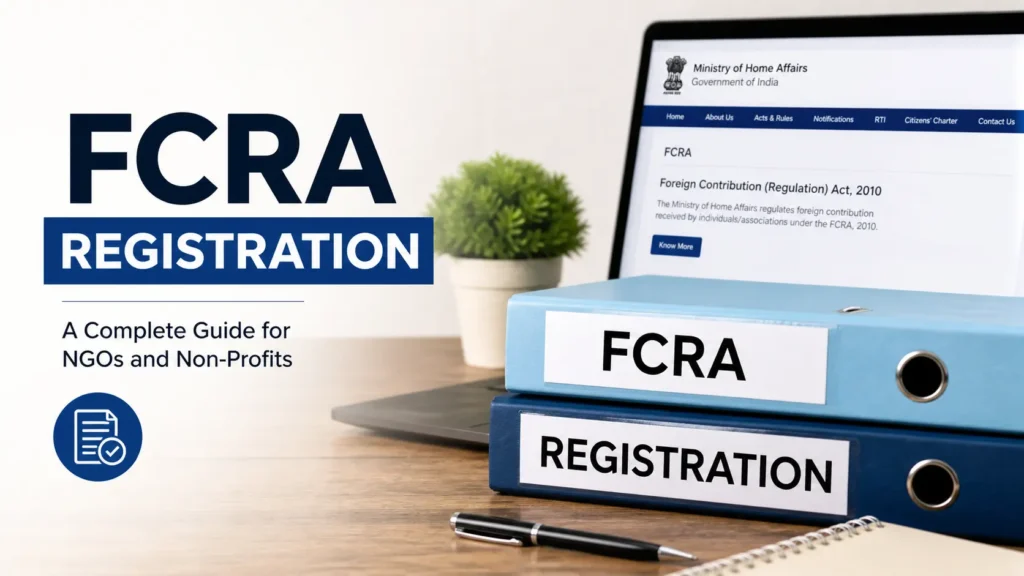
The Foreign Contribution (Regulation) Act, 2010 governs how organisations in India can receive money from foreign sources. The FCRA registration certificate is your official permission from the Government of India to receive such funds legally.
The law exists for a straightforward reason: the government wants to ensure that foreign money does not influence sensitive activities like politics, journalism, or national security. At the same time, it provides a clear and legal pathway for genuine development work.
Without valid FCRA registration, your organisation cannot open a designated FCRA bank account, cannot legally accept international grants, and cannot receive foreign donations, even from well-meaning donors abroad.
Who Needs FCRA Registration?
The following types of organisations typically need FCRA registration:
- Non-Governmental Organisations (NGOs) and voluntary associations
- Charitable trusts and societies registered under Indian law
- Section 8 companies (non-profit companies)
- Religious organisations receiving funds from abroad
- Educational institutions accepting foreign scholarships or grants
- Research bodies funded by international agencies
- Cultural organisations collaborating with foreign entities
If your organisation does not fall into these categories, you may still need FCRA prior permission for a one-time receipt of foreign funds. More on that below.
Key Benefits of Obtaining FCRA Registration
Getting your FCRA certificate is not just about regulatory compliance. It opens real doors for your organisation:
- Legal right to receive foreign contributions: You can accept donations, grants, and funding from international donors, foreign governments, and global foundations without legal risk.
- Enhanced credibility with international funders: Most foreign grant-making bodies, UN agencies, and bilateral donors require valid FCRA registration before releasing funds. It is a non-negotiable requirement.
- Access to larger grants and long-term partnerships: Registered organisations are trusted with multi-year funding relationships that transform the scale of their work.
- Dedicated FCRA bank account at SBI: FCRA registration allows you to open a designated bank account at the State Bank of India’s New Delhi Main Branch, which is where all foreign funds must be received.
- Improved governance and transparency: The compliance discipline that comes with FCRA registration, including annual returns and financial disclosures, makes your organisation more accountable and attractive to all kinds of funders.
- Priority in government partnerships: Government schemes that involve international co-funding often require partner NGOs to hold FCRA registration.
FCRA Registration Eligibility: Do You Qualify?
Before you begin the FCRA registration process, make sure your organisation meets these eligibility conditions:
- Your organisation must be registered in India (as a society, trust, or Section 8 company).
- It must have been in existence for at least three years.
- It must have spent at least Rs. 15 lakhs on its stated objectives during the three years prior to application, excluding administrative expenses.
- It must not be prohibited under the FCRA or any other Indian law.
- Key members, office bearers, or directors must not have been convicted under any law or have pending prosecution related to national security.
If your organisation is less than three years old or has not spent Rs. 15 lakhs on activities, you can apply for FCRA prior permission instead of full registration. This is a one-time permission for a specific project and a specific donor.
Step-by-Step FCRA Registration Process in India
The FCRA online application is submitted through the official MHA portal. Here is exactly how it works:
| Step | Process | Details |
|---|---|---|
| Step 1 | Open a Designated FCRA Bank Account | Before you even apply, you need to open a dedicated FCRA account at the State Bank of India’s New Delhi Main Branch (Branch Code: 11300). This is the only branch authorised to receive foreign contributions under the FCRA. |
| Step 2 | Register on the FCRA Online Portal | Visit the official MHA FCRA portal at fcraonline.nic.in and create an account for your organisation. This is the only authorised platform for FCRA registration applications. |
| Step 3 | Fill Out Form FC-3A | Form FC-3A is the application form for FCRA registration. Fill it carefully. Include your organisation’s details, activities, financial history, and key members. Any error here can delay or reject your application. |
| Step 4 | Attach All Required Documents |
You will need:
|
| Step 5 | Pay the Application Fee | Pay the prescribed fee of Rs. 10,000 through the FCRA portal using net banking or other digital payment modes. |
| Step 6 | Submit and Track Your Application | Once submitted, you can track the status of your FCRA online application through the MHA portal. The government may seek additional information or clarification, so monitor the portal regularly. |
| Step 7 | Field Verification | In most cases, the MHA or Intelligence Bureau will conduct a field verification of your organisation. Officers may visit your registered address, review your activities, and speak with key members. Ensure your records are in order before this happens. |
| Step 8 | Receive Your FCRA Certificate | If everything checks out, you will receive your FCRA registration certificate. The process typically takes 3 to 6 months from the date of application, though complex cases may take longer. |
FCRA Prior Permission: A Useful Alternative for New Organisations
If your organisation does not yet meet the eligibility criteria for full FCRA registration, FCRA prior permission is the route to take. It applies Form FC-3B and is project-specific. You name the donor, the amount, and the purpose upfront.
Prior permission is granted for a single, specific project and a defined time period. Once approved, the funds must be used strictly for that project. It is a good way to establish a track record before applying for full FCRA registration.
Common Mistakes That Delay or Reject FCRA Applications
Many well-intentioned organisations stumble during the FCRA registration process because of avoidable errors. Here are the most common ones:
- Incomplete or inaccurate Form FC-3A: Any mismatch between your application data and your documents will trigger a query or rejection. Double-check every field.
- Not meeting the Rs. 15 lakh expenditure requirement: Many organisations underestimate this threshold or fail to document expenditure correctly. Keep detailed records of all programmatic spending.
- Using the wrong SBI branch for the FCRA account: Only the New Delhi Main Branch (Branch Code 11300) is authorised for FCRA accounts. Opening an account elsewhere is a common and critical mistake.
- Ignoring field verification preparation: Your registered address must be real and operational. Officers do check. Having your documents and records easily accessible during the visit is essential.
- Lapses in annual filing after registration: FCRA registration comes with ongoing compliance obligations including Form FC-4 annual returns. Missing these can lead to cancellation of your registration.
- Submitting self-attested copies of wrong documents: Always verify the exact list of documents required at the time of application, as requirements can be updated by the MHA.
Expert Tips to Strengthen Your FCRA Application
- Maintain clean, audited accounts from the very beginning. MHA scrutinises financial records closely.
- Keep your organisation’s address consistent across all documents, including your registration certificate, tax filings, and MoA.
- Ensure all governing body members have valid Aadhar and PAN details updated in your records.
- Prepare a well-written activity report that clearly demonstrates the social impact of your work over three years.
- Do not accept any foreign funds before receiving your FCRA certificate or prior permission. Even partial receipt can attract penalties.
- Retain copies of all submissions and correspondence with MHA for at least seven years.
- Monitor the MHA FCRA portal regularly after submission. Delays often happen because organisations miss official queries.
FCRA Renewal: Keep Your Registration Active
FCRA registration is valid for five years and must be renewed before expiry. The renewal application must be filed at least six months before the expiry date using Form FC-3C on the FCRA online portal.
Organisations that miss the renewal deadline face suspension of their ability to receive foreign funds. In some cases, expired registrations have been cancelled without the possibility of immediate reinstatement. Mark the expiry date clearly in your compliance calendar.
Frequently Asked Questions
Q1. What is the difference between FCRA registration and FCRA prior permission?
FCRA registration is a long-term permission that allows an organisation to receive foreign funds for five years across multiple projects and donors. FCRA prior permission is a one-time permission for a specific project, a specific amount, and a specific foreign donor. New organisations with less than three years of existence generally apply for prior permission first.
Q2. How long does FCRA registration take?
The process generally takes 3 to 6 months from the date of application, subject to field verification and any additional queries raised by the MHA. Applications with complete documentation and clean records are processed faster.
Q3. Can a newly formed NGO apply for FCRA registration?
No. A newly formed NGO must be at least three years old and must have spent at least Rs. 15 lakhs on its stated objectives before applying for FCRA registration. New organisations can apply for FCRA prior permission instead for a specific project.
Q4. Which bank account should be used for FCRA funds?
All foreign contributions must be received in a dedicated FCRA bank account at the State Bank of India’s New Delhi Main Branch (Branch Code: 11300). This is a regulatory requirement and cannot be substituted with any other bank or branch.
Q5. What happens if an organisation accepts foreign funds without FCRA registration?
Accepting foreign contributions without valid FCRA registration or prior permission is a criminal offence under the FCRA. Penalties include confiscation of funds, prosecution of key members, and permanent disqualification from obtaining FCRA registration in the future.
Q6. Is FCRA registration required for receiving foreign scholarships?
Individual scholarships received directly by students from foreign institutions are generally exempt. However, if an educational institution acts as the intermediary to receive and distribute foreign scholarships, FCRA registration may be required. It is advisable to seek legal guidance for such specific situations.
Thinking About Applying? Here Is Where to Start
FCRA registration is a significant milestone for any organisation working on development, social, or humanitarian causes. Getting it right the first time saves months of delays and protects your organisation from compliance risk.
Start by checking your eligibility, reviewing the official MHA guidelines, and auditing your documents. If you are unsure about any step or want a professional to review your application before submission, a qualified legal or compliance consultant can make a real difference.
A small investment in expert guidance at the start is far less costly than dealing with a rejection, a query, or a compliance violation later. If you would like to speak with someone who handles FCRA registrations regularly, feel free to reach out for a consultation. We are happy to take a look at your situation and point you in the right direction.
Useful Links
All official and referenced resources mentioned in this post:
| Resource Name | Description | Official Link |
|---|---|---|
| MHA FCRA Online Portal (Official Application Gateway) | Main portal for FCRA registration, application submission, and compliance-related filings. | https://fcraonline.nic.in |
| Ministry of Home Affairs – FCRA Wing | Official government page providing rules, guidelines, and updates related to FCRA. | Visit FCRA Wing Page |
| SBI New Delhi Main Branch FCRA Account Info | Information related to opening and managing the designated FCRA bank account. | https://www.sbi.co.in |
| Foreign Contribution (Regulation) Act, 2010 (Full Text) | Complete legal document outlining provisions, rules, and compliance requirements under FCRA. | Download Act PDF |
| FCRA Annual Return (Form FC-4) Filing | Portal for submitting annual returns and compliance reports under FCRA. | https://fcraonline.nic.in |
| NGO Darpan Portal (NITI Aayog) | National database for NGOs to register and access government schemes and funding opportunities. | https://ngodarpan.gov.in |