

SAI NGO & BUSINESS CONSULTANCY
Expert services for NGO, Trust, Society Registration & Compliance across India.
Startup India Registration (officially called DPIIT Recognition) is a government certification that formally recognises your business as a startup under the Startup India scheme. Once registered, you get access to tax exemptions, simplified compliance, funding support, and a range of other government benefits designed to help new businesses grow faster.
What Is Startup India Registration?
If you have started or are planning to start a business in India, you have probably heard about the Startup India scheme. But what exactly is it, and why does it matter for you?
Startup India is a flagship initiative launched by the Government of India in January 2016. The goal is simple: make it easier for startups to grow, get funded, and operate without drowning in paperwork and taxes.
At the centre of this scheme is what is known as DPIIT Recognition, which stands for Department for Promotion of Industry and Internal Trade. When your business gets this recognition, it is officially considered a startup by the Indian government. That single certificate opens the door to a long list of advantages that regular businesses do not get.
This is not just a formality. The Startup India registration process gives your company a legitimate identity in the eyes of investors, government departments, and even customers. It signals that your business has been verified and meets the standards set by the government.
Who Is Eligible for Startup India Registration?
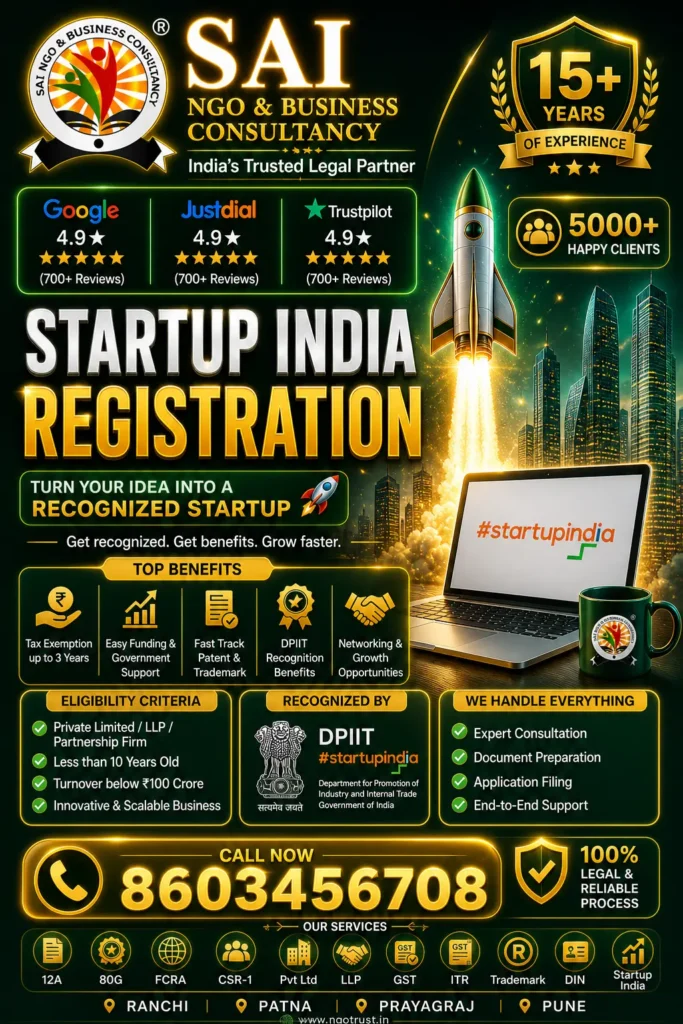
Before you apply, it is important to check whether your business qualifies. Not every new business is eligible. Here is what the government looks for:
- Age of the Business: Your entity must not be more than 10 years old from the date of its incorporation.
- Type of Entity: You must be registered as a Private Limited Company, a Limited Liability Partnership (LLP), or a Registered Partnership Firm. Sole proprietorships do not qualify.
- Annual Turnover: Your turnover should not have exceeded Rs 100 crore in any financial year since incorporation.
- Original and Scalable: The business should be working towards innovation, development, or improvement of a product, process, or service. It should also have the potential to create employment or generate wealth.
- Not a Restructured Entity: The startup should not have been formed by splitting up or reconstructing an already existing business.
If your business checks all these boxes, you are likely eligible. When in doubt, getting a quick review from a startup consultant or CA can save you time and prevent a rejection.
Why Bother? The Real Benefits of Startup India Registration

This is probably the most important section of this post. A lot of founders hesitate because they think registration is just more government paperwork. But the benefits are genuinely significant.
Tax Benefits That Actually Save Money
- Income tax exemption for 3 consecutive years out of the first 10 years after incorporation (under Section 80-IAC of the Income Tax Act)
- Exemption from tax on investments above fair market value (Angel Tax exemption under Section 56)
- Capital gains tax exemption on investments into DPIIT-recognised startups
Simplified Compliance
- Self-certification under 6 labour laws and 3 environmental laws for a period of 3 to 5 years
- Faster exit process: DPIIT-recognised startups can wind up operations within 90 days under the Insolvency and Bankruptcy Code
- Easier public procurement: No prior experience or turnover requirement when bidding for government tenders
Funding Access
- Access to the Fund of Funds for Startups (FFS) managed by SIDBI, with a corpus of Rs 10,000 crore
- Priority access to various government grants and seed funding schemes
- Listing on the Startup India portal makes your business visible to venture capital firms, angel investors, and incubators across India
IPR and Innovation Support
- 80% rebate on patent filing fees
- Fast-tracked patent examination
- Up to 50% rebate on trademark filing fees
Other Perks
- Access to over 50 central government schemes listed on the Startup India hub
- Networking opportunities through Startup India events, pitch fests, and connect programmes
- Recognition and credibility that helps during fundraising rounds and client conversations
How to Complete Your Startup India Registration: Step by Step
The actual process is entirely online and simpler than most people expect. Here is how it works:
- Incorporate Your Business First
You need to be a registered Private Limited Company, LLP, or Partnership Firm before you apply. If you are not incorporated yet, this has to happen first. You can incorporate through the MCA portal (Ministry of Corporate Affairs) at mca.gov.in.
- Create an Account on the Startup India Portal
Go to startupindia.gov.in and create a profile for your business. The portal is well-designed and the registration form is straightforward.
- Fill in the DPIIT Recognition Application
Under the section for DPIIT Recognition, fill in your company details, describe your business model, and explain the innovative or scalable nature of your work. This part matters, so take your time writing a clear and honest description.
- Upload the Required Documents
You will need to upload the following:
- Certificate of Incorporation / Registration Certificate
- PAN Card of the entity
- Brief description of your business and its innovative nature
- Details of patents or awards (if any, not mandatory)
- Submit and Wait for Approval
After submission, DPIIT reviews your application. If everything is in order, you receive your DPIIT Recognition Certificate digitally. This usually takes a few working days, though it can vary. There is no fee for this registration.
| Pro Tip: After getting DPIIT recognition, you will need to apply separately to the Income Tax Department for the Section 80-IAC tax exemption. These are two separate processes. Many founders miss this step and lose out on the tax benefit. |
Common Mistakes Founders Make During Startup India Registration

Based on what many consultants and founders have seen, here are the errors that cause the most problems:
1. Writing a Vague Business Description
The innovation description you write is reviewed by DPIIT. If it sounds generic or too similar to an existing business, your application may be rejected or asked for resubmission. Be specific about what makes your product, process, or service different.
2. Applying Before Incorporation
Some founders try to apply with only a GST registration or trade licence. This does not work. You must have a formal incorporation certificate from MCA before applying for DPIIT recognition.
3. Forgetting the Section 80-IAC Application
As mentioned above, getting DPIIT recognition does not automatically mean you get the income tax exemption. That requires a separate application to the Income Tax Department. Many founders only realise this at tax filing time.
4. Not Keeping the Entity Type Eligible
If your business is a sole proprietorship, you cannot register under Startup India. Some founders convert their business structure only after they have been operating for years, by which time they may have already exceeded the turnover or age limits.
5. Missing Annual Updates
Your startup profile on the Startup India portal needs to be updated periodically. Inactive or outdated profiles can cause issues when you try to claim benefits or apply for government schemes linked to your recognition.
Expert Tips to Make the Most of Your Registration
Getting the certificate is just the beginning. Here is how to actually use it well:
- Apply early: The 10-year age limit means every year you wait is a year less of eligibility. Startups that register early have longer windows to use all the benefits.
- Document your innovation: Keep records of your R&D work, patents applied for, and product development milestones. This helps if DPIIT ever asks for more information, and it also strengthens your investor pitch.
- Use the Startup India hub actively: Many founders register and then forget the portal exists. The hub has scheme listings, investor connect tools, and mentorship programmes that are genuinely useful.
- Get your DSC and DIN ready: Your company directors should have their Digital Signature Certificates and Director Identification Numbers in order before you start the application. Missing these can slow the process.
- Work with a CA or startup advisor: The application itself is free and not very complex, but the tax benefits that come after (especially 80-IAC) involve detailed documentation and eligibility conditions. A professional can help ensure you do not miss anything important.
| Thinking About Getting Your Startup India Registration Done? The registration itself is free and online. But the real value comes from making sure you qualify correctly, write the right application, and actually claim the tax and funding benefits that follow. If you would like a quick review of your eligibility, help with the application, or guidance on the Section 80-IAC filing, speaking with a startup advisor or chartered accountant who understands the DPIIT process can save you significant time and money. A 30-minute consultation could be the difference between getting it right the first time and going back and forth with rejections or missed benefits. |
Frequently Asked Questions
Q1. What is the difference between Startup India registration and company incorporation?
Company incorporation is the legal process of forming your business (Private Limited, LLP, etc.) through the MCA. Startup India registration (DPIIT Recognition) is a separate government certification that you apply for after incorporation. One does not replace the other.
Q2. Is there any fee for Startup India DPIIT registration?
No. The DPIIT recognition application through the Startup India portal is completely free. There is no government fee involved.
Q3. How long does it take to get DPIIT recognition?
Once you submit a complete and accurate application, DPIIT typically processes it within 2 to 7 working days. Incomplete applications or those requiring clarification can take longer.
Q4. Can a service-based startup apply for Startup India recognition?
Yes. Service-based startups can apply as long as the business meets the eligibility criteria, including the innovation or scalability requirement. IT services, edtech, healthtech, fintech, and many service-oriented businesses have successfully received DPIIT recognition.
Q5. What is the Section 80-IAC tax exemption and how do I apply for it?
Section 80-IAC of the Income Tax Act gives eligible DPIIT-recognised startups a 100% income tax exemption for 3 consecutive years out of the first 10 years. To claim this, you must apply separately to the Inter-Ministerial Board (IMB) set up by the government. This is not automatic upon DPIIT recognition.
Q6. Can I get Startup India registration if my business is more than 5 years old?
Yes, as long as the business is not more than 10 years old from incorporation and the turnover has not exceeded Rs 100 crore in any year. The scheme was expanded from 7 years to 10 years to accommodate more businesses.
7. What happens if my application for DPIIT recognition is rejected?
DPIIT will typically give you a reason for rejection. The most common reasons are an unclear innovation description or ineligible entity type. You can revise your application and reapply.
8. Is Angel Tax still a problem for DPIIT-recognised startups?
DPIIT-recognised startups have a specific exemption from Section 56(2)(viib) of the Income Tax Act, which covers Angel Tax on investments above fair market value. However, conditions and limits apply, so it is advisable to check the latest CBDT notifications or consult a tax advisor.
Useful Links
Here are the official and relevant resources mentioned and referenced in this post:
Startup India Official Portal – startupindia.gov.in
DPIIT Recognition Application (Startup India Hub)
Ministry of Corporate Affairs (MCA) – Company Incorporation
SIDBI Fund of Funds for Startups (FFS)
Income Tax India – Section 80-IAC Information
Insolvency and Bankruptcy Code – IBBI
Indian Patent Office – IPO (for Patent Filing Rebate)
CBDT Notifications on Angel Tax Exemption