
SAI NGO & BUSINESS CONSULTANCY
Expert services for NGO, Trust, Society Registration & Compliance across India.
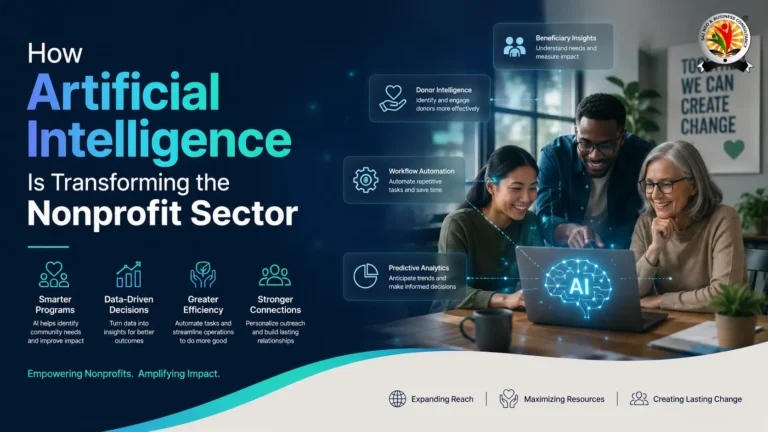
What does AI in the nonprofit sector mean? Artificial intelligence (AI) in the nonprofit sector refers to the use of machine learning, automation, natural language processing, and data analytics to help mission-driven organizations work smarter. This includes everything from automating grant research and personalizing donor outreach to predicting program outcomes and reducing administrative workload.
Artificial Intelligence Is Already Reshaping Nonprofits
Artificial intelligence is no longer a tool reserved for big tech companies or corporate giants. Nonprofits of every size are beginning to use AI to stretch limited budgets, reach more people, and make better decisions with data.
If you run or work within a nonprofit organization, you have probably already felt the pressure. Donors expect personalized communication. Funders want measurable outcomes. Volunteers need better coordination. Staff are stretched thin. AI can help with all of this.
This article breaks down exactly how artificial intelligence is being used across the nonprofit sector today, which areas see the biggest impact, and what organizations can realistically do to get started.
Why the Nonprofit Sector Is Turning to AI Now
The pace of change in the charitable sector has accelerated significantly. Several factors have pushed nonprofits toward AI-driven solutions:
- Funding pressures require doing more with less
- Donor expectations have risen sharply after years of personalized brand experiences
- Remote work and hybrid teams created new operational gaps
- Data from programs, donors, and communities has grown too large to manage manually
- Competitors (including other nonprofits) are moving faster using technology
According to research published by Salesforce, organizations using AI-driven tools report significantly higher satisfaction in donor relationships and program efficiency. The nonprofit sector is catching up, and the organizations moving early are already seeing results.
Key Areas Where AI Is Making a Real Difference

1. Donor Engagement and Fundraising
This is where many nonprofits feel the impact of AI most immediately. Traditional fundraising relied on broad campaigns sent to everyone on the mailing list. AI changes that entirely.
Machine learning models can now analyze a donor’s past giving history, communication preferences, and even seasonal behavior to predict when they are most likely to give and how much to ask for. Tools like DonorSearch and Bloomerang use AI scoring to help organizations focus their outreach on the donors most likely to respond.
The result: higher conversion rates, lower cost per donor acquired, and stronger long-term relationships.
2. Grant Research and Writing
Identifying the right funders and writing compelling grant proposals has always been time-intensive. AI is changing both sides of that equation.
Platforms like Instrumentl use AI to match nonprofits with relevant grant opportunities based on mission alignment, geographic focus, and past funding history. Meanwhile, large language models (like those behind tools built on OpenAI’s technology) can help staff draft initial sections of proposals, saving hours per application cycle.
This does not replace the human voice in grant writing. It removes the blank-page problem and the hours spent on funder research.
3. Program Delivery and Outcome Measurement
For direct-service nonprofits, AI is helping move from anecdotal impact reporting to data-driven outcome tracking.
Organizations working in areas like education, healthcare access, and housing stability are using predictive analytics to identify which individuals or communities are at the highest risk of falling through the cracks. AI-powered dashboards can flag early warning signs so case managers can intervene sooner.
The Poverty Lab at the University of Chicago has published research on how data modeling improves the targeting of social interventions. For nonprofits, this kind of evidence-based approach makes programs more effective and makes the case to funders much stronger.
4. Volunteer Management
Nonprofits often struggle to match the right volunteers to the right roles at the right times. AI-driven scheduling and communication tools can automate much of this coordination.
Platforms like VolunteerHub now incorporate intelligent matching features that connect volunteer skills and availability with organizational needs. Automated reminders, onboarding flows, and satisfaction surveys reduce the administrative burden on staff while improving the volunteer experience.
5. Communications and Content
Nonprofits need to communicate constantly: with donors, volunteers, community members, and the media. But creating quality content takes time that many small organizations simply do not have.
AI writing assistants can help draft newsletters, social media posts, impact reports, and appeal letters in a fraction of the time. When used thoughtfully, these tools help staff maintain a consistent voice without burning out on content production.
What AI Cannot Do for Nonprofits

It is worth being honest about the limits. Artificial intelligence is a tool, not a strategy.
- AI cannot build genuine relationships with donors or community members
- It cannot replace the judgment of experienced program staff
- It will not fix a broken organizational culture or unclear mission
- Without clean, well-organized data, most AI tools will produce poor results
The organizations that get the most out of AI are the ones that use it to support human decision-making, not replace it. The technology works best when staff understand its limits and apply it with care.
Real Examples of AI in Nonprofit Work
These are not hypothetical examples. Organizations around the world are using AI tools right now:
- Save the Children uses predictive analytics to improve the targeting of humanitarian aid distribution
- Charity: Water leverages data visualization and machine learning to track the real-time impact of funded water projects
- The American Cancer Society has used AI to improve donor segmentation and communication timing
- Small community organizations are using free tools like Google’s Looker Studio combined with CRM data to build AI-assisted dashboards
You do not need to be a large international organization to benefit. Many AI tools are now priced for nonprofits, and some are free.
Common Concerns Nonprofits Have About AI
Is AI Too Expensive for Our Budget?
Not always. Many AI-powered features are now built into tools nonprofits already use, including CRMs like HubSpot for Nonprofits and Salesforce’s Nonprofit Success Pack (NPSP). Others offer nonprofit pricing or free tiers. The bigger cost is often staff time to learn and implement new tools.
Will AI Replace Our Staff?
This is the concern most people voice first. The honest answer is that AI is much more likely to change how people work than to eliminate roles. Repetitive, time-consuming tasks get automated. Staff spend more time on the work that actually requires human empathy, creativity, and judgment.
What About Data Privacy?
This is a legitimate concern, especially for nonprofits handling sensitive information about the communities they serve. Any AI tool that touches beneficiary data should be evaluated for compliance with applicable data protection laws. In the US, this includes HIPAA for health data and FERPA for education data. Working with a technology advisor who understands both AI and nonprofit compliance is the safest path forward.
How to Get Started With AI in Your Nonprofit
You do not need to overhaul your entire organization to begin using artificial intelligence. A practical starting point:
- Audit your current tools: many already have AI features you are not using yet
- Identify one high-friction task that eats staff time: grant research, donor segmentation, or scheduling are good starting points
- Pilot one AI tool for 60 to 90 days with a small team before rolling it out organization-wide
- Track what changes: time saved, donor response rates, or volunteer retention
- Train your team: AI tools are only as good as the people using them
If your team is unsure where to begin, speaking with a nonprofit technology consultant can help you avoid costly mistakes and focus on the tools most likely to move your mission forward.
Frequently Asked Questions
What is the role of artificial intelligence in the nonprofit sector?
Artificial intelligence helps nonprofits improve operational efficiency, personalize donor communications, streamline grant research, and measure program outcomes more accurately. It is used to reduce manual workload and make data-driven decisions that support mission delivery.
Can small nonprofits afford to use AI?
Yes. Many AI-powered tools are either free, nonprofit-priced, or built into software organizations already use. The investment is often more about staff time and training than direct cost. Starting small with one tool and one use case is a low-risk way to begin.
How does AI help with nonprofit fundraising?
AI helps nonprofits identify which donors are most likely to give, predict optimal ask amounts, personalize outreach messages, and determine the best times to send communication. This increases conversion rates and donor retention while reducing the cost of fundraising.
Is AI safe to use with sensitive beneficiary data?
It can be, but it requires care. Organizations should review any AI tool’s data handling and storage practices before use, ensure compliance with relevant privacy laws, and work with advisors who understand both technology and nonprofit regulations.
What AI tools are available specifically for nonprofits?
Tools like DonorSearch, Bloomerang, Instrumentl, VolunteerHub, Salesforce NPSP, and HubSpot for Nonprofits all include AI-powered features designed for mission-driven organizations. General tools like ChatGPT, Google Gemini, and Microsoft Copilot can also support content creation, research, and data analysis.
Will AI replace nonprofit workers?
AI is not on track to replace nonprofit workers. It automates repetitive tasks so staff can focus on relationship-building, program delivery, and strategic work. The human element remains central to what nonprofits do.
Where Does Your Nonprofit Go From Here?
The organizations that will thrive in the years ahead are not necessarily the ones with the biggest budgets. They are the ones willing to ask: how can we use technology to serve our mission better?
Artificial intelligence is not a silver bullet. But used thoughtfully, it is one of the most practical tools available to help nonprofits do more, reach further, and report more clearly on the impact they create.
If you are unsure whether AI is the right fit for your organization, or simply do not know where to begin, it may be worth having a conversation with a nonprofit technology advisor. A short consultation can clarify which tools make sense for your specific mission, budget, and team capacity, without the pressure of diving into expensive implementations blindly.
You have built something worth protecting and growing. Getting the technology right is one way to make sure that happens.
Useful Links
Salesforce Nonprofit Success Pack (NPSP)
DonorSearch – AI-Powered Donor Insights
Bloomerang – Nonprofit Donor Management
Instrumentl – Grant Research and Management
VolunteerHub – Volunteer Management Software
Charity: Water – Impact Tracking
University of Chicago Poverty Lab
Google Looker Studio (Free Data Visualization)