
SAI NGO & BUSINESS CONSULTANCY
Expert services for NGO, Trust, Society Registration & Compliance across India.
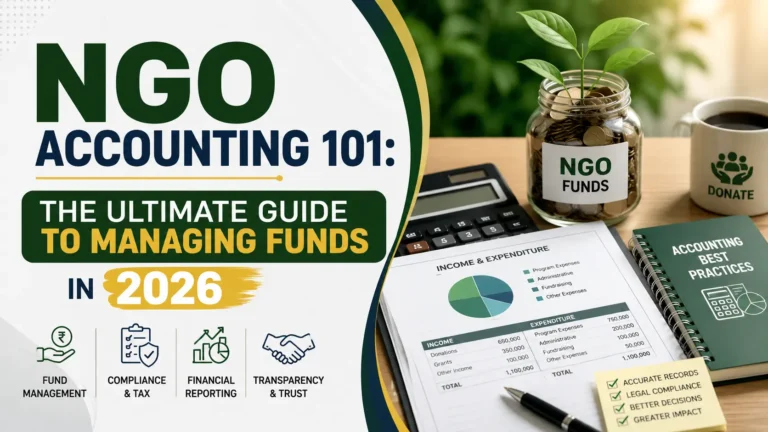
NGO accounting is the process of recording, tracking, and reporting how a nonprofit receives and spends money, so that every rupee can be traced back to its source and its purpose.
Unlike business accounting, it focuses on accountability to donors and regulators, not profit. Get it right, and you build donor trust, pass audits without stress, and stay compliant with laws like FCRA, 12A, and 80G.
If numbers make your head spin, you are not alone. Most NGO founders did not start their organization because they love spreadsheets. They started it because they wanted to change something. But here is the truth: an NGO that cannot show where its money went will struggle to raise more of it.
This guide walks you through NGO accounting in plain language. No heavy jargon, no confusing tables. Just what you need to know to manage funds properly in 2026.
What Is NGO Accounting and Why Does It Matter?

NGO accounting is a system for recording income, expenses, and fund movements in a way that shows transparency and purpose. It answers three simple questions for every rupee that comes in: Where did it come from? What was it meant for? Where did it go?
This matters for three reasons:
- Donors and grant-making bodies want proof their money was used as promised.
- The Income Tax Department and FCRA authorities require accurate, timely reporting.
- Your own team needs clear numbers to plan programs and avoid overspending.
Weak accounting is one of the quickest ways for an NGO to lose donor confidence, even if the actual program work is excellent.
How Is NGO Accounting Different From Regular Business Accounting?
A business tracks profit. An NGO tracks purpose. That single difference changes almost everything about how the books are kept.
A company can spend its revenue however management decides. An NGO usually cannot. Money often comes tagged for a specific project, region, or activity, and it has to be spent exactly that way.
- Businesses report profit and loss; NGOs report income and expenditure along with a Receipts and Payments Account.
- Businesses answer to shareholders; NGOs answer to donors, trustees, and government regulators.
- Businesses can reinvest surplus freely; NGOs must often route surplus back into approved charitable objectives.
What Are the Core Principles of Fund Accounting?
Fund accounting is the backbone of NGO financial management. It means separating money into different “funds” based on where it came from and how it can be used.
Restricted vs Unrestricted Funds
Restricted funds are tied to a specific purpose by the donor, such as a grant meant only for a school-building project. Unrestricted funds can be used for any legitimate organizational need, including staff salaries or office rent.
Mixing these two is one of the fastest ways to run into trouble during an audit or a donor review.
Fund-Based Accounting Explained
Instead of one big pool of money, fund accounting treats each grant, project, or donation category as its own mini ledger. This lets your team and your donors see exactly how each fund was used, rather than guessing from one combined total.
What Financial Records Should Every NGO Maintain?
Good NGO fund management starts with disciplined record-keeping. At a minimum, maintain these:
- Cash book and bank book for every account
- Receipts and Payments Account
- Income and Expenditure Account
- Balance Sheet
- Donor-wise and project-wise fund utilization reports
- Fixed asset register
- Salary and TDS records
- FCRA-specific bank statements, if you receive foreign contributions
Keep digital and physical copies, and reconcile your bank accounts every month, not just at year-end.
What Are the Key Compliance Requirements for NGOs in 2026?
Compliance is where most NGOs lose sleep, and it is also where good accounting pays off the most.
12A and 80G Registration
Registration under Section 12A gives your NGO income tax exemption, while 80G lets your donors claim a tax deduction on their contributions. Both need renewal and accurate financial statements filed with the Income Tax Department.
FCRA Compliance for Foreign Donations
If your NGO receives funds from outside India, FCRA registration and a dedicated FCRA bank account are mandatory. All foreign receipts and their utilization must be reported through the annual FC-4 return on the FCRA portal.
CSR Fund Reporting
NGOs receiving Corporate Social Responsibility funds under the Companies Act, 2013 must maintain project-wise utilization certificates, since corporate donors face their own compliance checks with the Ministry of Corporate Affairs.
How Can NGOs Manage Funds More Effectively?

Managing funds well is less about complex tools and more about consistent habits.
- Prepare an annual budget and review it against actuals every quarter
- Keep restricted and unrestricted funds in separate bank accounts where possible
- Get every expense approved and documented before payment, not after
- Reconcile accounts monthly instead of scrambling at year-end
- Share simple, visual fund utilization reports with your board and major donors
- Get an independent audit done every year, even if it is not legally required yet
What Accounting Tools Should NGOs Use in 2026?
Spreadsheets can work for very small NGOs, but they become risky once you handle multiple projects or foreign funds. Cloud-based accounting software built for nonprofits, or general tools like Tally and Zoho Books configured with fund-wise ledgers, make monthly reconciliation and reporting far easier. The right tool depends on your NGO’s size, number of active projects, and whether you handle FCRA funds.
What Are Common NGO Accounting Mistakes to Avoid?
- Mixing restricted and unrestricted funds in one account
- Recording cash donations without proper receipts
- Missing annual return deadlines for 12A, 80G, or FCRA
- Not maintaining donor-wise utilization records
- Delaying reconciliation until the financial year closes
- Treating the accountant’s role as optional rather than essential
Each of these mistakes is fixable, but they get harder to correct the longer they go unnoticed. A quick internal review every quarter catches most of them early.
Frequently Asked Questions
What is the difference between NGO accounting and fund accounting?
NGO accounting is the broader system of recording all financial activity for a nonprofit. Fund accounting is a method within it that separates money into restricted and unrestricted categories based on donor intent.
Does every NGO need to get its accounts audited?
Most registered NGOs in India are legally required to get their accounts audited annually, especially once they cross certain income thresholds or hold 12A, 80G, or FCRA registration. Even smaller NGOs benefit from a voluntary audit for credibility.
Can an NGO use donor funds for admin expenses?
Only if the donor has not restricted the funds to a specific purpose, or has explicitly allowed a percentage for administrative costs. Using restricted funds for unrelated expenses can breach the grant agreement and damage donor trust.
What happens if an NGO misses its FCRA reporting deadline?
Late or missed FCRA returns can lead to penalties, suspension, or even cancellation of FCRA registration, which cuts off the NGO’s ability to receive foreign funds. Timely, accurate reporting is one of the most important compliance tasks for any NGO handling foreign contributions.
How often should an NGO reconcile its bank accounts?
Monthly reconciliation is the safe standard. It catches errors early, keeps your books audit-ready, and gives your team a realistic picture of available funds at all times.
Getting Fund Management Right, Without the Stress
NGO accounting does not have to feel overwhelming. Most of it comes down to a few consistent habits: separating funds properly, keeping clean records, and staying on top of compliance deadlines. Once those systems are in place, everything else, from donor trust to audits, gets easier.
If your NGO is finding it hard to keep up with fund accounting, compliance filings, or 12A, 80G, and FCRA paperwork, it often helps to have someone experienced look at your books before small gaps turn into bigger problems. A short consultation with a team that works with nonprofits regularly can save months of correction later.
Useful Links
- Income Tax Department, India
- FCRA Online Services, Ministry of Home Affairs
- Ministry of Corporate Affairs (CSR)