
SAI NGO & BUSINESS CONSULTANCY
Expert services for NGO, Trust, Society Registration & Compliance across India.
A project budget for an NGO proposal is a detailed financial plan that shows a donor exactly how much money a project needs, where every rupee will go, and how the outcomes justify the cost. It usually includes personnel costs, direct program costs, administrative overhead, monitoring and evaluation expenses, and a contingency fund, all mapped against a clear timeline.
If you have ever spent weeks writing a strong NGO proposal only to get rejected over the budget page, you are not alone. Donors and grant committees often decide funding not on how good your idea sounds, but on how well your numbers back it up. A weak or vague project budget is one of the top reasons NGO proposals get turned down, even when the project idea itself is excellent.
In this guide, we will walk you through exactly how to prepare a project budget for NGO proposals that donors trust, step by step, along with a free, ready-to-use template you can download and start filling in today.
What Is a Project Budget in an NGO Proposal?
A project budget is the financial section of your proposal that translates your program plan into numbers. It tells the donor how much money you need, what you will spend it on, and when you will spend it.
Think of it as the financial story of your project. Every activity you describe in the narrative section should have a matching cost line in the budget. If your proposal talks about training 200 women in tailoring skills but the budget has no line for trainers, sewing machines, or venue rent, the donor will notice the gap immediately.
A good NGO project budget usually answers three questions clearly:
- How much money is needed in total?
- What exactly will the money be used for?
- How was each figure calculated?
Why Do Donors Reject NGO Proposals Over the Budget?
Donors reject budgets that feel unrealistic, unclear, or padded. Reviewers see hundreds of proposals, so anything that looks copied, rounded off carelessly, or missing detail raises doubt about the organisation’s financial management.
Some common red flags that make reviewers hesitate include:
- Round numbers everywhere (like a suspiciously neat Rs. 5,00,000) with no working shown
- No connection between activities in the proposal and cost lines in the budget
- Overhead or admin costs that look too high compared to program costs
- Missing local taxes, statutory costs, or bank charges
- No contingency planning for price changes or delays
The fix is simple: build your budget the way an accountant would, with a clear source for every figure, not the way a writer fills a blank page.
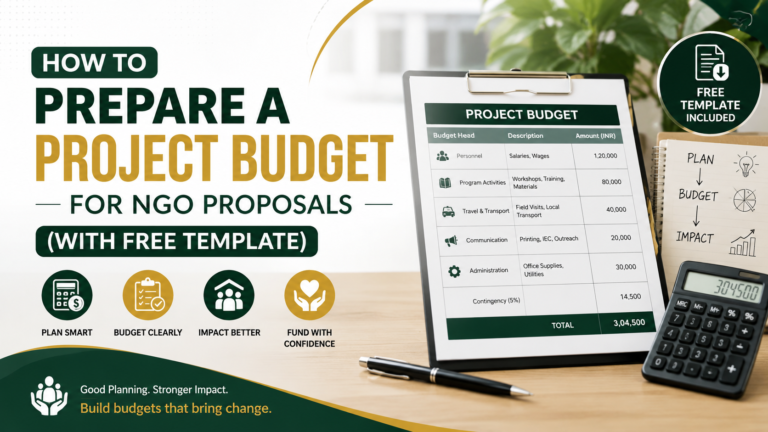
Key Components of an NGO Project Budget
Most donor formats expect the same core categories, even if the exact labels vary slightly. Here is what typically goes into a project budget for NGO proposals.
1. Personnel Costs
This covers salaries, honorariums, and consultant fees for everyone working on the project, whether full-time, part-time, or on a contract basis. Break this down by role (project coordinator, field officer, trainer) rather than listing a single lump sum.
2. Direct Program Costs
These are costs tied directly to project activities, such as training materials, transport for beneficiaries, venue rent, equipment, or supplies. Donors usually scrutinise this section the most since it shows exactly how the project will run on the ground.
3. Administrative and Overhead Costs
This includes office rent, utilities, internet, and a share of general staff time that supports the project indirectly. Most donors cap this between 10 to 15 percent of the total budget, so keep it proportionate.
4. Monitoring and Evaluation (M&E) Costs
Costs for tracking progress, collecting data, conducting surveys, and preparing reports for the donor. Including this line separately signals that your organisation takes accountability seriously.
5. Contingency Fund
A small buffer, usually 3 to 5 percent of the total budget, set aside for price fluctuations or unplanned costs. Not every donor allows this, so check the guidelines before adding it.
Step-by-Step: How to Prepare a Project Budget for NGO Proposals
Step 1: Start With the Project Plan, Not the Budget
List every activity in your project timeline first. The budget should grow out of this list, activity by activity, instead of being written separately from the narrative.
Step 2: List All Possible Cost Categories
Group expected costs under personnel, program, administrative, M&E, and contingency, as explained above. It helps to involve your programme team here since they know the real, ground-level costs better than anyone else.
Step 3: Research Real Market Rates
Use actual quotations, past invoices, or current market rates rather than guesswork. If a donor asks how you arrived at a figure, you should be able to show your working in one line.
Step 4: Match Costs to the Project Timeline
Spread the budget across months or quarters so the donor can see cash flow, not just a single annual total. This is especially useful for multi-year grants.
Step 5: Add Local Statutory Costs
Do not forget GST, bank transfer charges, audit fees, and any FCRA-related compliance costs if the funding comes from a foreign source. Missing these is one of the most common oversights in NGO budgets.
Step 6: Cross-Check Against the Donor’s Format
Many donors, especially government and CSR funders, provide their own budget format or cost heads. Always fit your numbers into their template rather than asking them to adapt to yours.
Step 7: Get a Second Set of Eyes
Ask your finance officer, a board member, or an external consultant to review the budget before submission. A fresh eye often catches errors, missing lines, or unrealistic assumptions you may have missed.
What Are the Most Common Budgeting Mistakes NGOs Make?
The most common mistakes are underestimating administrative costs, forgetting inflation over a multi-year project, and submitting a budget that does not match the activities described in the proposal narrative.
- Copying an old budget without updating rates
- Leaving out compliance and audit costs
- Requesting funds for activities not mentioned anywhere in the proposal text
- Using inconsistent currency formats or unclear units
- Not showing how the project will sustain itself after the grant period ends
Free NGO Project Budget Template: What’s Inside
To make this easier, we have put together a simple, ready-to-use project budget template you can adapt for any donor format. It includes:
- Pre-built cost category headers (personnel, program, admin, M&E, contingency)
- Formula-linked totals so the numbers update automatically
- A quarterly cash-flow view for multi-year projects
- A notes column to record the source of every cost estimate
You can request the free template through our contact page at NGOTrust.in, and our team can walk you through how to customise it for your specific donor or grant application.
How Much Overhead Cost Should an NGO Budget Include?
Most institutional donors accept an overhead or administrative cost between 10 and 15 percent of the total project budget. Some CSR funders in India cap this lower, around 5 to 10 percent, so it is worth checking the specific donor’s guidelines under the Companies Act CSR rules before finalising your figure.
Frequently Asked Questions
What is the ideal format for an NGO project budget?
There is no single universal format. Most NGOs use a spreadsheet with cost categories as rows and time periods (monthly, quarterly, or annual) as columns, along with a notes column explaining each figure.
How detailed should a budget be for a small grant?
Even for a small grant, break costs down by category and activity rather than giving one lump sum. Donors trust specific, itemised figures far more than a single round number.
Can NGOs include staff salaries in the project budget?
Yes, most donors allow a proportionate share of staff salaries as long as the time spent on the project is clearly documented and reasonable.
What percentage of the budget can go toward administrative costs?
Typically 10 to 15 percent, though this varies by donor. Government and CSR funders in India often prefer a lower percentage, so always confirm before submitting.
Do I need a separate budget for monitoring and evaluation?
It is strongly recommended. A dedicated M&E budget line shows the donor that your organisation plans to track results, not just spend funds.
Where can I get a free NGO project budget template?
You can request one through our contact page at NGOTrust.in, and our team will share a ready-to-edit version.
A Note Before You Submit Your Next Proposal
Preparing a project budget for NGO proposals is part accounting and part storytelling. The numbers need to be accurate, but they also need to tell the same story as your proposal narrative.
If you would rather have an expert set of eyes on your budget before it goes to a donor, our team at SAI NGO & Business Consultancy has helped organisations across India put together proposal-ready budgets for FCRA, CSR, and government grant applications. Feel free to reach out through NGOTrust.in whenever you are ready.
Useful Links
- NGO Darpan (NITI Aayog)
- FCRA Online Services, Ministry of Home Affairs
- Corporate Social Responsibility (CSR) Rules, Ministry of Corporate Affairs
- NGOTrust: NGO and Business Registration Consultancy