
SAI NGO & BUSINESS CONSULTANCY
Expert services for NGO, Trust, Society Registration & Compliance across India.
If you run or manage a non-profit organisation in India, chances are you have already thought about international funding. Many global foundations, foreign governments, and overseas donors are willing to support good work in education, health, environment, and social welfare.
But there is a catch. India has strict laws around how NGOs can receive foreign donations legally. Getting this wrong does not just mean a fine. It can mean cancellation of your registration, freezing of your bank account, or even criminal prosecution.
This guide breaks it all down in plain language. No legal jargon. No confusing terms. Just a clear, step-by-step explanation of what the law says, what you need to do, and how to stay compliant.
What Is FCRA and Why Does It Matter for NGOs?
The Foreign Contribution (Regulation) Act, 2010, commonly called FCRA, is the central law that governs how organisations in India can receive foreign contributions. It is administered by the Ministry of Home Affairs (MHA).
The purpose of this law is to ensure that foreign money does not influence Indian politics, security, or national interest. At the same time, it creates a legal pathway for genuine non-profit organisations to receive international support.
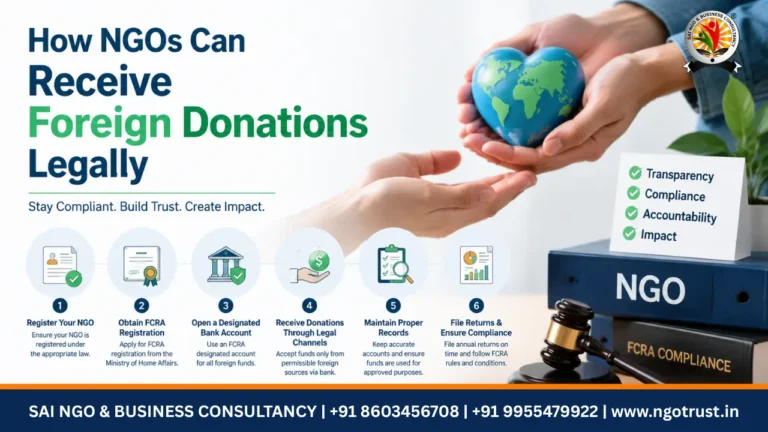
If your NGO wants to legally accept foreign donations, you must either:
- Hold a valid FCRA Registration (permanent), or
- Get FCRA Prior Permission (for a specific project from a specific donor)
Without one of these, accepting foreign contributions is a criminal offence under Section 11 of the FCRA 2010.
Who Needs FCRA Registration?
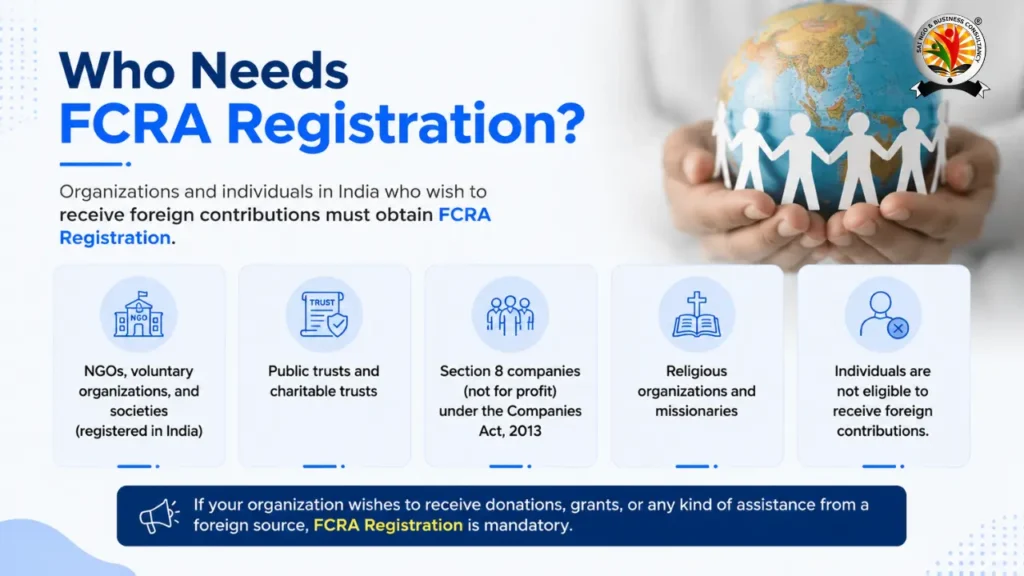
Not every organisation needs FCRA registration. But if you are a charitable trust, society, or Section 8 company in India and you want to receive funds from:
- Foreign individuals, organisations, or governments
- International NGOs or foundations based outside India
- Non-Resident Indians (NRIs) in some specific cases
- Foreign corporates or international grant-making bodies
…then yes, you need FCRA registration before you accept a single rupee.
Who Is Considered a Foreign Source?
Under the FCRA, a foreign source includes foreign governments, foreign companies, foreign citizens, international agencies, and even foreign-incorporated companies with more than 50% foreign shareholding. This definition is broader than most people realise, so it is worth checking carefully before assuming a donor does not qualify as a foreign source.
Eligibility Criteria: Can Your NGO Apply for FCRA?
Not every NGO automatically qualifies. The Ministry of Home Affairs has set clear eligibility conditions. Your organisation must:
- Be registered as a trust, society, or Section 8 company under Indian law
- Have a definite cultural, social, religious, educational, or economic purpose
- Have been in operation for at least three years
- Have spent a minimum of Rs. 15 lakh on its core activities in the last three years (excluding administrative expenses)
- Not be on the list of prohibited or unlawful associations
- Have no political affiliations or involvement in electoral activities
There are certain categories of organisations that are permanently barred from receiving foreign donations. These include members of legislature, political parties, government employees, judges, media organisations, and organisations of a political nature.
Step-by-Step: How to Apply for FCRA Registration
The application process is fully online through the FCRA Online Portal managed by the Ministry of Home Affairs. Here is how it works:
Step 1: Prepare Your Documents
Before you begin, gather the following:
- Registration certificate of your NGO (trust deed, society registration, or incorporation certificate)
- PAN card of the organisation
- Audited financial statements for the past three years
- List of office bearers and governing body members with ID proof
- Activity report showing work done in the last three years
- Details of the designated FCRA bank account (compulsorily with SBI, New Delhi Main Branch)
Step 2: Open the Designated FCRA Bank Account
This is a requirement many NGOs overlook. All foreign contributions must first be received in a designated bank account with the State Bank of India, New Delhi Main Branch (IFSC: SBIN0000691). You can later transfer funds to your utilisation account in any bank.
This rule was introduced through the FCRA Amendment 2020 and is strictly enforced.
Step 3: Register on the FCRA Portal
Go to the official FCRA Online Portal at fcraonline.nic.in and create an account. Fill in Form FC-3A (for registration) or Form FC-3B (for prior permission). Upload all required documents and pay the application fee of Rs. 10,000 online.
Step 4: Wait for Verification
The MHA will verify your application and may conduct an inquiry through the local district authority. This process typically takes 90 days, but can take longer. You will be notified of the outcome through the portal and by registered post.
Step 5: Receive Your FCRA Certificate
Once approved, you receive your FCRA registration certificate with a unique registration number. This is valid for five years and must be renewed before it expires.
What Is FCRA Prior Permission, and When Should You Use It?
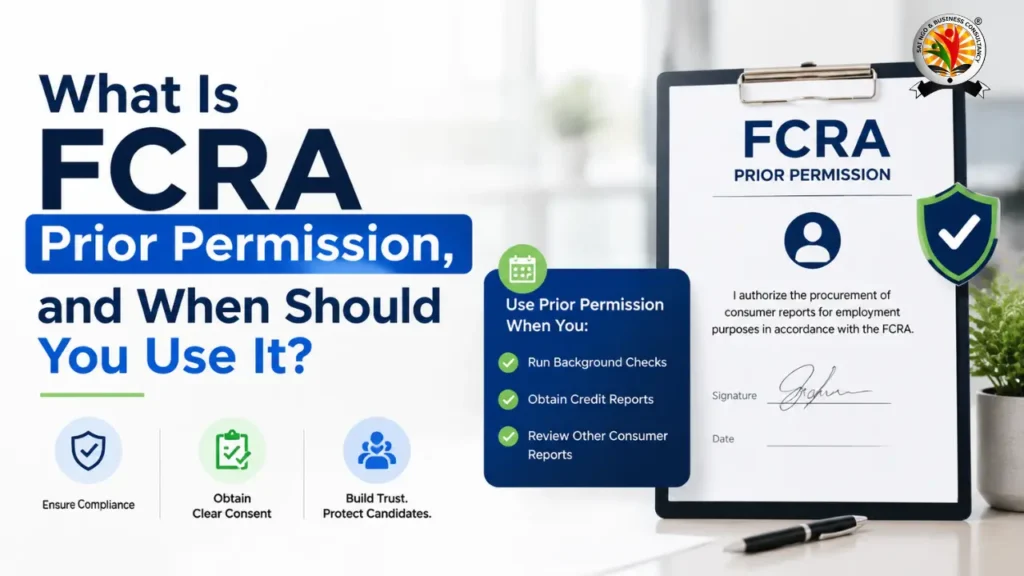
If your NGO does not yet meet the three-year eligibility requirement for full FCRA registration, you can still receive a specific foreign donation by applying for FCRA Prior Permission (Form FC-3B).
This option is for NGOs that:
- Have been registered for less than three years
- Have a specific foreign donor ready to contribute for a specific project
- Have not yet built the three-year financial track record
Prior permission is project-specific and donor-specific. You cannot use it to receive funds from any other source or for any other project. If you want to receive regular foreign contributions over time, full FCRA registration is the better route.
Ongoing Compliance: What FCRA Registered NGOs Must Do Every Year
Getting the FCRA certificate is just the beginning. Staying compliant is an ongoing responsibility. Here is what you need to do every year:
- File Annual Return (Form FC-4) within nine months of the end of the financial year via the FCRA portal
- Maintain a separate set of accounts exclusively for foreign contributions
- Ensure all foreign funds are first credited to the SBI New Delhi FCRA account
- Not use more than 20% of foreign funds for administrative expenses
- Not transfer foreign contributions to any other person or organisation without prior approval from MHA
- Intimate MHA within 15 days of any change in office bearers, address, or bank account details
- Renew your FCRA registration every five years (Form FC-3C, six months before expiry)
Failure to comply with any of these obligations can lead to suspension or cancellation of your FCRA registration. The MHA actively monitors compliance, so these are not optional formalities.
Common Mistakes NGOs Make (And How to Avoid Them)
Over the years, many well-meaning NGOs have lost their FCRA status due to avoidable errors. Here are the most common ones:
| Sr. No. | Action / Mistake | Details / Legal Note |
|---|---|---|
| 1 | Accepting foreign funds before FCRA approval | Even if it is a small amount, this is illegal. There are no exceptions. |
| 2 | Using a non-designated bank account | All incoming foreign contributions must go to the SBI New Delhi Main Branch account first. |
| 3 | Spending more than 20% on administration | This cap is strictly enforced under the FCRA Amendment 2020. |
| 4 | Not filing the annual FC-4 return on time | Late filing can lead to suspension of your FCRA status. |
| 5 | Transferring funds to another NGO without MHA permission | Sub-granting to another organisation requires prior approval. |
| 6 | Confusing NRI donations with foreign contributions | Donations from NRIs through Indian bank accounts (in Indian rupees) are generally not treated as foreign contributions, but the rules can be nuanced. |
The FCRA Amendment 2020: Key Changes That Affect You
The Foreign Contribution (Regulation) Amendment Act, 2020 made several significant changes that all NGOs must be aware of:
- Mandatory SBI New Delhi Main Branch account: All foreign contributions must go to this specific account first
- Administrative expense cap reduced: From 50% to 20% of total foreign funds received
- Prohibition on sub-granting: NGOs can no longer transfer foreign funds to other NGOs without MHA permission
- Aadhar requirement: All key office bearers must provide Aadhar details at the time of registration
These changes have had a significant impact on how NGOs manage their foreign funding operations. Many organisations had to restructure their banking and accounting processes as a result.
How Long Does the FCRA Process Take?
This is one of the most frequently asked questions. Officially, the Ministry of Home Affairs is supposed to process FCRA applications within 90 days. In practice, processing times vary based on:
- Completeness of your application and documents
- Verification by district authorities
- Volume of pending applications at MHA
- Any clarifications or additional documents requested
For most organisations, expect a realistic timeline of 3 to 6 months. Some applications have taken longer. Apply well in advance of when you need to receive funds.
Not sure if your NGO is ready to apply? A quick consultation with an NGO compliance specialist can save you months of back-and-forth with the Ministry of Home Affairs. Most application errors are avoidable with the right guidance upfront.
Frequently Asked Questions (FAQs)
Can an NGO receive foreign donations without FCRA registration?
No. Receiving foreign contributions without valid FCRA registration or prior permission is a criminal offence under the FCRA 2010. There are no exceptions, regardless of the amount or the purpose.
What is the minimum requirement to apply for FCRA registration?
Your NGO must be at least three years old, registered as a trust, society, or Section 8 company, and must have spent at least Rs. 15 lakh on its core activities (not administration) over the past three financial years.
Which bank account is mandatory for FCRA?
As per the FCRA Amendment 2020, all foreign contributions must first be credited to a designated account at the State Bank of India, New Delhi Main Branch (IFSC: SBIN0000691). You can then transfer funds to a utilisation account in any bank.
What happens if an NGO violates FCRA rules?
Violations can lead to suspension or cancellation of FCRA registration, freezing of bank accounts, and prosecution under the FCRA. In serious cases, office bearers can face imprisonment of up to five years.
How often does FCRA registration need to be renewed?
FCRA registration is valid for five years. You must apply for renewal using Form FC-3C at least six months before the expiry date.
Can a new NGO receive foreign donations?
A new NGO (less than three years old) cannot apply for full FCRA registration, but it can apply for FCRA Prior Permission for a specific donation from a specific foreign donor for a specific project.
Is CSR funding from a foreign company considered a foreign contribution?
Yes, if the CSR funds are coming from a foreign company (with more than 50% foreign shareholding), they are treated as foreign contributions and require FCRA registration to receive legally.
Can an FCRA registered NGO give money to another NGO?
After the FCRA Amendment 2020, FCRA registered NGOs can no longer transfer foreign contributions to another organisation without prior permission from the Ministry of Home Affairs.
Where to Get Help With Your FCRA Application
Navigating the FCRA process on your own is possible, but it takes time and careful attention to detail. Many NGOs make small errors in documentation or miss compliance deadlines, which can delay or derail their applications.
If you are serious about receiving foreign donations legally and building a transparent, compliant organisation, it is worth speaking to someone who has done this before. An experienced NGO consultant or legal professional can help you:
- Assess whether your NGO is ready to apply
- Prepare and organise all required documents correctly
- Set up the right banking and accounting structure
- Stay on top of annual compliance requirements
You do not need to figure this out alone. A short consultation call can often clarify months of confusion and put your organisation on the right track.
Ready to take the next step? Reach out to a qualified NGO compliance specialist today. Getting expert guidance early can make the entire process significantly smoother.
Useful Links
| Sr. No. | Resource / Portal | Description / Details | Link |
|---|---|---|---|
| 1 | FCRA Online Portal | Ministry of Home Affairs – Apply for FCRA registration and manage accounts | fcraonline.nic.in |
| 2 | Ministry of Home Affairs – FCRA Division | Official FCRA division of the Government of India | mha.gov.in |
| 3 | Foreign Contribution (Regulation) Act, 2010 | Full text of the FCRA 2010 (Official) | indiacode.nic.in – FCRA 2010 |
| 4 | FCRA Amendment Act, 2020 | Latest amendments made to FCRA legislation | indiacode.nic.in – FCRA Amendment 2020 |
| 5 | State Bank of India – FCRA Designated Branch | New Delhi Main Branch for receiving foreign contributions | sbi.co.in |
| 6 | NGO Darpan | NITI Aayog NGO Registration Portal | ngodarpan.gov.in |
| 7 | Income Tax India | Section 80G & 12A Registration for NGOs | incometax.gov.in |
| 8 | Ministry of Corporate Affairs | Section 8 Company Registration for non-profit companies | mca.gov.in |
This guide is for informational purposes only and does not constitute legal advice. Please consult a qualified legal or compliance professional for your specific situation.