
SAI NGO & BUSINESS CONSULTANCY
Expert services for NGO, Trust, Society Registration & Compliance across India.
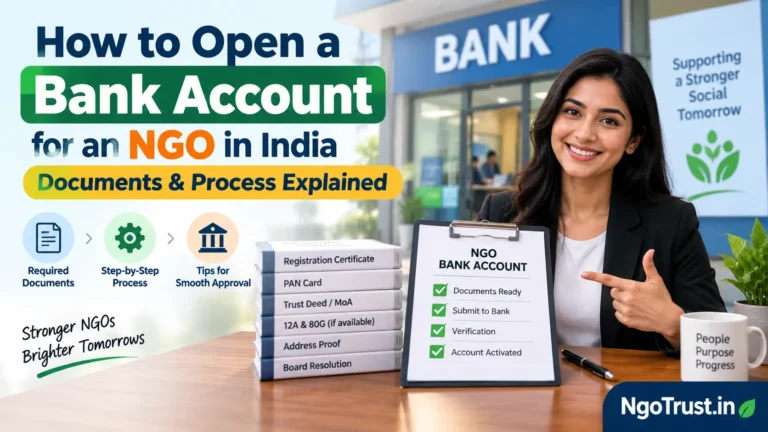
To open a bank account for an NGO in India, you need the registration certificate (Trust deed, Society registration certificate, or Section 8 incorporation certificate), the NGO’s PAN card, PAN and Aadhaar of all trustees or directors, a board resolution authorising the account, and proof of the registered office address. Most nationalised and private banks offer dedicated current accounts for NGOs, and the process usually takes 7 to 15 working days once your documents are verified.
If you have just registered a Trust, Society, or Section 8 Company, opening a bank account is one of the first practical steps you will take. It is also where a surprising number of NGOs get stuck. Banks ask for documents that founders don’t always have ready, and a small mismatch, like a spelling difference between the PAN and the registration certificate, can hold up the account for weeks.
This guide walks through exactly what you need and how the process works, so you can walk into the bank prepared instead of making three trips.
Why Your NGO Needs a Dedicated Bank Account
A personal bank account cannot be used for NGO activities, even if you are the founder. Donors, government departments, and auditors all expect funds to move through an account that is registered in the organisation’s name.
A dedicated NGO bank account matters for a few practical reasons:
- It is legally required to receive donations, grants, and CSR funds in the NGO’s name.
- It is needed to apply for 12A and 80G registration with the Income Tax Department.
- It is mandatory for FCRA registration if you plan to receive foreign contributions.
- It keeps your NGO’s finances separate from personal funds, which auditors and donors will always check.
- Banks and government portals like NGO Darpan ask for account details as part of registration and reporting.
Types of Bank Accounts an NGO Can Open
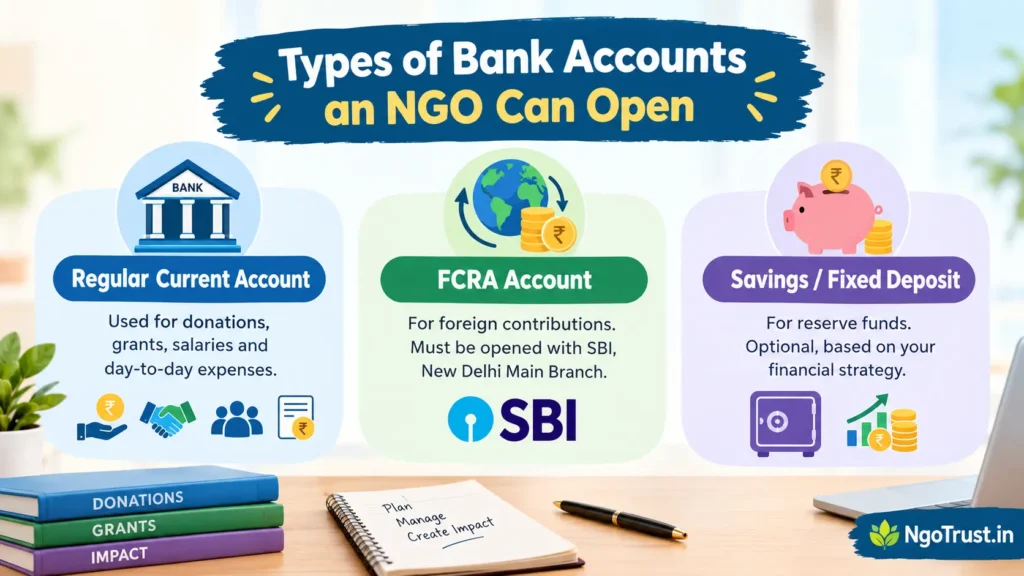
Most NGOs open a current account, since current accounts are built for regular transactions and don’t cap the number of monthly withdrawals or deposits the way savings accounts do.
Regular current account
This is your NGO’s main operating account, used for donations, grants, salaries, and day-to-day expenses.
FCRA account
If your NGO receives or plans to receive funding from outside India, the law requires a separate FCRA-designated bank account. As of now, this account must be opened with the State Bank of India, New Delhi Main Branch, and it is the only account permitted to receive foreign contributions.
Fixed deposit or savings accounts
Some NGOs also keep a savings or fixed deposit account for reserve funds, though this is optional and depends on how the organisation manages its finances.
Documents Required to Open a Bank Account for an NGO
The exact document list varies slightly by bank, but the core requirements are consistent across Trusts, Societies, and Section 8 Companies.
Common documents every NGO type will need
- Certificate of registration (Trust deed, Society registration certificate, or Certificate of Incorporation)
- PAN card in the name of the NGO
- Address proof of the registered office (electricity bill, rent agreement, or property tax receipt)
- Board resolution authorising the opening of the account and naming the authorised signatories
- PAN card and Aadhaar card of all trustees, members, or directors
- Passport-size photographs of authorised signatories
- List of trustees, governing body members, or directors on the NGO’s letterhead
Additional documents for Trusts
- Registered Trust deed, signed and stamped
- List of trustees along with their addresses
Additional documents for Societies
- Society registration certificate issued by the Registrar of Societies
- Memorandum of Association and by-laws
- List of governing body members
Additional documents for Section 8 Companies
- Certificate of Incorporation issued by the Ministry of Corporate Affairs
- Memorandum of Association (MOA) and Articles of Association (AOA)
- Board resolution passed under the Companies Act, 2013
- CIN (Corporate Identification Number) and DIN of directors
Keep both physical copies and scanned PDFs of everything. Some banks now accept part of the process online, but the physical documents are almost always verified at the branch before the account is activated.
Step-by-Step Process to Open a Bank Account for an NGO
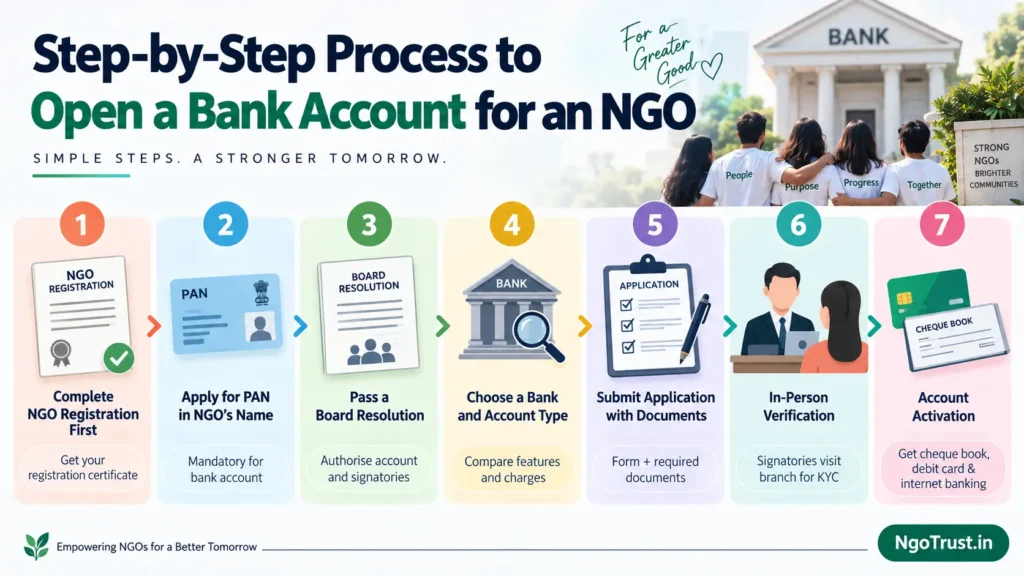
Step 1: Complete your NGO registration first
You cannot open an NGO bank account before registration is complete. The bank will ask for your registration certificate as the very first document.
Step 2: Apply for PAN in the NGO’s name
If your NGO doesn’t already have a PAN card, apply for one right after registration. Almost every bank treats this as mandatory, and you will need it again later for 12A and 80G applications.
Step 3: Pass a board resolution
The governing body or board must pass a formal resolution authorising the account and naming the people who will operate it. Most banks provide a template, but it’s worth preparing this on your NGO’s letterhead in advance.
Step 4: Choose a bank and account type
Compare a few banks before deciding. Look at minimum balance requirements, cheque book charges, online banking features, and how familiar the branch staff are with NGO accounts, since this varies a lot from branch to branch.
Step 5: Submit the application with documents
Fill out the bank’s current account opening form and submit it along with the documents listed above. Carry originals for verification along with self-attested photocopies.
Step 6: In-person verification
Most banks require the authorised signatories to visit the branch in person for KYC verification and to sign the account opening forms.
Step 7: Account activation
Once verification is complete, the bank activates the account and issues a cheque book, debit card (if applicable), and internet banking credentials.
Which Bank Should You Choose for Your NGO?
There isn’t one bank that’s right for every NGO. Public sector banks like SBI, Bank of Baroda, and Punjab National Bank tend to have branch staff who are more familiar with Trust deeds and Society documents, which can make the process smoother for a first-time applicant. Private banks like HDFC and ICICI often offer better digital banking tools and faster turnaround, but may be stricter on minimum balance requirements.
A few things worth checking before you commit to a bank:
- Minimum average balance requirement for a current account
- Whether the branch has handled NGO or Trust accounts before
- Charges for cheque books, NEFT/RTGS, and account maintenance
- Quality of net banking and mobile banking, since you’ll likely need to generate statements for auditors and donors
Common Reasons NGO Bank Account Applications Get Rejected or Delayed
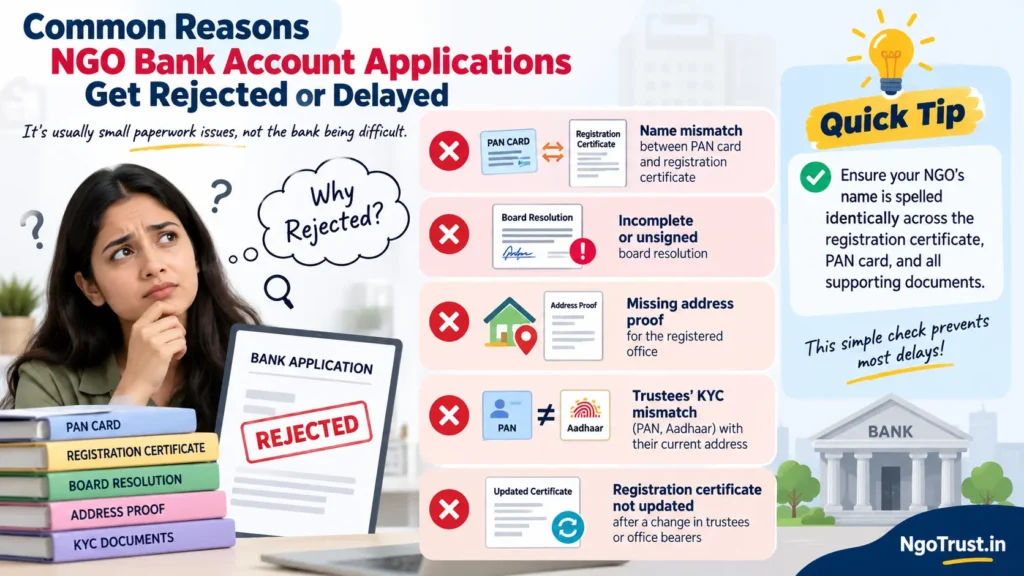
Most delays aren’t about the bank being difficult. They come down to small mismatches in paperwork.
- Name mismatch between the PAN card and the registration certificate
- Incomplete or unsigned board resolution
- Missing address proof for the registered office
- Trustees or directors whose KYC documents (PAN, Aadhaar) don’t match their current address
- Registration certificate not yet updated after a change in trustees or office bearers
Before submitting anything, double-check that the NGO’s name is spelled identically across the registration certificate, PAN card, and every supporting document. This one step prevents most of the back-and-forth.
How Long Does It Take to Open a Bank Account for an NGO?
With complete documents and no discrepancies, most banks open an NGO current account within 7 to 15 working days. FCRA accounts can take longer, since they go through additional compliance checks. If documents are incomplete or need correction, the timeline can stretch to a month or more, which is why it helps to get the paperwork right the first time.
Frequently Asked Questions
Can an unregistered NGO open a bank account?
No. Banks require a registration certificate, whether that’s a Trust deed, Society registration, or Certificate of Incorporation, before they will open an account in the NGO’s name.
Is a PAN card mandatory to open an NGO bank account?
Yes. Almost every bank requires the NGO’s PAN card as a core KYC document, and you’ll need it again for 12A, 80G, and FCRA applications later.
Can an NGO have a savings account instead of a current account?
Most banks require NGOs to open a current account for regular operations, since current accounts don’t restrict the number of transactions. Some NGOs additionally hold a savings account for reserve funds, but this is separate from the main operating account.
Do all trustees need to visit the bank in person?
Usually, only the authorised signatories named in the board resolution need to visit for KYC verification and signature, not every trustee or member.
Can an NGO open a bank account before receiving 12A and 80G registration?
Yes. A bank account is generally needed before applying for 12A and 80G, since the application process itself requires the NGO to have an active account.
Which bank is best for opening an FCRA account?
By law, the FCRA-designated bank account can only be opened at the State Bank of India, New Delhi Main Branch, regardless of where the NGO is registered.
Getting the paperwork right the first time saves weeks of back-and-forth with the bank. If you’d rather not deal with document mismatches, board resolution formats, or repeated branch visits, our team at SAI NGO & Business Consultancy helps NGOs handle registration and bank account documentation from start to finish. Feel free to reach out if you’d like a hand with it.
Useful Links
Ministry of Corporate Affairs (MCA)
FCRA Online Services, Ministry of Home Affairs