
SAI NGO & BUSINESS CONSULTANCY
Expert services for NGO, Trust, Society Registration & Compliance across India.
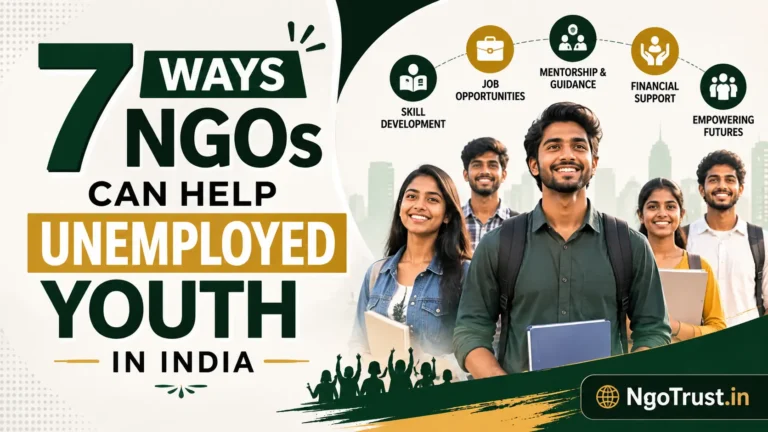
NGOs help unemployed youth in India through skill training, career counselling, job placement support, entrepreneurship guidance, digital literacy programs, financial literacy, and life skills coaching. These seven areas together help young people move from being job seekers to job holders or job creators.
India has one of the youngest populations in the world, and that should be an advantage. But for millions of young people, finding steady work is still a daily struggle. Unemployed youth in India often face a gap between what they studied and what employers actually need. This is where NGOs step in, quietly, but with real impact.
In this post, we will look at seven practical ways NGOs support unemployed youth in India, why this support matters, and how it fits into the bigger picture of youth employment in the country.
What Does “Unemployed Youth” Really Mean in India?
The term does not just mean someone without a job. It includes graduates who cannot find work that matches their qualification, young people who dropped out of school early, rural youth with limited access to training centres, and first-generation job seekers who have no family network to guide them.
According to labour data tracked by government and independent sources, youth unemployment remains higher than the national average, especially among educated young people in urban and semi-urban areas. This gap between education and employability is exactly the space NGOs try to fill.
Why Is Youth Unemployment Still a Big Problem in India?
Part of the answer is speed. India’s education system, especially in smaller towns and villages, has not kept pace with what industries need today. A young person may hold a degree in commerce or arts, yet never have practiced writing an email, sitting for a formal interview, or using a spreadsheet.
Another part is access. Good training institutes, career fairs, and internship opportunities tend to cluster in big cities. A young person from a smaller district often has the talent but not the doorway. NGOs are one of the few institutions built specifically to stand in that gap, close to where people actually live.
Family and social pressure also play a role. Many young job seekers are expected to start earning quickly, which pushes them toward the first available job rather than one that matches their ability.
Structured NGO programs give families a reason to trust a slightly longer training path, because they can see a clear plan and a track record of results.
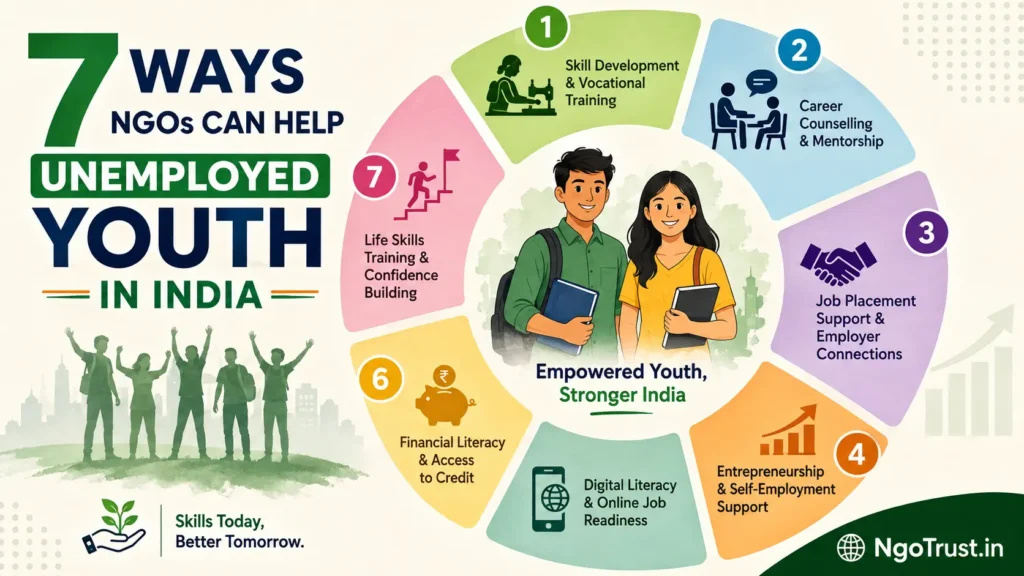
7 Ways NGOs Can Help Unemployed Youth in India
Here are the main areas where NGOs make a real difference for young job seekers.
1. Skill Development and Vocational Training
Many young people leave school or college without any hands-on, job-ready skill. NGOs run short-term vocational courses in areas like tailoring, computer basics, electrical work, retail, hospitality, and beauty and wellness.
These programs are usually free or low-cost, and they focus on skills that local industries actually need. Some NGOs also work alongside government missions such as the Skill India programme to widen their reach.
- Short, practical courses instead of long theory-heavy classes
- Certification that employers recognise
- Training centres closer to home for rural and semi-urban youth
2. Career Counselling and Mentorship
A lot of young people simply do not know what career path suits them. NGOs offer one-on-one counselling sessions where a mentor helps a young person understand their strengths, explore realistic job options, and set a step-by-step plan.
This kind of guidance is often missing in government schools, so NGO-led mentorship fills an important gap, especially for first-generation learners.
3. Job Placement Support and Employer Connections
Training alone is not enough if there is no job at the end of it. Good NGOs build relationships with local businesses, factories, and companies, and act as a bridge between trained youth and hiring employers.
Some NGOs also organise job fairs and walk-in interview drives, where dozens of employers meet hundreds of candidates in one place. This saves time for both sides and gives shy or first-time candidates a low-pressure environment to try.
4. Entrepreneurship and Self-Employment Support
Not every young person wants a salaried job, and not every local job market can absorb everyone who needs work. Many NGOs now support small business ideas through basic business training, help with loan applications, and guidance on registering a small enterprise.
This is particularly useful for youth in areas with fewer large employers, where starting a small shop, tailoring unit, or service business can be a faster path to income than waiting for a job opening.
5. Digital Literacy and Online Job Readiness
Today, even basic jobs often need some comfort with smartphones, apps, and online forms. NGOs run digital literacy classes covering email, online applications, video calls, and basic use of platforms like the National Career Service portal.
- Filling online job applications correctly
- Creating a simple resume on a phone or computer
- Attending video interviews with confidence
6. Financial Literacy and Access to Credit
Money management is rarely taught in schools. NGOs help unemployed youth understand budgeting, saving, and safe borrowing, which matters a lot for those trying to start a small business or manage their first salary.
Some NGOs also connect youth to government-backed loan schemes, so young entrepreneurs do not have to depend on informal lenders with high interest rates.
7. Building Confidence Through Life Skills Training
Technical skill is only part of the picture. Many young job seekers struggle with communication, punctuality, teamwork, or simply speaking up in an interview. NGOs run soft-skill workshops that cover interview etiquette, workplace communication, and basic professional behaviour.
This kind of training often makes the biggest difference for youth from underprivileged backgrounds, who may have the ability but lack exposure to a formal work environment.
How Do NGOs Choose Which Youth to Support First?
Most NGOs work with limited funding and staff, so they cannot reach everyone at once. A typical approach starts with a simple survey of the local area to identify young people who are out of school, out of work, and not enrolled in any training program.
- Age and education level of the candidate
- Household income and financial need
- Willingness to attend regular training sessions
- Local job demand in that particular skill area
This selection process is not about excluding anyone. It is about making sure the first batch of a new program has a strong success rate, which then builds the case for expanding to more youth in the next phase.
What Role Do CSR Funds and Government Schemes Play?
Very few NGOs run youth employment programs entirely on their own money. Corporate Social Responsibility, or CSR, funding under the Companies Act has become a major source of support for skill-training and livelihood projects, especially those aimed at unemployed youth in India.
Government schemes add another layer of support. Programs under the Ministry of Skill Development and Entrepreneurship, along with state-level missions, often partner with NGOs to run training centres, since NGOs already have the trust and local presence that a government office may lack.
For an NGO, understanding how to apply for CSR funding, and how to stay compliant with reporting requirements, is often just as important as the training content itself. Poor documentation can quietly end a good program, even when the ground work is excellent.
Why NGO Support Matters for Youth Employment in India
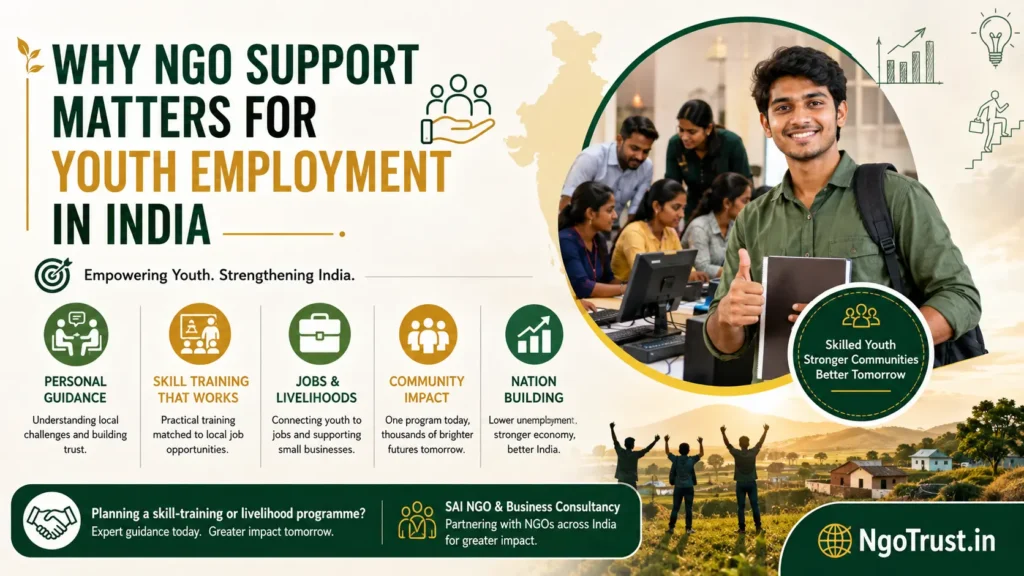
Government schemes exist, but they do not always reach every village or every family. NGOs work at the ground level, one person and one community at a time. They understand local challenges, whether that is a lack of transport, family pressure to earn quickly, or simply a fear of the unknown.
For unemployed youth in India, this personal, patient kind of support often matters as much as the training itself. It builds trust, and trust is what keeps a young person coming back to finish a course instead of giving up halfway.
Over time, this ground-level work adds up. A single well-run NGO program might place a few hundred young people into jobs or small businesses each year.
Multiply that across thousands of NGOs working in districts across India, and the impact on youth unemployment becomes far more meaningful than any single headline number can show.
If your organisation is working with young job seekers, or you are exploring how to structure a skill-training or livelihood programme, a bit of expert input at the planning stage can save a lot of time later.
Our team at SAI NGO & Business Consultancy works with NGOs across India on programme design, registration, and compliance, and we are happy to have a conversation if that would help.
Frequently Asked Questions (FAQ)
How do NGOs help unemployed youth in India?
NGOs help through free or low-cost skill training, career counselling, job placement drives, entrepreneurship support, digital and financial literacy classes, and confidence-building workshops.
Which skills do NGOs usually teach unemployed youth?
Common areas include computer basics, tailoring, retail and hospitality skills, electrical and technical trades, digital literacy, and communication or soft skills.
Can NGOs help youth start their own business instead of finding a job?
Yes. Many NGOs offer basic entrepreneurship training, help with business plans, and guidance on applying for government-backed small business loans.
Are NGO skill training programs free in India?
Most NGO-run vocational and skill programs are either free or charged at a very low fee, since many are funded through CSR contributions, donations, or government partnerships.
How can an NGO start a youth employment programme?
An NGO typically starts by assessing local job demand, tying up with training partners or employers, applying for relevant certifications or government scheme partnerships, and setting up a simple counselling and placement process.
How can CSR funding support youth unemployment programs?
Companies can direct CSR funds toward skill development and livelihood projects under the Companies Act. NGOs partner with these companies to run training centres, placement drives, and entrepreneurship support for unemployed youth.
What is the biggest challenge NGOs face while helping unemployed youth?
Limited funding, staff shortage, and reaching remote or rural youth are the most common challenges. Many NGOs also struggle to keep training aligned with fast-changing employer demand.
Useful Links
- National Career Service (NCS) portal, run by the Ministry of Labour and Employment: ncs.gov.in
- Skill India, the national skill development mission: skillindia.gov.in
- National Skill Development Corporation (NSDC): nsdc.in
- Ministry of Skill Development and Entrepreneurship (MSDE): msde.gov.in
- International Labour Organization, India office, for youth employment data: ilo.org/india
Unemployed youth in India need more than good intentions. They need structured, well-run programs that connect training to real jobs. If you are setting up or scaling an NGO focused on youth employment, we would be glad to talk through the registration, funding, and compliance side of it, whenever you are ready.