
SAI NGO & BUSINESS CONSULTANCY
Expert services for NGO, Trust, Society Registration & Compliance across India.
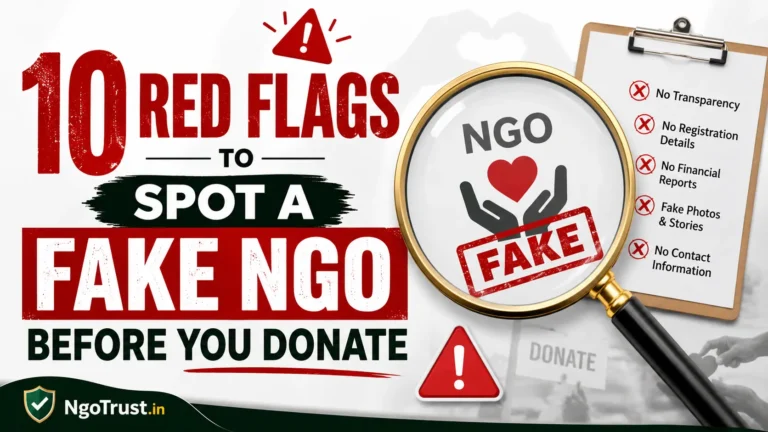
A fake NGO usually shows a mix of these signs: no registration number, no 12A or 80G certificate, refusal to share financial reports, pressure for instant cash donations, a missing or fake office address, and vague answers about how funds are used. If you notice two or more of these together, pause and verify the organisation before you donate.
A fake NGO is a group that presents itself as a nonprofit working for a social cause, but it either has no valid legal registration, misuses the money it collects, or exists mainly to gather donations without doing any real work on the ground.
Some fake NGOs are set up with fraud in mind from day one. Others start as genuine efforts but slowly stop following the rules, stop filing returns, and stop being transparent with donors. Either way, the warning signs are usually similar, and a little checking goes a long way.
Why NGO Verification Matters Before You Donate
India has lakhs of registered nonprofits, and thousands more informal groups that raise funds without any registration at all. Most people who run NGOs are doing honest, hard work. But a small number use the trust donors place in “social work” to collect money that never reaches the people it’s meant for.
Every rupee you give to a fake or poorly run NGO is a rupee that doesn’t reach a child, a farmer, a flood victim, or a patient who actually needed it. Spending two or three minutes checking an NGO’s basic details protects your money and makes sure your generosity actually helps someone.
How Can You Tell If an NGO Is Fake? 10 Red Flags to Watch For
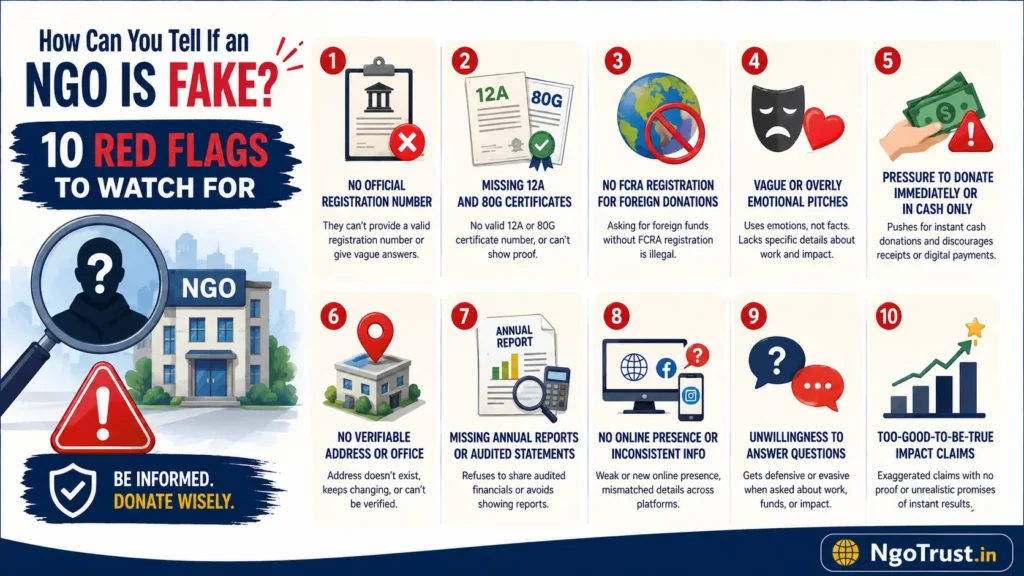
Here are the ten most common warning signs that separate a genuine, well-run NGO from one you should stay away from.
1. No Official Registration Number
Every legitimate NGO in India is registered as a Trust, a Society, or a Section 8 Company. A genuine organisation will happily share its registration number and the name of the registering authority.
If an NGO can’t tell you whether it’s registered, or gives you a vague answer like “we’re in the process,” treat that as a serious warning sign, especially if they’ve already been collecting donations for months or years.
2. Missing 12A and 80G Certificates
A 12A certificate exempts the NGO’s income from tax, and an 80G certificate lets donors claim a tax deduction on their donation. Most established, well-run NGOs hold both.
- Ask for the 12A and 80G registration numbers
- Check them on the Income Tax e-filing portal
- Be cautious of NGOs that promise an 80G receipt but can’t produce a valid certificate number
3. No FCRA Registration for Foreign Donations
If an NGO asks for donations from outside India, it legally needs FCRA (Foreign Contribution Regulation Act) registration or prior permission from the Ministry of Home Affairs. Accepting foreign funds without this is illegal, and NGOs that dodge questions about FCRA status are worth avoiding.
4. Vague or Overly Emotional Fundraising Pitches
Genuine NGOs describe their work with specific details: which village, how many children, what the budget covers, and what has been achieved so far. Fake NGOs often lean entirely on emotional photos and dramatic stories with almost no concrete information.
If a pitch makes you feel a lot but tells you very little, ask direct questions before you give.
5. Pressure to Donate Immediately or in Cash Only
Real fundraising campaigns can handle a donor who wants to think it over, ask questions, or pay by cheque or online transfer with a proper receipt. Fake NGOs often push hard for instant decisions and prefer cash, since cash is nearly impossible to trace.
- Be wary of street or door-to-door collectors who refuse to give a receipt
- Avoid organisations that discourage bank transfers or digital payments
- Never feel rushed into donating on the spot
6. No Verifiable Address or Office
A genuine NGO usually has a registered office address that you can look up, visit, or at least verify through Google Maps or local records. If the address doesn’t exist, belongs to someone unrelated, or keeps changing, that’s a strong red flag.
7. Missing Annual Reports or Audited Financial Statements
Established NGOs publish annual reports with audited financial statements showing exactly how donations were spent. Ask to see the last one or two years of reports. An organisation that refuses, delays endlessly, or gives excuses instead of documents is not being transparent with its donors.
8. No Online Presence or Inconsistent Information
A basic website, active social media, or at least a Google Business listing helps confirm an NGO is real and active. Watch out for:
- Websites with no working contact page or physical address
- Social media accounts created just weeks before a big fundraising push
- Names, registration numbers, or logos that don’t match across different platforms
9. Unwillingness to Answer Questions
A genuine NGO welcomes questions about its work, funding, and impact, because it has real answers. If asking simple questions makes a fundraiser defensive, evasive, or annoyed, that reaction alone tells you something important.
10. Too-Good-to-Be-True Impact Claims
Be cautious of NGOs claiming they’ve “helped one million people” with a tiny team and no verifiable projects, or promising unrealistic outcomes like guaranteed job placements or instant poverty elimination. Real social change is usually slower, more specific, and easier to verify than these claims suggest.
How to Verify an NGO Before You Donate: A Quick Checklist
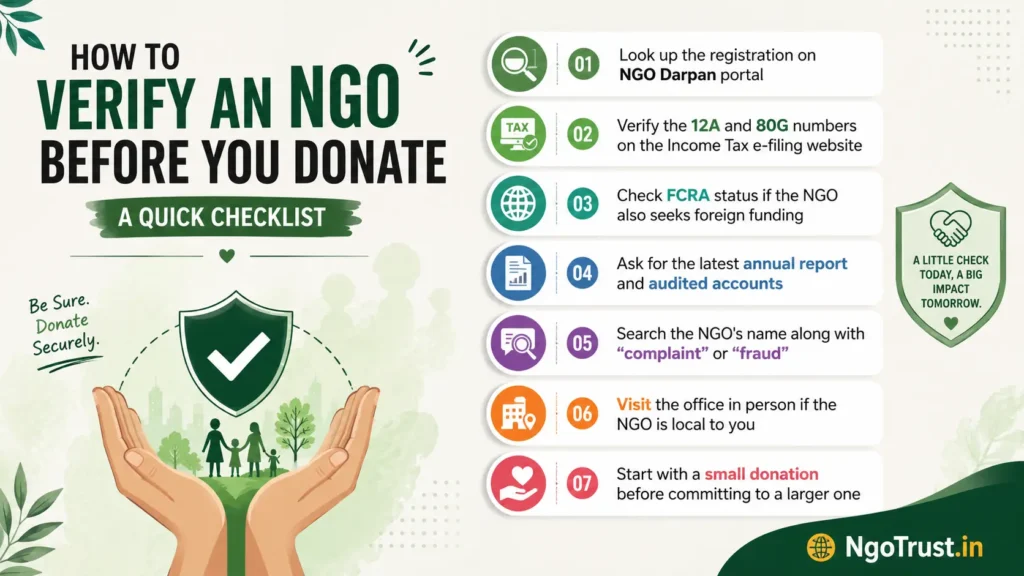
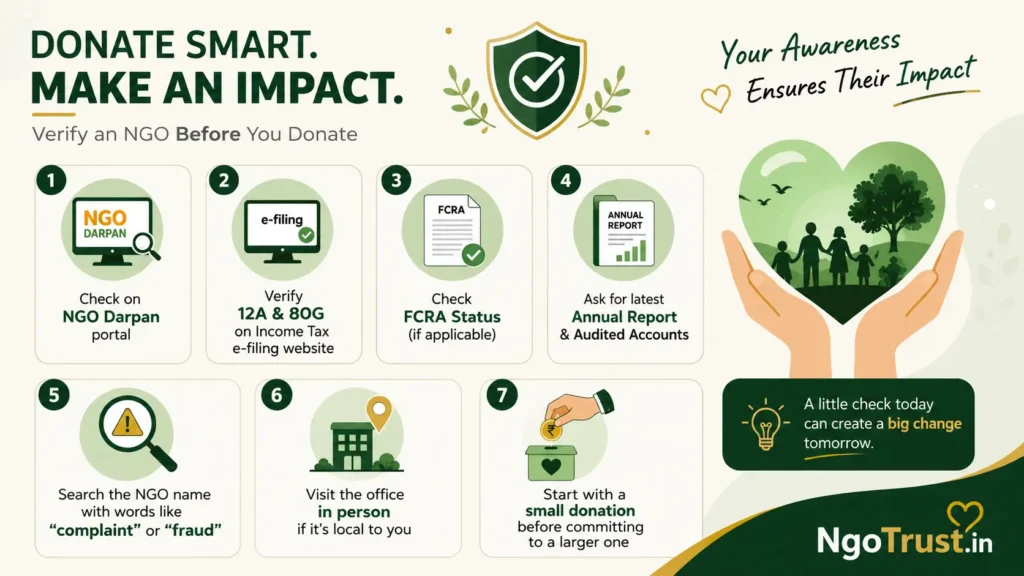
Before you donate, especially for a larger amount, run through this quick checklist:
- Look up the registration on the NGO Darpan portal
- Verify the 12A and 80G numbers on the Income Tax e-filing website
- Check FCRA status if the NGO also seeks foreign funding
- Ask for the latest annual report and audited accounts
- Search the NGO’s name along with words like “complaint” or “fraud”
- Visit the office in person if the NGO is local to you
- Start with a small donation before committing to a larger one
What to Do If You Suspect an NGO Is Fake
If something feels off, trust that instinct and dig a little deeper.
- Do not donate cash, and do not share personal or banking details
- Ask for written proof of registration, 12A, 80G, and FCRA status
- Report suspicious fundraising to local police or the Ministry of Corporate Affairs
- Warn friends and family if you’ve confirmed the organisation is not genuine
A Word for NGOs Reading This: Trust Is Built on Compliance
If you run an NGO and this list made you a little uneasy about your own paperwork, you’re not alone. Many honest organisations lose donor trust simply because their registration, 12A, 80G, or FCRA compliance is incomplete or outdated, not because anything is wrong with their work.
Getting these fundamentals right is one of the simplest ways to reassure donors and unlock more consistent funding. If you’d like a straightforward review of where your NGO stands on registration and compliance, the team at SAI NGO & Business Consultancy is happy to walk you through it, no pressure, just a clear picture of what’s in place and what needs attention.
Frequently Asked Questions
How can I check if an NGO is registered in India?
You can check an NGO’s registration status on the NGO Darpan portal run by NITI Aayog, which lists registration details for Trusts, Societies, and Section 8 Companies across India.
What is the difference between 12A and 80G certificates?
A 12A certificate exempts the NGO itself from paying income tax on its earnings. An 80G certificate lets the donor claim a tax deduction on the amount they donate. Both are issued by the Income Tax Department, and genuine NGOs are usually able to share both numbers.
Can I get a tax deduction for donating to any NGO?
No. You can only claim a tax deduction under Section 80G if the NGO holds a valid, current 80G certificate. Donating to an unregistered or non-80G organisation does not qualify for a deduction, even if you receive a receipt.
What is FCRA registration and why does it matter?
FCRA registration allows an NGO to legally receive donations from foreign sources. It matters because accepting foreign funds without FCRA registration or prior permission is illegal under Indian law, and NGOs that skip this step around international donors should be approached with caution.
How do I report a fake or fraudulent NGO?
You can file a complaint with your local police station, report suspected FCRA violations to the Ministry of Home Affairs, or flag registration-related concerns to the Ministry of Corporate Affairs, depending on how the NGO is structured.
Are all small or new NGOs fake?
No. Many small and newly registered NGOs are completely genuine and simply haven’t built a large presence yet. Age and size are not reliable indicators on their own, always check registration, certificates, and financial transparency instead of judging by how big or well-known an NGO is.
Useful Links
- NGO Darpan Portal
- Income Tax India e-Filing Portal
- FCRA Online Services, Ministry of Home Affairs
- Ministry of Corporate Affairs (Section 8 Companies)
- SAI NGO & Business Consultancy, NGO Registration & Compliance Help