


SAI NGO & BUSINESS CONSULTANCY
Expert services for NGO, Trust, Society Registration & Compliance across India.
Allotment of shares is the formal process by which a company creates and issues new shares to applicants. It is the first step in turning a share application into an actual shareholding. Under the Companies Act, 2013 (India), allotment must follow a specific legal procedure to be valid.
If you are starting a company, raising funds, or bringing in new investors, you will eventually deal with the allotment of shares. It sounds straightforward, but a small procedural error can have serious legal consequences. Companies have faced penalties, invalid fundraising rounds, and even shareholder disputes just because the allotment was not done correctly.
This guide breaks down everything you need to know about the share allotment process, in plain language. No confusing legal jargon, just clear steps, real risks, and practical guidance.
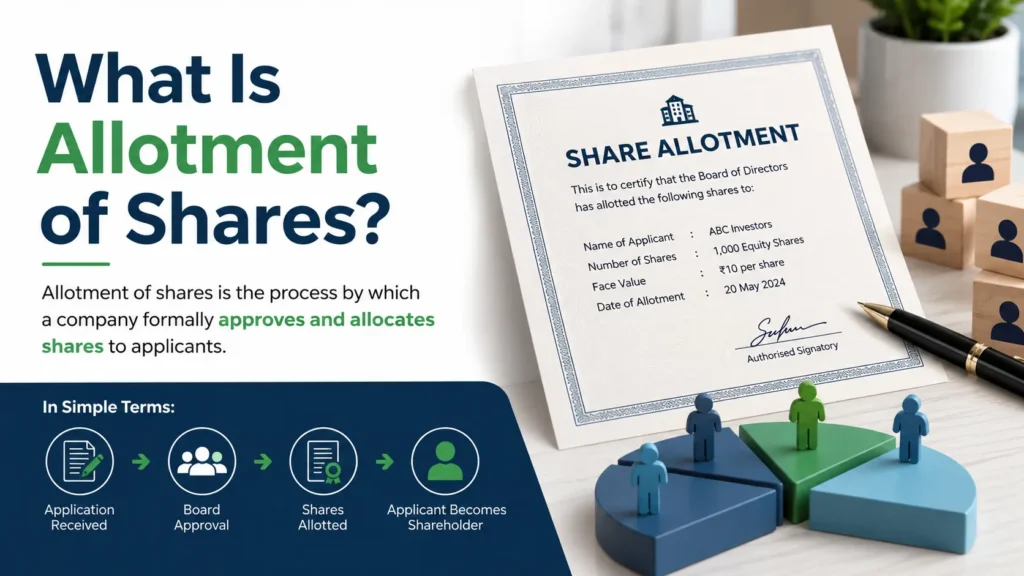
Allotment of shares is a company’s official response to a share application. When someone applies for shares, the company reviews the application and then formally assigns a specific number of shares to that person. That assignment is called allotment.
Think of it this way: applying for shares is like placing an order. Allotment is the company confirming that order and handing over ownership.
This process applies to:
- Private limited companies raising equity from investors
- Public companies doing an IPO or rights issue
- Startups issuing shares to co-founders or ESOP participants
- Any company increasing its share capital
The short answer: anyone involved in running or investing in a company. Specifically, this topic is important for:
- Founders and promoters who are structuring equity among co-founders or early investors
- CFOs and company secretaries who are responsible for filing compliance documents
- Angel investors and VCs who want to confirm their shares are legally allotted after funding rounds
- HR and legal teams managing employee stock option plans (ESOPs)
- Startup advisors and consultants guiding early-stage companies through fundraising
Not all allotments are the same. The type of allotment depends on who the shares are being issued to and the reason for the issuance.
| Type of Allotment | Description | Key Features |
|---|---|---|
| 1. Initial Allotment | This happens at the time of company incorporation. | The subscribers to the memorandum of association receive shares as the first allotment. |
| 2. Allotment During Fundraising | When a private limited company receives investment from angel investors, seed funds, or venture capital firms, the company allots new shares in exchange for the investment. | This is one of the most common scenarios in the startup ecosystem. |
| 3. Rights Issue | Existing shareholders are offered additional shares in proportion to their current holdings. | Shareholders have the right, but not the obligation, to subscribe to the additional shares. |
| 4. Bonus Issue | Free shares are given to existing shareholders from the company’s reserves. | No money changes hands. It is essentially a process of capitalising profits. |
| 5. Preferential Allotment | Shares are issued to a specific group of people, such as strategic investors or promoter groups. | The shares may be issued at a price different from market rates. This is common in listed companies as well. |
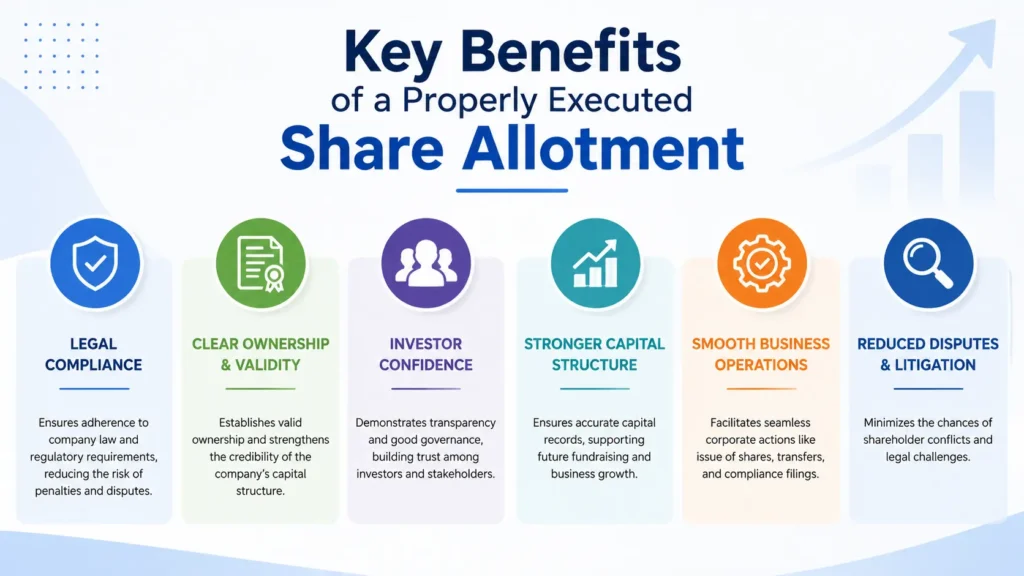
Getting the allotment of shares right is not just a legal checkbox. It has real, tangible benefits for your business:
- Legal ownership is clear and protected. Once shares are allotted, there is no ambiguity about who owns what. This prevents future disputes among shareholders.
- Enables clean fundraising. Investors expect proper allotment documentation before transferring funds. A clean cap table backed by legal allotment records builds investor confidence.
- Supports valuation. Properly allotted shares make it easier to value the company, especially during due diligence for further rounds of funding.
- Compliance avoids penalties. The Companies Act, 2013 requires filing of Form PAS-3 (Return of Allotment) within 30 days of allotment. Missing this deadline attracts fines.
- ESOP plans become valid. Employee share option plans only have teeth if the underlying shares are properly allotted. Good allotment records protect both the company and the employees.
- Strengthens corporate governance. Transparent allotment processes build trust with all stakeholders, including auditors, banks, and regulators.
Here is a practical walkthrough of how the share allotment process works under the Companies Act, 2013:
| Step | Process | Details | Important Notes |
|---|---|---|---|
| Step 1 | Pass a Board Resolution | The company’s Board of Directors must pass a resolution approving the allotment. | The resolution should clearly state the number of shares, type of shares, allottees, and price per share. |
| Step 2 | Check the Authorised Share Capital | Before allotting shares, make sure the company’s authorised share capital is sufficient to accommodate the new shares. | If the authorised share capital is insufficient, the company must increase it first by passing a special resolution and filing Form SH-7. |
| Step 3 | Issue a Letter of Offer (if applicable) | For certain types of allotment, such as rights issues, a formal letter of offer must be sent to existing shareholders. | The letter should include complete details of the issue. |
| Step 4 | Receive Applications and Application Money | Collect share application forms and application money from allottees. | The application money should be kept in a separate bank account until the allotment process is completed. |
| Step 5 | Pass a Resolution for Allotment | The Board of Directors must pass another resolution to formally allot shares to the applicants. | This resolution finalises the allotment in favour of specific applicants. |
| Step 6 | File Form PAS-3 with the MCA | Within 30 days of allotment, the company must file the Return of Allotment using Form PAS-3 on the Ministry of Corporate Affairs (MCA) portal. | Attach the list of allottees and a copy of the board resolution along with the form. |
| Step 7 | Issue Share Certificates | Under Section 56 of the Companies Act, 2013, share certificates must be issued to allottees. | Share certificates must be issued within 60 days from the date of allotment. |
| Step 8 | Update the Register of Members | The company must update its Register of Members after the allotment process. | The register should reflect the names of the new shareholders and their updated shareholding details. |
These are the errors that come up most frequently, especially in early-stage companies and startups:
- Missing the PAS-3 filing deadline. Many founders do not realise that Form PAS-3 must be filed within 30 days of allotment. Late filing attracts penalties and can complicate future audits.
- Not checking authorised capital first. Allotting shares beyond the authorised share capital is legally void. Always verify headroom before proceeding.
- Verbal agreements instead of board resolutions. Handshake deals are not enough. Every allotment must be backed by a properly documented board resolution.
- Incorrect valuation in private placements. Under Section 42 and Section 62 of the Companies Act, 2013, shares must be priced based on a registered valuer’s report for certain types of allotment. Ignoring this can invite regulatory scrutiny.
- Skipping the Register of Members update. Allotment without updating the register creates practical problems during future fundraising, due diligence, or transfer of shares.
- Issuing share certificates late. Delays beyond 60 days in issuing certificates can lead to penalties.
- Not distinguishing between types of allotment. Using the wrong procedure for preferential allotment versus a rights issue, for example, can make the entire process non-compliant.
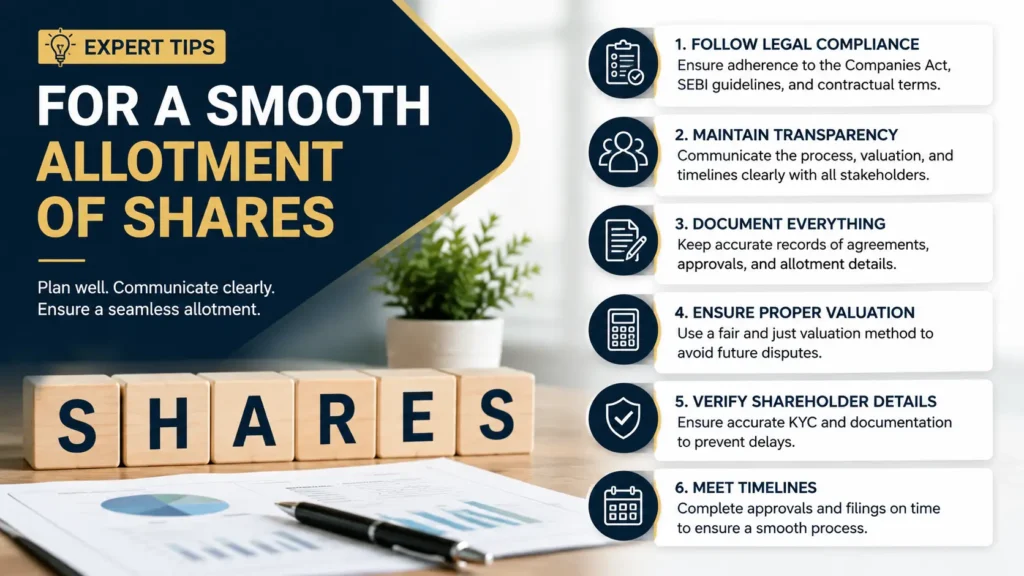
These are practical tips from company law professionals and seasoned startup advisors:
- Always appoint a qualified Company Secretary (CS) before initiating any allotment. A CS understands the procedural nuances and keeps filings on track.
- Maintain a cap table from day one. A clear capitalisation table showing who owns what, post every allotment round, is invaluable during investor negotiations.
- Use a shareholders’ agreement alongside allotment. Allotment creates shares, but a well-drafted shareholders’ agreement governs how those shares can be transferred, voted upon, or exited.
- Keep all board meeting minutes and resolutions neatly filed. Auditors and investors will ask for these during due diligence.
- For foreign investors, FEMA (Foreign Exchange Management Act) compliance is essential. Allotment to non-residents must follow RBI guidelines, including filing FC-GPR forms within 30 days of receiving consideration.
- If in doubt about valuation for allotment pricing, always get a formal report from a SEBI-registered valuer. This is not optional for many types of allotment.
- Review your articles of association before every allotment. Some articles place restrictions on share issuance that can make an allotment invalid if not followed.
If you want to read the source laws yourself, here are the most relevant provisions:
| Section / Rule | What It Covers |
|---|---|
| Section 39 | Public offer of shares and minimum subscription requirements. |
| Section 40 | Securities to be dealt in stock exchanges. |
| Section 42 | Private placement of shares. |
| Section 56 | Transfer and transmission of securities, including share certificate issue timelines. |
| Section 62 | Further issue of share capital and rights issues. |
| Form PAS-3 | Return of allotment to be filed with the MCA within 30 days. |
| FEMA / FC-GPR | Foreign investment allotment compliance under RBI guidelines. |
Frequently Asked Questions (FAQ)
What is the difference between issue of shares and allotment of shares?
The issue of shares is a broader term that refers to the entire process of making shares available to the public or specific individuals. Allotment is a specific step within that process where the company formally assigns shares to an applicant. You cannot have allotment without an issue, but an issue process is not complete without allotment.
How many days do you have to file Form PAS-3 after allotment?
Form PAS-3 (Return of Allotment) must be filed with the Ministry of Corporate Affairs (MCA) within 30 days from the date of allotment. Delays attract late fees and penalties under the Companies Act, 2013.
Can a private limited company allot shares to the public?
No. A private limited company is legally prohibited from making a public offer of shares. It can only allot shares through private placement to a maximum of 200 individuals in a financial year (excluding QIBs and employees under ESOP).
Is a board resolution mandatory for allotment of shares?
Yes, a board resolution is a mandatory prerequisite for any valid allotment of shares. Without a properly passed and recorded board resolution, the allotment has no legal standing.
What happens if shares are allotted without following proper procedure?
An irregular allotment can be declared void by a court or tribunal. It can also expose directors to personal liability, trigger regulatory penalties, and complicate future fundraising rounds or M&A transactions.
Can shares be allotted for consideration other than cash?
Yes. Shares can be allotted for non-cash consideration such as intellectual property, assets, services, or conversion of debt. However, the valuation of such consideration must be done by a registered valuer and the procedures must be followed carefully.
What is a preferential allotment in a listed company?
In a listed company, a preferential allotment refers to issuing shares to a specific group of investors, promoters, or entities at a pre-determined price. This is governed by SEBI (Issue of Capital and Disclosure Requirements) Regulations, 2018, and requires shareholder approval via special resolution.
The allotment of shares is one of those areas where the details really matter. A missed filing, an incorrect resolution, or a procedural shortcut can create problems that take months to unravel. If you are in the middle of a funding round, setting up an ESOP, or onboarding a new shareholder, it is always worth speaking to a qualified professional before you proceed.
If you would like guidance specific to your company’s situation, feel free to book a consultation with our team. We help founders, CFOs, and growing businesses get their compliance right the first time.
Useful Links
All official and reference sources mentioned in or relevant to this post:
| Resource | Description | Official Link |
|---|---|---|
| Ministry of Corporate Affairs (MCA) | Official government portal for company law compliance, filings, and corporate services in India. | Visit MCA Portal |
| MCA Form PAS-3 Filing Guidelines | Official filing guidelines and forms related to Return of Allotment (PAS-3). | View PAS-3 Guidelines |
| Companies Act, 2013 – Full Text | Complete official text of the Companies Act, 2013 issued by the Government of India. | Read Companies Act, 2013 |
| SEBI ICDR Regulations 2018 | SEBI regulations covering preferential allotment rules, disclosure requirements, and issue of capital. | View SEBI ICDR Regulations |
| RBI – FEMA Guidelines for Foreign Investment (FC-GPR) | RBI guidelines relating to foreign investment reporting and FEMA compliance, including FC-GPR filing requirements. | Read RBI FEMA Guidelines |
| ICSI – Institute of Company Secretaries of India | Official website of ICSI providing professional guidance, compliance resources, and company law updates. | Visit ICSI Website |
| Startup India | Government of India initiative offering resources, recognition, and support for startups and founders. | Visit Startup India |