

SAI NGO & BUSINESS CONSULTANCY
Expert services for NGO, Trust, Society Registration & Compliance across India.
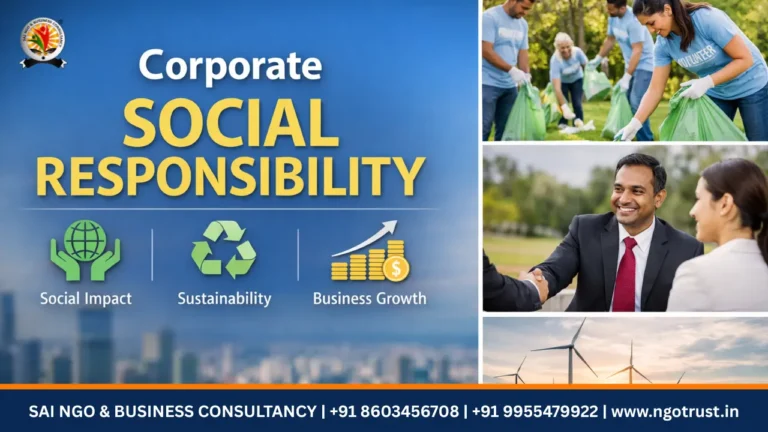
Businesses today are expected to do more than just make a profit. They are expected to care — about people, the environment, and the communities they operate in. That expectation has a name: Corporate Social Responsibility, or CSR.
But what exactly does it mean? Why does it matter so much? And how can your business actually practice it in a way that makes a real difference?
This guide breaks it all down — clearly, practically, and without the jargon.
What Is Corporate Social Responsibility?
The corporate social responsibility meaning, at its core, is simple: it is a business’s commitment to operate in a way that benefits society, not just its shareholders.
The World Business Council for Sustainable Development defines CSR as a company’s commitment to contribute to sustainable economic development by working with employees, their families, the local community, and society at large to improve their quality of life.
In plain terms, CSR is about asking: “As a business, what kind of impact are we making — and can we make it better?”
This goes beyond writing a charity cheque once a year. It means weaving responsible practices into the everyday fabric of how a business operates — from how it treats employees to how it sources raw materials, manages waste, and communicates with the public.
Who Needs CSR?
The short answer: every business. But CSR is especially critical for:
- Large corporations with significant environmental or social footprints
- Companies in regulated industries like manufacturing, energy, and finance
- Startups and SMEs looking to build a brand people trust from day one
- Businesses seeking investment, as ESG (Environmental, Social, Governance) criteria now heavily influence investor decisions
Whether you run a 10-person agency or a multinational enterprise, CSR is no longer optional — it is expected.
Types of Corporate Social Responsibility
Understanding the types of corporate social responsibility helps businesses figure out where to focus first. The four widely recognised categories are:
| Type | Description |
|---|---|
| 1. Environmental Responsibility | This focuses on reducing a company’s environmental impact. It includes cutting carbon emissions, reducing waste, using renewable energy, and improving corporate social responsibility and environmental management practices. Companies like Patagonia and IKEA are well-known for their environmental CSR commitments. |
| 2. Ethical Responsibility | Ethical CSR ensures a business operates fairly and honestly. This covers fair wages, humane working conditions, transparent supply chains, and anti-corruption policies. |
| 3. Philanthropic Responsibility | This involves giving back — through donations, volunteering, sponsoring education, or supporting community development initiatives. It is the most visible form of CSR, though not necessarily the most impactful on its own. |
| 4. Economic Responsibility | Economic CSR means operating profitably in a way that is also good for society. This includes paying fair taxes, creating jobs, supporting local suppliers, and investing in employee development. |
| Balancing all four types is where the real power of CSR lies. | |
Corporate Social Responsibility Models
Different frameworks guide how businesses approach CSR. Here are the most widely used corporate social responsibility models:
| Model / Framework | Description |
|---|---|
| Carroll’s Pyramid of CSR | One of the most cited models, it arranges responsibilities in a pyramid — economic, legal, ethical, and philanthropic — with economic responsibility forming the base. |
| Stakeholder Theory (Freeman) | This model argues that businesses are accountable not just to shareholders, but to all stakeholders — employees, customers, suppliers, and communities. |
| Triple Bottom Line (Elkington) | Encourages businesses to measure success across three dimensions: People, Planet, and Profit. |
| ISO 26000 | An international standard providing guidance on social responsibility, covering human rights, labour practices, the environment, and community involvement. |
| ESG Framework | Increasingly used by investors, ESG evaluates companies on Environmental, Social, and Governance criteria. |
The Key Benefits of Corporate Social Responsibility
The benefits of corporate social responsibility are both tangible and long-lasting. Here is what businesses consistently gain from genuine CSR commitment:
| Benefit | Description |
|---|---|
| Stronger brand reputation | Consumers increasingly choose brands that align with their values. CSR builds the trust and goodwill that advertising cannot buy. |
| Customer loyalty and retention | People stick with companies they believe are doing good. A Nielsen study found that 66% of global consumers are willing to pay more for sustainable products. |
| Attract and retain top talent | Employees — especially younger generations — want to work for companies with purpose. CSR improves recruitment and reduces staff turnover. |
| Investor appeal | ESG performance is now a core consideration for many institutional investors. Strong CSR credentials can open doors to new funding. |
| Risk reduction | Proactively managing social and environmental risks reduces legal exposure, regulatory fines, and reputational crises. |
| Operational efficiency | Sustainable practices like reducing energy consumption or cutting waste often lead directly to cost savings. |
| Community goodwill | Local communities are more likely to support businesses that invest in them, making expansion and operations smoother. |
| Regulatory compliance | Good CSR practices often align with — and sometimes get ahead of — legal requirements. |
CSR is not just the right thing to do. It is also the smart business decision.
Corporate Social Responsibility in Company Law
The legal dimension of CSR is growing. Corporate social responsibility in company law has evolved significantly, particularly in countries like India, where the Companies Act, 2013 made CSR spending mandatory for certain companies.
Under Section 135 of the Indian Companies Act, companies with a net worth of INR 500 crore or more, turnover of INR 1,000 crore or more, or net profit of INR 5 crore or more are legally required to spend at least 2% of their average net profits on CSR activities.
In the UK, the Companies Act 2006 requires large companies to report on environmental and social matters in their strategic reports. The EU’s Corporate Sustainability Reporting Directive (CSRD), effective from 2024, requires large companies and listed SMEs to report on sustainability matters.
For businesses operating globally, understanding the legal CSR landscape in each jurisdiction is critical. Organisations like the UN Global Compact and the Global Reporting Initiative (GRI) provide widely recognised frameworks for CSR reporting.
CSR and Environmental Management
Of all the areas within CSR, environmental management is among the most urgent. Corporate social responsibility and environmental management are increasingly treated as inseparable — and for good reason.
Climate change, resource depletion, and pollution are no longer distant threats. Businesses are directly contributing to — and can directly help solve — these challenges.
Key environmental CSR practices include:
- Setting science-based emissions reduction targets
- Conducting regular environmental impact assessments
- Adopting circular economy principles to reduce waste
- Transitioning to renewable energy sources
- Implementing supply chain sustainability audits
- Reporting transparently through frameworks like the CDP (Carbon Disclosure Project)
The UN Sustainable Development Goals (SDGs) — particularly SDG 13 (Climate Action) and SDG 12 (Responsible Consumption) — are increasingly used as a compass for corporate environmental strategy.
Real-World Corporate Social Responsibility Examples
Nothing explains CSR better than seeing it in action. Here are some standout corporate social responsibility examples from companies doing it well:
- Microsoft: Has pledged to become carbon negative by 2030 and to remove all historical carbon emissions by 2050. Their AI for Good initiative uses technology to address humanitarian challenges.
- Unilever: Their Sustainable Living Plan set targets across 67 social and environmental performance indicators. They work to improve livelihoods across their supply chain and reduce environmental footprint per product.
- Tata Group (India): One of the oldest examples of CSR in practice, Tata has long invested in education, healthcare, and rural development through Tata Trusts.
- Ben & Jerry’s: Integrates activism into its business model — from sourcing fair trade ingredients to vocal campaigns on social justice issues.
- LEGO: Committed to making all products from sustainable materials by 2030 and has invested heavily in renewable energy.
These examples show that CSR is not a one-size-fits-all exercise. The most effective strategies are those tailored to the company’s values, industry, and stakeholder needs.
Practical Steps to Build a CSR Strategy
If you are ready to take CSR seriously, here is a practical roadmap to get started:
| Step | Description |
|---|---|
| Assess your current impact | Conduct a CSR audit. What are your current environmental, social, and governance practices? Where are the gaps? |
| Engage your stakeholders | Talk to employees, customers, suppliers, and community representatives. Find out what matters most to the people your business affects. |
| Set clear, measurable goals | Vague intentions do not create change. Set SMART CSR goals — specific, measurable, achievable, relevant, and time-bound. |
| Integrate CSR into your business model | CSR should not be a department — it should be embedded in procurement, HR, operations, and finance decisions. |
| Choose the right framework | Decide which CSR model fits your business — whether Carroll’s Pyramid, Triple Bottom Line, or ESG — and align your reporting accordingly. |
| Report transparently | Publish a CSR or sustainability report. Platforms like GRI Standards and the UN Global Compact make this straightforward. |
| Review and improve | CSR is a journey, not a destination. Conduct annual reviews, update your targets, and celebrate progress with your team. |
Common CSR Mistakes to Avoid
Even well-intentioned companies get CSR wrong. Watch out for these common pitfalls:
- Greenwashing: Making vague or exaggerated environmental claims without evidence. Consumers and regulators are increasingly skilled at spotting it — and the backlash can be severe.
- Treating CSR as a PR exercise: If CSR is driven purely by marketing goals rather than genuine values, it will feel hollow to employees and customers alike.
- Ignoring your own backyard: Many companies donate to global causes while neglecting their own employees’ wellbeing or the local communities in which they operate.
- Setting goals without accountability: CSR targets without clear ownership, timelines, or reporting mechanisms rarely get achieved.
- Failing to involve employees: CSR programmes work best when employees feel personally connected to them. Top-down mandates without employee input often fall flat.
- Copying competitors blindly: What works for another company may not fit yours. CSR must be authentic and aligned with your specific business context and values.
Expert Tips for Effective CSR
- Start small and build credibility: You do not need to solve global poverty to have meaningful CSR. Start with one focused initiative, do it well, and expand from there.
- Align CSR with your core business: The most powerful CSR strategies leverage what the company already does. A logistics firm reducing carbon in its fleet is far more credible than sponsoring an unrelated charity.
- Make data your foundation: Use clear metrics to track impact. What gets measured gets improved — and gets communicated credibly to stakeholders.
- Partner strategically: NGOs, academic institutions, and government bodies can extend your CSR impact significantly. Look for partnerships where both parties bring distinct value.
- Communicate honestly: Share not just your wins but your challenges. Transparent reporting — including missed targets — builds more trust than polished success stories.
- Embed CSR into leadership KPIs: When senior leaders are held accountable for CSR outcomes, it signals that the organisation takes it seriously.
Ready to Build a CSR Strategy That Actually Works?
Corporate social responsibility is not a box to tick. It is an ongoing commitment to doing business in a way that creates value — for your company, your people, and the world around you.
The good news: you do not have to figure it all out alone.
Whether you are starting from scratch or looking to strengthen an existing CSR framework, working with experienced advisors can help you avoid costly mistakes, align your strategy with legal requirements, and communicate your impact with confidence.
If you would like to explore how to build a meaningful, legally compliant, and results-driven CSR programme for your organisation, we would be glad to help. Feel free to get in touch for a no-obligation conversation.
Useful Links
| Organization / Framework | Official Website |
|---|---|
| UN Global Compact | Visit Website |
| Global Reporting Initiative (GRI) | Visit Website |
| UN Sustainable Development Goals (SDGs) | Visit Website |
| ISO 26000 (Social Responsibility Standard) | Visit Website |
| Carbon Disclosure Project (CDP) | Visit Website |
| European Commission — Corporate Sustainability Reporting Directive (CSRD) | Visit Website |
| Patagonia CSR & Environmental Initiatives | Visit Website |
| Microsoft CSR & Sustainability Report | Visit Website |
| Unilever Sustainable Living Plan | Visit Website |
| Tata Trusts | Visit Website |