
SAI NGO & BUSINESS CONSULTANCY
Expert services for NGO, Trust, Society Registration & Compliance across India.
If you’re planning to start a food business in India — whether it’s a home kitchen, a restaurant, or a large manufacturing unit — there’s one thing you absolutely cannot ignore: your FSSAI food license.
Many food entrepreneurs jump straight into sourcing ingredients, designing menus, and marketing their brand. But without proper licensing in place, all that hard work can come to a sudden halt — or worse, attract hefty penalties. This guide breaks it all down for you in plain, simple language.
What Is an FSSAI Food License?
FSSAI stands for the Food Safety and Standards Authority of India. It is the government body responsible for regulating and supervising food safety across the country, operating under the Ministry of Health and Family Welfare.
An FSSAI food license (or FSSAI registration) is a legal requirement for anyone involved in the manufacture, storage, transportation, distribution, or sale of food products in India. When you get licensed, you receive a unique 14-digit registration number that must be displayed on your food products and premises.
Think of it as your food business’s official permission slip — it tells your customers, suppliers, and authorities that your operations meet the national standards for food safety.
Who Needs an FSSAI Food License?
Almost every food business operator (FBO) in India needs some form of FSSAI registration or license. This includes:
- Restaurants, cafes, dhabas, and food stalls
- Home-based food businesses and cloud kitchens
- Food manufacturers and processors
- Importers and exporters of food products
- Wholesale and retail food traders
- Food distributors and transporters
- E-commerce food businesses and aggregators
- Hotels, caterers, and canteen operators
Even if you’re selling homemade pickles on Instagram or running a tiffin service from your home — if food is involved and money is changing hands, you likely need to be registered.
Types of FSSAI License in India
FSSAI doesn’t follow a one-size-fits-all approach. There are three categories based on the size and nature of your business:
- Basic Registration — For small or petty food businesses with an annual turnover of up to ₹12 lakhs. This includes small retailers, hawkers, and home-based food producers.
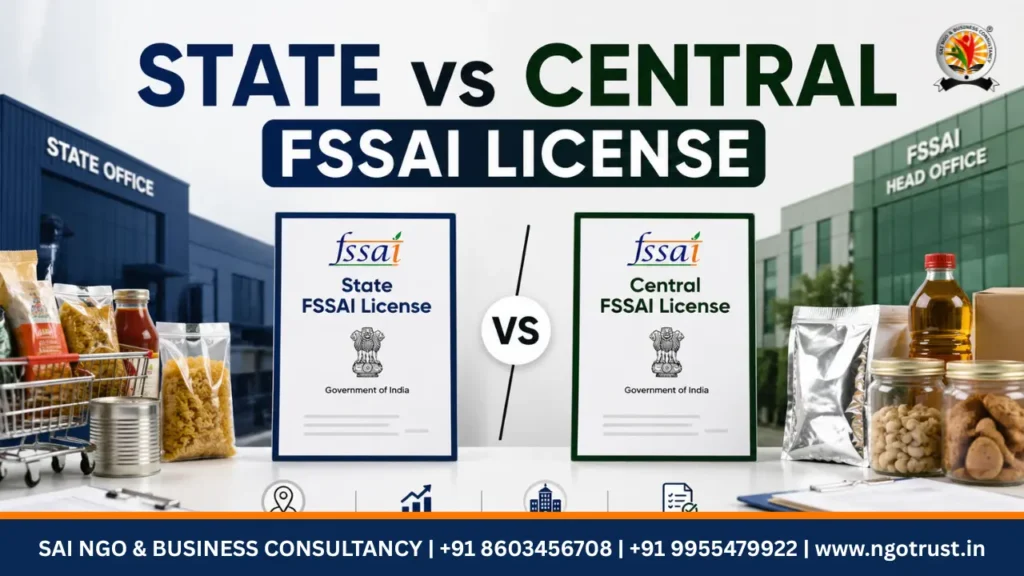
- State License — For medium-scale businesses with a turnover between ₹12 lakhs and ₹20 crores. This applies to most restaurants, mid-size manufacturers, and distributors operating within one state.
- Central License — For large food businesses with a turnover exceeding ₹20 crores, those involved in import/export, or multi-state operations. This is also required for businesses in central government establishments.
Choosing the wrong category is one of the most common mistakes new food businesses make — so it’s worth getting this right from the start.
Key Benefits of Getting Your FSSAI License
| Key Benefit | Description |
|---|---|
| Legal protection | Operating without an FSSAI license can result in fines up to ₹5 lakhs and even imprisonment. Having one keeps you on the right side of the law. |
| Consumer trust | Displaying the FSSAI logo and registration number instantly boosts credibility. Customers feel safer buying from a licensed food business. |
| Business expansion | Many retailers, supermarkets, and e-commerce platforms (like Swiggy, Zomato, Amazon) require FSSAI certification before onboarding you as a vendor. |
| Loan and funding eligibility | Banks and investors often require valid FSSAI registration as part of the documentation for business loans and grants. |
| Better quality practices | The process of obtaining a license encourages businesses to adopt proper hygiene and food safety standards — which leads to fewer complaints and better reviews. |
| Brand reputation | In a market where food safety is increasingly important to consumers, being certified sets you apart from unlicensed competition. |
How to Apply for an FSSAI Food License: Step-by-Step
The application process is fully online through the FoSCoS portal (Food Safety Compliance System). Here’s a simplified walkthrough:
| Step | Process Details |
|---|---|
| Step 1 | Determine your license type based on turnover and business category |
| Step 2 | Register on the FoSCoS portal at foscos.fssai.gov.in |
| Step 3 | Fill in Form A (Basic) or Form B (State/Central) |
| Step 4 | Upload required documents |
| Step 5 | Pay the applicable fee online |
| Step 6 | Await inspection or approval from your state/central authority |
Common Documents Required
- Identity and address proof of the proprietor/partners/directors
- Proof of business premises (rental agreement or ownership documents)
- Business incorporation certificate (if applicable)
- List of food products to be manufactured or handled
- NOC from the municipality or local body
- Bank account details
- Food safety management plan (for Central License applicants)
Processing time: Basic registration is typically processed within 7 working days. State licenses can take 30–60 days. Central licenses may take up to 60 working days, depending on inspection requirements.
Common Mistakes to Avoid
Watch out for these pitfalls:
- Choosing the wrong license category — Many new businesses underestimate their turnover or misclassify their activity, leading to compliance gaps later.
- Delays in renewal — FSSAI licenses are valid for 1 to 5 years and must be renewed before expiry. A lapse can attract penalties and disrupt operations.
- Incomplete or incorrect documentation — Even minor discrepancies in documents can lead to rejection or significant delays in the approval process.
- Not updating the license — If your business address, product range, or scale changes, you’re required to update your FSSAI license. Operating on outdated information is a violation.
- Ignoring display requirements — Your FSSAI number must be printed on all food labels and displayed at your premises. Skipping this can invite penalties during inspections.
Expert Tips for a Smooth FSSAI License Process
- Apply early. Don’t wait until you’re already operating. Apply before your launch date to avoid any disruption to your business.
- Keep digital copies of all documents. The FoSCoS portal requires uploads, so having clear, scanned copies ready will save significant time.
- Use the correct turnover figures. If you’re a new business, use projected turnover carefully — overstating or understating can put you in the wrong license category.
- Stay informed about product-specific rules. Certain food categories (dairy, meat, packaged water, health supplements) have additional regulations. Know which rules apply to your product line.
- Set a renewal reminder well in advance. At least 30 days before your license expiry, initiate the renewal process. Late renewal attracts a penalty of ₹100 per day.
- Maintain a Food Safety Management System (FSMS). Even if not mandatory for your category, having documented safety practices shows good faith during inspections.
FSSAI License Fees: A Quick Overview
- Basic Registration: ₹100 per year
- State License: ₹2,000–₹5,000 per year (varies by business type)
- Central License: ₹7,500 per year
These are the government fees. Keep in mind that professional assistance fees, if you choose to hire a consultant or filing service, will be additional.
Final Thoughts
Getting your FSSAI food license isn’t just about ticking a regulatory box. It’s about building a food business that’s trustworthy, scalable, and resilient. When your customers see that FSSAI mark, it communicates something important: that you care about what goes into the food you serve.
The process can feel a bit daunting at first — especially with the documentation, the portal navigation, and the decision of which license type fits your business. But once you’ve done it, it becomes one less thing to worry about as you focus on growing.
If you’re unsure about which category applies to you, or you want to make sure your application goes through without delays, it’s always a good idea to consult someone who’s navigated the process before.
Not sure where to start with your FSSAI license?
Getting it right the first time saves time, money, and stress. If you’d like guidance tailored to your specific food business, we’re happy to help you figure out the right path forward. No pressure — just a conversation.