
SAI NGO & BUSINESS CONSULTANCY
Expert services for NGO, Trust, Society Registration & Compliance across India.
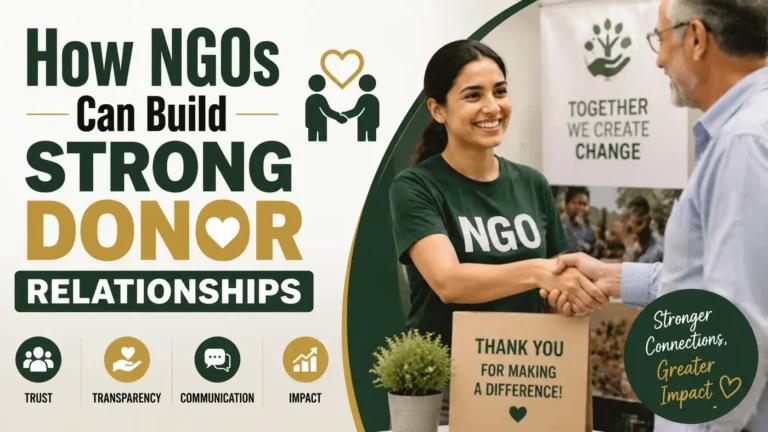
NGOs build strong donor relationships by communicating honestly, showing real impact, thanking donors often, and treating every donor as a partner instead of a source of funds. Trust grows when donors can see where their money goes and feel genuinely heard, not just asked for more.
Donors don’t stop giving because they run out of money. Most stop because they stop feeling connected. For any NGO, whether you’re a small trust running one community programme or a large Section 8 company managing national projects, donor relationships are the real backbone of long-term funding. This post breaks down exactly how NGOs can build strong donor relationships that hold up year after year.
What Does Donor Relationship Building Actually Mean?

Donor relationship building is the ongoing effort an NGO makes to keep donors informed, involved, and emotionally connected to its work. It’s not a one-time thank-you email after a donation. It’s a habit that runs through every stage: before someone gives, right after they give, and long after the project is finished.
A strong donor relationship usually has three things in common:
- The donor understands where their money went
- The donor feels appreciated, not just billed for a receipt
- The donor is invited back into the story, not just asked for the next gift
Why Strong Donor Relationships Matter for NGOs
Fundraising is expensive. Finding a brand-new donor almost always costs more time and money than keeping an existing one. When an NGO builds strong donor relationships, it gets:
- Lower dependency on one-time or emergency appeals
- Higher donor retention, which steadies year-to-year income
- More word-of-mouth referrals from donors who trust the organisation
- Easier conversations during audits, since giving history and communication are already documented
Groups like Candid, which tracks nonprofit and philanthropic data, regularly point out that donor trust is one of the strongest predictors of repeat giving. In other words, relationships aren’t a soft add-on to fundraising, they are the fundraising strategy.
There’s also a compliance angle that’s easy to overlook. NGOs registered in India already maintain records for FCRA, 12A, and 80G filings. Donors, especially larger ones and CSR-linked corporate donors, often check this information before they commit.
A well-maintained relationship makes that verification step smoother, because the trust is already built before the paperwork is even asked for.
How Do NGOs Build Trust With Donors?
Trust is earned in small, consistent actions, not one big gesture. Donors are often supporting causes they care deeply about, so any sign of vague reporting or poor communication makes them cautious. Here’s where most NGOs should start.
Be Transparent About Where the Money Goes
Donors give more freely when they know exactly what their contribution funds. Share simple, honest breakdowns: how much goes to the actual programme, how much covers admin costs, and what the money achieved. Avoid vague statements like ‘funds were used for the cause’ with no detail behind them.
Share Real Stories, Not Just Numbers
Numbers show scale, but stories show meaning. A short update about one family, one child, or one community that benefited from a donor’s gift usually creates a stronger emotional bond than a spreadsheet of statistics ever will. Use both together for the best result.
Keep Financial Records Clean and Public
NGOs registered under NGO Darpan or filing under FCRA already maintain compliance records. Turning some of that same information into a simple annual report for donors builds credibility without extra work. When donors see clean, consistent records, hesitation drops.
How Often Should NGOs Communicate With Donors?
There’s no single fixed number, but silence is the biggest relationship killer. A workable rhythm for most NGOs looks like this:
- Immediate thank-you after every donation, even small ones
- A short project update within 60-90 days
- A quarterly newsletter with progress, stories, and upcoming needs
- An annual impact report summarising the full year
The goal isn’t to message donors constantly. It’s to make sure a donor never wonders, ‘did my donation actually do anything?’
What Are the Best Ways to Thank Donors?
A generic thank-you email is fine, but it rarely builds a relationship on its own. Donors remember gratitude that feels personal.
- Call or message major donors directly instead of relying only on automated emails
- Mention the donor’s specific contribution, not a generic amount range
- Send a short handwritten note for larger or first-time gifts
- Publicly recognise donors who are comfortable being named, with their permission
- Invite long-term donors to visit a project site or attend an event
Even simple gestures, done consistently, tend to outperform expensive donor appreciation events.
How Can Small NGOs Build Donor Relationships With a Limited Budget?
Smaller NGOs often assume donor relationship management needs a big team or paid software. It doesn’t. A simple spreadsheet, a shared inbox, and a fixed monthly reminder to send updates can cover most of the basics.
- Keep one simple donor list with names, dates, amounts, and notes
- Set a recurring monthly reminder to send at least one update
- Batch thank-you messages instead of writing each one from scratch
- Use WhatsApp or email groups for low-cost, direct updates
As the donor base grows, many NGOs eventually move to a proper CRM. Platforms built for nonprofits, such as those listed by the National Council of Nonprofits, can help once manual tracking becomes hard to manage.
It also helps to assign one person, even part-time, as the point of contact for donor communication. When updates come from different people at different times, the tone becomes inconsistent and donors notice. A single voice, even a simple one, feels more reliable than scattered messages from different volunteers.
Should NGOs Segment Their Donors?
Yes. Not every donor wants the same type of contact, and treating every donor identically usually weakens the relationship instead of strengthening it. A first-time donor of a small amount and a recurring donor who has given for five years need different messages.
- First-time donors: focus on warm welcomes and clear proof that their gift was used well
- Recurring donors: focus on deeper updates, milestones, and long-term impact
- Major donors: focus on personal contact, direct reporting, and involvement in decisions where possible
- Lapsed donors: focus on a respectful re-engagement message, not a guilt-driven appeal
Even a basic split like this, tracked in a simple spreadsheet, helps an NGO sound less like a mass mailing list and more like an organisation that actually knows its supporters.
Common Mistakes NGOs Make With Donors
- Only reaching out when asking for the next donation
- Sending the same generic message to every donor, regardless of their giving history
- Failing to report back after a campaign ends
- Treating donor data casually, without proper records or consent
- Focusing only on big donors and ignoring smaller, recurring ones who often give the longest
Fixing even two or three of these habits usually improves donor retention within a single fundraising cycle.
Building a Long-Term Donor Relationship System
Strong donor relationships rarely happen by accident. They come from a repeatable system: clear communication, honest reporting, personal appreciation, and a clean compliance record that backs it all up. Many NGOs already do parts of this well but lose donors simply because the process isn’t consistent or documented.
This is often where NGOs benefit from outside support, whether it’s setting up donor communication templates, building compliance-ready reports, or simply organising a donor management process that the whole team can follow.
Getting the basics right early also saves time later, since fixing years of inconsistent donor records is far harder than setting up a clean system from the start.
If your NGO is finding it hard to keep donor communication consistent, a short consultation can help you set up a simple, repeatable system suited to your size and budget.
FAQ: Donor Relationships for NGOs
How do NGOs build strong donor relationships?
NGOs build strong donor relationships through honest communication, timely thank-yous, transparent reporting, and personal engagement that goes beyond asking for the next donation.
What is donor stewardship?
Donor stewardship is the process of managing and nurturing donor relationships after a gift is made, including thank-yous, updates, reporting, and recognition.
How often should an NGO contact its donors?
Most NGOs benefit from an immediate thank-you, a short update within 60-90 days, a quarterly newsletter, and an annual impact report.
Do small NGOs need a CRM to manage donors?
No. Small NGOs can start with a simple spreadsheet and a monthly reminder to send updates. A CRM becomes useful once the donor list grows too large to track manually.
What is the biggest reason donors stop giving?
The most common reason is silence. Donors who don’t hear how their gift was used or don’t feel appreciated are far more likely to stop giving.
Useful Links